
PM
Product Manager Interview Preparation: A Structured Guide
Preparing for a product manager interview can feel strangely unstructured for a role that lives and dies by structure. You’re told to “think like a CEO,” “be...
Preparing for a product manager interview can feel strangely unstructured for a role that lives and dies by structure. You’re told to “think like a CEO,” “be data-driven,” “tell great stories,” and “prioritize ruthlessly”—all in 45-minute conversations with strangers.
This guide turns that chaos into a roadmap.
We’ll walk through a structured approach to product manager interview preparation: the core skill areas, how to practice each, common pitfalls, and a concrete prep plan you can execute over a few weeks. The goal is not to memorize answers, but to build reusable thinking frameworks that hold up across companies and product management roles.
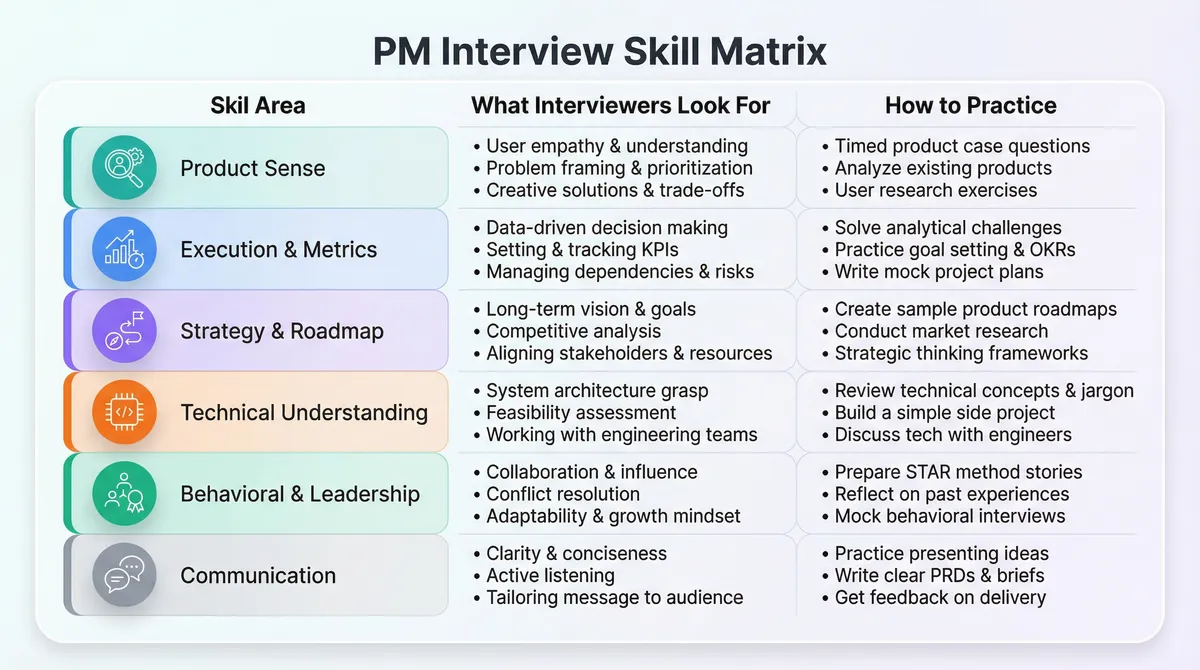
Understanding the Product Manager Interview Loop
Most PM interview processes converge on a similar structure, even if titles differ (APM, PM, Senior PM, Group PM).
Typical components:
- Product sense / product design
- Execution / metrics / analytical thinking
- Strategy / roadmap thinking
- Technical / system understanding (varies by company)
- Behavioral / leadership / culture fit
- Case study or take-home assignment (sometimes)
Think of each as a separate skill track in your pm interview prep roadmap.
How companies evaluate PMs
Underneath the different rounds, companies are usually assessing:
-
Customer & problem understanding
Can you deeply understand users and define the right problem? -
Product thinking & creativity
Can you generate thoughtful solutions and trade-offs? -
Execution & prioritization
Can you break down work, define success, and ship? -
Analytical rigor
Can you reason from data, metrics, and experiments? -
Communication & collaboration
Can you align engineers, designers, and stakeholders? -
Leadership & ownership
Do you take responsibility and drive outcomes?
Your preparation should map directly to these dimensions.
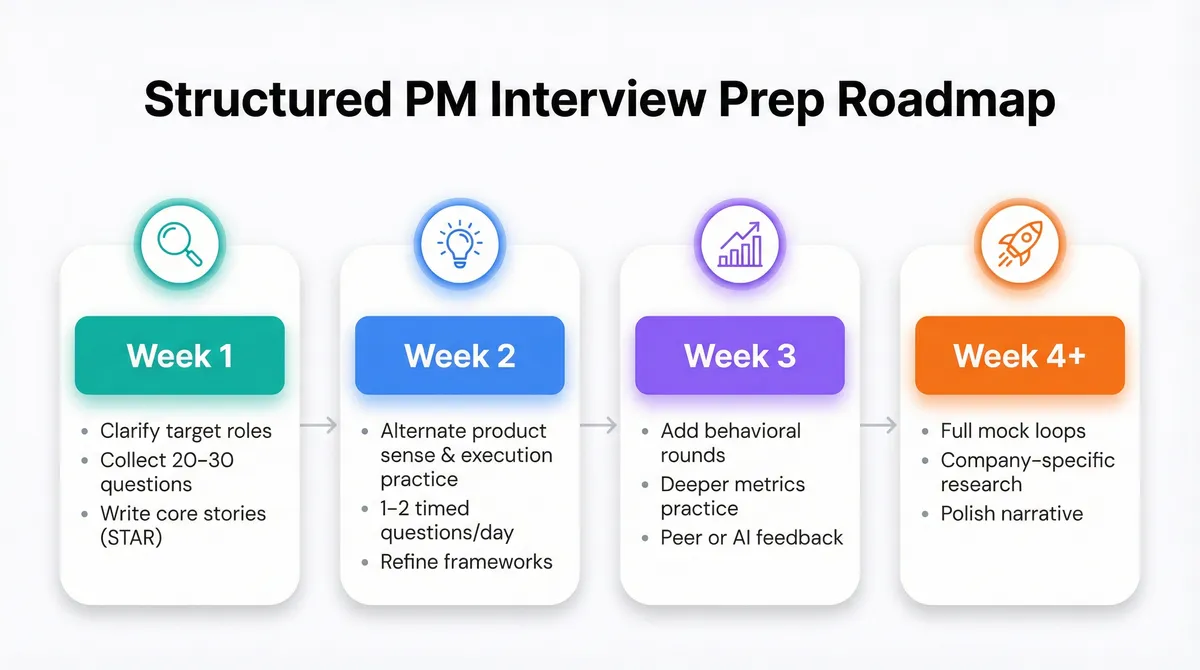
A Structured PM Interview Prep Roadmap
Before diving into specific question types, it helps to define a PM roadmap for your own preparation.
A practical 4–6 week roadmap:
-
Week 1: Foundations
- Clarify your target roles (consumer vs B2B, early-stage vs big tech).
- Collect 20–30 real PM interview questions from company sites, Glassdoor, and peers.
- Write your career narrative and 6–8 core stories (STAR format).
-
Week 2–3: Depth by interview type
- Alternate days:
- Product sense practice
- Execution/metrics practice
- Behavioral practice
- Do 1–2 timed questions per day, review and refine frameworks.
- Alternate days:
-
Week 4–5: System-level practice
- Full mock interviews (45–60 minutes).
- Simulate onsite loops: 3–4 interviews back-to-back.
- Identify systematic gaps (e.g., weak metrics, shallow trade-offs).
-
Week 6: Company-specific prep
- Deep dive into each company’s products, org structure, and culture.
- Tailor your stories and examples.
- Prepare specific product critiques and ideas.
You can run this roadmap solo, with peers, or with an AI-based coach or mock interviewer (e.g., tools like Thita’s AI interview practice: free mock interview simulator with real-time feedback for technical interviews can approximate real interviewers and give structured feedback).
Product Sense: Designing Products in Real Time
This is often labeled “product design” or “product sense” and is central to most product manager interview loops.
Typical prompts:
- “Design a product for commuters.”
- “Improve YouTube for creators.”
- “How would you design a product for blind users to use Instagram?”
A reusable product sense framework
You don’t want a script; you want a structured way of thinking. One robust approach:
-
Clarify the goal & constraints
- Who is the user?
- What problem space?
- Any constraints (platform, timeline, business model)?
-
Understand the user & problem
- Segment users (e.g., new vs power users, creators vs viewers).
- Map user journeys and pain points.
- Prioritize the most impactful problems.
-
Define success
- What does success look like?
- What are primary metrics (e.g., DAU, retention, NPS, revenue)?
-
Generate solution directions
- 2–3 distinct solution directions.
- For each: pros, cons, impact, risk.
-
Prioritize a solution
- Choose one direction.
- Explain trade-offs explicitly.
-
Detail the MVP
- Core user flow.
- Key features vs v2 features.
- Edge cases & risks.
-
Measurement & iteration
- How to validate post-launch.
- Metrics and user feedback loops.
Example: “Improve YouTube for new creators”
A condensed walkthrough:
-
Clarify
- Focus on new video creators (0–10 videos published).
- Platform: mobile and web.
- Goal: help them grow and retain them as creators.
-
User & problem
- Segments: hobbyists, aspiring professionals, brand channels.
- Pain points (hypothesize):
- Hard to understand what content works.
- Low initial discovery → discouragement.
- Complex creator tools and analytics.
Prioritize: early discovery and learning feedback loop.
-
Define success
- Creator 30-day retention.
- Number of creators publishing 3+ videos.
- Views per new creator in first 30 days.
-
Solution directions
- Direction A: “New Creator Onboarding” with guided setup, best practices.
- Direction B: “Creator Coach” – personalized recommendations and next steps.
- Direction C: “New Creator Boost” – algorithmic promotion for first videos.
-
Prioritize
- Choose “Creator Coach” as MVP:
- Scales across creators.
- Integrates with existing analytics.
- Lower risk than algorithmic boosts.
- Choose “Creator Coach” as MVP:
-
MVP details
- New “Coach” tab in Studio:
- “Next Best Action” card (e.g., “Post Shorts 2x/week”).
- Simple insights: “Videos with clear thumbnails get 30% more clicks.”
- Notifications triggered by milestones (first upload, 100 views, etc.).
- New “Coach” tab in Studio:
-
Measurement
- A/B test creators with vs without Coach.
- Track 30-day retention, videos published, views.
- Qualitative feedback via in-product surveys.
Interviewers care more about your structure and trade-offs than the specific feature you propose.
Execution & Metrics: From Idea to Impact
These rounds test whether you can ship and measure products, not just imagine them.
Typical prompts:
- “How would you measure the success of Instagram Stories?”
- “A key metric dropped by 20%. How do you debug it?”
- “You have limited resources—how do you prioritize this backlog?”
A metrics-first approach
A useful pattern for metrics questions:
- Clarify the product and goal
- Define primary metric(s)
- Define guardrail metrics
- Break metrics into levers
- Outline experiments or actions
Example: “How would you measure success of Instagram Stories?”
-
Clarify
- Success for whom? Users? Creators? Business?
- Time horizon: launch vs mature feature?
-
Primary metrics (user engagement perspective)
- DAU/WAU using Stories.
- Number of Stories posted per user per week.
- Average time spent viewing Stories.
-
Guardrails
- Overall app DAU (avoid cannibalizing feed usage too much).
- User reports/abuse rate in Stories.
- App performance (crash rate, load time for Stories).
-
Levers
- Creation funnel:
- Users who tap camera →
- Users who record →
- Users who post.
- Consumption funnel:
- Users who open Stories →
- Stories viewed →
- Completion rate.
- Creation funnel:
-
Experiments
- Onboarding prompts to first Story.
- Templates and stickers to reduce friction.
- Auto-advance and UI tweaks to increase view completion.
Debugging metric drops
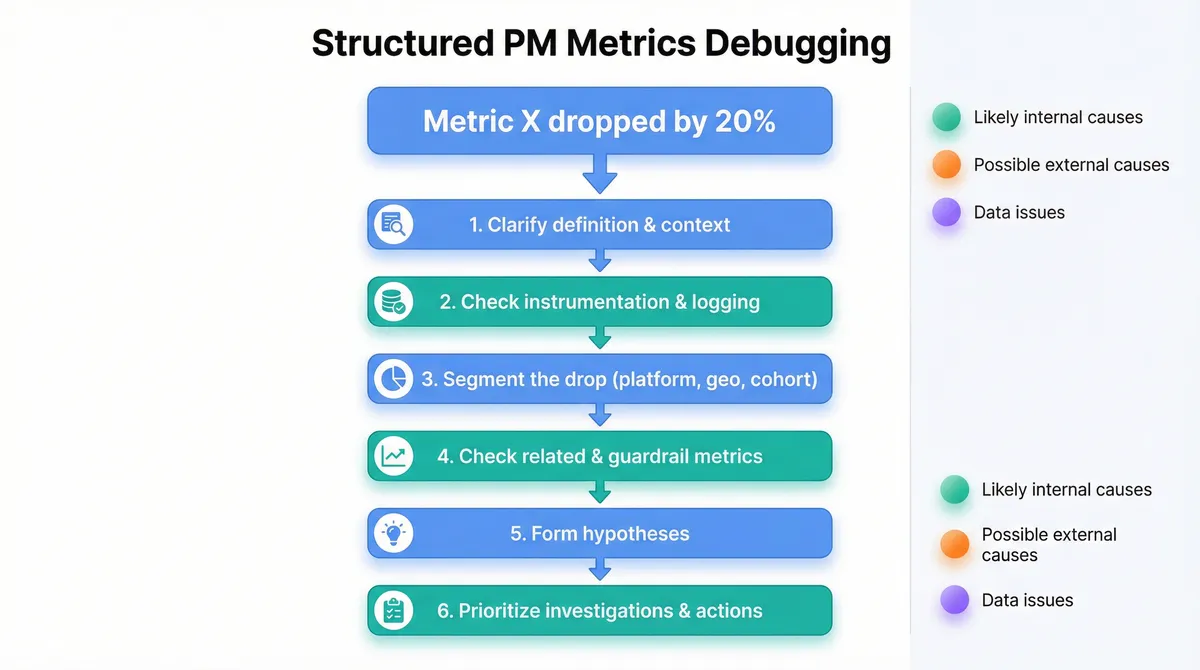
For “Metric X dropped by 20%” questions, a structured approach:
-
Clarify the metric and context
- Definition, segment, time range.
- Any recent launches, experiments, outages?
-
Check for instrumentation issues
- Logging changes, event schema changes.
- Analytics pipeline issues.
-
Segment the drop
- By platform (iOS/Android/web).
- By geography.
- By user cohort (new vs existing).
- By product surface.
-
Check related metrics
- Upstream and downstream metrics.
- Guardrails (e.g., latency, errors).
-
Form hypotheses
- Product changes (UI, algorithm).
- External factors (seasonality, competitor launches).
- Technical issues (performance, bugs).
-
Prioritize investigations
- Triage: high-likelihood, high-impact first.
- Plan quick checks vs deeper analyses.
This mirrors how strong PMs and data partners actually debug issues in production systems.
Strategy & Roadmap: Thinking Beyond Features
Senior PMs are often evaluated heavily on product strategy and roadmap thinking, but even junior roles get lightweight strategy questions.
Typical prompts:
- “What should our 1-year roadmap be for [product]?”
- “How would you decide whether to enter [new market]?”
- “We have Product A and B; where should we invest more?”
A simple strategy framework
You can structure strategy answers like this:
-
Clarify objective and constraints
- Revenue vs growth vs engagement vs defensibility.
- Time horizon (6–12 months vs 3–5 years).
- Resource constraints.
-
Analyze context
- Users & use cases.
- Market & competition.
- Company strengths/weaknesses.
-
Define strategic pillars
- 2–3 high-level themes (e.g., “Improve retention,” “Expand to SMBs,” “Monetize existing base”).
-
Map initiatives to pillars
- For each pillar, propose 2–3 initiatives.
- Roughly size impact vs effort.
-
Prioritize & sequence (roadmap)
- Q1–Q4 or Phase 1–3.
- Dependencies and risk management.
-
Define success & feedback loops
- Metrics to track for each pillar.
- How you’d adjust the strategy over time.
Example: High-level PM roadmap for a note-taking app
Objective: Increase revenue over 12 months while maintaining user satisfaction.
-
Context
- Users: students, professionals, teams.
- Market: crowded (Notion, Evernote, OneNote).
- Strengths: fast sync, strong mobile experience.
- Weakness: weak team collaboration.
-
Strategic pillars
- Pillar 1: Deepen engagement with power users.
- Pillar 2: Expand into small teams and SMBs.
- Pillar 3: Monetize advanced features.
-
Initiatives
- Pillar 1:
- Advanced search and tagging.
- Offline-first mode improvements.
- Pillar 2:
- Shared workspaces.
- Simple permissioning and comments.
- Pillar 3:
- Pro tier with storage, version history, integrations.
- Pillar 1:
-
Prioritization & sequencing
- Q1–Q2: Build collaboration primitives (workspaces, comments).
- Q2–Q3: Launch Pro tier with collaboration + storage.
- Q3–Q4: Optimize search, offline, and integrations.
-
Success metrics
- MRR, conversion to paid.
- Team accounts created.
- Retention of Pro users.
The interviewer is looking for structured thinking, trade-offs, and alignment with a clear objective, not a perfect roadmap.
Technical Understanding for PMs
The “technical” interview for PMs is rarely about coding. It’s about:
- Communicating effectively with engineers.
- Understanding system behavior and constraints.
- Reasoning about trade-offs in architecture and implementation.
Typical prompts:
- “Explain how an API works to a non-technical stakeholder.”
- “Design the backend for a news feed at a high level.”
- “What are the trade-offs of using a cache here?”
What you should know (for most PM roles)
-
Basic web & mobile architecture
- Client–server model.
- REST APIs, request/response cycles.
- Latency vs throughput, simple caching concepts.
-
Data basics
- Difference between OLTP (transactional DBs) and OLAP (data warehouses).
- Events, logs, and how metrics are derived.
- High-level understanding of A/B testing infrastructure.
-
Scalability trade-offs
- Vertical vs horizontal scaling (very high-level).
- Rate limiting, eventual consistency (conceptually).
You don’t need to implement systems, but you should be able to:
- Ask the right questions.
- Understand when something might be technically risky.
- Collaborate intelligently on technical decisions.
If you come from a non-technical background, invest time in reading engineering blogs and system design primers. You don’t need to write code, but you should be comfortable with diagrams and flows. For deeper technical interview prep, consider resources like The Complete AI & LLM Roadmap 2026: 80+ Topics to Master Modern AI Engineering which covers modern technical concepts relevant to PMs working with AI products.
Behavioral & Leadership: Your Operating System
Behavioral questions are not “soft.” They often decide offers when candidates are similar on product sense and execution.
Common themes:
- Ownership and bias for action.
- Dealing with conflict.
- Influencing without authority.
- Handling failure and ambiguity.
Typical prompts:
- “Tell me about a time you disagreed with engineering.”
- “Describe a product you shipped end-to-end.”
- “Tell me about a failure and what you learned.”
Building your story library
Use a structured approach like STAR (Situation, Task, Action, Result), but elevate it:
- Situation & context
- 1–2 sentences; keep it tight.
- Task & stakes
- What were you responsible for?
- Why did it matter?
- Actions (your decisions)
- Focus on your thought process.
- Show trade-offs and constraints.
- Results & reflection
- Concrete metrics or outcomes.
- What you’d do differently now.
Create 6–8 core stories that can be reused and adapted:
- A launch you led.
- A time you turned around a failing project.
- A conflict with a peer or manager.
- A time you influenced without authority.
- A time you made a mistake.
- A time you worked under extreme ambiguity.
Map each story to common competencies (ownership, leadership, collaboration, resilience). Reuse and adapt rather than inventing new stories on the fly. For practicing behavioral and other interview questions, AI-based tools can be helpful; see AI Tools for Interview Preparation: Benefits and Pitfalls for guidance on leveraging AI effectively.
Common Mistakes in PM Interview Prep
Even strong candidates fall into predictable traps.
1. Frameworks without substance
- Over-memorizing generic frameworks (“CIRCLES”, “AARM”, etc.) and reciting them mechanically.
- Interviewers can tell when your thinking is driven by a checklist instead of the problem.
Fix: Use frameworks as scaffolding, not scripts. Adapt them to the question and explicitly connect each step to the problem at hand.
2. Jumping to solutions
- Answering “How would you improve X?” with features in the first 20 seconds.
- Skipping user understanding, segmentation, and goals.
Fix: Force yourself to clarify user, problem, and success metrics before proposing features. Say it out loud: “Before jumping into solutions, I’d like to understand the users and goals.”
3. Vague metrics and outcomes
- Saying “engagement” or “growth” without defining them.
- Describing past projects with no numbers or concrete impact.
Fix: Always specify:
- What metric.
- How it’s defined.
- What baseline and delta you saw (even approximate).
4. Over-indexing on one area
- Spending 90% of prep time on product sense, ignoring execution, metrics, or behavioral.
- Or, for ex-engineers, over-focusing on technical rounds.
Fix: Balance your pm interview prep across all core areas. If you’re already strong in one, maintain it but invest more in weaker areas.
5. Not practicing out loud
- Reading solutions or silently thinking through answers.
- Real interviews require verbal clarity and pacing under pressure.
Fix: Practice out loud with:
- Peers.
- Recorded sessions (self-review).
- AI-based mock interviews that simulate back-and-forth, similar to those discussed in AI Mock Interviews vs Real Interviews: Do They Actually Help?.
Best Practices and Actionable Tips
To make your preparation efficient and realistic:
1. Treat prep like a product
- Define the goal: e.g., “Be ready for top-tier PM interviews in 6 weeks.”
- Identify constraints: time per day, competing responsibilities.
- Measure progress: track number of mocks, feedback themes, and areas of improvement.
2. Use deliberate practice, not just volume
Instead of doing 10 product sense questions shallowly:
- Do 3–4 deeply.
- After each:
- Write down your structure.
- Compare with sample answers or peers’ answers.
- Identify one improvement for next time (e.g., “better user segmentation”).
3. Build a personal “PM playbook”
Maintain a document with:
- Your product sense framework.
- Your metrics and debugging framework.
- Your strategy/roadmap framework.
- Your 6–8 core behavioral stories.
- A list of 10–15 products you know deeply (for critique questions).
Review this playbook before each interview loop. Over time, it becomes your reusable mental model library.
4. Practice with constraints
Simulate interview conditions:
- Timebox: 30–40 minutes per question.
- No notes during answer (except quick bullet outlines).
- Ask follow-up questions to yourself (or have a partner/AI do it).
Tools like Thita’s /ai-coach or similar can generate follow-ups and push on weak spots, which is often where real interviews get challenging.
5. Tailor to the company and level
- For early-stage startups:
- Emphasize scrappiness, ambiguity, and end-to-end ownership.
- For big tech:
- Emphasize scale, cross-functional alignment, and metrics rigor.
- For senior roles:
- Spend more time on strategy, org leadership, and influencing.
Putting It All Together: A Sample Weekly Plan
Here’s a concrete weekly schedule you can adapt:
Monday
- 1 product sense question (45 minutes).
- 30 minutes reviewing and rewriting answer.
Tuesday
- 1 execution/metrics question (45 minutes).
- 30 minutes reading a product analytics or growth case study.
Wednesday
- 2 behavioral questions (45 minutes).
- 15 minutes refining your story library.
Thursday
- 1 strategy/roadmap question (45 minutes).
- 30 minutes reading company/product strategy docs or blogs.
Friday
- 1 full mock interview (60 minutes) with peer or AI.
- 30 minutes debrief and notes.
Weekend (optional)
- Company research for upcoming interviews.
- Update your PM playbook with new insights and patterns.
Consistent, structured practice compounds. You’re not just preparing for a single product manager interview; you’re building a durable way of thinking that will serve you on the job.
Key Takeaways
- Treat pm interview prep as a structured roadmap, not ad-hoc question drilling.
- Focus on the core dimensions: product sense, execution/metrics, strategy, technical understanding, and behavioral leadership.
- Use frameworks as scaffolding, then layer on depth: user understanding, trade-offs, and clear metrics.
- Build a reusable PM playbook: frameworks, stories, and product analyses you can draw on in any interview.
- Practice under realistic constraints, ideally with feedback loops from peers, mentors, or AI-based mock interviews.
A strong PM isn’t the one with the flashiest feature ideas; it’s the one who can repeatedly turn ambiguous problems into shipped products and measurable outcomes. Your interview prep should mirror that same discipline and structure.