
Resume
Best Projects to Put on Your Software Engineer Resume in 2026
Most software engineers know they “should build projects,” but when you sit down to choose what to build, the questions start:
Most software engineers know they “should build projects,” but when you sit down to choose what to build, the questions start:
- What are the best resume projects for a software engineer in 2026?
- What do hiring managers actually care about?
- How do you stand out when everyone has a to-do app, a weather app, and a CRUD dashboard?
This guide takes a practical, engineering-first approach to portfolio projects tech recruiters and senior engineers actually respect. We’ll cover what makes a project strong, concrete project ideas (with increasing difficulty), how to present them on your developer resume, and the common mistakes that quietly kill otherwise good work.
What Makes a “Good” Resume Project for Software Engineers?
Before specific ideas, you need a selection framework. The best coding projects for your resume share a few traits:
- They demonstrate real engineering skills, not just tutorials.
- They reflect how modern systems are built in 2026.
- They are scoped enough to finish, but deep enough to discuss.
- They show decisions you made: tradeoffs, patterns, constraints.
Core Evaluation Criteria
When I review resumes, I subconsciously score projects on:
-
Relevance to the role
- Backend roles: APIs, data modeling, reliability.
- Frontend roles: state management, performance, accessibility.
- Full-stack: end-to-end feature, from DB to UI.
- ML/AI: data pipelines, model training, evaluation, deployment.
-
Complexity and depth
- Does it go beyond CRUD?
- Did you handle concurrency, caching, pagination, auth, or background jobs?
- Are there non-trivial algorithms or data structures?
-
Code quality and architecture
- Clear separation of concerns, tests, documentation.
- Use of appropriate design patterns, not just frameworks.
-
Production-minded thinking
- Logging, metrics, error handling.
- Performance considerations.
- Basic security practices.
-
Evidence of ownership
- Did you design it, or just follow a tutorial?
- Are tradeoffs documented? Are there design docs or READMEs?
Use these as constraints when picking what to build and what to highlight.
Types of Resume Projects for Software Engineers (2026 Landscape)
In 2026, the strongest portfolio projects tech candidates show tend to fall into a few categories:
- End-to-end product clones with a twist
- Systems and backend infrastructure projects
- Data-intensive and AI-powered applications
- Developer tools and CLI utilities
- Real-world integrations and automation
We’ll go through each with concrete examples and how to scope them.
1. End-to-End Product Clones (With a Twist)
These are great resume projects for software engineers early in their career because they show you can ship a complete experience.
1.1 “Production-Grade” Web App Clone
Idea: Build a focused clone of a well-known product (e.g., Trello, Notion, Slack), but add one “differentiating” feature.
Examples:
- Trello-like Kanban board with:
- Real-time collaboration via WebSockets.
- Offline-first behavior with local caching and sync.
- Notion-like notes app with:
- Rich text editor.
- Full-text search and tag-based organization.
- Role-based access control (RBAC).
Skills demonstrated:
- REST/GraphQL APIs.
- Database schema design (e.g., relational with indexes).
- State management on the frontend.
- Real-time updates and optimistic UI.
- Authentication and authorization.
Sample Stack:
- Backend: Node.js (Express/Fastify) or Go/Fiber, PostgreSQL.
- Frontend: React/Vue/Svelte with TypeScript.
- Infra: Docker, simple deployment on a cloud provider.
Example feature: Real-time board updates
TS
Why this stands out in an interview:
- You can talk about WebSocket vs polling.
- You can discuss consistency issues (what if DB write fails after broadcasting?).
- You can discuss scaling to multiple instances (Redis pub/sub, etc.).
2. Systems and Backend Infrastructure Projects
These projects are especially strong for backend, platform, or infrastructure roles.
2.1 URL Shortener with Observability and Rate Limiting
This is a classic, but in 2026 the bar is higher. A good version includes:
- Short URL generation with collision handling.
- Click tracking and analytics (e.g., per-day counts).
- IP-based rate limiting.
- Basic observability: metrics, logs, dashboards.
Tech focus:
- Data modeling: table for URLs, table for hits.
- Caching popular URLs in Redis.
- Implementing rate limiting (token bucket or leaky bucket).
- Exposing Prometheus metrics.
Data model sketch:
urls(id, original_url, short_code, created_at, owner_id)url_hits(id, url_id, hit_timestamp, ip_hash, user_agent)
Rate limiting (token bucket) pseudo-code:
PYTHON
Interview talking points:
- Why use Redis vs in-memory.
- How to handle hot keys.
- How to shard by IP or user.
- Time/space complexity of operations.
2.2 Job Queue and Worker System
Build a minimal distributed job processing system:
- REST API to enqueue jobs.
- Persistent job store (e.g., PostgreSQL).
- Worker processes that claim and execute jobs.
- Retry with exponential backoff.
- Dead-letter queue for failed jobs.
Why it’s a top-tier resume project:
- Mirrors real-world systems (email sending, report generation).
- Lets you talk about idempotency, fault tolerance, and concurrency.
Core worker loop (simplified):
GO
Complexity:
- Each job claim is
O(1)amortized due to indexed queries. - Concurrency controlled by DB locking semantics.
3. Data-Intensive and AI-Powered Projects
In 2026, showing you can work with data, not just APIs, is a differentiator.
3.1 Retrieval-Augmented Generation (RAG) Knowledge Base
Idea: Build a private documentation search assistant using LLMs and vector search.
Features:
- Ingest markdown docs or PDFs.
- Chunk and embed text using an embedding model.
- Store embeddings in a vector DB (e.g., PostgreSQL + pgvector, or a dedicated store).
- Query: user question → retrieve top-k chunks → build prompt → call LLM.
Skills demonstrated:
- Data pipelines (ingestion, cleaning).
- Working with embeddings and vector search.
- Prompt engineering and evaluation.
- API design and latency considerations.
High-level flow:
-
Ingestion:
- Parse docs.
- Split into chunks (e.g., 500 tokens with overlap).
- Embed each chunk.
- Store
(chunk_id, text, embedding).
-
Query:
- Embed query.
- Vector similarity search for nearest chunks.
- Call LLM with retrieved context.
Pseudocode for query:
TS
Interview angles:
- Chunk size vs retrieval quality.
- Caching embeddings and LLM responses.
- Handling hallucinations (e.g., cite sources).
For a deeper understanding of the tradeoffs involved in RAG and prompt design, reviewing RAG vs Fine-Tuning vs Prompt Engineering: How to Choose the Right One can be very helpful.
3.2 Data Pipeline with Incremental ETL
Idea: Build a small data pipeline that:
- Ingests data from a public API (e.g., GitHub, weather, cryptocurrency).
- Stores raw data in a data lake (e.g., object storage).
- Transforms into analytical tables (e.g., daily aggregates).
- Exposes a simple dashboard or API for queries.
Tech focus:
- Batch jobs and scheduling (e.g., Airflow, Dagster, or a custom scheduler).
- Schema evolution and backfills.
- Data quality checks.
This is especially strong for data engineering, ML, or analytics-heavy roles. For those interested in data science interview preparation and project ideas, the End-to-End Data Science Projects That Impress Interviewers post offers valuable insights.
4. Developer Tools and CLI Utilities
Developer tools are excellent best coding projects for your resume because they show empathy for other engineers and real-world pain points.
4.1 Code Search or Refactoring Tool
Idea: A CLI that scans a codebase to:
- Find deprecated API usage.
- Enforce conventions (e.g., file naming, imports).
- Optionally auto-fix some patterns.
Skills:
- Parsing code (ASTs).
- Designing CLIs and configuration.
- Performance on large repos.
Example (TypeScript AST search):
TS
Why this impresses:
- Shows ability to work with compilers/ASTs.
- Directly relevant to internal tooling teams.
4.2 Performance Profiler for Web Apps
Idea: A small browser extension or script that:
- Measures page load times, bundle sizes.
- Highlights large images or scripts.
- Suggests optimizations (e.g., lazy loading, compression).
This showcases performance engineering skills and frontend depth.
5. Real-World Integrations and Automation
These projects show you can work with APIs, auth flows, and messy edge cases.
5.1 SaaS Integration Dashboard
Idea: Build a dashboard that integrates with 2–3 external APIs, for example:
- GitHub (issues, pull requests).
- Linear/Jira (tickets).
- Slack (notifications).
Features:
- OAuth login with one provider.
- Fetch and normalize data from multiple APIs.
- Unified view of “my work” across systems.
- Webhook handling for real-time updates.
Skills:
- OAuth 2.0 and token refresh.
- Webhook security (signatures, replay protection).
- Rate limit handling and backoff.
How to Present Projects on Your Developer Resume
Even the best portfolio projects tech candidates build can be weakened by poor presentation.
5.1 Structure of a Strong Project Entry
Aim for 2–4 bullet points per project, each showing impact and technology.
Template:
- [Project Name] – 1-line description with scope and users.
- Bullet 1: What problem it solves / what it does.
- Bullet 2: Technical challenges and how you solved them.
- Bullet 3: Scale or metrics (if any).
- Tech stack line.
Example:
KanbanSync – Real-time collaborative Kanban board for small teams
- Built a full-stack web app supporting concurrent editing of boards, lists, and cards with WebSocket-based updates and optimistic UI.
- Designed PostgreSQL schema with row-level security and implemented role-based access control for board sharing and permissions.
- Added Redis-backed rate limiting and caching for hot boards, reducing average response time from 220ms to 80ms under load tests (1k concurrent users).
- Stack: TypeScript, React, Node.js (Fastify), PostgreSQL, Redis, Docker.
5.2 Link to Code and Live Demo (When Safe)
Include:
- GitHub repository (with clear README).
- Live demo URL (if stable and secure).
- Short note if you can’t share code (e.g., NDA, course policy) but can discuss design.
Visual Framework: Mapping Projects to Skills
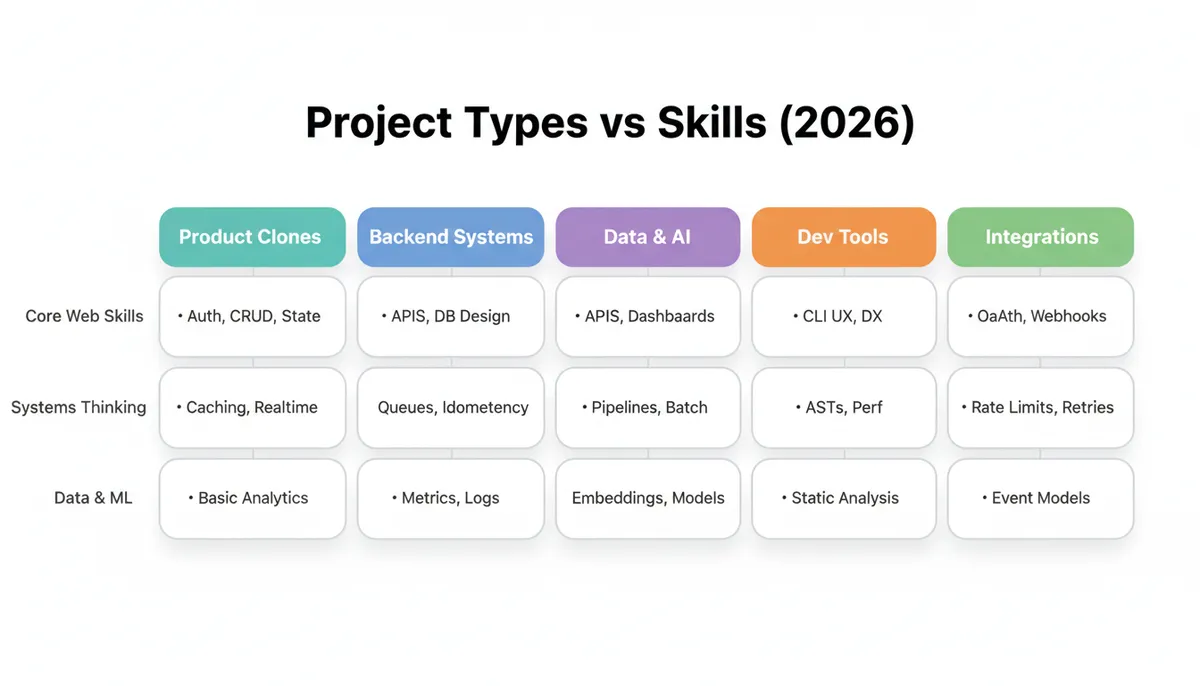
Use a mix of project types to cover the skills that match your target roles.
Common Mistakes That Weaken Otherwise Good Projects
6.1 Overly Generic or Tutorial-Like Projects
- To-do list, blog engine, weather app, calculator.
- No clear differentiator or complexity.
Fix: If you start from a tutorial, extend it meaningfully:
- Add offline support.
- Add multi-tenant logic.
- Add background jobs, rate limiting, or advanced search.
6.2 No Evidence of Scale, Testing, or Reliability
Projects that look like “demo code” instead of “production-minded”:
- No tests.
- No logging or error handling.
- No mention of performance considerations.
Fix: Add:
- Unit tests for core logic (e.g., job scheduling, rate limiting).
- Integration tests for critical flows.
- A short “Operations” section in the README: monitoring, alerts, scaling.
6.3 Overemphasis on UI Without Engineering Depth
Beautiful UI with no interesting backend or data work is less compelling for many SWE roles.
Fix: Even for frontend-heavy roles, highlight:
- State management complexity.
- Performance optimizations (code splitting, memoization).
- Accessibility and internationalization.
6.4 Unclear Ownership in Team Projects
Group or hackathon projects are fine, but you must be clear:
- What you built.
- What design decisions you influenced.
- How you collaborated (code reviews, design docs).
6.5 Poor Documentation and Onboarding
If a senior engineer can’t run your project in 5–10 minutes, they may not bother.
Fix: In your README:
- One-paragraph description.
- Architecture diagram or brief explanation.
- Setup steps (dependencies, env vars, commands).
- Sample data or seed script.
- Key design decisions and tradeoffs.
Best Practices: Turning Projects into Interview Assets
7.1 Align Projects with Target Roles
- Backend / Platform: Emphasize APIs, queues, caching, data modeling, observability.
- Frontend: Emphasize complex state, performance, a11y, testing.
- Data / ML: Emphasize pipelines, feature engineering, evaluation, deployment.
- Full-stack / Generalist: End-to-end features that touch DB, backend, and UI.
You can use something like Thita’s /dsa-patterns-sheet alongside these projects to ensure your algorithmic skills match your systems skills.
7.2 Prepare “Deep Dive” Stories
For each major project, be ready to answer:
- What was the hardest technical problem? How did you solve it?
- What are 2–3 tradeoffs you considered and why?
- How would you scale this to 10x traffic?
- What would you refactor if you had another week?
7.3 Use Patterns and Name Them
Hiring managers like to hear:
- “We used a producer-consumer pattern with a job queue.”
- “We implemented circuit breakers around flaky external APIs.”
- “The frontend uses a normalized state store similar to Redux patterns.”
If you’re practicing system design or DSA with an AI coach or mock interviews (e.g., tools like AI Interview Practice: Free Mock Interview Simulator with Real-Time Feedback for Technical Interviews or AI Tools for Interview Preparation: Benefits and Pitfalls), integrate those patterns back into your projects.
Example Project Roadmaps by Level
8.1 If You’re Early in Your Career (0–1 Years)
Aim for 2–3 solid projects:
- End-to-end product clone with auth and real-time feature
- URL shortener or note-taking app with search and tagging
- Simple integration app (e.g., GitHub + Slack notifications)
Focus on:
- Clean code.
- Tests.
- Clear documentation.
8.2 If You’re Mid-Level (2–5 Years)
Aim for 3–4 deeper projects:
- Job queue and worker system (or similar infra).
- RAG-based knowledge base or data pipeline.
- Developer tool (CLI or VSCode extension).
- Multi-service architecture (e.g., separate auth, API, worker services).
Focus on:
- Tradeoffs and architecture.
- Observability and reliability.
- Performance and scalability.
8.3 If You’re Switching Specialties (e.g., to Data/ML or Infra)
Build 2–3 projects that look like the work you want:
-
For Data/ML:
- ETL pipeline with incremental loads.
- Model training + evaluation + deployment.
- Analytics dashboard.
-
For Infra/Platform:
- CI/CD pipeline for another project.
- Metrics + alerting stack (Prometheus/Grafana).
- Config management or secrets handling.
Visual: Anatomy of a Strong Project README
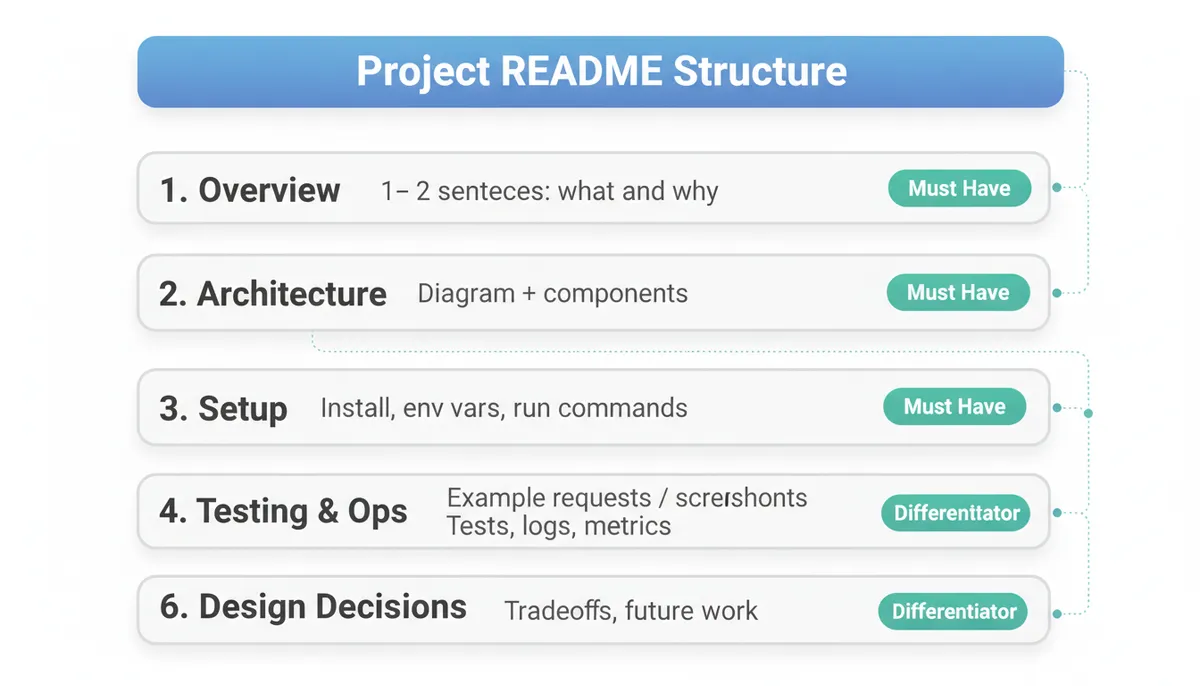
A clear README increases the chance someone actually reviews your code and helps you talk through the design in interviews.
Key Takeaways
-
The best resume projects for software engineers in 2026:
- Mirror real-world systems (queues, APIs, integrations, data pipelines).
- Show depth: tradeoffs, patterns, reliability, and performance.
- Are well-documented and easy to run.
-
Strong categories of portfolio projects tech hiring managers value:
- Product clones with a twist.
- Backend infrastructure (queues, rate limiting, observability).
- Data/AI applications (RAG, ETL, analytics).
- Developer tools and automation.
- Multi-API integrations.
-
Presentation matters:
- Clear bullets emphasizing challenges and decisions.
- Links to code and demos.
- Prepared deep-dive stories for interviews.
If you treat your projects like small production systems—tested, observable, and thoughtfully designed—they’ll do far more than fill a resume line: they’ll become the backbone of your technical narrative in 2026 interviews.