
Resume
Best Resume Format for Software Engineers in 2026 (ATS + Recruiter Friendly)
Most software engineers don’t get rejected because they’re underqualified. They get rejected because their resume never makes it past the first filter—an ATS...
Most software engineers don’t get rejected because they’re underqualified. They get rejected because their resume never makes it past the first filter—an ATS system or a recruiter skimming 200+ resumes in an hour.
If you’re searching for the best resume format for software engineers in 2026 that is both ATS-friendly and recruiter-friendly, you’re really asking two questions:
- How do I structure my resume so machines can parse it correctly?
- How do I present my work so a human engineer or hiring manager immediately sees signal?
This guide answers both, with specific templates, patterns, and examples you can apply directly.
What “Best Resume Format 2026” Actually Means for Software Engineers
When people say “best resume format 2026,” they usually mean:
- ATS-friendly resume: Parsed correctly by modern Applicant Tracking Systems (Greenhouse, Lever, Workday, etc.).
- Recruiter-friendly: Easy to skim in 10–20 seconds; key signals pop out.
- Engineer-friendly: A senior engineer can quickly understand your impact, tech depth, and fit.
In 2026, that translates into a few non-negotiables:
- Single-column layout
- Clean section headings
- Minimal styling (no tables for core content, no text inside images)
- Strong, quantified bullet points
- Skills and tech stack clearly mapped to each role
We’ll walk through the structure first, then go deeper on each section with examples and pitfalls.
High-Level Structure: The Canonical Software Engineer Resume Format
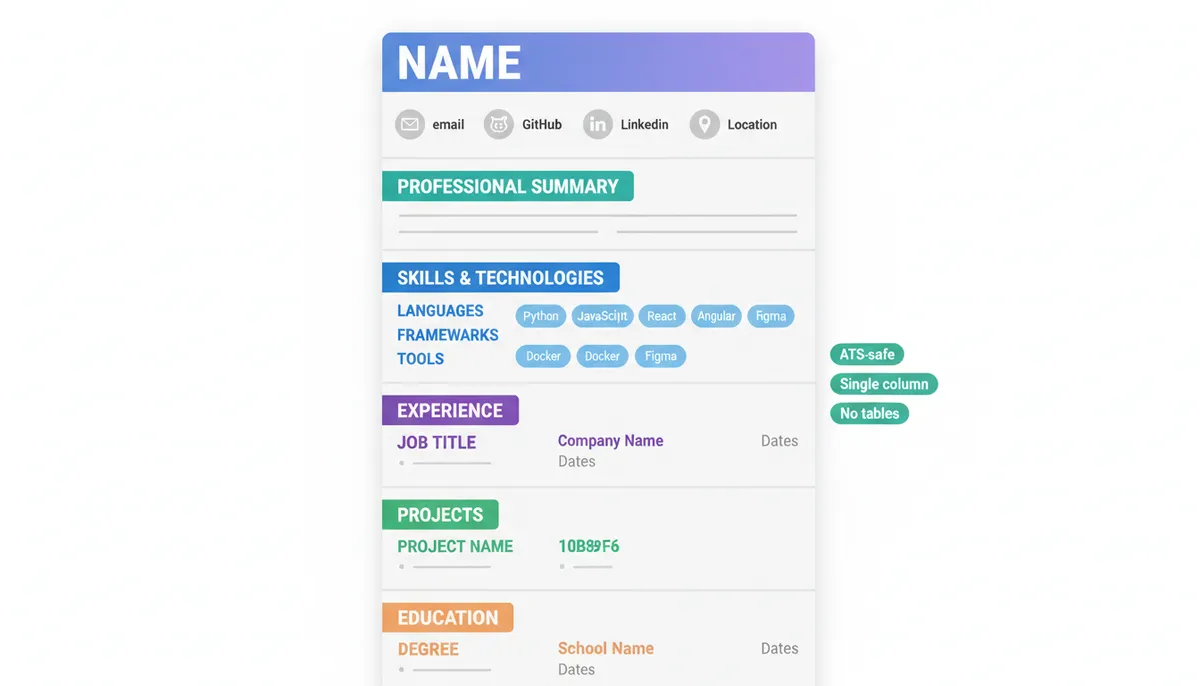
This is the layout that works best for both ATS and humans in 2026:
- Header
- Professional Summary (or “Profile”) – optional but recommended
- Skills & Technologies
- Experience
- Projects (especially important for students / career switchers)
- Education
- Additional (open source, publications, patents, speaking, etc.)
One page if you have <10–12 years of experience; two pages only if you have substantial, relevant history.
1. Header: Machine-Readable, Signal-Rich
What to include
- Full name (no nicknames)
- Email (professional handle, e.g., firstname.lastname@…)
- Location (City, Country or “City, Country · Open to remote”)
- GitHub / GitLab
- Portfolio / personal site (if it has real content)
- Optional: phone number (still common in many markets)
Format example:
TEXT
What to avoid
- Putting your name in a text box or image (ATS can fail to read it)
- Icons only without text (ATS can’t parse icons)
- Full mailing address (street, zip) — not needed
2. Professional Summary: 3–4 Lines That Set Context
In 2026, a short, targeted summary is more useful than the old “Objective” section. Think of it as a commit message for your resume: concise, specific, and contextual.
Good pattern
- Who you are (role + level)
- Years of experience
- Core domains / tech focus
- 1–2 proof points (impact, scale, outcomes)
- Target direction (what kinds of roles)
Example (mid-level backend engineer):
Backend software engineer (5+ years) specializing in distributed systems and high-throughput APIs in Go and Java. Designed and scaled services handling 50K+ RPS and terabyte-scale data pipelines on AWS. Strong focus on reliability (SLOs, observability) and performance optimization. Looking for backend / platform roles in high-scale product teams.
Avoid
- Vague buzzwords: “results-driven, hardworking, passionate”
- Obvious statements: “seeking a challenging position where I can utilize my skills”
3. Skills & Technologies: Structured for ATS and Humans
This is where many tech resumes either turn into keyword soup or under-sell real strengths.
Structure for an ATS-friendly resume
Use simple headings and comma-separated lists. Avoid tables for core content.
Recommended grouping:
- Languages
- Frameworks / Libraries
- Platforms / Cloud
- Databases
- Tools & DevOps
- Data / ML (if relevant)
Example:
TEXT
2026 nuance: signal over noise
- Prioritize what you’ve used in production over what you’ve just “touched.”
- Order by strength or relevance, not alphabetically.
- Don’t list 20 languages; list the 3–6 you can defend in an interview.
4. Experience: The Core of Your Software Engineer Resume Format
This is where the best resumes differentiate themselves.
Ordering and labeling
For each role:
- Job title
- Company
- Location (or “Remote”)
- Date range (Month Year – Month Year; avoid only years)
- 3–7 bullet points (most recent role: 5–7; older roles: 3–4)
Example header:
TEXT
Bullet point formula that works in 2026
Use a consistent pattern:
Action verb + what you built/changed + how (tech, approach) + measurable impact
Think: designed X, using Y, resulting in Z.
Weak bullet:
- Worked on microservices and improved performance.
Strong, ATS + recruiter-friendly bullet:
- Designed and implemented a rate-limiting microservice in Go backed by Redis, reducing API 429 errors by 63% and stabilizing p95 latency under 150ms at 20K RPS.
Examples by domain
Backend / distributed systems:
- Led migration of a monolithic billing system to 8 Spring Boot microservices, introducing idempotent APIs and saga-based workflows, cutting payment failure retries by 40% and improving deployment frequency from monthly to daily.
- Implemented end-to-end tracing with OpenTelemetry and Jaeger across 12 services, reducing mean time to identify root cause (MTTI) from ~2 hours to 15 minutes.
Frontend / web:
- Rebuilt a legacy React dashboard into a modular Next.js app with code-splitting and client-side caching, improving first contentful paint by 45% and increasing user task completion rate by 18%.
- Developed an internal component library in TypeScript with Storybook and automated visual regression tests, reducing UI bugs reported by QA by 30%.
Data / ML:
- Built a real-time feature store on top of Kafka and Redis for a recommendation system, reducing feature latency from 3 minutes to under 5 seconds and improving CTR by 8.2%.
- Productionized an XGBoost-based churn prediction model with a Kubeflow pipeline, enabling weekly retrains and improving recall@0.8 precision from 0.61 to 0.74.
Mapping skills to experience
To make your tech stack credible, mention key technologies inside bullets:
- “…using Kubernetes, Helm, and ArgoCD…”
- “…migrated from MySQL to PostgreSQL with zero downtime…”
This is both ATS-friendly (keywords in context) and convincing to humans.
5. Projects: Critical for Juniors, Still Useful for Seniors
In 2026, strong projects are still one of the fastest ways to show capability, especially if:
- You’re early-career
- You’re switching domains (e.g., web → ML)
- Your current job doesn’t reflect what you want next
How to format projects
For each project:
- Name + short tag (personal / open source / hackathon)
- Tech stack
- 2–4 bullets with the same action–how–impact pattern
Example:
TEXT
If you’re using a platform like Thita’s Beginner to Advanced DSA Roadmap for Software Engineers in 2026 to prep, your project bullets should be detailed enough that you could walk an interviewer through design, tradeoffs, and failure modes.
6. Education: Straightforward, No Fluff
Include:
- Degree
- Major
- Institution
- Graduation date (or expected)
- Relevant honors (Dean’s list, GPA if strong and recent)
- Selected relevant coursework (for students)
Example:
TEXT
If you’re >3–5 years into your career, keep this section compact and move it below Experience and Projects.
7. Additional Sections That Matter in 2026
Use these only if they add real signal:
- Open Source
- “Contributor to Kubernetes: Implemented XYZ feature (PR #12345), used by …”
- Publications / Patents
- Speaking / Teaching
- Certifications
- Only if relevant (e.g., AWS SA Professional) and not a substitute for real experience.
ATS-Friendly Resume: Concrete Do’s and Don’ts for 2026
ATS systems in 2026 are better than in 2016, but they still break on certain patterns.
Do
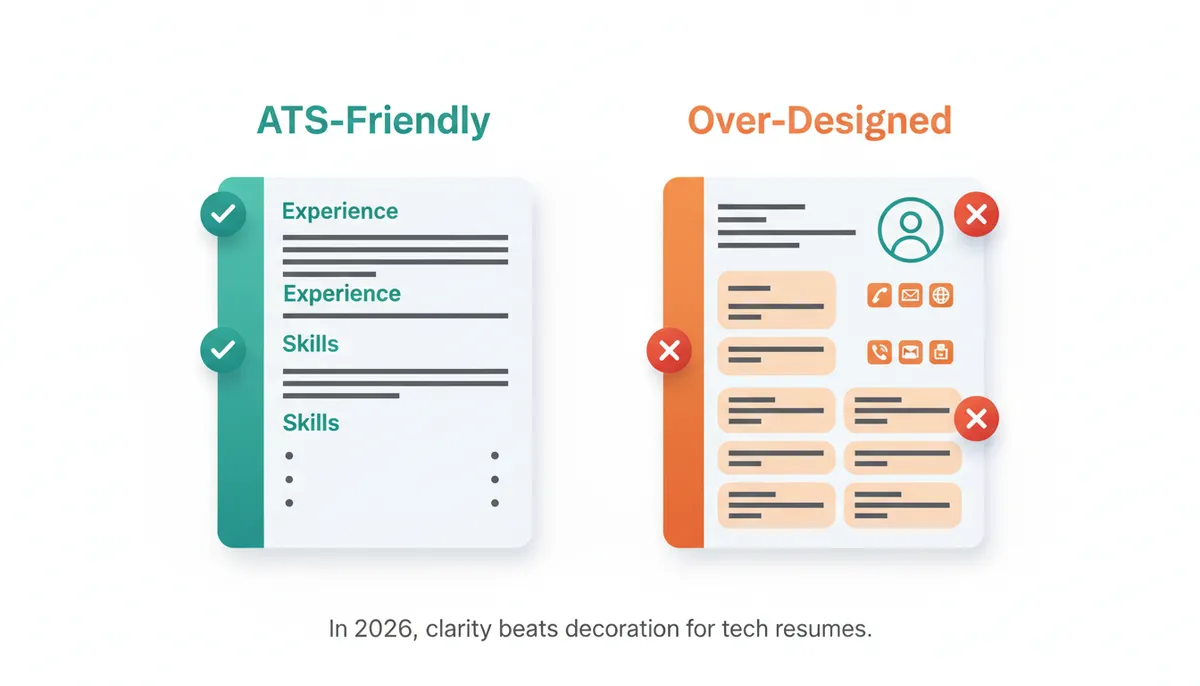
- Use standard section headings: “Experience”, “Education”, “Skills”, “Projects”.
- Use a single-column layout.
- Use .pdf unless the job description explicitly asks for .docx.
- Use simple bullet characters (•, -, or standard list bullets).
- Keep fonts common: Arial, Calibri, Helvetica, Times New Roman.
Don’t
- Don’t put core content (experience, skills) inside tables or multi-column layouts.
- Don’t embed text inside images or diagrams.
- Don’t use headers/footers for important info (some ATS ignore them).
- Don’t use overly stylized fonts or heavy graphics.
Recruiter-Friendly: Optimizing for a 15-Second Scan
Recruiters and hiring managers scan for a few things very quickly:
- Current role and level
- Years of experience
- Core tech stack
- Companies / products they recognize
- Evidence of impact
Make these elements pop
- Put your current title and company prominently near the top of Experience.
- Make your skills section concise and near the top third of the page.
- Use bold selectively inside bullets for key numbers or tech:
- “reduced p95 latency by 47%”
- “migrated from MongoDB to PostgreSQL”
Use consistent visual patterns
Humans are fast at pattern recognition. Use that:
- Same format for each job entry
- Same tense (past tense for past roles, present for current)
- Same bullet structure
Examples: Before and After Bullet Rewrites
Example 1: Backend engineer
Before:
- Worked on improving the performance of our APIs using caching and database optimization.
After:
- Reduced p95 API latency from 480ms to 190ms by introducing Redis-based response caching and optimizing PostgreSQL indexes on high-traffic endpoints (~15K RPS).
Example 2: Frontend engineer
Before:
- Responsible for developing UI components and fixing bugs.
After:
- Built reusable React component library with TypeScript and Storybook, cutting new feature UI build time by ~30% and reducing UI-related bugs reported by QA by 25%.
Example 3: Data engineer
Before:
- Created ETL pipelines and reports for stakeholders.
After:
- Designed and deployed a Spark-based ETL pipeline on AWS EMR that ingested and transformed 500GB/day of clickstream data, reducing data availability latency from 24 hours to 2 hours for analytics teams.
Common Mistakes in Tech Resumes (and How to Fix Them)
1. Listing responsibilities instead of impact
Symptom:
- “Responsible for maintaining microservices.”
- “Involved in design discussions.”
Fix:
- Replace “responsible for” with what changed because you were there.
- Ask: If I removed my name, would anything measurable change?
2. Overloading with irrelevant tech
Symptom:
- Skills list with 25+ items, including HTML, CSS, Excel, Word, etc.
Fix:
- Keep the list curated. If you wouldn’t want to be asked deep questions about it in an interview, don’t list it as a primary skill.
3. Too much academic / course content for experienced engineers
Symptom:
- Senior engineer resume with half a page of coursework and GPA.
Fix:
- After ~3–5 years, compress Education to 2–3 lines. Use the space for impact at work or open source.
4. Dense paragraphs instead of bullets
Symptom:
- A full paragraph describing a role.
Fix:
- Break into bullets, each focused on one project or outcome.
5. Ignoring the job description
Symptom:
- Same generic resume for backend, ML, and DevOps roles.
Fix (2026 reality):
- Maintain a base resume and 1–2 variants:
- Backend-focused
- Data/ML-focused
- Frontend-focused
Adjust summary, skills ordering, and which bullets you emphasize.
Tailoring Your Resume to the Role (Without Keyword Stuffing)
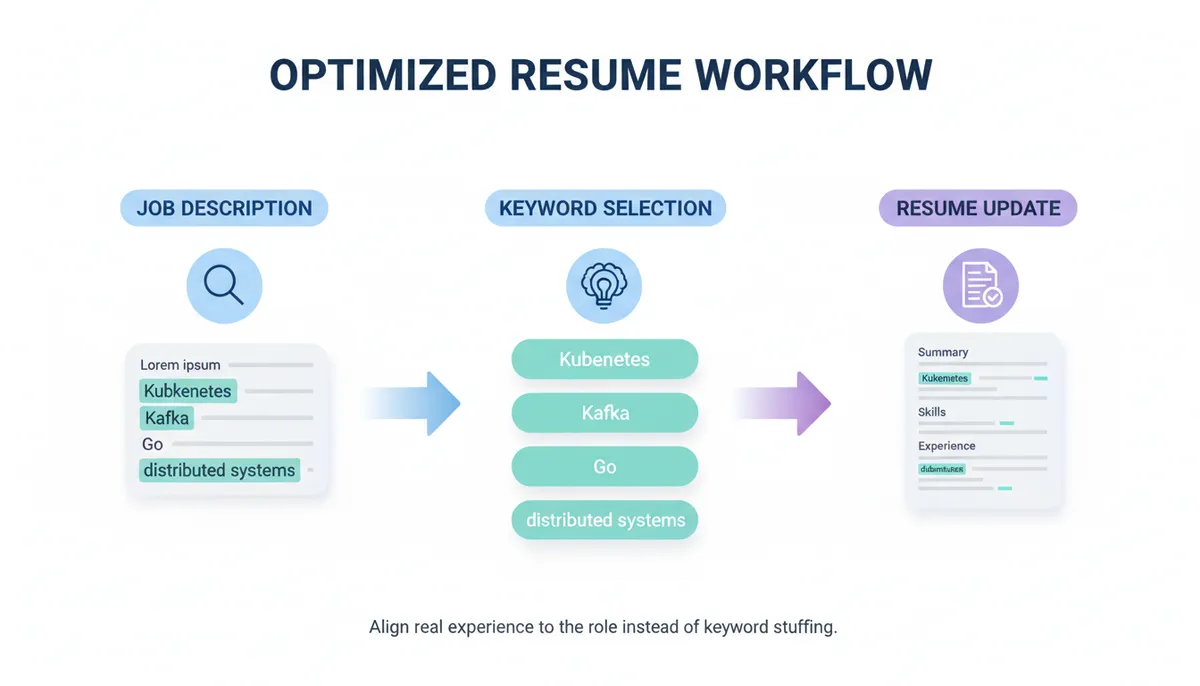
ATS systems often score resumes based on how well they match the job description. You don’t need to game this with keyword stuffing; instead, align honestly.
Step-by-step approach
-
Read the JD once as an engineer, not as a job hunter.
- What problems are they solving?
- What systems are they building?
-
Highlight 5–10 core keywords:
- Tech: “Kubernetes”, “Kafka”, “React”, “AWS Lambda”
- Responsibilities: “design distributed systems”, “build data pipelines”, “optimize performance”
-
Map those to your real experience:
- If you’ve done similar work, ensure the same words appear in your bullets.
- If you haven’t, don’t fabricate; instead, highlight adjacent strengths.
-
Update your summary and skills ordering:
- Front-load matching tech and domains.
2026-Specific Considerations: AI, GitHub, and Portfolios
AI-generated content
By 2026, many candidates are using AI to draft resumes. Recruiters and engineers can tell when:
- Bullets are overly generic
- Every sentence has the same structure and tone
- The resume doesn’t line up with how you talk about your work
Use AI as a drafting tool, then edit heavily:
- Replace generic metrics with your real numbers.
- Inject domain-specific details (e.g., “idempotent payment retries”, “exactly-once semantics in Kafka consumers”).
GitHub and code samples
For software engineers, GitHub is often more credible than a portfolio site full of templates.
- Pin 3–6 repos that reflect production-like work:
- Tests
- CI
- Docs
- Non-trivial design
If you’re practicing on a platform like Thita’s Beginner to Advanced DSA Roadmap for Software Engineers in 2026, that doesn’t need to be on the resume, but solving those problems should show up indirectly: clearer thinking, better explanations, and more robust project design.
Formatting Details That Matter More Than You Think
Length and density
- 0–5 years: 1 page
- 6–12 years: 1–2 pages (lean toward 1.5; don’t pad)
-
12 years: 2 pages is fine, but still prioritize recent, relevant work.
White space is not wasted space. Dense walls of text reduce readability and hurt you.
Fonts and sizes
- Name: 18–24 pt
- Section headings: 12–14 pt, bold
- Body text: 10–11 pt
Use a single font family. Avoid mixing more than two text colors (black/very dark gray for body, one accent color for headings if desired).
File naming
- Use a clear filename:
FirstName_LastName_Software_Engineer_2026.pdf - Avoid spaces and special characters.
Putting It All Together: A Minimal, Modern Tech Resume Template (Text-Only)
Here’s a condensed, ATS-friendly structure you can adapt:
TEXT
Key Takeaways: Best Software Engineer Resume Format for 2026
- Use a single-column, ATS-friendly layout with clear section headings.
- Lead with a concise professional summary that sets your level, domain, and impact.
- Keep your skills section curated, grouped, and aligned with the roles you want.
- In Experience and Projects, use action–how–impact bullets with real numbers and tech details.
- Optimize for 15-second scans: consistent formatting, selective bolding, and clear structure.
- Tailor to each role by aligning to the job description without fabricating experience.
- Use AI tools as drafting assistants, but ensure your resume reflects how you actually think and work.
If you structure your resume this way, you’re doing two things at once: helping the ATS parse your profile correctly, and making it easy for a senior engineer or hiring manager to see why you’re worth interviewing.