
Resume
Common Resume Red Flags That Get Candidates Rejected
Most engineers assume they’re rejected because their skills aren’t strong enough. In reality, a large share of tech hiring rejections happen before anyone ev...
Most engineers assume they’re rejected because their skills aren’t strong enough. In reality, a large share of tech hiring rejections happen before anyone evaluates your skills at all—your resume is filtered out due to avoidable resume mistakes and subtle resume red flags.
Hiring managers and recruiters routinely review hundreds of resumes per role. They rely on patterns and heuristics to quickly decide who moves forward and who doesn’t. If your resume triggers the wrong patterns—even if you’re a strong engineer—you’ll never get to the technical interview.
This post breaks down the most common resume red flags in tech hiring, why they matter, and how to fix them with concrete, engineering-oriented examples.
Why Resume Red Flags Matter So Much in Tech Hiring
Before diving into specific resume mistakes, it’s useful to understand the system you’re operating in.
How resumes are actually screened
In a typical software engineering role:
- An ATS (Applicant Tracking System) ingests your resume.
- A recruiter or sourcer spends 10–30 seconds on each profile.
- Only a subset is escalated to an engineering manager or tech lead.
- That manager often reviews 20–50 resumes in one sitting.
In that environment, red flags are not subtle. They’re filters.
Common resume red flags help hiring teams:
- Reduce risk (avoid people likely to fail, quit early, or misrepresent skills)
- Save time (avoid candidates who don’t match the role)
- Maintain quality bar (avoid weak signals on impact or craft)
You don’t need a “perfect” resume. You need one that avoids obvious failure modes and makes it easy to say “yes” to a phone screen.
1. Content-Level Resume Red Flags
These are issues with what you say: missing information, misaligned claims, or signals that undermine your credibility.
1.1 Vague responsibilities instead of concrete impact
One of the biggest resume mistakes in tech is describing responsibilities, not results.
Red flag patterns:
- “Responsible for developing features for the web application”
- “Worked on backend services using Java and Spring”
- “Involved in testing and bug fixing”
These lines say nothing about whether you were effective.
Why this is a red flag
Hiring managers want evidence of:
- Ownership
- Impact
- Ability to ship and improve systems
Vague bullet points force them to guess. Under time pressure, they won’t.
Fix: use metrics, scope, and context
Convert responsibilities into impact statements:
-
Before: “Worked on backend services using Java and Spring”
-
After: “Designed and implemented 3 new REST APIs in Java/Spring used by 5+ frontend teams, reducing average response time from 450ms to 160ms (65% improvement).”
-
Before: “Responsible for testing”
-
After: “Built Jest-based unit test suite for core pricing module, increasing coverage from 42% to 88% and catching 3 critical production bugs pre-release.”
When metrics aren’t available, use concrete scope:
- “Implemented authentication and authorization flows (JWT + refresh tokens) for ~20K MAU B2B SaaS product, including role-based access control and audit logging.”
1.2 Buzzword stuffing and tech stacks with no evidence
Another common resume red flag: listing every technology you’ve ever touched, with no connection to real work.
Red flag patterns:
- Skills section with 20–40+ technologies, from C to Kubernetes to TensorFlow to Figma
- Listing “expert” in languages you’ve only used in a tutorial
- Mentioning trendy tools (Kubernetes, Kafka, Redis) that never appear in experience bullets
Why this is a red flag
Experienced reviewers have seen this pattern from weak candidates:
- Overstated skills
- Shallow exposure
- Inability to go deep in interviews
If your resume looks like a buzzword grab-bag, reviewers assume you’re inflating your profile.
Fix: constrain and connect
- Limit “primary” skills to tools you can discuss in depth (design trade-offs, performance, failure modes).
- Separate Primary vs Familiar technologies.
- Ensure every major technology in your skills section appears in at least one concrete bullet.
For example:
Technologies
Primary: Python, Go, PostgreSQL, Docker, AWS (EC2, S3, RDS)
Familiar: TypeScript, React, Redis, Kubernetes
Then in experience:
- “Containerized legacy Python services using Docker and deployed to AWS ECS, reducing deployment time from ~1 hour manual steps to 5-minute automated pipeline.”
- “Introduced Redis caching layer for product catalog reads, cutting DB read load by ~40% during peak traffic.”
If you list Kubernetes but never mention it again, it reads as padding.
1.3 Misaligned experience vs target role
A subtle but serious resume mistake: your resume doesn’t clearly match the role you’re applying for.
Red flag patterns:
- Applying for backend roles with a resume that looks 90% front-end or UI
- Applying for ML roles with no ML projects, only “interest in AI”
- Applying for SRE roles with no mention of observability, on-call, or reliability work
Why this is a red flag
Recruiters often scan for “pattern match”:
- Backend: APIs, databases, services, scaling, performance
- Frontend: React/Vue, component design, accessibility, performance
- SRE: incident response, monitoring, CI/CD, infra-as-code
- ML: models, data pipelines, evaluation, deployment
If your resume doesn’t show the right pattern, they move on—even if you could do the job.
Fix: tailor your resume for each role family
You don’t need to rewrite from scratch, but you should:
- Reorder bullets to surface relevant work first.
- Emphasize the aspects of each project that map to the target role.
- Use role-specific terminology accurately.
Example: same project, two versions.
Backend-focused version:
- “Designed and implemented order aggregation service in Go, integrating with 3 external APIs and PostgreSQL; handled ~150 RPS at p95 latency <200ms.”
SRE-focused version:
- “Improved reliability of order aggregation service by adding Prometheus metrics, SLO dashboards, and alerting; reduced mean time to detect incidents from ~20 minutes to <5 minutes.”
Both are true; you choose which to foreground.
2. Structural Resume Red Flags
These are issues with how your resume is organized and formatted. They’re often enough to get you ignored, even if the content is decent.
2.1 Dense, unreadable layout
Reviewers skim. If your resume is a wall of text, they can’t extract signal quickly.
Red flag patterns:
- Long paragraphs instead of bullet points
- Tiny font sizes to squeeze more content
- Margins so narrow the page feels cramped
- No clear hierarchy (everything same font size/weight)
Why this is a red flag
Unclear structure suggests:
- Poor communication
- Lack of empathy for the reader
- Difficulty prioritizing what matters
In engineering, communication and prioritization matter.
Fix: optimize for 10-second scanning
- Use a clean, single-column or simple two-column layout.
- Use consistent headings: Experience, Education, Projects, Skills.
- 3–6 bullets per role is usually enough.
- Use whitespace deliberately; don’t fear a second page if you have 6+ years of experience.
A reviewer should be able to answer in 10 seconds:
- What level are you? (intern, junior, mid, senior)
- What kind of engineer? (backend, full-stack, ML, mobile, etc.)
- Where did you work and what did you ship?
2.2 Overly creative or ATS-hostile formatting
Creative layouts can break parsing and annoy reviewers.
Red flag patterns:
- Heavy use of tables, text boxes, or multi-column grids that confuse ATS
- Resumes as images or non-selectable PDFs
- Graphical skill bars (“JavaScript █████░░░░ 3/5”)
- Colorful, multi-font designs that look like marketing portfolios
Why this is a red flag
- ATS may fail to parse your experience, so you never appear in keyword searches.
- Skill bars are meaningless and uncalibrated.
- Over-designed resumes can read as style over substance, especially for engineering roles.
Fix: prioritize clarity and compatibility
- Use a simple, ATS-friendly format (exported PDF from Word/Google Docs is fine).
- Avoid text inside images, complex tables, or columns that break reading order.
- Use straightforward text lists for skills.
If you want to show design sense (e.g., for front-end roles), do it via a portfolio link with live projects, not your resume layout.
3. Timeline and Career-Path Red Flags
Hiring managers look for patterns in your career timeline. Certain patterns can raise concerns if not explained.
3.1 Frequent short stints with no explanation
Job hopping is nuanced, but it can be a red flag when:
- You have 3–5 roles in 3 years, each <12 months
- Multiple internships or contracts with no clear progression
- Many “stealth startups” or “self-employed” entries with vague descriptions
Why this is a red flag
Teams worry about:
- Retention risk (you’ll leave after 6–12 months)
- Performance issues (you were let go or didn’t pass probation)
- Reliability (you might be difficult to work with)
No one expects a 10-year tenure, but pattern + no explanation is risky.
Fix: add context and signal stability
You don’t need to overshare, but you can:
- Label short roles clearly as “Contract”, “Internship”, or “Fixed-term”.
- Add a brief note in the bullet or description.
Examples:
- “Software Engineer (Contract, 6 months) – Project ended as planned after client handoff.”
- “Backend Engineer – Startup shut down due to funding; led final data migration and service decommissioning.”
Also:
- Emphasize longer tenures or sustained contributions.
- Highlight continuity (e.g., “promoted from Junior to Mid-level in 18 months”).
3.2 Large unexplained gaps
Gaps are not inherently bad, but unexplained gaps can be.
Red flag patterns:
- 12+ month gap with no entry
- “Freelance” or “Self-employed” with no details
Why this is a red flag
Reviewers wonder:
- Were you unemployed due to performance?
- Did you stop coding and fall behind?
- Are you hiding something?
Fix: be honest and specific at a high level
Some acceptable ways to cover gaps:
- “Career break (Jan 2022 – Dec 2022) – Relocated internationally, completed advanced algorithms coursework and built personal projects (see GitHub).”
- “Family leave (Jun 2021 – Mar 2022).”
- “Full-time interview preparation and self-study in algorithms, system design, and distributed systems; solved 300+ coding problems and implemented 4 open-source tools.”
Then make sure your projects / GitHub show actual activity in that period.
4. Signal Quality Red Flags
These are patterns that suggest low technical or professional quality, even if unintentionally.
4.1 No evidence of depth or ownership
Resumes that suggest “passenger” roles rather than drivers are a concern.
Red flag patterns:
- All bullets start with “Assisted”, “Helped”, “Supported”
- Only mentions of bug fixing, no features or systems
- No mention of design, architecture, or trade-offs even for 3–5+ years experience
Why this is a red flag
Senior engineers are expected to:
- Own features or components end-to-end
- Make design decisions
- Influence direction
If your resume only shows you as support, reviewers assume that’s your ceiling.
Fix: highlight ownership at your actual level
You don’t need to exaggerate. Show real ownership:
- For juniors:
- “Independently implemented password reset flow (email verification + token expiry) used by ~5K monthly users.”
- For mid-level:
- “Owned migration of user profile data from MongoDB to PostgreSQL, including schema design, data migration scripts, and rollback plan.”
- For senior:
- “Led design and rollout of feature flagging system (Go + Redis) across 8 microservices, enabling safe canary releases and A/B testing for ~1M MAU.”
If you truly had minimal ownership in past roles, use side projects or open-source work to demonstrate depth.
4.2 Overclaiming and unverifiable achievements
Some candidates overcorrect and make claims that look unrealistic.
Red flag patterns:
- “Increased company revenue by 300%” (from an intern)
- “Built system handling billions of requests per second” (at a small startup)
- “Expert in 10+ languages and frameworks”
Why this is a red flag
Experienced reviewers can smell exaggeration. When numbers or claims don’t match the context (company size, role level), they assume:
- You don’t understand the business
- You’re inflating impact
- You may be dishonest
Fix: calibrate and qualify your claims
- Use ranges and “approx” when appropriate.
- Tie impact to your scope, not the entire company.
Better versions:
- “Optimized image processing pipeline, reducing average processing time per image from ~2.5s to ~400ms, enabling marketing team to increase campaign volume by ~3x.”
- “Contributed to service handling peak ~5K RPS during campaign events; implemented caching that reduced DB read load by ~30%.”
When in doubt, be slightly conservative. Strong engineers don’t need inflated numbers; they need clear, credible ones.
5. Communication and Professionalism Red Flags
These are easily avoidable, but still very common resume mistakes.
5.1 Typos, grammar issues, and inconsistent formatting
On a resume, these are more than cosmetic.
Red flag patterns:
- Misspelled technologies (“Java Script”, “Pyhton”)
- Inconsistent date formats (“Jan 2022 – Present” vs “3/2020 - 7/21”)
- Random capitalization (“developed MicroServices using java and SpringBoot”)
Why this is a red flag
Engineering work involves:
- Careful attention to detail
- Clear written communication (PRs, design docs)
- Working in codebases where a single typo can break builds
If your one-page resume has obvious errors, reviewers question your rigor.
Fix: treat your resume like production code
- Run spell check.
- Ask 1–2 detail-oriented friends or mentors to review.
- Standardize on one date format and style guide (e.g., US spelling, consistent capitalization of technologies).
If you’re applying in a non-native language, this is even more important. Consider professional review or using an AI writing assistant to polish wording.
5.2 Unprofessional email, missing links, or broken links
Red flag patterns:
- Email like
coolhacker420@gmail.com - No GitHub/portfolio/LinkedIn for early-career candidates
- Links to GitHub with no recent activity or only forked repos
- Broken or 404 links in contact section
Why this is a red flag
- Poor attention to detail (broken links)
- Questionable professionalism (silly email)
- For juniors, lack of public code can make it harder to assess potential.
Fix: clean, minimal, reliable
- Use a professional email:
firstname.lastname@...or a simple variant. - Include:
- GitHub (with at least a few meaningful repos)
- LinkedIn (reasonably complete)
- Portfolio or personal site if you have one
Test every link in the final PDF.
6. Examples: Weak vs Strong Engineering Resume Bullets
Transforming weak bullets into strong ones is one of the highest ROI changes you can make.
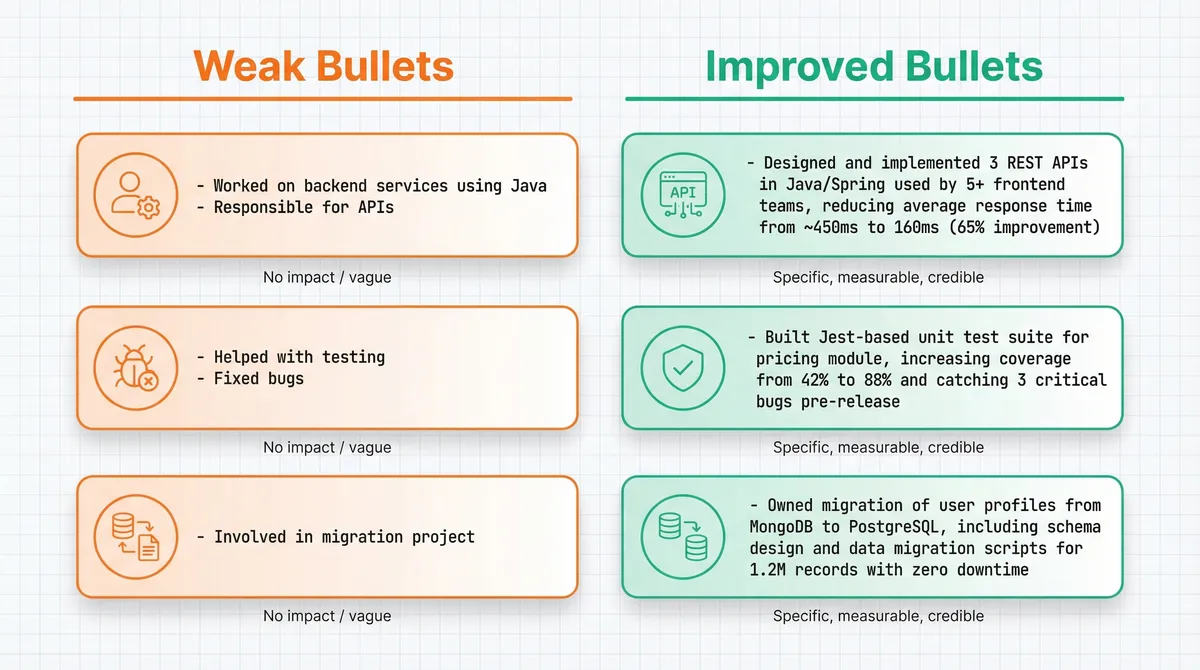
Patterns to emulate in strong bullets:
- Start with a verb: Designed, Implemented, Optimized, Led, Built, Migrated.
- Mention tech stack when relevant: “Go + gRPC”, “React + TypeScript”, “PostgreSQL”.
- Quantify: latency, throughput, users, coverage, error rates, time saved.
- Show scope: “for 5+ teams”, “for 200K users”, “across 8 microservices”.
7. Quick Checklist: Common Resume Red Flags and Fixes
This section is designed for fast scanning and self-review.
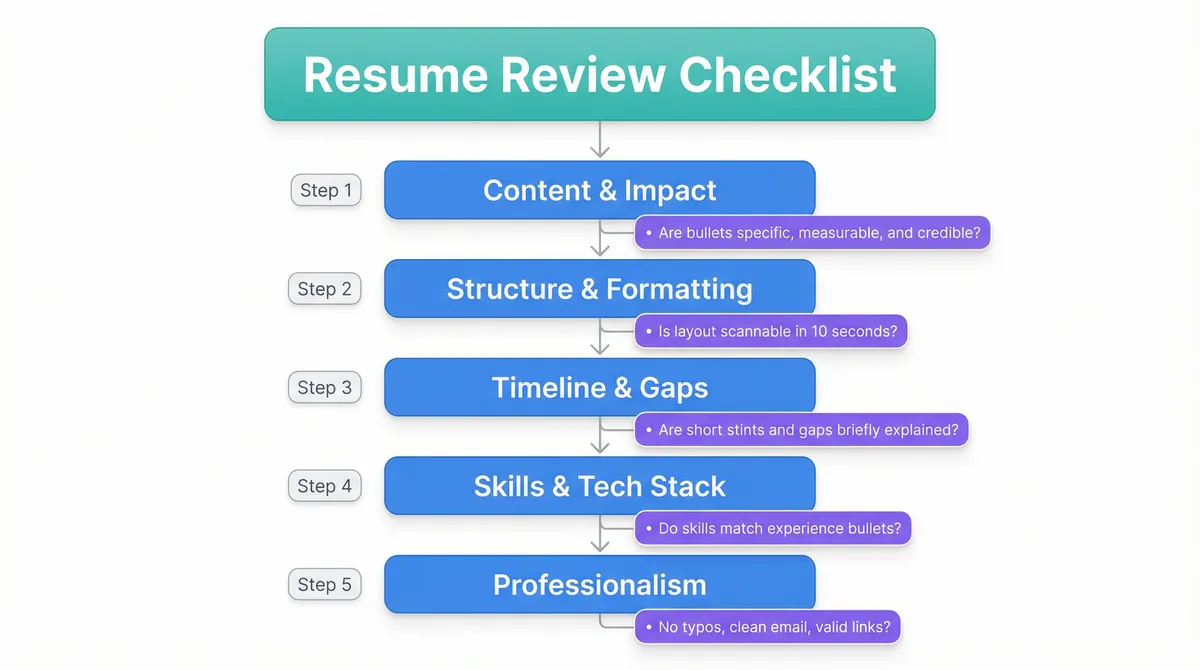
Use this as a concrete checklist:
Content & impact
- Each role has 3–6 bullets.
- Most bullets mention impact, not just responsibilities.
- At least some bullets include numbers (latency, users, coverage, etc.).
- Your experience clearly matches the roles you’re applying for.
Structure & formatting
- Clean, readable font; reasonable margins.
- Clear sections: Experience, Education, Projects, Skills.
- No large text blocks; bullets are concise.
- PDF exports cleanly and text is selectable.
Timeline & gaps
- Dates are consistent and chronological.
- Short stints are labeled (Contract, Internship, etc.) or briefly explained.
- Gaps >6–12 months have a high-level, honest explanation.
Skills & tech stack
- Skills list is focused; no obvious buzzword stuffing.
- Technologies listed appear in experience or projects.
- Seniority and specialization are clear (e.g., Backend, ML, Full-stack).
Professionalism
- No obvious typos or grammar issues.
- Email is professional; links are valid.
- No irrelevant personal information (marital status, photo, age, etc., unless regionally expected).
8. How This Plays into the Rest of the Hiring Funnel
Your resume is only one part of the hiring process, but it gates everything else:
-
Resume → Recruiter Screen
Avoid red flags so you actually get a call. -
Recruiter Screen → Technical Rounds
Resume content often seeds interview questions:- If you claim “optimized X by 70%”, expect to be asked how.
- If you list “distributed systems”, expect design questions.
-
Technical Rounds → Hiring Manager / Onsite
A strong resume aligned with your actual skills helps:- Interviewers design appropriate questions.
- You tell a coherent story about your growth.
If you’re actively preparing for coding interviews, aligning your resume with the skills you’re practicing (data structures, algorithms, system design) also helps. For example, if you’ve been working through structured DSA patterns and building projects around them, those projects should be visible and well-described on your resume.
9. Putting It All Together: A Before-and-After Example
Consider this simplified “before” resume segment for a mid-level backend engineer:
Backend Engineer, XYZ Startup (2021 – Present)
- Worked on backend microservices using Java and Spring Boot
- Responsible for APIs and database
- Helped fix bugs and improve performance
- Involved in migration to AWS
This triggers multiple resume red flags:
- Vague responsibilities
- No metrics
- Buzzwords (“microservices”, “AWS”) with no detail
- No sense of scope or ownership
An improved version, based on the same underlying work:
Backend Engineer, XYZ Startup (2021 – Present)
- Designed and implemented 4 Java/Spring Boot microservices for order processing and notifications, handling peak ~300 RPS with p95 latency <200ms.
- Introduced Redis-based caching for product catalog reads, reducing PostgreSQL read load by ~40% during peak traffic and cutting average response time from ~600ms to ~220ms.
- Built internal admin API (Java + PostgreSQL) for operations team, automating manual order adjustments and saving ~10 hours/week of manual work.
- Led migration of core services from on-prem VMs to AWS ECS, including Dockerization, Terraform infrastructure definitions, and CI/CD pipeline in GitHub Actions.
Now the same reviewer sees:
- Clear backend focus
- Real ownership and design
- Concrete performance and productivity impact
- Credible AWS and infra experience
No extra years of experience, no new job—just better communication and fewer resume mistakes.
Key Takeaways
- Many job rejections happen before any technical evaluation, due to resume red flags that signal risk, low impact, or misalignment.
- The most harmful resume mistakes in tech are:
- Vague, responsibility-only bullets with no measurable impact.
- Buzzword-stuffed skills sections disconnected from real work.
- Unclear or concerning timelines (frequent short stints, unexplained gaps).
- Poor structure, formatting, and professionalism that make your resume hard to read or trust.
- You can systematically fix these issues by:
- Writing impact-focused bullets with metrics and scope.
- Tailoring your resume to each role family (backend, frontend, ML, SRE).
- Explaining short stints and gaps briefly but honestly.
- Using a clean, ATS-friendly layout and consistent formatting.
Treat your resume like any production system: design for clarity, remove unnecessary complexity, and validate assumptions. Once you’re consistently getting to the technical interview stage, tools like structured pattern practice and AI mock interviews can help you focus on what comes next: proving the skills your resume now communicates clearly.