
Resume
How Many Projects Should You Have on a Tech Resume?
Most engineers overthink this: *how many projects should you have on a tech resume* to be taken seriously? Three? Five? Ten? A full GitHub page?
Most engineers overthink this: how many projects should you have on a tech resume to be taken seriously? Three? Five? Ten? A full GitHub page?
Hiring managers don’t count projects. They scan for signal.
This article breaks down how many projects you actually need, what kind of projects create real signal, and how to adapt your resume as you progress from student to senior engineer. We’ll treat this like a design problem: optimize for the constraints of time, space (one page), and attention (6–10 seconds of recruiter scan time).
The Short Answer: How Many Projects Should You Have on a Tech Resume?
For most software engineers:
- Students / recent grads / career switchers:
2–4 high-quality projects, with 2 featured and up to 2 more briefly listed. - 1–3 years of experience:
1–2 projects, only if they add something beyond your work experience. - 3+ years of experience:
0–1 projects, only if they are unusually impressive (open source, startups, large-scale systems).
The right question is less “how many projects resume?” and more:
“Which projects demonstrate the skills required for the job, as efficiently as possible?”
The rest of this guide explains how to choose that set and present it like an engineer, not a hobbyist.
Why Projects Matter (and When They Don’t)
What hiring managers actually look for
When scanning a tech resume, reviewers are trying to answer:
- Can you code at the level we need?
- Have you built anything non-trivial end-to-end?
- Do your skills match our stack and problem space?
- Are you likely to pass our coding and system design rounds?
Projects are just one signal among many (experience, education, GitHub, online judges, etc.). For early-career candidates, they’re often the primary signal. For experienced engineers, they’re supporting evidence.
When projects are critical
Projects are especially important if:
- You have no prior software job.
- You’re switching fields (e.g., mechanical engineer → backend developer).
- Your degree is not CS/CE.
- Your work experience is not directly related to software (IT support, QA, etc.).
- You’re applying to internships or new grad roles.
In these cases, projects are your experience section.
When projects are secondary
Projects matter less (but can still help) when:
- You have multiple years of relevant SWE experience.
- You’ve shipped production systems used by real users.
- You have strong internship experience at well-known companies.
In these scenarios, projects should not dominate your resume; they should fill specific gaps (e.g., you want to pivot from frontend to backend).
How Many Projects by Career Stage (With Examples)
1. Students and New Grads: 2–4 Projects
Target: 2 featured, up to 2 more listed.
You want enough projects to show:
- Breadth: you can work across multiple areas (web, backend, data, etc.).
- Depth: at least one project where you went beyond a tutorial.
- Relevance: alignment with the roles you’re applying to.
Example layout (student resume)
- Experience
- Internship at XYZ (if any)
- Projects (2 detailed, 2 brief)
- Project A (detailed, 3–4 bullets)
- Project B (detailed, 3–4 bullets)
- Project C (1–2 bullets)
- Project D (1–2 bullets)
You don’t need 10 projects. Two strong, well-explained projects beat ten “to-do apps” with no depth.
2. Early Career (1–3 Years): 1–2 Projects
Target: 0–2 projects, only if they add unique value.
Your work experience should carry most of the weight. Add projects only if:
- They use different technologies than your job (e.g., you do frontend at work, but have a backend systems project).
- They show ownership (you designed and built it end-to-end).
- They demonstrate scale or complexity not visible in your day job.
Example layout (1–3 years)
- Experience
- Software Engineer, Company A
- Software Engineer, Company B (internship)
- Selected Projects (optional)
- Open-source library with 500+ GitHub stars
- Side project used by 1,000+ monthly users
If your projects are weaker than your work experience, leave them out.
3. Mid/Senior Engineers (3+ Years): 0–1 Projects
Target: 0–1 projects, only if highly relevant or impressive.
At this level, your professional experience is the primary signal. Projects are only worth the space if they:
- Are widely used open-source contributions.
- Demonstrate architecture-level thinking (distributed systems, high-scale infra).
- Are directly relevant to the target role (e.g., you’re applying for a developer tools role and you built a CI/CD tool used by multiple teams).
Otherwise, use the space for stronger descriptions of your impact at work.
Quality vs Quantity: What Makes a “Good” Project?
If you’re going to list only a few projects, they need to be strong. Use this checklist.
A strong tech resume project should:
-
Solve a real problem
- Real users, real data, or a realistic scenario.
- Avoid “yet another to-do list” unless it has unique complexity.
-
Demonstrate relevant technologies
- Match the job description: e.g., backend roles → APIs, databases, concurrency.
- Explicitly show languages/frameworks:
Python, FastAPI, PostgreSQL, Redis.
-
Show technical depth
- Non-trivial logic, data modeling, performance considerations.
- Use of DSA or systems concepts when appropriate (caching, queues, indexing). See how applying DSA patterns can strengthen your technical depth.
-
Show ownership and impact
- “Designed and implemented…” > “Worked on…”
- Quantify where possible:
reduced latency by 40%,handled 50k events/day.
-
Be reproducible and verifiable
- A GitHub link that builds.
- A short README with architecture and setup instructions.
- (Nice-to-have) Live demo or screenshots.
How to Decide Which Projects to Include
Think of this as a selection problem with constraints (one page, limited attention).
Step 1: List your candidate projects
Include:
- Course projects
- Hackathon projects
- Personal side projects
- Open-source contributions
- Research prototypes
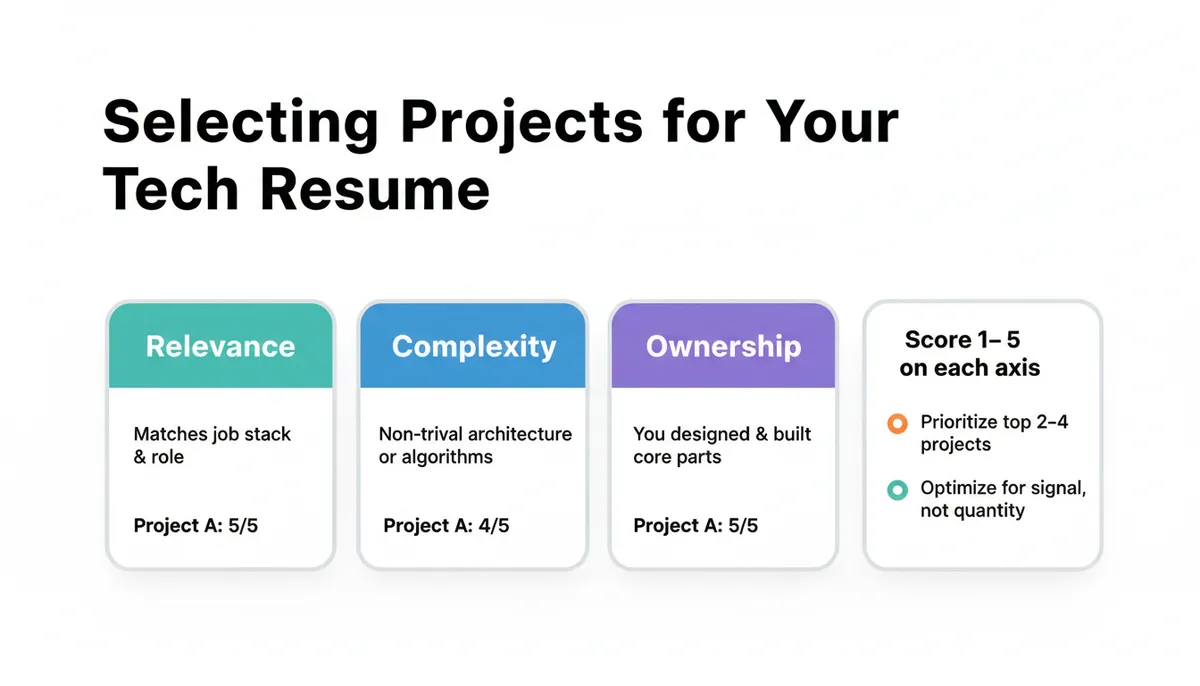
Step 2: Score each project on key dimensions
Score from 1–5 on:
- Relevance to target role (stack, domain, responsibilities)
- Complexity (architecture, algorithms, scale)
- Ownership (how much you personally did)
- Polish (tests, docs, deployment, reliability)
Compute a rough score and pick the top 2–4.
Step 3: Map to career stage
- Students: pick top 2–4 projects by score.
- Early career: pick 0–2 if they beat your weaker work experiences.
- Senior: pick 0–1 only if they’re exceptional.
How to Structure the Projects Section (With Examples)
General formatting guidelines
- Section title: “Projects” or “Selected Projects” (for experienced engineers).
- Order: Place it after Experience for early-career, before Experience if projects are stronger than internships.
- Each project entry should include:
- Name + brief descriptor
- Tech stack (on the first line)
- 2–4 bullet points focused on impact and implementation
- Optional: GitHub / live demo link
Example: Strong project entry (backend-focused)
Distributed Log Aggregator — Personal Project
Tech: Go, gRPC, Kafka, PostgreSQL, Docker, Kubernetes
- Designed and implemented a distributed log aggregation service ingesting ~50k events/min from simulated microservices.
- Built a gRPC-based ingestion API and Kafka-based pipeline to buffer and fan-out logs to multiple storage backends.
- Optimized PostgreSQL schema and indexing to support filtered queries over 100M+ log entries with p95 latency under 200ms.
- Deployed to a local Kubernetes cluster using Helm; added Prometheus metrics and Grafana dashboards for monitoring.
This shows:
- Relevant stack
- Scale
- Performance metrics
- System design thinking
Example: Strong project entry (frontend-focused)
Interactive Data Visualization Dashboard — Course Project
Tech: TypeScript, React, D3.js, Node.js, Express
- Built a single-page dashboard to visualize 1M+ time-series data points with zooming, panning, and cross-filtering interactions.
- Implemented virtualized rendering and debounced event handlers to maintain 60 FPS interactions on mid-range laptops.
- Exposed a REST API in Node.js/Express for querying data with pagination and server-side filtering.
How Many Bullets per Project?
As a rule of thumb:
- Featured projects: 3–4 bullets.
- Secondary projects: 1–2 bullets.
- Do not write paragraphs; bullets should be crisp and outcome-oriented.
Think in terms of signal per line. Each bullet should communicate something new: a feature, a technical challenge, a performance improvement, or a design decision.
Mapping Projects to Job Descriptions
Your project selection should be role-aware.
Backend roles
Emphasize:
- APIs (REST/gRPC/GraphQL)
- Databases (SQL/NoSQL), indexing, transactions
- Caching, queues, background jobs
- Concurrency, parallelism, distributed systems concepts
- Monitoring, logging, observability
Frontend roles
Emphasize:
- Modern frameworks (React, Vue, Angular, Svelte)
- State management (Redux, Zustand, etc.)
- Performance (bundle size, rendering optimizations)
- Accessibility (a11y), responsive design
- Testing (Jest, React Testing Library, Cypress)
Full-stack roles
Show:
- At least one project where you own both frontend and backend
- Authentication/authorization
- Deployments (CI/CD, hosting, containers)
Data / ML roles
Emphasize:
- Data pipelines (ETL/ELT)
- Model training + evaluation
- Feature engineering
- Metrics (accuracy, F1, latency)
- Serving models (APIs, batch scoring)
For candidates focusing on ML roles, aligning projects with a complete data science roadmap can help ensure coverage of essential skills.
Common Mistakes in Tech Resume Projects
1. Too many low-signal projects
Listing 7–10 tiny projects dilutes your strongest work. Reviewers won’t read them all.
Fix: Keep 2–4. Merge or drop clones (“another CRUD app”).
2. Vague, non-technical bullets
Bad:
- “Worked on a web app using React.”
- “Learned about machine learning.”
- “Built a project management tool.”
These don’t show what you did or why it’s impressive.
Better:
- “Implemented dynamic form builder in React using controlled components and custom hooks, reducing duplicated UI code by ~40%.”
- “Trained a gradient boosting model (XGBoost) on 500k labeled samples, improving F1 score from 0.72 to 0.84 compared to baseline logistic regression.”
3. No tech stack listed
Reviewers shouldn’t have to infer your tools.
Fix: Add a tech line:
Tech: Python, Django, PostgreSQL, Redis, Docker, AWS EC2
4. Unverifiable or broken links
A GitHub repo that doesn’t build or an empty README is negative signal.
Fix:
- Ensure the main branch builds.
- Add a minimal README: problem, architecture, setup, sample usage.
- If the code is private (e.g., NDA), omit links and focus on description.
5. Over-indexing on tutorials
A project that looks like a step-by-step YouTube tutorial is low signal.
Fix:
- Extend tutorials with your own features or architecture.
- Document what you added: “Extended tutorial X by adding Y and Z…”
Best Practices: Making Each Project Count
1. Write bullets like you’d write a postmortem
Be specific about:
- Problem
- Approach
- Trade-offs
- Results
Use a pattern like:
[Action] + [What you built] + [How you built it] + [Result/metric]
Example:
“Implemented batched writes to PostgreSQL using COPY and connection pooling, reducing ingestion latency by ~60% under peak load.”
2. Surface DSA and systems thinking when relevant
You don’t need to mention “Big-O” everywhere, but sometimes it’s useful:
- “Replaced O(n²) naive search with indexed lookups using a hash map, reducing request time from 800ms to 40ms on average.”
- “Used a min-heap to maintain top-K trending items in O(n log k) time for a real-time feed.”
This reinforces that you can apply algorithmic thinking in real systems—useful for interviews and aligns with pattern-based learning like you’d see in a Beginner to Advanced DSA Roadmap for Software Engineers in 2026.
3. Show evolution over time
If you only have 1–2 projects, show that you iterated:
- v1: monolith → v2: modular services
- v1: polling → v2: WebSockets or event-driven
- v1: single-region → v2: multi-region support
This mirrors how real production systems evolve.
4. Tailor the project set per application
You don’t need a single static resume.
- For backend roles: highlight backend-heavy projects.
- For frontend roles: swap in UI-heavy projects.
- For ML roles: emphasize data and modeling projects.
Small edits can significantly increase relevance.
Example: Two Versions of the Same Resume
Assume you’re a new grad with 4 projects:
- Chat application (React + Node.js + WebSockets)
- Image classifier (PyTorch)
- Algorithm visualizer (TypeScript + D3.js)
- DevOps pipeline (GitHub Actions + Docker + Kubernetes)
Applying to a backend role
Projects section:
-
Real-time Chat Application — Personal Project
Tech: Node.js, Express, WebSockets, Redis, PostgreSQL, Docker- Implemented a real-time chat server handling 5k concurrent connections with WebSockets and Redis pub/sub.
- Designed relational schema for users, messages, and rooms; added indexes to support efficient retrieval of message history.
- Containerized app with Docker and used Nginx as a reverse proxy; load tested with k6 to validate throughput and latency.
-
CI/CD Pipeline for Microservices — Personal Project
Tech: GitHub Actions, Docker, Kubernetes, Helm- Built a CI/CD pipeline that runs tests, builds Docker images, and deploys to a local Kubernetes cluster on every push.
- Implemented blue-green deployment strategy to minimize downtime during rollouts.
(Maybe list ML and visualizer briefly or omit if space-constrained.)
Applying to a frontend role
Projects section:
-
Algorithm Visualizer — Personal Project
Tech: TypeScript, React, D3.js- Implemented interactive visualizations for sorting and pathfinding algorithms (quicksort, mergesort, Dijkstra, A*).
- Used React hooks and memoization to keep animations smooth at 60 FPS for arrays of up to 500 elements.
- Designed a responsive UI and keyboard shortcuts to improve usability across desktop and tablet devices.
-
Real-time Chat Application — Personal Project
Tech: React, TypeScript, Tailwind CSS, Node.js- Built a responsive chat UI with message grouping, typing indicators, and online/offline presence.
- Implemented optimistic UI updates and error handling for unreliable network conditions.
Now the same underlying work is presented differently to match the role.
Should You Include Code Snippets on Your Resume?
Generally: no. Space is too limited.
Instead:
- Put code in GitHub.
- Show architecture-level decisions in the resume.
- Use interviews and portfolio reviews to dive into code.
If you want to highlight a specific algorithm or implementation, mention it in a bullet:
“Implemented A* search with a custom heuristic to reduce pathfinding time by 30% compared to Dijkstra’s algorithm in grid-based maps.”
How Projects Interact with Interview Prep
Strong projects help you:
- Have concrete systems to reference in system design interviews.
- Practice articulating trade-offs (caching strategies, database choices, API design).
- Show that you can apply DSA patterns to real use cases.
Mock interviews (human or AI-driven) are a good way to test whether your project explanations land well. If you struggle to explain a project clearly in 2–3 minutes, refine either the project or your narrative. Tools like an AI interview partner can help you rehearse this repeatedly.
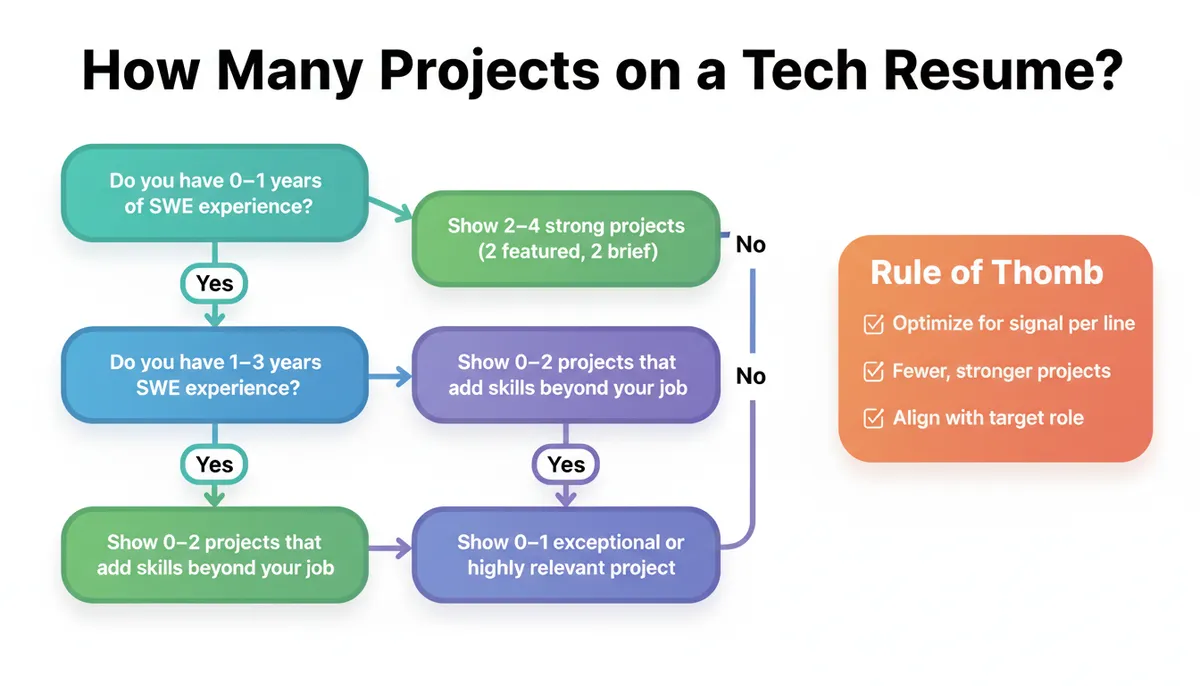
Visual Checklist: How Many Projects and Which Ones?
Key Takeaways
- There is no magic number, but there is a good rule of thumb:
- Students/new grads: 2–4 projects, 2 of them detailed.
- 1–3 years experience: 0–2 projects, only if they add unique value.
- 3+ years experience: 0–1 exceptional project, or none.
- Prioritize quality over quantity. Each project should demonstrate real skills, clear ownership, and relevant technologies.
- Write specific, technical bullets that show how you built things and what impact you achieved.
- Tailor your project selection and framing to the job description—backend, frontend, full-stack, or data/ML.
- Treat your projects as training data for interviews: practice explaining them clearly, focusing on design, trade-offs, and results.
If you think about your projects like an engineer—optimizing for signal, not volume—you won’t need ten of them. You’ll need a small, well-chosen set that quietly but clearly proves you can do the job.