
Resume
Resume vs Portfolio: What Matters More for Software Engineers
Most software engineers obsess over their resume. A few obsess over their portfolio. Very few think deeply about how the two work together in modern tech hir...
Most software engineers obsess over their resume. A few obsess over their portfolio. Very few think deeply about how the two work together in modern tech hiring.
If you’re preparing for job applications today—especially in competitive markets—you’ve probably wondered: resume vs portfolio: what actually matters more for software engineers? And where should you invest your limited time?
This post breaks that down from a hiring and engineering perspective. We’ll look at how recruiters and engineers actually review candidates, when a portfolio is a differentiator vs a distraction, and concrete patterns for building both without wasting effort.
Resume vs Portfolio: What’s the Real Difference?
Before deciding which matters more, you need precise definitions. In tech hiring, “resume” and “portfolio” are not interchangeable.
What is a resume for software engineers?
A resume is a structured, compressed summary of your professional signal:
- Who you are (contact, location, links)
- What you’ve done (jobs, internships, education)
- What you can do (skills, tech stack, impact)
- What you’ve shipped or achieved (projects, outcomes, metrics)
Key properties:
- Format: 1–2 pages, PDF, text-first
- Audience: recruiters, hiring managers, sometimes automated parsers
- Goal: survive the first 15–60 seconds of screening and get you an interview
- Optimization axis: clarity, relevance, signal density
Think of your resume as a highly-optimized index into your career, not the full documentation.
What is a software engineer portfolio?
A software engineer portfolio is a living, richer artifact that shows depth:
- Code samples (GitHub, GitLab, Bitbucket)
- Deployed apps, demos, or products
- Technical blog posts, talks, or open-source contributions
- Case studies explaining design decisions and tradeoffs
Key properties:
- Format: website, GitHub profile, Notion doc, or combination
- Audience: hiring managers, senior engineers, tech leads
- Goal: validate and deepen the claims on your resume; show how you think and build
- Optimization axis: depth, credibility, craftsmanship
Think of your portfolio as the source code and documentation behind the API surface that is your resume.
How Tech Hiring Actually Works: Where Resume and Portfolio Fit
To understand resume vs portfolio impact, map them to the stages of a typical tech hiring funnel.
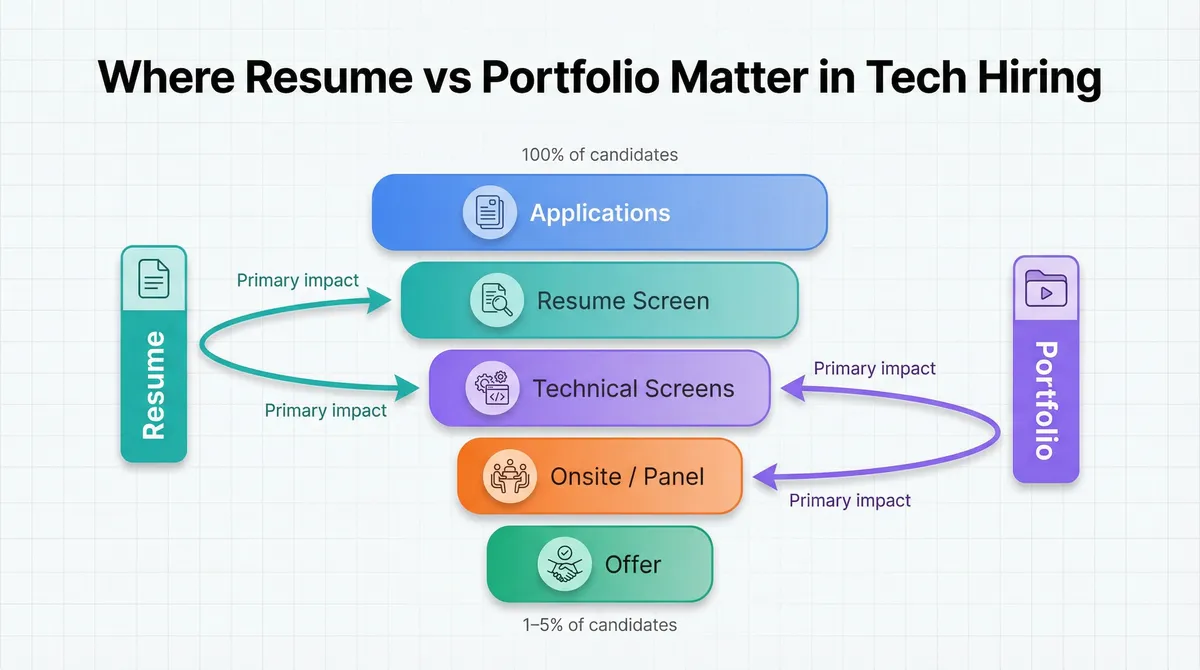
Stage 1: Application and resume screen
At most companies:
- Recruiters or automated systems first see your resume, not your portfolio.
- Many use keyword-based filters (skills, titles, locations).
- Time spent per resume can be 15–30 seconds for early screening.
At this stage:
- A strong resume can move you forward even with no portfolio.
- A strong portfolio cannot help you if your resume is filtered out or unreadable.
Implication: For getting interviews, resume quality is non-negotiable. Portfolio is secondary.
Stage 2: Technical screen (phone/online)
Once you’re past the initial filter:
- Interviewers may glance at your resume before or during the call.
- They rarely have time to explore your portfolio in depth.
- But if you link a clean GitHub or project, some interviewers will skim it quickly.
Here:
- Resume shapes what they choose to ask you about (“Tell me about this distributed cache project.”).
- Portfolio can reinforce credibility (“I see you actually implemented a Raft-based log here.”).
Stage 3: Onsite / panel interviews
This is where portfolios can matter more:
- Senior engineers and hiring managers sometimes review candidates in more depth beforehand.
- For certain roles (front-end, infra, ML), a portfolio can become a discussion anchor:
- “Walk me through how you designed this system.”
- “Show me how you structured this React app.”
- “Let’s look at how you tested this service.”
Resume is still the index; portfolio is the reference material.
Resume vs Portfolio: What Matters More, and When?
The short answer:
- For getting interviews: resume > portfolio
- For standing out among similar candidates: portfolio ≥ resume
- For senior / staff roles: resume + portfolio + reputation
Early-career engineers (students, bootcamp grads, 0–2 years)
You often lack:
- Long work history
- Big-name companies
- Formal titles
So what matters more?
- Resume: Still the primary gatekeeper. You must:
- Show relevant projects
- Highlight concrete skills
- Avoid noise and fluff
- Portfolio: Can be a huge differentiator:
- Deploy 2–4 solid projects
- Show code quality, tests, documentation
- Demonstrate consistent learning
For early-career engineers, it’s not either/or. It’s:
- Resume to get noticed
- Portfolio to prove you’re not just buzzwords
Mid-level engineers (2–6 years)
You now have:
- Real production experience
- Specific domains (backend, frontend, data, infra)
What matters:
- Resume:
- Clear progression and scope increase
- Impact metrics (latency, revenue, reliability)
- Technologies at scale
- Portfolio:
- Selected work that showcases depth:
- A complex side project
- A meaningful open-source contribution
- A well-written technical blog post
- Selected work that showcases depth:
At this level, a portfolio is not required at many companies, but it can:
- De-risk hiring for smaller teams (“We can see how they structure systems.”)
- Differentiate you when many resumes look similar
Senior and above (7+ years)
At senior/staff/principal levels, hiring leans heavily on:
- Track record (companies, teams, promotions)
- References and reputation
- System design and leadership experience
Still:
- Resume:
- Needs to tell a coherent story of scope (team size, system complexity, ownership)
- Portfolio (broad sense):
- Talks, conference presentations
- RFCs or design docs (redacted if needed)
- Long-form writing on architecture, reliability, scaling
You might not have a “portfolio website,” but you should have artifacts that demonstrate how you think, lead, and design.
Comparing Resume vs Portfolio Side by Side
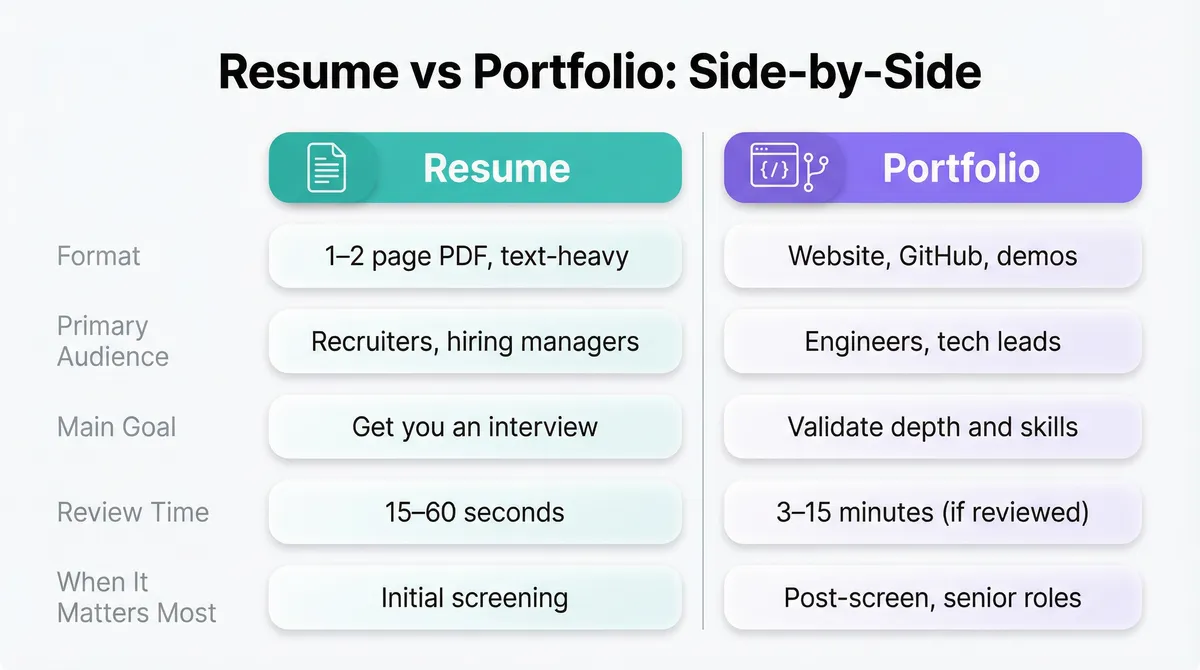
What a Strong Software Engineer Resume Actually Looks Like
Let’s focus on the highest leverage asset first: your resume.
Core principles of an effective engineering resume
-
Signal density over volume
- Prioritize information that predicts job success:
- Technologies you’ve used in depth
- Systems you’ve built or owned
- Measurable impact
- Remove low-signal content:
- Generic soft skills lists (“hardworking, team player”)
- Unrelated hobbies unless they show exceptional achievement
- Prioritize information that predicts job success:
-
Outcomes over responsibilities
Bad:
- “Responsible for maintaining backend services.”
Better:
- “Reduced p95 API latency by 40% (320ms → 190ms) by redesigning caching strategy and optimizing DB queries.”
-
Specificity over buzzwords
Bad:
- “Worked on scalable microservices using cutting-edge technologies.”
Better:
- “Designed and implemented a Go-based microservice handling ~15k RPS, backed by PostgreSQL and Redis, with horizontal autoscaling via Kubernetes HPA.”
Example: transforming a weak bullet into a strong one
Weak bullet:
Worked on a web application using React and Node.js.
Transformed:
Built and maintained a React + Node.js application serving ~50k MAUs; implemented client-side caching and pagination that reduced average page load time by 35%.
Why this is better:
- Quantified impact (50k MAUs, 35% improvement)
- Clear stack (React, Node.js)
- Action and outcome, not just tools
What a Strong Software Engineer Portfolio Looks Like
A portfolio isn’t “more projects.” It’s curated evidence that you can build, reason, and maintain.
Core components of a high-signal portfolio
-
Fewer, deeper projects
Two well-executed projects beat ten half-finished ones.
Look for:
- Real users or real usage (even if small)
- Non-trivial complexity:
- Background jobs
- Authentication
- Caching
- Integrations with external APIs
- Tests and documentation
-
Visible code quality
A hiring engineer scanning your repo will look for:
- Clear project structure
- Readable naming
- Tests (unit/integration)
- Error handling and logging
- Sensible abstractions (not over-engineered)
-
Narratives, not just code
For each featured project, include:
- Problem: What were you trying to solve?
- Constraints: Time, resources, tech choices
- Architecture: High-level design and tradeoffs
- Challenges: What was hard and how you solved it
- Results: Performance, users, or learning outcomes
Example: portfolio project write-up structure
Instead of just linking to github.com/you/app, create a project page (README or website) like:
- Title: “Realtime Collaborative Whiteboard”
- Tech stack: TypeScript, React, Node.js, WebSocket, Redis, PostgreSQL
- Problem: “Enable multiple users to draw and edit on the same canvas in real-time.”
- Architecture:
- WebSocket server for realtime updates
- Redis pub/sub for horizontal scaling
- Postgres for persistence
- Key challenges:
- Handling concurrent edits and conflict resolution
- Efficiently broadcasting updates without flooding clients
- Results:
- Supports 100 concurrent users per room with sub-150ms update latency on average
- Deployed on Fly.io with CI via GitHub Actions
This is the kind of artifact a senior engineer can skim in 3–5 minutes and quickly conclude: “This person knows what they’re doing.”
How Recruiters and Engineers Actually Read These
How recruiters scan your resume
Most recruiters are not deeply technical, but they:
- Match keywords from job description:
- Languages (Python, Go, TypeScript)
- Technologies (Kubernetes, React, AWS)
- Domains (payments, ML, infra)
- Look for signal:
- Well-known companies or schools
- Clear job titles and progression
- Duration (no unexplained 2-month stints stacked)
They will:
- Spend seconds, not minutes
- Often not click your portfolio link unless:
- You’re a non-traditional candidate and the resume is intriguing
- The role explicitly values portfolios (design, front-end, creative tech)
How engineers review your portfolio (if they do)
Engineers are more likely to:
- Open your GitHub link
- Click into 1–2 repos
- Skim:
README.mdsrc/structure- A few representative files
- Tests
- Look for red flags:
- Copy-pasted tutorials with no customization
- No tests or documentation anywhere
- Overuse of global state, poor error handling, “god objects”
They’re not expecting production-level perfection, but they are looking for taste and discipline.
When a Portfolio Is Critical vs Optional
Critical (or strongly advantageous)
-
Self-taught / career switchers
- You lack traditional signals (CS degree, internships).
- Portfolio becomes your primary way to prove capability.
-
Front-end / UX-heavy roles
- Visual output and interaction design matter.
- Deployed, polished interfaces are high-signal.
-
Freelance / contract engineers
- Clients often choose based on visible past work.
- Case studies and demos directly drive trust.
-
Research / ML / data science
- Papers, notebooks, experiments, and repos show your depth.
Helpful but not mandatory
-
Backend / infra roles at larger companies
- Strong resumes with good companies/projects can be enough.
- Portfolio still helps if you’re competing with many similar profiles.
-
Traditional CS grads with internships
- Internships at reputable companies already provide signal.
- A portfolio can still differentiate you if it shows unusual initiative.
Common Mistakes in Resume and Portfolio (and How to Fix Them)
Resume mistakes
-
Too generic and buzzword-heavy
- Long lists of technologies with no context.
- Vague phrases like “proficient in.”
Fix: Tie each technology to a concrete project and outcome.
-
No impact, only responsibilities
- “Worked on X” without results.
- “Responsible for Y” without metrics.
Fix: Add:
- Performance improvements
- Reliability gains
- Revenue or user impact
- Scale numbers (RPS, data volume, users)
-
Poor structure and readability
- Dense paragraphs
- Inconsistent formatting
- Tiny fonts
Fix:
- Use bullet points
- Consistent tense and style
- Clear section headings: Experience, Projects, Education, Skills
Portfolio mistakes
-
Too many low-quality projects
- 15 small apps, all incomplete.
- Multiple abandoned tutorials.
Fix: Archive or hide weak repos. Pin 3–6 strong ones.
-
No documentation or explanation
- Repos with no README.
- No context on what the project does.
Fix:
- Add a short but clear README:
- What it does
- How to run it
- Tech stack
- Key features
-
Obvious tutorial clones
- Projects that are clearly from a YouTube or Udemy course.
- No customization or extension.
Fix:
- If you start from a tutorial, extend it:
- Add new features
- Change architecture
- Improve UX
- Explain your extensions in the README.
-
Broken demos and links
- Dead Heroku apps
- 404 portfolio pages
Fix:
- Regularly check and update links.
- If a demo is down, remove the link or clearly mark it and provide screenshots.
Building a Resume and Portfolio That Work Together
You don’t want two disconnected artifacts. You want a coherent story.
Step 1: Decide your target role and stack
Before writing anything, clarify:
- What roles are you targeting?
- Backend, full-stack, front-end, data, ML, infra, etc.
- What technologies are most relevant?
This drives what you emphasize in both resume and portfolio.
Step 2: Design your resume as the “map”
Your resume should:
- Highlight:
- 2–4 most relevant experiences/projects
- Skills that match your target roles
- Include links:
- GitHub profile
- Personal website / portfolio
Each featured project on your resume should be:
- Briefly described (1–2 bullets)
- Linked to a deeper portfolio entry (repo or case study)
Step 3: Design your portfolio as the “zoom-in”
For each project listed on your resume:
- Create a dedicated section or README that:
- Expands on the architecture
- Shows code snippets
- Includes diagrams or screenshots if relevant
- Explains tradeoffs and decisions
This way:
- Resume: “Built X that did Y with Z impact.”
- Portfolio: “Here’s how I actually built X and what I learned.”
Concrete Example: Resume Bullet and Matching Portfolio Section
Resume entry (Experience → Projects):
Distributed Job Queue (Go, Redis, Docker)
Designed and implemented a distributed job queue processing ~200k jobs/day with at-least-once delivery and exponential backoff; reduced batch processing time by 60% vs previous cron-based system.
Portfolio (GitHub README or project page):
- Overview: Distributed job queue for processing image transformations.
- Tech stack: Go, Redis (as a broker), PostgreSQL, Docker, Kubernetes
- Architecture:
- Producers enqueue jobs into Redis lists.
- Workers pull jobs, process them, and update status in Postgres.
- At-least-once delivery using visibility timeouts and retry queues.
- Reliability:
- Exponential backoff on failure (1s, 5s, 30s, 5m).
- Dead-letter queue after 5 failed attempts.
- Metrics:
- Prometheus metrics for job throughput, latency, and failure rates.
- Grafana dashboards for monitoring.
- Results:
- 60% reduction in total batch processing time (from ~5 hours to ~2 hours).
- Ability to horizontally scale workers independently.
Now an interviewer can:
- Start from the resume bullet.
- Dive into the portfolio to see real code and design decisions.
- Use this as the basis for a deep technical conversation.
Lightweight Code Example: Portfolio Project with Tests
If you’re building a portfolio, including simple but well-structured code with tests is high-signal.
PYTHON
PYTHON
This is not production code, but it shows:
- Clear structure
- Tests
- Handling of edge cases (retries)
Exactly the kind of thing a hiring engineer wants to see in a portfolio.
Visual Framework: Deciding Where to Invest Your Time
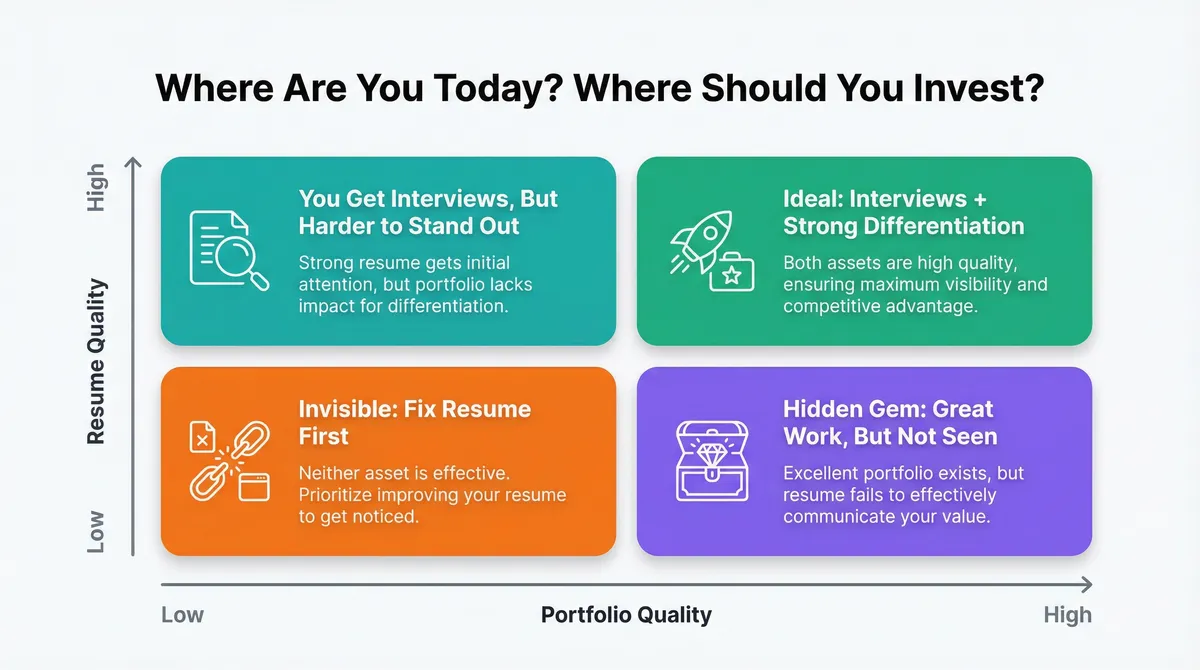
Use this as a guide:
- If your resume is weak, fix that first. You’re not even getting into the room.
- If your resume is strong but you’re plateauing, invest in 1–3 high-quality portfolio projects.
- If your portfolio is strong but you’re not getting interviews, your resume is likely under-selling you or misaligned with roles.
Best Practices and Actionable Checklist
Resume checklist (high priority)
- 1–2 pages, clean layout, consistent formatting
- Clear target role implied by your skills and experience
- Each role has 3–6 bullets with:
- Action verb + task + impact
- Specific technologies mentioned in context
- Quantified results where possible
- Projects section focused on 2–4 relevant projects
- Skills section grouped (Languages, Frameworks, Tools, Cloud)
- Links to GitHub, portfolio, LinkedIn
Portfolio checklist (medium to high priority)
- 3–6 pinned or featured projects, not 20+
- Each project has:
- Clear README with overview, stack, how to run
- Explanation of design and tradeoffs
- Tests for non-trivial logic
- At least 1–2 deployed demos (if feasible)
- No obviously broken links or dead demos
- No sensitive or proprietary code
How This Connects to Interview Performance
Your resume and portfolio get you into the interview loop. To convert that into offers, you still need to:
- Recognize common problem patterns
- Communicate your thinking clearly
- Handle behavioral and system design questions
Pattern-based practice and mock interviews help you align your actual skills with what your resume and portfolio promise. If you want structured practice on the algorithmic side, Thita’s DSA patterns sheet can be a useful complement to the work you put into your application materials.
Key Takeaways: Resume vs Portfolio for Software Engineers
- Resume is the gatekeeper. It matters more for getting interviews. If you’re not getting callbacks, fix your resume first.
- Portfolio is the amplifier. It matters more for standing out and proving depth, especially for non-traditional backgrounds or specialized roles.
- They should tell one coherent story. Resume is the map; portfolio is the zoomed-in terrain.
- Depth beats volume. A few strong, well-documented projects are far better than many shallow ones.
- Think like your reviewers. Recruiters want clarity and relevance; engineers want signal and craftsmanship.
Treat your resume and portfolio as two parts of the same system: an interface and its implementation. Both need to be solid if you want your work—and your potential—to be easy to understand, trust, and hire. For those preparing for interviews, integrating your portfolio and resume efforts with effective interview preparation strategies like the 7-Day, 30-Day, and 90-Day Coding Interview Preparation Plans Compared can maximize your chances of success.