
System Design
AI That Reads Your Whiteboard vs AI That Scores Your Architecture
Can an AI see your system diagram, or does it assess the design? Learn what architecture evaluation requires and how to fairly test AI interview tools.

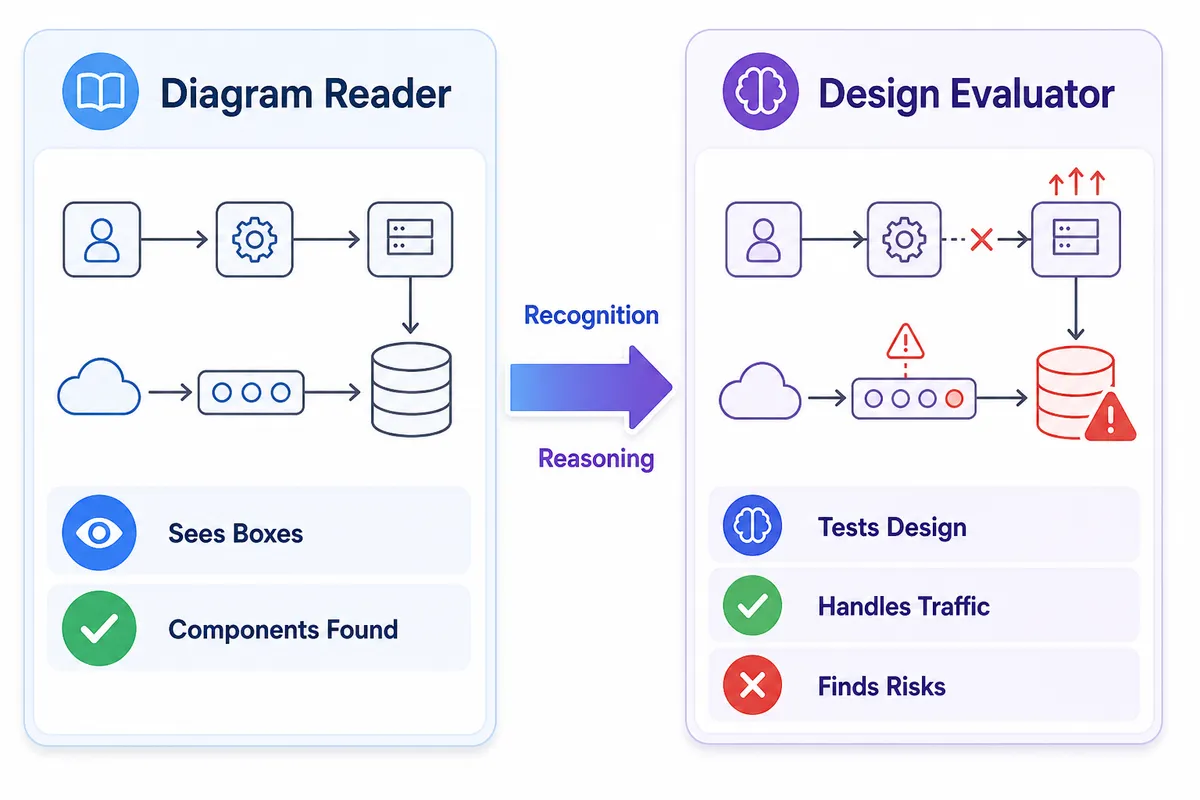
A system design canvas can look impressive. You draw clients, load balancers, services, queues, caches, databases, arrows and replicas. The AI can see the boxes. It can describe the components back to you. It may even say your design is “well structured”.
But that does not necessarily mean your AI system design interview is evaluated.
There is a meaningful difference between an AI that can read your whiteboard and one that can judge whether your architecture would survive real traffic, partial failure and the follow-up questions an interviewer is likely to ask. If you are using a live AI system design interview to prepare, that difference matters more than a polished canvas or a friendly summary.
A reader can recognise a diagram. An evaluator must reason about it.
Why “the AI can see your diagram” is not enough
Image recognition, diagram parsing and architecture evaluation are related capabilities, but they are not the same capability.
A tool that reads your whiteboard might identify that you have included a CDN, a message queue and a primary database. That is useful at the most basic level: it can make the conversation aware of what you drew rather than asking you to restate every component.
However, identifying a queue is not the same as asking the questions that matter:
- Why does this workflow need asynchronous processing?
- What happens when consumers fall behind producers?
- How will users know whether an upload, payment or notification has completed?
- Where does ordering matter, and what do you lose by scaling consumers horizontally?
- What happens if the cache is cold during a traffic spike?
- Why is this database the source of truth?
- Which failure are you accepting in exchange for lower latency?
A diagram can contain all the familiar boxes and still be a weak answer. Candidates often learn the visual vocabulary of system design before they learn the reasoning behind it. They add Redis because “systems use caches”, Kafka because “high scale needs queues”, and sharding because “large databases need shards”.
A real interviewer does not award marks for decorative infrastructure. They listen for whether you can connect each choice to a requirement, quantify the pressure on the system, and explain the cost of the choice.
That is the standard an AI evaluator should meet too.
⚠️ Important: A visually complete architecture is not automatically a coherent architecture. If feedback mostly praises the number of components you drew, it may be rewarding diagram complexity rather than design quality.
How is a system design interview scored?
There is no universal interview scorecard, but most strong interviewers assess a similar set of abilities. They are not looking for one canonical diagram. They are looking for the quality of your decisions under incomplete information.
A useful system design evaluation should examine at least six areas.
1. Requirement clarification
Before drawing anything, strong candidates establish what they are building.
Is this a feed that needs low-latency reads? A chat product that needs delivery guarantees? A ticketing platform where overselling is unacceptable? A logging system where high throughput matters more than immediate consistency?
An evaluator should notice whether you ask clarifying questions and whether those answers change your design. If the AI gives the same feedback whether you are designing a URL shortener or a payment ledger, it is not following the problem closely enough.
2. Capacity reasoning
You do not need production-perfect arithmetic. You do need enough estimation to make your architecture credible.
A system design interviewer may expect you to translate daily active users, requests per second, payload size and retention periods into decisions about caching, partitioning, storage and throughput. For example, saying “we will use a queue for scale” is incomplete. Explaining that writes may peak at a certain rate, that consumers can be independently scaled, and that the queue absorbs burst traffic is much stronger.
A system design AI evaluation should identify hand-wavy scale claims. It should ask for numbers when your design depends on numbers.
3. Trade-off recognition
Every serious design choice gives you something and takes something away.
Caching improves read latency but introduces invalidation and staleness. Replication improves availability and read throughput but complicates consistency. Synchronous writes can simplify correctness but increase tail latency. Eventual consistency may be acceptable for likes but not for account balances.
Good feedback does not simply say, “Use a cache.” It asks whether a cache is needed, what data belongs there, how it is invalidated and what users experience when it is stale.
This is where a genuine evaluator separates a memorised answer from an engineering answer.
4. Failure modes and recovery
Many candidates can draw the happy path. Fewer can explain what happens when a service times out, a region becomes unavailable, a consumer processes the same message twice or a database replica falls behind.
A good architecture is not one that never fails. It is one that fails in known, bounded ways and has a recovery story.
An AI that evaluates your design should challenge assumptions such as “the queue guarantees everything” or “we can retry requests”. Retries can create duplicate writes. Queues can back up. A cache can become a bottleneck. A single primary database can become both a performance and availability risk.
5. Communication and prioritisation
System design interviews are timed. You cannot explain every possible subsystem.
Interviewers assess whether you can start with a clear high-level design, identify the critical path, and go deeper where the requirements justify it. A candidate who spends ten minutes naming cloud services before defining the main data flow is usually not showing good judgement.
The feedback should therefore evaluate structure as well as content: did you establish requirements, present a simple first version, then deepen the discussion around the likely bottleneck?
6. Adaptive follow-ups
The strongest signal comes after your first answer.
“What if traffic grows tenfold?” “What if users delete content?” “What if the same request arrives twice?” “What if we need global availability?” “What would you change if consistency mattered more than latency?”
A useful mock interviewer adapts to your submitted architecture. If you chose a cache, the follow-up should explore invalidation or cache stampedes. If you chose asynchronous processing, it should explore idempotency, ordering or dead-letter handling.
That is much closer to how a real system design interview is scored.
What real AI architecture evaluation looks like
The question is not whether an AI can identify your components. Modern models can often do that reasonably well. The question is whether the feedback is grounded in your actual architecture and its consequences.
A real evaluator should be able to do four things.
First, it should trace your design. It should understand the route a request takes through the components you submitted, rather than responding with a generic textbook answer for the same prompt.
Second, it should find gaps. If you have a write-heavy system but no partitioning strategy, that should be raised. If you put a cache in front of data that must be strongly consistent, it should ask why. If an image-processing pipeline has no asynchronous path, it should probe the resulting latency and reliability implications.
Third, it should challenge trade-offs. Feedback is most useful when it explains not only what is missing, but why the omission matters and what alternative you could defend.
Finally, it should change direction when you change the design. If you replace a single database with regionally partitioned storage, the conversation should move from basic scalability to cross-region routing, replication lag, conflict handling and operational complexity.
That is the difference between a diagram-aware chat interface and an evaluator.
💡 Pro Tip: Ask yourself whether the feedback could have been generated without seeing your whiteboard. If the answer is yes, it is probably generic advice rather than architecture-specific evaluation.
A five-minute test for any system design tool
You do not need to rely on feature lists or marketing language. You can test what you are getting.
Test one: draw an intentionally weak design
Choose a familiar prompt such as “design a photo-sharing service”. Draw one application server and one database. Skip caching, replication, object storage and asynchronous processing.
Then ask the AI to evaluate it.
Useful feedback should identify specific risks: the database storing media objects, a single point of failure, no strategy for read-heavy traffic, and synchronous image processing on the request path. Vague comments such as “consider scalability and reliability” are not enough.
Test two: add a component without a reason
Add a queue between two services but do not explain why it is there.
A genuine system design AI evaluation should ask what workload is asynchronous, whether ordering matters, how failures are retried and how users receive completion status. A tool that merely compliments your queue has recognised an icon, not assessed an architecture.
Test three: make a trade-off explicit
Say, “I am using eventual consistency for profile updates because low-latency reads are more important than immediate global visibility.”
The feedback should engage with that decision. It might ask which updates are safe to make eventually consistent, how long staleness can last, or whether deletion requests need different handling. If it gives the same response regardless of your stated trade-off, it is not reasoning with your answer.
Test four: change the scale
Take the same design from thousands of requests per day to hundreds of thousands per second. Ask what breaks first.
A strong evaluator should refer to your existing components and identify likely pressure points. It should not simply reply with a generic list containing CDN, cache, queue and sharding.
Test five: ask for your weakest decision
Ask, “Which part of my design would you challenge most in an interview?”
This is a revealing question. Useful feedback names a decision you made and explains the interviewer’s likely concern. Generic feedback gives you a checklist that could apply to any candidate.
Is AI system design feedback useful?
Yes, provided it is specific enough to change your next attempt.
AI feedback is particularly useful for repetition. Human mock interviews are valuable, but they take time to arrange and may not happen often enough for you to practise explaining the same core concepts repeatedly. An AI session lets you rehearse requirement gathering, high-level architecture, bottleneck analysis and follow-ups whenever you have time.
The limitation is equally important: generic AI feedback can create false confidence. If a tool praises every answer, it can reinforce the exact habits a real interviewer will challenge.
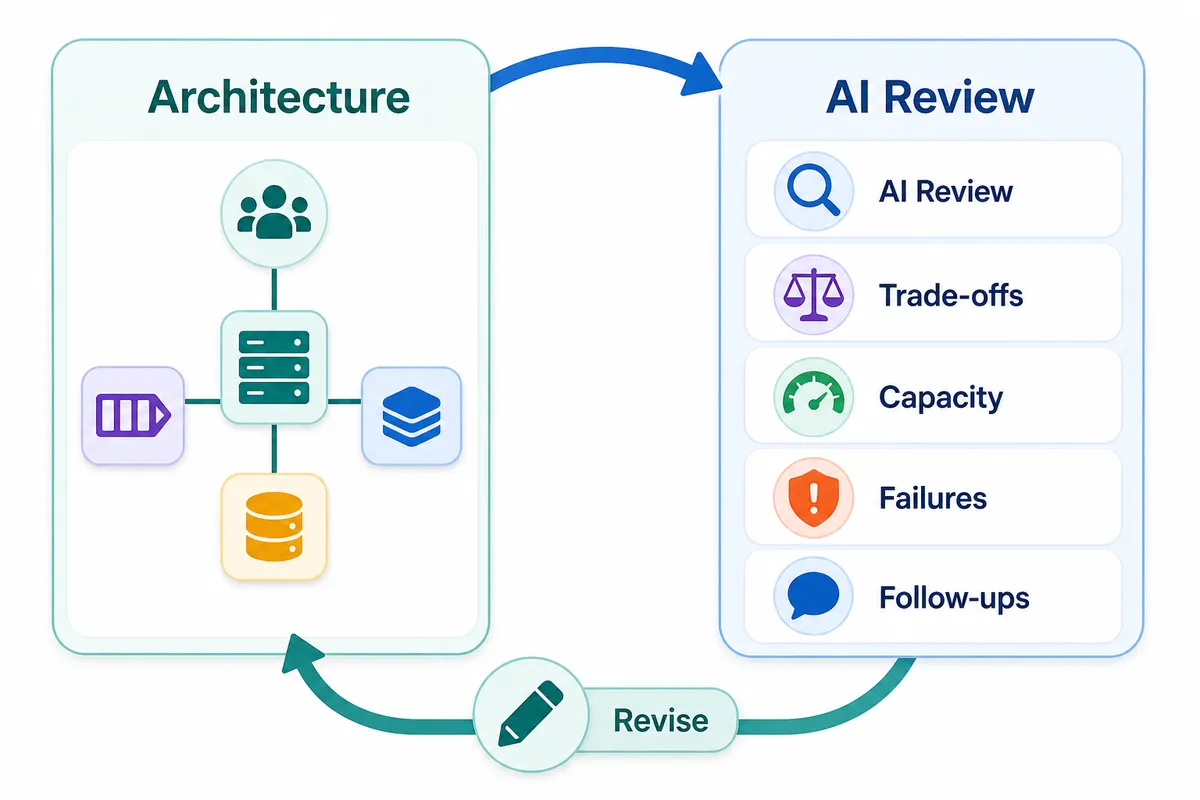
For that reason, use AI feedback as a training loop rather than a verdict. Do a design, review the weak points, redraw the critical flow, then repeat the prompt with different constraints. Pair that with occasional human feedback where possible.
The market is not all the same
Hello Interview is a credible option worth naming directly: it has a genuinely strong AI-evaluated system design canvas. If system design is your sole priority, it is a real option and helps establish the standard candidates should expect from this category.
The useful comparison is not “does this platform have a whiteboard?” It is whether the tool evaluates the architecture you drew, recognises trade-offs, tests capacity assumptions and failure modes, asks follow-ups based on your choices, and lets you repeat sessions without scheduling another person.
At Thita, system design takes place on a canvas and the AI evaluates the architecture you submit. The session is live and voice-led, so you also practise explaining your choices, recovering from challenges and prioritising what to discuss. You can practise a system design interview with adaptive follow-ups whenever you are ready.
The platform covers the technical interview formats that matter here — system design, DSA, low-level design and machine coding. For coding rounds, you can practise in six languages: Python, C++, Java, JavaScript, Go and C#.
How to use evaluation feedback without memorising architectures
The goal is not to collect perfect diagrams. It is to build reliable reasoning habits.
✅ Do begin every practice session by clarifying users, core actions, expected scale, latency needs and correctness requirements.
✅ Do explain why each major component exists. If you cannot give a one-sentence reason for a queue, cache or database choice, do not add it yet.
✅ Do revisit your design after feedback. Redraw the data flow and explain the revised trade-off aloud.
❌ Don't copy a “standard architecture” without understanding the workload it solves. A feed, payment system and messaging product can all use familiar components for very different reasons.
❌ Don't treat scale as a magic word. Estimate enough to justify the decision you are making.
❌ Don't ignore failure modes until the end. Mention the critical ones as you introduce the components they affect.
Frequently asked questions
What does it mean when an AI system design interview is evaluated? It means the AI assesses the architecture you actually submitted: your request flow, capacity assumptions, trade-offs, bottlenecks, failure modes and follow-up answers. It is more than recognising boxes and arrows on a canvas.
Is AI system design feedback useful for interview preparation? Yes, when it is specific, architecture-aware and actionable. It is especially useful for repeating practice sessions and improving weak reasoning patterns between human mocks.
How is a system design interview scored? Interviewers commonly assess requirement clarification, scalability reasoning, trade-off awareness, reliability, communication, prioritisation and how you handle follow-up questions. There is rarely one perfect diagram.
Can an AI tell whether my architecture is scalable? It can provide useful feedback if it considers your stated scale, traffic patterns, storage needs and component choices. Be cautious of feedback that says only “add a cache” or “use microservices” without explaining why.
How can I test whether a system design tool evaluates my diagram? Submit a deliberately weak design, add an unexplained queue, change the expected traffic and ask which specific decision an interviewer would challenge. The feedback should change with your architecture.
Should I use a whiteboard or a text answer for system design practice? Use the format closest to your target interview. A canvas helps you practise communicating flows, boundaries and dependencies, while voice explanation prepares you for follow-up questions.
Does Thita evaluate submitted system design architectures? Yes. Thita system design interviews use a canvas, and the AI evaluates the architecture you submit while running a live voice session with adaptive follow-ups.
Practise architecture reasoning, not just diagram drawing
A good whiteboard helps you communicate. A good evaluator helps you discover whether the architecture behind it holds up.
Before trusting any tool, run the five-minute test: draw something weak, make a questionable trade-off and see whether the feedback identifies the consequences. If it can, you have a useful practice loop. If it only describes the components you drew, you have a diagram reader.
Start a live AI system design interview on Thita and practise explaining, defending and improving the architecture you submit.
If you are hiring rather than interviewing, visit https://interviews.thita.ai/.
Topics
Related on Thita
Your next step
Practise system design the way it is interviewed
12 system design families, 26 worked case studies, and AI mock interviews that question your design.