System Design
Most Common System Design Mistakes in Interviews (And How to Avoid Them)
Most candidates walk out of a system design interview thinking, “I could have done better, but I’m not sure *where* I went wrong.” The most common system des...
Most candidates walk out of a system design interview thinking, “I could have done better, but I’m not sure where I went wrong.” The most common system design mistakes aren’t about not knowing every distributed systems buzzword—they’re about how you structure your thinking under pressure.
This guide walks through the most frequent system design mistakes in interviews (and how to avoid them), with concrete examples, patterns of failure, and practical strategies you can practice before your next architecture interview.
We’ll focus on system design mistakes that show up in scalability interviews and architecture discussions, and how to replace them with systematic, senior-level reasoning.
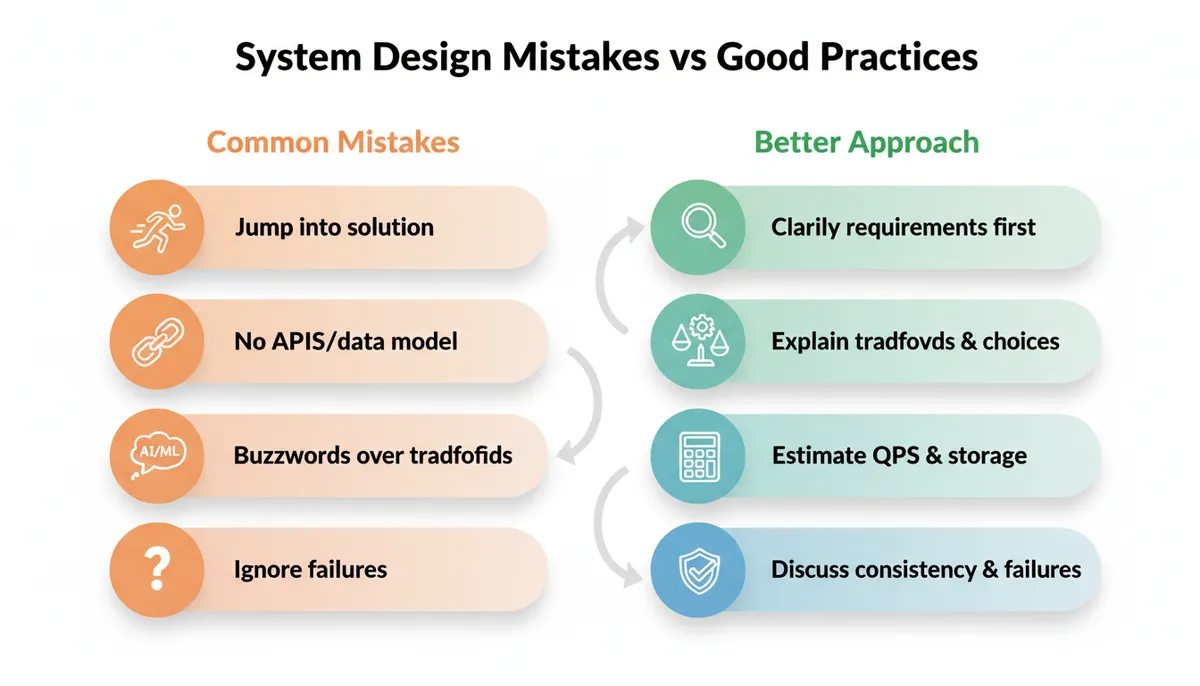
1. Jumping Into Solutions Without Clarifying Requirements
Why this is one of the biggest system design mistakes
Interviewers often start with a broad prompt:
“Design Twitter.”
“Design a URL shortener.”
“Design a real-time chat system.”
Many candidates immediately start drawing boxes: “We’ll have a load balancer, some app servers, a database, Redis, Kafka…”
This is a red flag. You’re designing an architecture without knowing:
- Who the users are
- What the traffic patterns look like
- What the critical features and constraints are
- What “success” means for this system
You end up optimizing for the wrong things: over-engineering for scale when the real challenge is consistency, or focusing on read performance when writes are the bottleneck.
What good looks like: requirements-first thinking
Before drawing any components, spend 3–5 minutes clarifying:
- Functional requirements
- Core features: “For Twitter, do we need tweets, likes, retweets, follows, timelines?”
- Real-time vs eventual processing: “Timeline freshness requirements?”
- Non-functional requirements
- Scale: “Approximate DAU/MAU? QPS for reads/writes?”
- Latency: “P95 latency expectations for key operations?”
- Availability: “Is this a 99.9% or 99.99% system?”
- Consistency: “Is it OK if timelines are slightly stale?”
- Constraints and priorities
- “If we have to trade off between consistency and availability, what do we prefer?”
- “Is this a global product or single-region for now?”
You’re not fishing for exact numbers; you’re demonstrating that your architecture is driven by explicit constraints.
How to avoid this mistake
- Memorize a short script:
“Before I design anything, I’d like to clarify functional and non-functional requirements, and rough scale. Is that okay?” - Practice turning vague prompts into crisp requirements in mock interviews (e.g. with an AI interview partner).
2. Ignoring the API and Data Model
The architecture interview error: designing boxes without contracts
Another frequent mistake: drawing services and databases without ever defining:
- What APIs clients call
- What data is stored
- How entities relate to each other
Without APIs and data models, it’s hard to reason about:
- Consistency guarantees
- Indexing and query patterns
- What belongs in which service
Make API definitions your first design artifact
Spend a couple of minutes defining the core APIs before you go to boxes and arrows. For a URL shortener:
HTTP
Then sketch the core data model:
TEXT
Once you have this, you can reason about:
- How many writes per second to
url_mapping - Read patterns on
short_code - Whether you need secondary indexes or search
How to avoid this mistake
- For every design question, ask yourself: “What is the minimal set of APIs and entities this system needs?”
- Even in tight time constraints, outline at least 1–2 core endpoints and 1–2 core tables or documents.
3. Over-Indexing on Buzzwords Instead of Tradeoffs
Symptom: “Let’s just use Kafka, Redis, Cassandra, and microservices”
Many candidates treat the system design interview as a buzzword recital:
- “We’ll use Kafka for everything.”
- “We’ll shard the database.”
- “We’ll use microservices and event sourcing.”
Interviewers are looking for something else: your ability to identify tradeoffs and choose tools that match constraints.
Example: premature microservices
For a simple URL shortener with moderate scale:
- A monolith with:
- API layer
- Business logic
- DB access
- Behind a load balancer
…is often perfectly fine. Going full microservices:
- Increases complexity:
- Service discovery
- Network hops
- Distributed transactions
- Provides little benefit if the domain is small and the team is small.
Focus on why, not what
Instead of:
“We’ll use Cassandra because it’s scalable.”
Say:
“We need high write throughput and can tolerate eventual consistency for analytics events. A wide-column store like Cassandra or a managed time-series DB would fit because it scales horizontally and optimizes for write-heavy workloads. However, for user data requiring strong consistency, I’d prefer a relational store like Postgres with read replicas.”
You’re showing:
- You understand tool characteristics
- You can align them to requirements
- You can articulate tradeoffs
How to avoid this mistake
- For every technology choice, say:
- “I’m choosing X because…”
- “The tradeoffs are…”
- “Alternatives could be Y or Z, but I’m not picking them because…”
- Practice designing a simple system twice: once as a monolith, once as microservices—compare the tradeoffs out loud.
4. No Capacity Estimates or Back-of-the-Envelope Math
Why capacity planning matters in scalability interviews
A core signal in system design interviews: can you reason quantitatively about scale?
Common mistake: candidates never estimate:
- QPS (queries per second)
- Storage requirements
- Network bandwidth
- Cache hit rates
Without numbers, you can’t justify:
- When to shard
- When to introduce a cache
- How to choose data partitioning
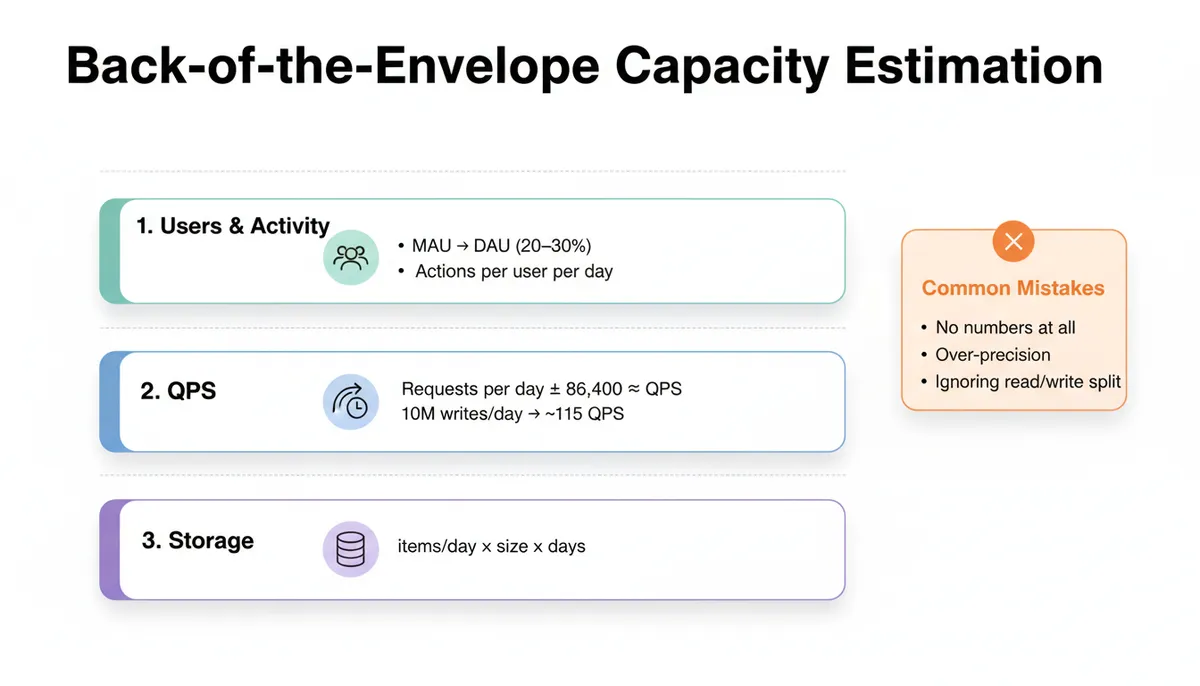
Simple estimation framework
You don’t need perfect accuracy. You need order-of-magnitude reasoning.
Example: designing a photo-sharing app.
- User scale
- 50M MAU (monthly active users)
- Assume 20% DAU → 10M DAU
- Traffic per user
- Each DAU uploads 2 photos/day → 20M uploads/day
- Each photo view triggers 5 image loads (thumbnails, etc.)
Assume 100 views per photo → 10B image views/day
- QPS
- Uploads: 20M / 86,400 ≈ 230 writes/sec
- Image views: 10B / 86,400 ≈ 115k reads/sec
- Storage
- Avg photo size 1 MB
- Daily storage: 20M * 1 MB = 20 TB/day (raw)
- Yearly (no deletion): ~7.3 PB (before compression, replication)
Now you can justify:
- Object storage (S3, GCS) for photos
- CDN in front of storage for 100k+ reads/sec
- Metadata in a DB with appropriate indexing
How to avoid this mistake
- Practice Fermi estimates: “How many X per day?” “What’s the QPS?”
- Aim for 1–2 quick calculations per design to anchor your decisions.
- Use round numbers and simple math; narrate your reasoning.
5. Vague High-Level Diagrams With No Deep Dives
The “box and arrow” anti-pattern
Another common architecture interview error: candidates draw a generic diagram—
- Client → Load Balancer → App Servers → Database → Cache
—and then keep it at that level for 30 minutes.
Interviewers want to see:
- Can you take one part (e.g., feed generation, search, messaging) and design it in depth?
- Can you identify bottlenecks and failure modes inside that component?
How to structure your depth
After your high-level view, explicitly ask:
“Which part would you like me to dive deeper into? For example, we could go deeper into feed generation, data modeling, or caching strategy.”
Then, for the chosen component:
- Define the problem precisely
- “We need to generate a user’s home timeline with <200 ms latency, supporting 1M QPS reads.”
- Describe the core flow
- Write path: how data is ingested and stored
- Read path: how data is retrieved and composed
- Discuss scaling strategies
- Sharding, partitioning keys
- Caching layers
- Asynchronous processing
- Handle failures and edge cases
- Partial failures
- Retries, idempotency
- Backpressure and rate limiting
How to avoid this mistake
- Always follow high-level with: “Now I’ll zoom in on X, since it’s the most critical/interesting part.”
- Practice 2–3 common deep dives: timeline service, search service, notification system, chat messaging.
6. Ignoring Data Modeling and Indexing
Why this is a top system design mistake
Many candidates treat the database as a black box: “We’ll store it in a DB.”
Interviewers want to see:
- How you choose between relational vs NoSQL
- How you design schemas / documents / key structures
- How you index for the access patterns
Example: designing a messaging system
Core entities:
- Users
- Conversations (1:1 or group)
- Messages
One possible relational model:
TEXT
From here, you can reason:
- Fetch latest messages for a conversation:
- Query
messagesbyconversation_idordered bycreated_at DESCwith index support
- Query
- Fetch all conversations for a user:
- Query
conversation_participantsbyuser_id
- Query
Common mistakes in data modeling
- Designing schemas without thinking about query patterns
- No secondary indexes, leading to full table scans
- Over-normalizing or over-denormalizing without justification
- Choosing NoSQL “for scale” when relational is simpler and sufficient
How to avoid this mistake
- For each entity, ask: “How will it be read? How will it be written?”
- Design indexes explicitly for those access patterns.
- If you choose NoSQL, explain how keys and partitioning work.
7. Not Addressing Caching Strategy Properly
The caching anti-patterns
Common caching-related system design mistakes:
- “We’ll add a cache” with no details:
- What data goes into the cache?
- What’s the key?
- What’s the eviction policy and TTL?
- Ignoring cache invalidation:
- How do you keep cache consistent with DB?
- Assuming 100% cache hit rate
A structured way to talk about caching
- What to cache
- Hot read-heavy data:
- User profiles
- Timelines
- Product details
- Hot read-heavy data:
- Cache granularity
- Entire objects (e.g., full user profile)
- Partial objects (e.g., user stats)
- Aggregated views (e.g., rendered timeline)
- Read/Write flow
- Read-through:
- On miss, load from DB, populate cache
- Write-through vs write-behind:
- Tradeoffs in consistency vs write latency
- Read-through:
- Invalidation
- Time-based (TTL)
- Event-based (on write, delete keys)
- Combination
Example: caching user profiles
- Cache key:
user:{user_id}:profile - Value: JSON blob with name, avatar, bio, follower count
- TTL: 5–15 minutes
- Flow:
- Read:
- Check Redis by key
- On miss, query DB, populate Redis
- Write:
- Update DB
- Delete Redis key or update it
- Read:
Discuss:
- Expected cache hit rate (e.g., 80–95% for hot data)
- Impact on DB QPS
- What happens on cache failure
How to avoid this mistake
- Always specify:
- Cache keys
- TTL/eviction
- Invalidation strategy
- Mention consistency implications: “We may show slightly stale follower counts, which is acceptable.”
8. No Discussion of Consistency, Availability, and Failure Modes
The “happy path only” mistake
Many candidates design as if everything always works:
- No network partitions
- No node failures
- No partial writes
In real systems, and in architecture interviews, failure handling is critical.
Use CAP and consistency models pragmatically
You don’t need to recite CAP theorem, but you should:
- Recognize when strong consistency is required:
- Bank account balances
- Inventory counts
- Recognize when eventual consistency is acceptable:
- News feed ordering
- Like counts
Example: designing a social feed
- Requirement: “It’s okay if likes and comments counts are slightly stale.”
- Design:
- Store canonical data in DB
- Maintain aggregated counters in a cache or separate store
- Update counters asynchronously via a queue
- Tradeoff:
- High availability and performance
- Slightly stale counts
Talk about failure modes explicitly
For a write path:
- What if the DB is down?
- What if the cache is down?
- What if the message queue is overloaded?
Example discussion:
“If the cache is down, we’ll see increased load on the DB. To protect the DB, we can add rate limiting and degrade gracefully—e.g., show less personalized content or a cached static page. We should also have alerts for cache failures and automatic failover or restart.”
How to avoid this mistake
- After describing a design, always add:
- “Now let me talk about consistency and failure scenarios.”
- Pick one or two critical flows and walk through:
- What fails?
- How do we detect it?
- How do we recover?
9. Not Addressing Security, Privacy, and Multi-Tenancy
The blind spot: non-functional but critical
Many candidates ignore:
- Authentication and authorization
- Data privacy (PII, GDPR)
- Multi-tenant isolation
- Rate limiting and abuse prevention
You don’t need a full security design, but you should show awareness.
Examples of what to mention
- AuthN/AuthZ
- “We’ll use OAuth 2.0 / JWT tokens for authentication.”
- “Service-to-service calls will be authenticated via mTLS or signed tokens.”
- Rate limiting
- “We’ll add per-IP and per-user rate limits at the API gateway to protect against abuse.”
- Data privacy
- “PII like emails will be encrypted at rest and in transit.”
- “Access to PII will be audited and restricted.”
How to avoid this mistake
- Add a short “Security & Privacy” note near the end of your design:
- 1–2 sentences on auth
- 1–2 sentences on rate limiting
- 1 sentence on encryption / PII
Even brief coverage shows you think like a production engineer.
10. Poor Communication and Lack of Structure
The meta-mistake: how you think, not what you know
Many system design interview tips focus on technology; fewer talk about communication. But interviews are about:
- How you structure an ambiguous problem
- How you communicate under time pressure
Common communication mistakes:
- Talking non-stop without drawing
- Drawing but not explaining
- Jumping randomly between topics
- Not checking in with the interviewer
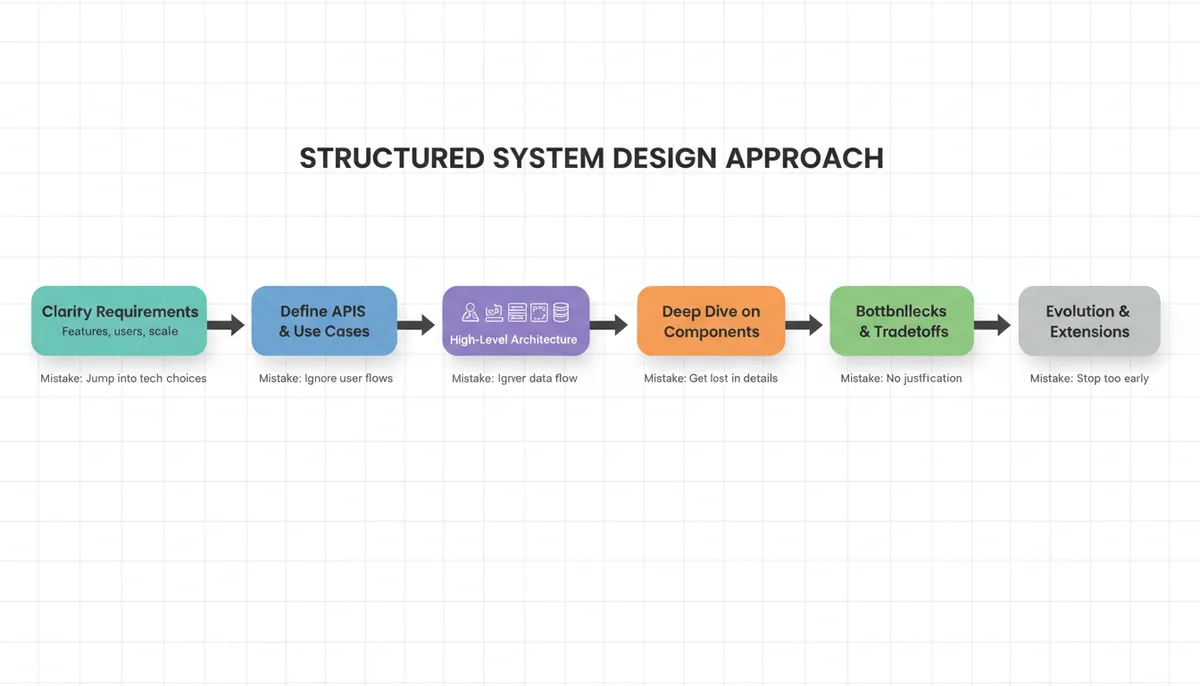
A simple structure to follow
- Clarify requirements
- Define APIs and data model
- Propose high-level architecture
- Estimate capacity (QPS, storage)
- Deep dive into 1–2 components
- Discuss:
- Caching
- Consistency
- Failure modes
- Security / privacy
- Summarize tradeoffs and possible extensions
At each step, narrate what you’re doing:
“I’ll start by clarifying requirements.”
“Now I’ll define the core APIs.”
“Next, I’ll draw a high-level architecture and then we can pick a component to deep dive.”
How to avoid this mistake
- Practice with a timer and a whiteboard (physical or virtual).
- After each mock interview, write down:
- What structure you followed
- Where you got stuck or rambled
Structured repetition matters as much here as in DSA pattern practice (similar to how you might practice through a pattern-based sheet for algorithms).
11. Ignoring Evolution and Future Extensions
The “one-shot design” problem
Many candidates design a system for today’s scale and stop there. Interviewers also care about:
- How the system evolves as load increases 10x–100x
- How you add new features without massive rewrites
Example: evolution path for a URL shortener
- Phase 1: MVP
- Single-region deployment
- Monolith app, relational DB
- Phase 2: Scale reads
- Add read replicas
- Add cache in front of DB
- Introduce CDN for redirect landing page
- Phase 3: Scale writes and reliability
- Shard DB by short code prefix or hash
- Move analytics events to a separate pipeline (queue + analytics store)
- Phase 4: Global
- Multi-region read replicas or multi-master
- Geo-DNS for latency-based routing
Discussing evolution shows:
- You understand scaling is incremental
- You can design for change, not perfection
How to avoid this mistake
- Reserve 3–5 minutes at the end to answer:
- “How would this system change if we had 10x users?”
- “How would you support multi-region traffic?”
12. Putting It All Together: A Checklist to Avoid Common System Design Mistakes
Use this as a quick mental checklist in your next architecture interview.
Before you draw anything
- Clarify functional requirements
- Clarify non-functional requirements (scale, latency, availability, consistency)
- Ask about constraints and priorities
High-level design
- Define core APIs
- Sketch core data model and indexes
- Draw a high-level architecture (clients, LB, services, DBs, caches, queues)
Reasoning and scalability
- Estimate QPS and storage with back-of-the-envelope math
- Identify read/write patterns
- Propose caching strategy (keys, TTL, invalidation)
- Discuss partitioning/sharding if needed
Depth and robustness
- Deep dive into 1–2 critical components
- Discuss consistency model and tradeoffs
- Walk through failure modes and recovery
- Mention security, auth, and rate limiting briefly
Closing
- Summarize tradeoffs and design choices
- Describe how the system could evolve with 10x traffic or new features
Key Takeaways
- The most common system design mistakes are process mistakes, not missing a specific technology.
- Start with requirements, APIs, and data models before choosing tools.
- Use simple quantitative estimates to drive scalability decisions.
- Go deep on one or two components rather than staying at a vague high level.
- Explicitly discuss caching, consistency, failures, and security—these are signals of real-world experience.
- Practice a repeatable structure so your thinking is clear under interview pressure.
System design interviews reward candidates who can think like engineers building real systems, not just recite buzzwords. With deliberate practice on these patterns—and by avoiding the pitfalls in this guide—you can turn a stressful, ambiguous conversation into a structured technical discussion that feels like working with a strong teammate.