
Data Science
Data Science Interview Preparation: Complete Roadmap
Most data science interview guides feel like laundry lists: “learn SQL, brush up stats, revise ML algorithms.” Helpful, but not enough. A real data science i...
Most data science interview guides feel like laundry lists: “learn SQL, brush up stats, revise ML algorithms.” Helpful, but not enough. A real data science interview is a sequence of different conversations—product sense, modeling, experimentation, analytics, and sometimes systems design—compressed into 60–90 minutes.
This roadmap breaks that down into a concrete, end-to-end plan. We’ll cover what actually happens in a data science interview, how to prepare for ML interviews and analytics interviews, and how to build a data science roadmap that’s realistic and measurable.
1. Understand the Data Science Interview Landscape
Before you prepare, you need to know what you’re preparing for. “Data scientist” can mean very different things across companies.
1.1 Common Data Science Role Types
Most roles cluster into three broad profiles:
-
Analytics / Product Data Scientist
- Focus: business metrics, experiments, dashboards, insights.
- Typical rounds:
- SQL / data manipulation
- Product sense / metrics
- A/B testing & statistics
- Case study (analytics problem)
-
Machine Learning Engineer / Applied Scientist
- Focus: building and deploying ML models.
- Typical rounds:
- ML fundamentals & modeling
- Coding (often Python, sometimes DSA-style)
- System design for ML (data pipelines, serving)
- Research / modeling deep dive
-
Generalist Data Scientist
- Mix of analytics and ML.
- Typical rounds:
- SQL + exploratory analysis
- ML / modeling
- Product and stakeholder communication
- Take-home project or notebook review
Your roadmap should match the role type. Read job descriptions carefully: count how often you see “SQL,” “experimentation,” “ML models,” “production,” “stakeholders,” etc.
2. High-Level Data Science Roadmap
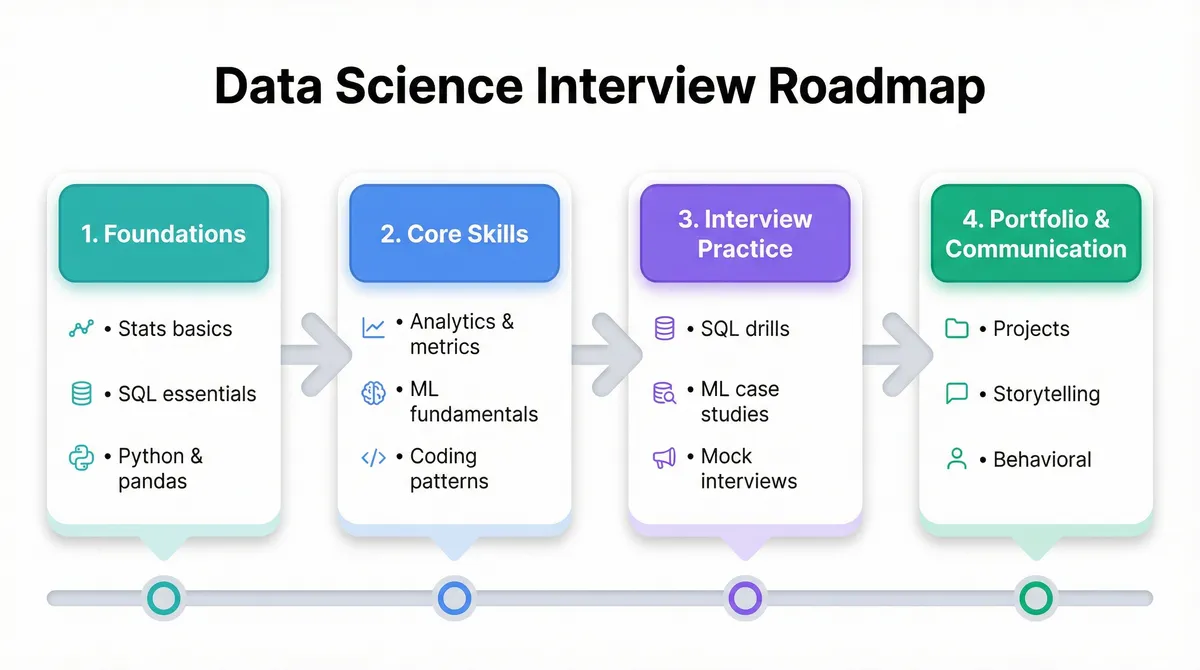
Here’s a structured roadmap you can adapt to your timeline (6–12 weeks is typical):
-
Foundations (1–2 weeks)
- Probability & statistics
- SQL basics and intermediate queries
- Python for data analysis (pandas, NumPy)
-
Core Skills (3–4 weeks)
- Analytics: metrics, funnels, cohorts, A/B testing
- ML: supervised/unsupervised learning, evaluation, feature engineering
- Coding: writing clean, efficient Python; basic algorithms
-
Interview-Specific Practice (2–4 weeks)
- SQL and analytics case questions
- ML interview questions and modeling case studies
- Mock interviews (live or AI-based) and feedback loops
-
Portfolio & Communication (ongoing)
- 2–3 solid projects with clear problem, approach, and impact
- Storytelling: STAR framework, explaining tradeoffs, handling ambiguity
3. Core Technical Foundations
3.1 Statistics and Probability for Data Science Interviews
You don’t need a PhD, but you do need fluency in the following:
Descriptive statistics
- Mean, median, variance, standard deviation
- Quantiles, percentiles, IQR
- When to prefer median over mean (e.g., skewed distributions)
Probability basics
- Random variables, expectation
- Conditional probability, Bayes’ theorem
- Independence vs correlation
Distributions
- Bernoulli, Binomial, Normal, Poisson, Exponential
- Use cases:
- Binomial: number of successes in N trials (e.g., email opens)
- Poisson: count of events per interval (e.g., requests per second)
Inference
- Confidence intervals
- Hypothesis testing (null/alternative, p-values, Type I/II errors)
- t-test, z-test, chi-square test
- Power and sample size
Interview-style question example
You run an A/B test and observe a p-value of 0.03. What does it mean, and would you ship variant B?
Good answer touches:
- Meaning of p-value (“assuming null is true, probability of seeing result this extreme or more”)
- Pre-defined alpha (e.g., 0.05)
- Practical significance vs statistical significance
- Risks of multiple testing and peeking
3.2 SQL for Analytics and ML Interviews
SQL is non-negotiable for analytics interviews and common for generalist roles.
Core patterns to master:
- Filtering, aggregation, grouping
- Joins (INNER, LEFT, FULL), self-joins
- Window functions (ROW_NUMBER, RANK, LAG/LEAD, SUM OVER)
- Subqueries and CTEs
- Date/time functions
Example SQL question
Given a
page_views(user_id, page, ts)table, compute the daily active users (DAU) over the last 7 days.
SQL
Follow-ups often test:
- Handling time zones
- De-duplication
- Performance (indexes, approximate distinct counts)
3.3 Python and Data Manipulation
You should be comfortable with:
- Python basics: loops, functions, list/dict comprehensions
- pandas:
groupby,merge,pivot_table,apply - NumPy arrays and basic vectorized operations
- Reading/writing data, basic plotting (matplotlib/seaborn)
Example pandas transformation
PYTHON
Time complexity matters less here than clarity and correctness. But in ML-heavy roles, you may also get algorithmic questions where complexity does matter. Pattern-based DSA prep (like using a structured DSA patterns sheet) can help you cover the most relevant coding patterns efficiently.
4. Analytics Interviews: Metrics, Experiments, and Product Sense
For analytics and product data science roles, this is where most of the signal comes from.
4.1 Metrics and Business Understanding
You’ll be asked to define, critique, and design metrics.
Common themes:
- North Star metrics vs guardrail metrics
- Leading vs lagging indicators
- Retention, engagement, conversion, churn, LTV
Example question
How would you define a success metric for a new “Saved Items” feature in an e-commerce app?
A strong answer might:
- Propose a primary metric (e.g., “% of users who save at least one item per week” or “incremental revenue attributed to saved items”)
- Add guardrails (e.g., “checkout completion rate”, “return rate”)
- Discuss segmentation (new vs existing users, mobile vs web)
- Consider long-term vs short-term tradeoffs
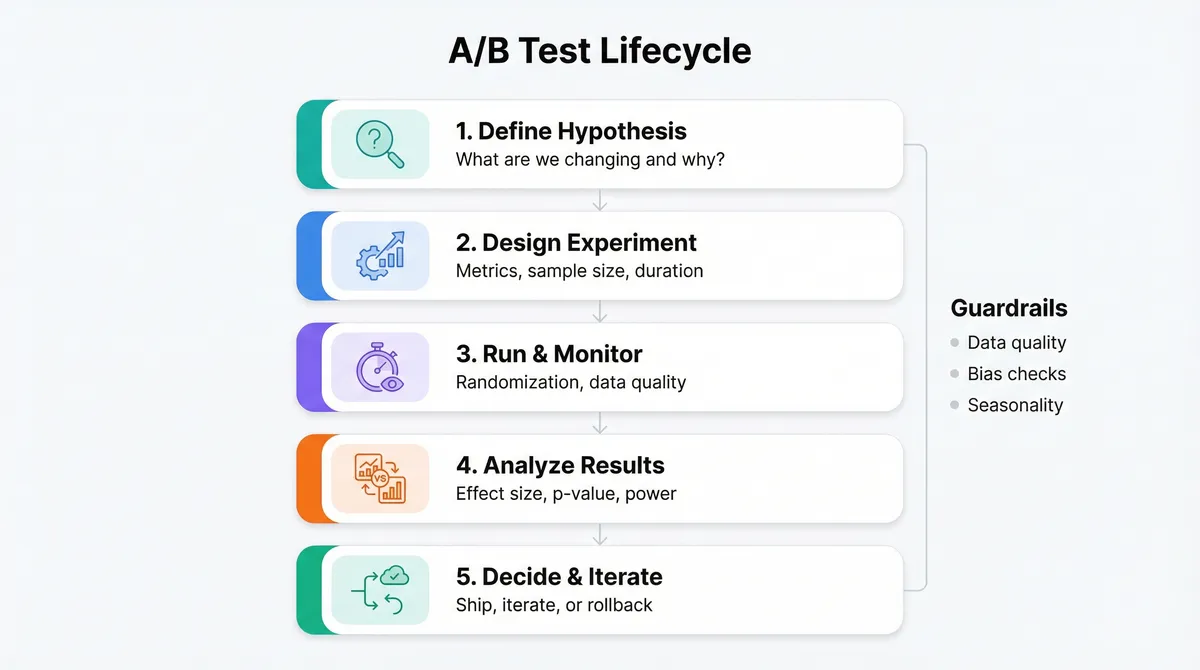
4.2 A/B Testing and Causal Inference
You should be able to:
- Explain randomization and why it matters
- Define null/alternative hypotheses
- Choose appropriate metrics and test statistics
- Interpret results and decide whether to roll out
Key topics
- A/B vs multivariate tests
- One-tailed vs two-tailed tests
- Sample size and power
- Common pitfalls: peeking, novelty effects, seasonality
Example experiment question
You launched an A/B test on a new checkout flow. Conversion increased by 1.2%, but p-value is 0.09. What do you do?
Thoughtful answer:
- Clarify if 1.2% is absolute or relative
- Compare to minimal detectable effect and business impact
- Discuss whether to extend test, run follow-up, or accept inconclusive result
- Consider prior beliefs and cost of wrong decision
4.3 Analytics Case Studies
These are open-ended questions like:
Sign-ups have dropped 10% week-over-week. How would you investigate?
Structure your answer:
- Clarify the problem (scope, segments, time window)
- Break down the funnel (visits → sign-ups → activation)
- Segment (device, geography, channel, new vs returning)
- Check for data issues (tracking, logging, deployment)
- Propose concrete analyses (SQL queries, dashboards)
- Suggest potential root causes and next steps
Interviewers are looking for:
- Systematic thinking
- Ability to prioritize
- Awareness of data limitations
- Communication clarity
5. ML Interviews: Modeling, Evaluation, and Systems
For ML-heavy roles, the emphasis shifts toward modeling and systems.
5.1 ML Fundamentals to Master
You should be comfortable explaining:
Supervised learning
- Regression vs classification
- Linear/logistic regression, decision trees, random forests, gradient boosting
- Regularization (L1/L2), bias-variance tradeoff
Unsupervised learning
- Clustering (k-means, hierarchical)
- Dimensionality reduction (PCA)
Model evaluation
- Regression: MSE, RMSE, MAE, R²
- Classification: accuracy, precision, recall, F1, ROC-AUC, PR-AUC
- Calibration, confusion matrix
- Cross-validation, train/validation/test splits
Feature engineering
- Handling missing values
- Encoding categorical variables
- Scaling/normalization
- Feature selection
Example conceptual question
Why might you prefer ROC-AUC over accuracy for a credit default model?
Expected points:
- Class imbalance issues
- ROC-AUC is threshold-independent
- Focus on ranking ability vs absolute classification
5.2 ML Case Study Example
You’re building a churn prediction model for a subscription app. How would you approach it?
Outline:
-
Problem definition
- Predict churn in next 30 days? Next billing cycle?
- What is “churn” exactly (cancellation, non-renewal, inactivity)?
-
Data and labeling
- Historical usage logs, billing events, support tickets
- Define positive/negative labels with clear time windows (observation vs prediction windows)
-
Feature engineering
- Usage frequency, recency, session duration
- Payment history, plan type, tenure
- Engagement with key features
-
Model choice
- Baseline: logistic regression or gradient boosted trees
- Justify tradeoffs (interpretability vs performance)
-
Evaluation
- Metrics: ROC-AUC, PR-AUC, calibration
- Business metrics: uplift in retention, incremental revenue
-
Deployment and monitoring
- Score frequency (daily/weekly)
- Integration with CRM/notification systems
- Monitor drift and performance degradation
5.3 Coding in ML Interviews
You may be asked to:
- Implement simple algorithms (e.g., gradient descent for linear regression)
- Manipulate data structures in Python
- Write clean, modular code around ML pipelines
Example: simple gradient descent
PYTHON
Be ready to reason about:
- Time complexity: O(n_samples × n_features × n_iters)
- Convergence behavior (learning rate, scaling features)
6. System Design for Data and ML
Senior or ML engineer roles often include a systems round.
Topics:
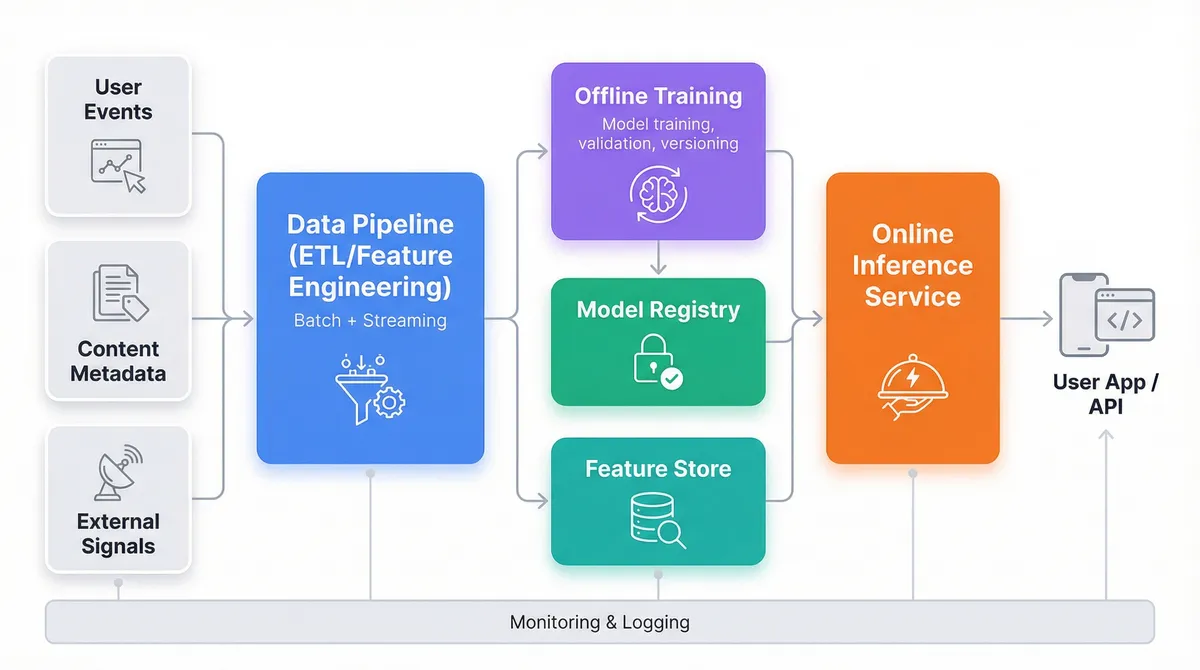
- Data pipelines: batch vs streaming
- Feature stores and offline/online consistency
- Model training, versioning, and deployment
- Real-time vs batch inference
- Monitoring: latency, throughput, model performance
Example question
Design a recommendation system for a news homepage. How would you architect the data and ML components?
You don’t need to draw boxes, but you should:
- Describe data sources (click logs, impressions, article metadata)
- Separate offline training (batch jobs) from online serving (low-latency API)
- Discuss feature computation (real-time signals vs historical aggregates)
- Address feedback loops and bias (popularity bias, cold start)
For a deeper understanding of how to approach these challenges, reviewing the complete AI & LLM roadmap can provide valuable insights into modern AI engineering concepts relevant to ML system design.
7. Behavioral and Communication Skills
Many candidates underestimate this part. Data science is collaborative; interviewers want to know you can explain complex ideas to non-experts and work with stakeholders.
7.1 Common Behavioral Questions
- Tell me about a time you worked with incomplete or messy data.
- Describe a project where the results contradicted stakeholder expectations.
- Tell me about a time your model did not perform as expected. What did you do?
Use the STAR framework:
- Situation: context
- Task: your responsibility
- Action: what you did, in detail
- Result: quantifiable impact if possible
Focus on:
- Tradeoffs you made
- How you handled ambiguity
- How you communicated risks and limitations
7.2 Explaining Technical Concepts
Practice explaining:
- P-values to a PM
- ROC-AUC to a designer
- Regularization to a new grad engineer
Aim for:
- Minimal jargon
- Analogies where appropriate
- Clear “so what?” for the business
Mock interviews—whether with peers or tools like an AI interview coach—are useful to stress-test your explanations and get structured feedback.
8. Putting It Together: Weekly Preparation Plan
Here’s a sample 8-week plan you can adapt.
Weeks 1–2: Foundations
- Stats: review probability, distributions, hypothesis testing (2–3 hours/week)
- SQL: practice basic to intermediate queries, especially joins and aggregations (3–4 hours/week)
- Python/pandas: small data analysis exercises (2–3 hours/week)
Weeks 3–4: Analytics & ML Core
- Analytics:
- Metrics design and product sense cases
- A/B testing scenarios and pitfalls
- ML:
- Revise core algorithms and evaluation metrics
- Implement simple models end-to-end on a public dataset
Weeks 5–6: Interview-Style Practice
- Daily:
- 1–2 SQL problems
- 1 analytics or ML conceptual question
- Weekly:
- 1 full case study (analytics or ML)
- 1–2 mock interviews (live or AI-based, e.g., AI interview practice)
Weeks 7–8: Refinement and Gaps
- Review weak areas (e.g., window functions, causal inference, ML systems)
- Polish 2–3 projects for your portfolio
- Prepare behavioral stories using STAR
- Run timed full-length mock interviews
9. Common Mistakes and How to Avoid Them
9.1 Over-indexing on Theory, Under-indexing on Practice
- Knowing formulas is not enough; you must apply them to real problems.
- Fix: work through full case studies from problem definition to recommendation.
9.2 Treating SQL as an Afterthought
- Many strong ML candidates fail analytics interviews due to weak SQL.
- Fix: daily practice with realistic schema and queries; focus on window functions and joins.
9.3 Ignoring Communication
- Rambling or overly technical answers lose interviewers.
- Fix: practice concise, structured responses; summarize first, then dive deeper.
9.4 Memorizing Answers Instead of Frameworks
- Companies and domains differ; memorized scripts break easily.
- Fix: learn reusable frameworks for:
- Metrics design
- Root cause analysis
- Experiment design
- ML project lifecycle
9.5 Neglecting Evaluation and Tradeoffs
- “I’d use XGBoost” without explaining why is a red flag.
- Fix: always discuss:
- Baselines
- Evaluation metrics
- Interpretability vs performance
- Latency and resource constraints
10. Best Practices and Actionable Tips
-
Always clarify the problem first
- Ask questions: goal, constraints, success criteria, data availability.
- This shows maturity and avoids misaligned answers.
-
Think out loud, but structure your thoughts
- Use signposting: “I’ll approach this in three steps…”
- Summarize periodically: “So far, we’ve established…”
-
Ground your answers in data and business impact
- Whenever possible, tie metrics and models back to revenue, retention, cost, or user experience.
-
Practice under realistic constraints
- Time-boxed SQL and case questions.
- Simulate the pressure of live interviews with mock sessions.
-
Build a small but deep portfolio
- Better to have 2–3 well-executed projects than 10 shallow ones.
- For each project, be ready to discuss:
- Problem and motivation
- Data and features
- Models and evaluation
- Failure modes and what you’d do next
Key Takeaways
- A successful data science interview spans foundations (stats, SQL, Python), analytics skills (metrics, experimentation, product sense), and ML skills (modeling, evaluation, systems), plus strong communication.
- Tailor your data science roadmap to the role type: analytics, ML, or generalist.
- For ML interviews, emphasize end-to-end thinking: problem definition → data → features → model → evaluation → deployment.
- For analytics interviews, emphasize structured thinking: clear metrics, careful experiment design, and root cause analysis.
- Practice is multiplicative: combine targeted study with realistic mock interviews and feedback loops.
If you treat interview prep as building a reusable skill set—rather than cramming disconnected facts—you’ll not only perform better in interviews but also be more effective once you’re on the job.