
Data Science
Machine Learning vs Data Science Interviews: What's the Difference?
Most candidates only realize there’s a difference between *machine learning* and *data science* interviews when they’re already in the loop—and by then, it’s...
Most candidates only realize there’s a difference between machine learning and data science interviews when they’re already in the loop—and by then, it’s often too late to adjust. The job descriptions look similar, the buzzwords overlap, and both roles work with models and data. But the interview expectations, depth of math, coding style, and business focus can be very different.
This guide breaks down ML vs data science interviews in practical detail: what each one actually tests, what “good” answers look like, and how to prepare efficiently depending on your target data science career path.
1. Role First, Interview Second: What Are Companies Actually Hiring For?
Before talking about interviews, it’s important to understand the typical role expectations. The interview is just a noisy approximation of what the team needs you to do.
1.1 Typical Machine Learning Engineer (MLE) role
A Machine Learning Engineer is usually closer to software engineering with ML expertise:
- Primary focus
- Build, productionize, and maintain ML systems
- Own training pipelines, model serving, monitoring, and performance
- Core skills
- Strong coding (Python, plus backend languages like Java/Go/C++ in some orgs)
- Deep understanding of ML algorithms and tradeoffs
- ML infrastructure: feature stores, batch/online inference, A/B testing, monitoring
- Example problems
- Build a real-time recommendation service with low latency
- Refactor a research prototype into a scalable training pipeline
- Design an experiment to evaluate a new ranking model in production
1.2 Typical Data Scientist (DS) role
A Data Scientist is usually closer to analytics and experimentation (though this varies by company):
- Primary focus
- Use data to inform product decisions and strategy
- Design experiments, analyze impact, build dashboards
- Sometimes build models, but often in a more exploratory or analytical context
- Core skills
- Statistics and causal inference
- SQL and data manipulation
- Experiment design and interpretation
- Communicating insights to non-technical stakeholders
- Example problems
- Evaluate the impact of a new onboarding flow on retention
- Identify key drivers of user churn
- Design and analyze A/B tests for pricing or UI changes
1.3 Why this matters for interviews
If you’re preparing for machine learning interview prep but the role is actually analytics-heavy, you’ll misallocate your time. Conversely, if you want a true ML engineering role and only prepare statistics and SQL, you’ll be surprised by system design and ML architecture rounds.
Rule of thumb:
- If the job description emphasizes pipelines, deployment, APIs, latency, scalability, think MLE.
- If it emphasizes experimentation, SQL, dashboards, product, insights, think Data Scientist.
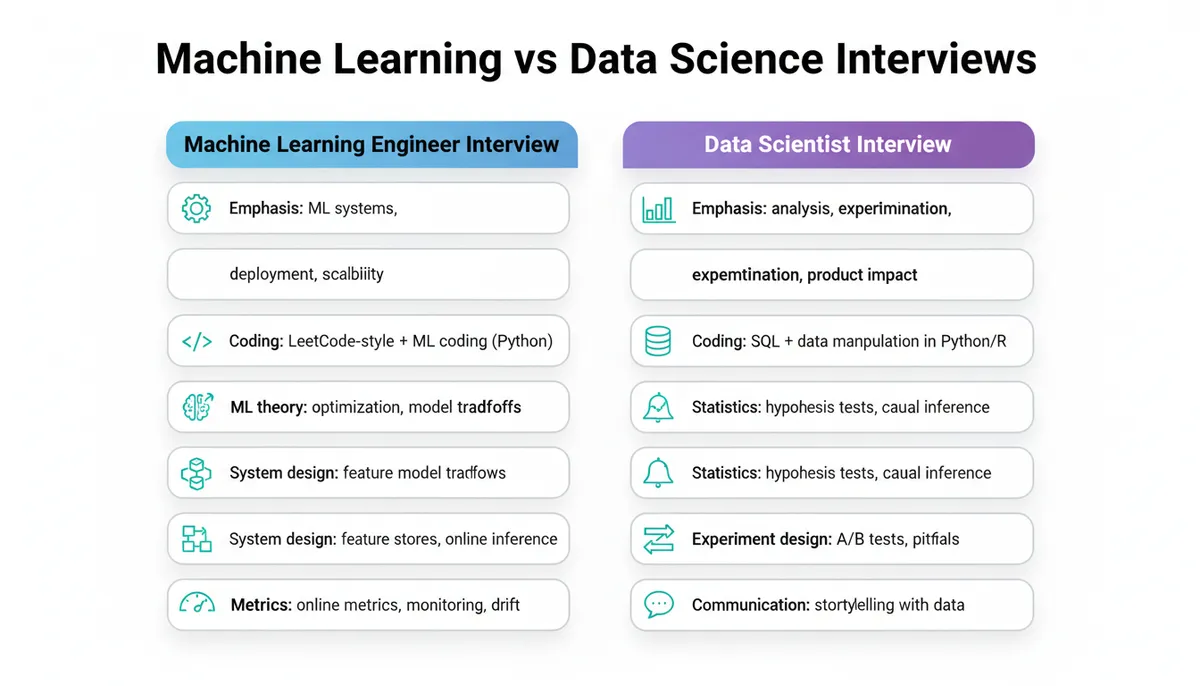
2. High-Level Comparison: ML vs Data Science Interviews
At a 10,000-foot view, here’s how the interviews typically differ.
3. Interview Round Types: Side-by-Side
Below is a typical breakdown of rounds. Exact structure varies by company, but the patterns are consistent.
3.1 Coding and Algorithms
Machine Learning Engineer
- What’s tested
- DSA fundamentals: arrays, strings, hash maps, trees, graphs, dynamic programming
- Clean, production-quality Python (or similar)
- Sometimes ML-flavored coding (implementing loss functions, simple training loops)
- Example questions
- Implement LRU cache, K closest points, top-K frequent elements
- Implement logistic regression with gradient descent from scratch
- Write a function to compute ROC AUC given labels and predictions
- Expectations
- Similar bar to a general SWE role, sometimes slightly more lenient on hardcore algorithms but stronger expectations on ML-relevant coding
Data Scientist
- What’s tested
- SQL: joins, window functions, aggregations, subqueries
- Data manipulation in Python/R: pandas, numpy, basic EDA
- Example questions
- Given tables
eventsandusers, compute 7-day retention by cohort - In pandas, compute session-level metrics from event logs
- Given tables
- Expectations
- Less focus on algorithmic complexity, more on correctness, clarity, and understanding of data semantics
Key difference:
MLE interviews often feel like SWE interviews plus ML; DS interviews feel like analytics interviews plus stats.
3.2 ML / Statistics Theory
Machine Learning Engineer
- Focus areas
- Supervised/unsupervised learning algorithms and tradeoffs
- Optimization: gradient descent variants, regularization
- Bias-variance tradeoff, overfitting/underfitting
- Practical ML: feature engineering, cross-validation, hyperparameter tuning
Example prompts
- “Explain the difference between L1 and L2 regularization. When would you prefer one over the other?”
- “How would you handle severe class imbalance in a fraud detection model?”
- “What are the pros/cons of gradient boosting vs deep neural networks for tabular data?”
Data Scientist
- Focus areas
- Statistics: distributions, confidence intervals, p-values
- Hypothesis testing: t-tests, chi-square tests, non-parametric tests
- Causal inference basics: A/B testing, biases, confounders
- Sometimes light ML: linear/logistic regression, basic tree methods
Example prompts
- “Explain p-value in an A/B test. What does p < 0.05 actually mean?”
- “How would you test whether a new feature improved conversion rate?”
- “What are the assumptions behind linear regression, and how do you check them?”
Key difference:
MLE theory is model-centric and optimization-heavy. DS theory is inference-centric and experiment-heavy.
3.3 System / Product Design
This is one of the biggest interview differences and often the least prepared-for.
Machine Learning Engineer – ML System Design
- Goal: Can you design an end-to-end ML system that works in production?
- Topics
- Data ingestion and feature pipelines (batch vs streaming)
- Model training, evaluation, deployment (batch, online, shadow, canary)
- Online serving: latency, throughput, caching
- Monitoring: model performance, data drift, feature quality
- Example question
- “Design a real-time recommendation system for an e-commerce site.”
- “How would you design an ML system to detect abusive content in near real-time?”
Data Scientist – Analytics / Product Design
- Goal: Can you use data to drive product decisions?
- Topics
- Experiment design: metrics, power, sample size
- Defining success metrics and guardrails
- Tradeoffs between different product directions
- Example question
- “We want to increase engagement on the home feed. How would you approach this?”
- “Design an experiment to test a new pricing model. What could go wrong?”
Key difference:
MLE design is about systems and architecture. DS design is about metrics, experiments, and product tradeoffs.
4. Deep Dive: Example Interview Scenarios
4.1 Same problem, different lens: “Improve search”
Imagine the company wants to “improve search quality” for a marketplace app.
Machine Learning Engineer version
- “Design an ML-based search ranking system for our marketplace.”
- Expectations:
- Clarify: input signals (query, user profile, item attributes), constraints, latency
- Propose architecture:
- Offline feature computation (e.g., item embeddings, click-through rates)
- Online features (query text, user context)
- A ranking model (e.g., gradient-boosted trees or neural ranker)
- Serving architecture (feature store, online inference, caching)
- Discuss evaluation:
- Offline metrics (NDCG, MRR)
- Online A/B testing
- Address operational concerns:
- Cold start, model retraining cadence, monitoring
Data Scientist version
- “How would you measure whether our search results are good? How would you improve them?”
- Expectations:
- Define metrics:
- Click-through rate, conversion rate, time to first click, query reformulation rate
- Design analyses:
- Identify bad queries (no results, low engagement)
- Segment by user type, device, geography
- Propose experiments:
- Rank changes, UI tweaks, filters
- Discuss interpretation:
- Tradeoffs between short-term clicks and long-term satisfaction
- Confounding factors (seasonality, marketing campaigns)
- Define metrics:
Same product area, but completely different interview expectations.
5. Coding Example: MLE vs DS Style
5.1 ML Engineer-style coding: Implement logistic regression
You might be asked to implement a simple model from scratch.
PYTHON
An interviewer might then ask:
- Time complexity of
fitin terms ofn_samples,n_features,n_iters - How to add L2 regularization
- How to handle class imbalance
5.2 Data Scientist-style coding: SQL for retention
A DS interview might focus on SQL like this:
Given a table
events(user_id, event_date, event_type)whereevent_typecan be 'signup' or 'login', compute 7-day retention by signup date.
SQL
Here, the interviewer cares about:
- Correctness of retention definition
- Handling of date ranges
- Use of
DISTINCTand joins - Reasoning about edge cases (multiple logins, time zones)
6. Common Pitfalls in ML vs Data Science Interviews
6.1 Misreading the role
- Problem
- Applying for “Data Scientist” but the role is actually MLE (or vice versa)
- Symptoms
- Over-preparing the wrong topics (e.g., leetcode for an analytics-heavy DS role)
- Fix
- Ask explicit questions during recruiter screen:
- “What percentage of the role is modeling vs analytics vs engineering?”
- “What are the typical projects your team shipped in the last 6 months?”
- Ask explicit questions during recruiter screen:
6.2 Over-indexing on theory, under-indexing on practicality
- MLE candidates
- Can explain every optimizer variant but can’t describe a robust training pipeline
- Talk only about model architecture, not monitoring, data quality, or failure modes
- DS candidates
- Can derive statistical formulas but can’t design a realistic experiment with constraints
Fix: Anchor your answers in real-world constraints: latency, data quality, missing data, noisy logs, conflicting metrics, stakeholder needs.
6.3 Ignoring communication
Both roles require clear communication:
- MLE: explain complex ML systems to non-ML engineers and PMs
- DS: explain analyses and tradeoffs to product, marketing, leadership
Interviewers often silently down-level or reject strong technical candidates who can’t:
- State assumptions clearly
- Summarize takeaways
- Say “I don’t know, here is how I’d find out” instead of bluffing
6.4 Not connecting models to business impact
Especially for DS, but increasingly for MLE roles:
- It’s not enough to say “I improved AUC by 3%”
- You need to connect it to:
- “This reduced false positives by X, which saved Y in costs”
- “This led to Z% increase in conversion in our A/B test”
7. How to Prepare: Machine Learning Interview Prep vs Data Science
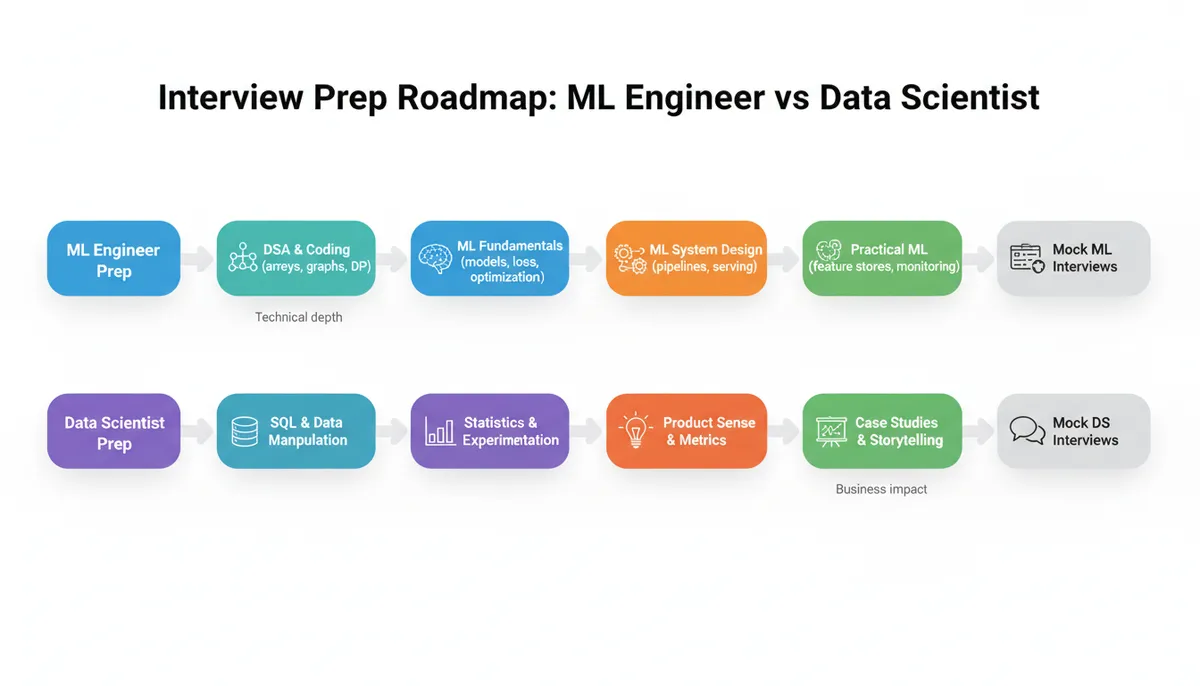
7.1 For Machine Learning Engineer interviews
Core pillars
-
DSA & coding
- Practice classic patterns: sliding window, two pointers, BFS/DFS, binary search, DP
- Focus on Python fluency and clean code
- A structured pattern-based resource (like a DSA patterns sheet) can help you avoid random grinding
- For more comprehensive guidance, consider following the Beginner to Advanced DSA Roadmap for Software Engineers in 2026 to master essential coding interview topics.
-
ML fundamentals
- Linear/logistic regression, trees, random forests, gradient boosting, basic deep learning
- Loss functions, regularization, optimization basics
- Evaluation metrics for classification, regression, ranking
-
ML system design
- Read about:
- Feature stores
- Offline vs online inference
- A/B testing for ML systems
- Monitoring (data drift, concept drift, performance)
- Practice whiteboarding end-to-end systems
- Read about:
-
Project deep dives
- Prepare 2–3 ML projects you can explain in depth:
- Problem, data, features, model choice
- Offline and online evaluation
- Failures and what you’d do differently
- Prepare 2–3 ML projects you can explain in depth:
-
Mock ML interviews
- Do dry runs for:
- Coding + ML coding
- ML system design
- ML theory and project deep dives
- An AI-based mock interview tool (e.g., /ai-interview) can be useful for feedback loops if you don’t have many peers to practice with
- Do dry runs for:
7.2 For Data Science interviews
Core pillars
-
SQL and data manipulation
- Practice:
- Joins, group by, window functions, CTEs
- Event-based schemas, funnels, retention, cohorts
- Use realistic schemas, not toy tables only
- For a detailed preparation plan, check out the Data Science Interview Preparation: Complete Roadmap which covers essential topics and strategies.
- Practice:
-
Statistics and experimentation
- Hypothesis testing, confidence intervals, p-values
- Power analysis, sample size calculation
- Common pitfalls: peeking, multiple comparisons, selection bias
-
Product sense and metrics
- Learn how companies define:
- North star metrics
- Guardrail metrics
- Leading vs lagging indicators
- Practice framing: “If X is the goal, here’s how I’d measure and move it”
- Learn how companies define:
-
Case studies and storytelling
- Prepare 2–3 analytics projects:
- Problem, approach, key insights
- Impact and limitations
- Practice explaining to a non-technical audience in 3–5 minutes
- Prepare 2–3 analytics projects:
-
Mock DS interviews
- Focus on:
- SQL live coding
- Product and experiment design
- Take-home analyses (if applicable)
- Focus on:
8. How to Choose: ML vs Data Science Career Path
If you’re still deciding between paths, align with what you enjoy doing day-to-day.
8.1 You might prefer ML Engineer if you:
- Enjoy building systems and writing production code
- Like thinking about latency, scalability, and reliability
- Are excited by model architectures, embeddings, and infrastructure
- Are okay with less direct involvement in product decision-making (varies by org)
8.2 You might prefer Data Scientist if you:
- Enjoy asking “why” and “what should we do next?” more than “how do we build it?”
- Like designing experiments and making decisions from data
- Are comfortable with ambiguity and messy business questions
- Want to collaborate closely with product, marketing, and leadership
Both paths are valuable and can intersect (e.g., “applied scientist” roles, research engineers). But your ai interview differences will be significant depending on which track you choose.
9. Best Practices to Stand Out
Regardless of path, some principles are universal.
9.1 Be explicit about tradeoffs
- For ML:
- “I’d choose gradient boosting over deep learning here because we have tabular data, limited data size, and we care about interpretability.”
- For DS:
- “I’d prioritize this metric as primary because it’s closest to long-term value, and use these guardrail metrics to ensure we don’t harm user experience.”
9.2 Show you understand the end-to-end lifecycle
- MLE:
- Data → Features → Training → Evaluation → Deployment → Monitoring → Iteration
- DS:
- Question → Data → Analysis/Experiment → Insight → Decision → Measurement
9.3 Practice clear, structured communication
Use simple scaffolds:
- For design questions (MLE or DS):
- Clarify → Propose options → Deep dive → Edge cases → Tradeoffs
- For project discussions:
- Context → Problem → Approach → Results → Limitations → Next steps
9.4 Don’t fake depth
If you don’t know something:
- Say what you do know
- State your assumptions
- Outline how you’d figure it out
This is often rated higher than a shallow or incorrect confident answer.
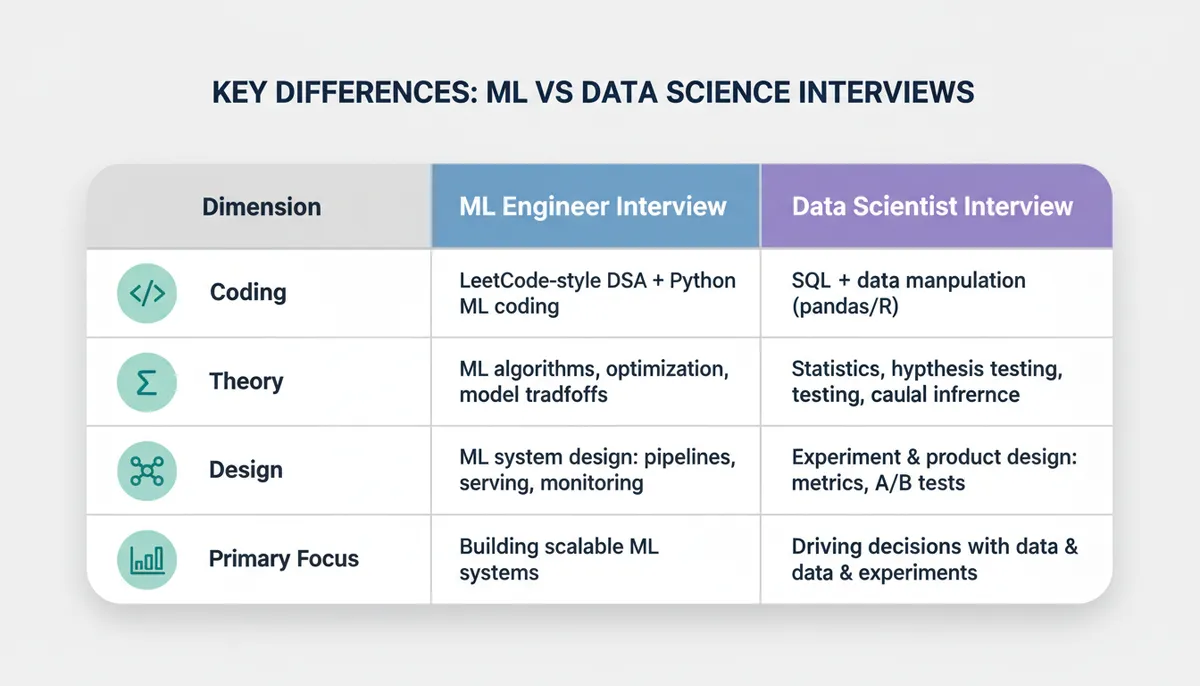
10. Summary: Key Differences at a Glance
-
ML Engineer interviews
- Feel like SWE interviews with ML specialization
- Emphasize algorithms, ML theory, and system design
- Expect strong coding and understanding of production ML
-
Data Scientist interviews
- Feel like analytics + statistics + product sense interviews
- Emphasize SQL, experimentation, and communication
- Expect strong reasoning about metrics and business impact
If you align your machine learning interview prep (or data science prep) to the actual expectations of the role—and practice with realistic questions and mock interviews—you dramatically increase your odds of not just passing, but joining a team where your skills and interests are a good match.