
Data Science
Top Python Topics for Data Science Interviews
Python is the default language of modern data science—and interviewers know it. In most data science and ML interviews, your Python fluency is evaluated impl...
Python is the default language of modern data science—and interviewers know it. In most data science and ML interviews, your Python fluency is evaluated implicitly: how you explore data, implement models, debug, and reason about performance. This guide walks through the top Python topics for data science interviews, with concrete examples, common pitfalls, and what “good” looks like in code.
We’ll focus on the Python skills that actually show up in interviews, not an exhaustive language tour. If you’re preparing for data science or ML interviews and wondering where to focus your Python practice, this is the roadmap.
1. Core Python Fundamentals for Data Science Interviews
Even for experienced data scientists, many interview bugs come from basic Python misunderstandings: mutability, scoping, iteration, and data structures. Interviewers often start here before moving into libraries and modeling.
1.1 Data Types and Data Structures
You should be comfortable with:
list,tuple,set,dict- When to use each
- Time complexity of common operations (at least at a high level)
PYTHON
Interview-style question:
“You have a list of user IDs with duplicates. Return the list of unique IDs while preserving original order.”
PYTHON
Be ready to explain why a set alone is not enough (it loses order) and why this is O(n) time, O(n) extra space.
1.2 Mutability, Aliasing, and Copying
Bugs in data pipelines often come from unintended mutation.
PYTHON
You should know:
list.copy()ora[:]for shallow copiescopy.deepcopy()for nested structures- That
list * nduplicates references, not nested lists
PYTHON
2. Control Flow, Functions, and Pythonic Style
Interviewers watch for code that is not just correct, but idiomatic and maintainable.
2.1 Functions, Arguments, and Scoping
You should understand:
- Positional vs keyword arguments
- Default arguments (and the mutable default trap)
- Local vs global scope and closures
PYTHON
Expect questions like: “Explain what’s wrong with this function and how you’d fix it.”
2.2 Comprehensions and Generators
Pythonic data science code leans heavily on comprehensions and generator expressions.
PYTHON
Use generators when processing large data streams or logs to avoid loading everything into memory.
PYTHON
3. Strings, Dates, and File I/O
Data rarely arrives as clean DataFrames. You’ll often need to parse logs, CSVs, or JSON by hand in interviews.
3.1 String Manipulation
Common operations:
- Splitting and joining
- Stripping whitespace
- Basic pattern checks
PYTHON
You should also know in, startswith, endswith, and basic re usage for simple patterns.
3.2 Working with Dates and Times
Interviews often include time-series or log questions.
PYTHON
Be ready to:
- Parse timestamps from strings
- Compute differences (
(dt2 - dt1).total_seconds()) - Round or truncate to day/hour
4. Object-Oriented Python in Data Science Context
You don’t need to design large systems, but you should understand classes well enough to:
- Wrap preprocessing logic
- Implement simple model-like APIs
- Understand how scikit-learn estimators are structured
PYTHON
This pattern mirrors scikit-learn’s fit / transform / fit_transform interface, which interviewers often expect you to recognize and use.
5. NumPy: The Foundation of Numerical Python
For ML interview prep, NumPy is non-negotiable. Many “Python interview questions” for data science are really NumPy questions.
5.1 Arrays, Shapes, and Broadcasting
You should be fluent with:
- Creating arrays
- Understanding shapes and ranks
- Broadcasting rules
PYTHON
Common operations:
PYTHON
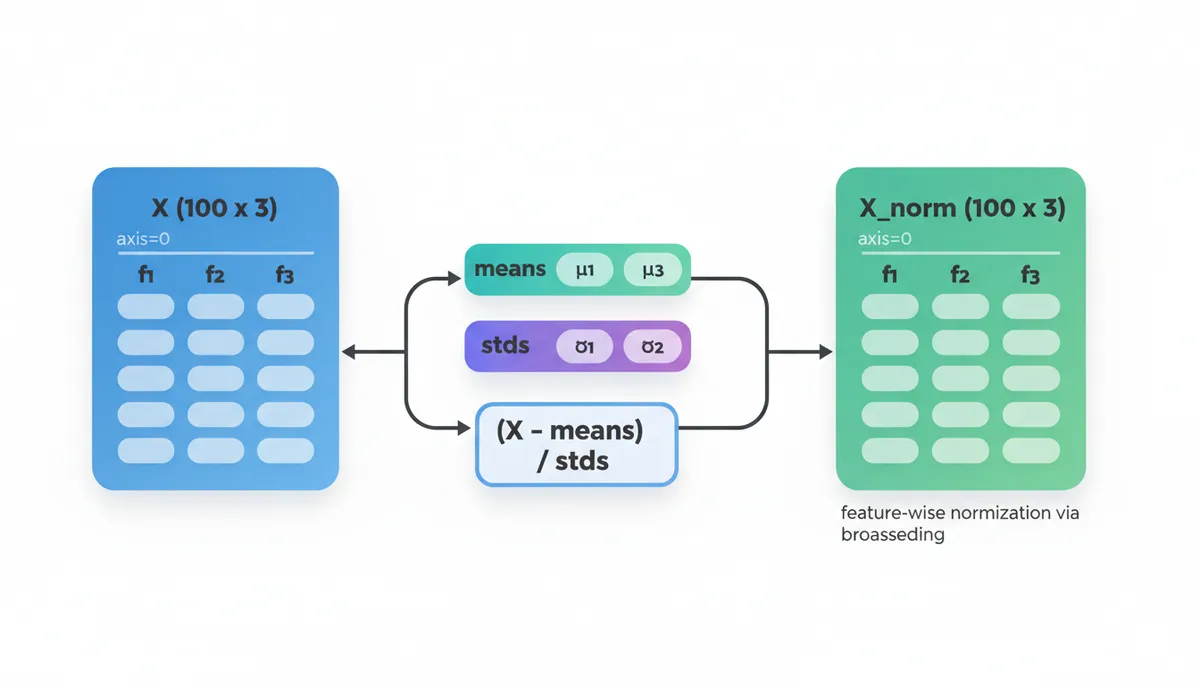
You should be able to explain what happens when shapes don’t align and how to debug shape errors.
5.2 Vectorization vs Loops
A classic interview pattern: “Implement this in NumPy without explicit Python loops.”
Example: Euclidean distance between rows of two matrices.
PYTHON
Discuss why this is faster than nested Python loops:
- Computation in C
- Better cache locality
- Fewer Python-level operations
5.3 Linear Algebra Essentials
At minimum:
- Matrix multiplication:
A @ B - Transpose:
A.T - Inverse and pseudo-inverse:
np.linalg.inv,np.linalg.pinv - Solving linear systems:
np.linalg.solve
For a simple linear regression solution:
PYTHON
6. Pandas: Data Manipulation and Analysis
For data science Python topics, Pandas is where most interview time is spent. You should be comfortable doing 80–90% of typical data wrangling tasks.
6.1 Core Objects: Series and DataFrame
Basic creation and inspection:
PYTHON
Know the difference between:
df["col"](Series) vsdf[["col"]](DataFrame)df.loc[row_label, col_label]vsdf.iloc[row_index, col_index]
6.2 Filtering, Sorting, and Selecting
Example: “Find top 3 countries by average revenue, excluding missing values.”
PYTHON
Be able to chain operations clearly and explain each step.
6.3 GroupBy and Aggregations
This is one of the most asked Python for data science interview topics.
PYTHON
Understand:
- Why
nuniquevscount - How to rename aggregated columns
- The difference between
groupby().agg()vsgroupby().apply()
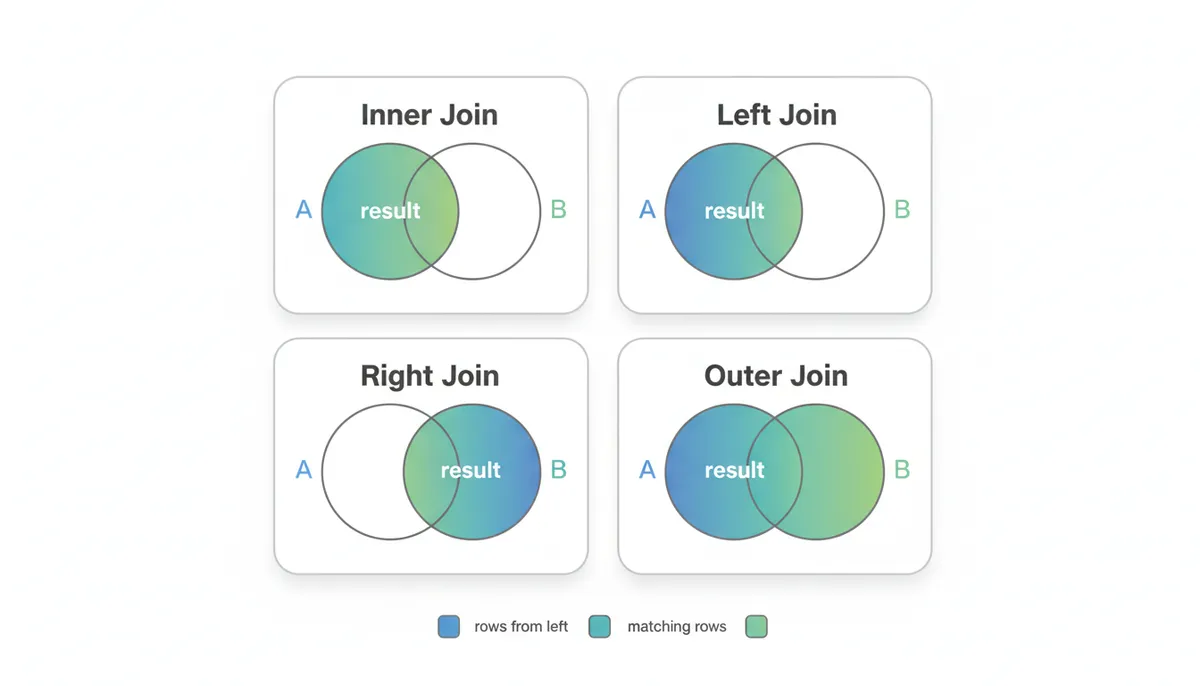
6.4 Joins and Merging
Example: “Join user attributes with daily metrics.”
PYTHON
You should be comfortable with:
howtypes:inner,left,right,outer- Handling duplicate keys and suffixes:
suffixes=("_left", "_right")
7. Python for Machine Learning Interviews
Once you’re comfortable with NumPy and Pandas, interviews often move to scikit-learn and model implementation basics.
7.1 scikit-learn API and Pipelines
You should know the standard estimator pattern:
model = Estimator(params...)model.fit(X_train, y_train)model.predict(X_test)
Example: Logistic regression with a preprocessing pipeline.
PYTHON
Be able to explain:
- Why scaling is important for some models
- How
Pipelineensures identical preprocessing at train and test time - Where you would insert feature engineering steps
7.2 Basic Model Implementation from Scratch
Some ML interview prep includes coding simple models in pure Python/NumPy.
Example: Binary logistic regression with gradient descent (conceptual-level implementation):
PYTHON
You don’t need to derive gradients in every interview, but you should:
- Recognize the pattern: forward pass → loss → gradient → update
- Understand the shapes of
X,w,y - Be able to debug broadcasting or shape misalignment
8. Performance, Memory, and Scaling in Python
Senior-level interviews often probe whether you understand performance tradeoffs.
8.1 Time Complexity and Big-O Intuition
You don’t need to memorize every detail, but you should know:
list.appendisO(1)amortizedx in listisO(n)vsx in setisO(1)averagedictoperations areO(1)average- Sorting is
O(n log n)
If you’re preparing more algorithmic questions, pattern-based resources like Thita’s DSA patterns roadmap can help, but for data science interviews the focus is usually on collections and loops.
8.2 Efficient Data Processing
Common patterns:
- Use
itertoolsfor streaming - Use
chunkprocessing for large files - Avoid
applyin Pandas when vectorization is possible
PYTHON
For large CSVs:
PYTHON
9. Testing, Debugging, and Reproducibility
Interviewers often infer your engineering maturity from how you test and debug.
9.1 Basic Testing Patterns
You don’t need full pytest fluency, but you should:
- Write small sanity checks
- Compare expected vs actual outputs
- Use assertions
PYTHON
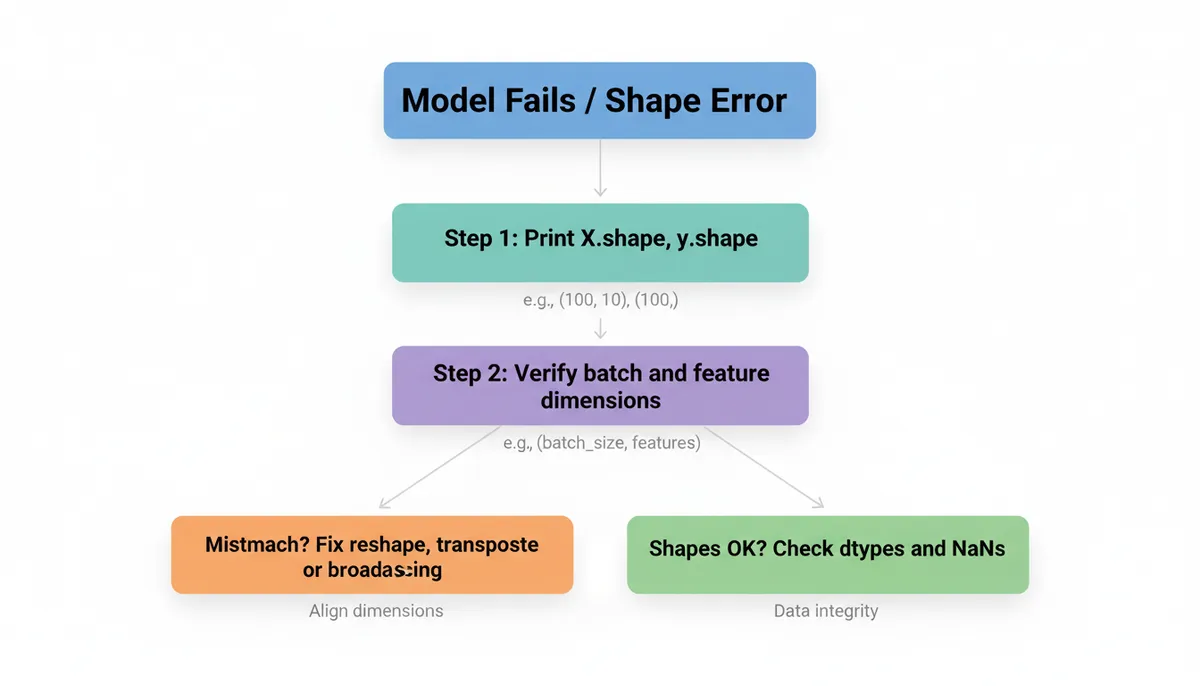
9.2 Debugging with Print and Shape Checks
In interviews, you won’t have a full IDE. Rely on:
- Printing shapes:
print(X.shape) - Inspecting head of DataFrames:
print(df.head()) - Checking dtypes:
print(df.dtypes)
10. Common Python Mistakes in Data Science Interviews
Interviewers see the same issues repeatedly. Avoiding these is an easy way to stand out.
10.1 Using apply Everywhere
apply is convenient but often slower and less readable than vectorized operations.
- Prefer built-in string methods:
df["col"].str.lower() - Prefer NumPy ufuncs:
np.log1p(df["revenue"]) - Use
maporreplacefor simple value mappings
10.2 Ignoring Copy vs View in Pandas
This often shows up as SettingWithCopyWarning.
PYTHON
Explain that .copy() creates an explicit copy, making behavior predictable.
10.3 Overusing Global State
In interview code:
- Avoid relying on global variables
- Pass data explicitly to functions
- Make functions pure where possible (no side effects)
This makes your reasoning clearer and your code easier to test.
11. Best Practices for Python in Data Science Interviews
11.1 Write Clean, Readable Code
- Use meaningful variable names:
user_id,revenue_per_day - Break long expressions into intermediate variables
- Add short comments for non-obvious logic
PYTHON
11.2 Communicate While Coding
Interviewers evaluate how you:
- Choose data structures
- Trade off simplicity vs performance
- Handle edge cases (empty data, missing values, outliers)
Explain your choices:
- “I’m using a
dicthere because we need O(1) lookups by user_id.” - “I’ll filter out rows with missing revenue before computing the mean.”
If you want structured practice on this kind of communication, an AI mock interviewer like Thita’s AI interview simulator can simulate the pressure and format of real interviews.
11.3 Handle Edge Cases Explicitly
- Empty inputs
- All-NaN columns
- Single-row or single-column arrays
- Non-unique keys in joins
Even a single if not len(df): return df can demonstrate that you think about robustness.
12. Putting It All Together: A Mini End-to-End Example
Consider a common interview-style task:
You’re given a CSV of user events with columns:
user_id,timestamp,event_type,revenue. Compute, for each country, the average 7-day rolling revenue per active user.
Assume you also have a users.csv with user_id and country.
A structured Python solution uses many of the topics above:
PYTHON
This snippet exercises:
- File I/O
- Date parsing
- Merging
- GroupBy and rolling windows
- Clean function design
In an interview, you’d walk through each step and justify choices (e.g., nunique vs count, min_periods=1, left join).
Key Takeaways
- Python for data science interviews is less about obscure language features and more about clean, correct, and efficient use of NumPy, Pandas, and scikit-learn.
- Master the fundamentals: data structures, mutability, comprehensions, and basic I/O. Many bugs originate here.
- Be fluent with NumPy shapes, broadcasting, and vectorization. Avoid Python loops for numerical code where possible.
- In Pandas, focus on groupby, joins, filtering, and time-based operations. These are the workhorses of real-world data tasks.
- Write code that’s readable, testable, and robust. Explain your decisions aloud during interviews.
If you systematically practice these Python topics with realistic interview-style problems and timed sessions, your data science and ML interview prep will be significantly more effective. For a comprehensive overview, consider following the Complete Data Science Roadmap 2026: Master 72 Essential Topics Across 12 Core Patterns.