
DSA
Beginner Mistakes While Learning Data Structures and Algorithms
Most people don’t fail DSA because they’re “bad at algorithms.” They fail because they practice in ways that quietly sabotage their progress.
Most people don’t fail DSA because they’re “bad at algorithms.” They fail because they practice in ways that quietly sabotage their progress.
If you’re searching for DSA beginner mistakes or wondering why learning data structures feels harder than it should, the problem is usually not the content—it’s the approach: what you practice, how you practice, and what you ignore.
This post walks through the most common algorithm mistakes and coding interview prep errors beginners make, and how to fix them with concrete, actionable habits. The goal is to help you learn DSA like a software engineer, not like a test-taker.
1. Treating DSA as Memorization, Not Problem Solving
Many beginners start by trying to memorize every data structure and algorithm they see. That approach breaks down quickly.
1.1 The Symptom
- You watch a video on binary search trees, feel you “understand it,” and move on.
- A week later, faced with a tree problem, you freeze.
- You recognize the words, but can’t derive the solution.
This is the classic “I’ve seen this before” trap.
1.2 Why Memorization Fails
Algorithms are tools. Knowing their names isn’t enough; you must understand when and why to use them.
Example:
TEXT
A memorizer might think: “I know binary search… but how do I tweak it for ‘first index’?”
A problem solver thinks in patterns:
- Data is sorted → binary search candidate
- Need a boundary (first index satisfying condition) → use binary search variant that keeps searching left even after finding a valid index.
1.3 Fix: Focus on Patterns and Invariants
Instead of memorizing full solutions, focus on:
- Patterns: sliding window, two pointers, binary search on answer, BFS/DFS, backtracking, DP on sequences, etc.
- Invariants: conditions that remain true throughout the algorithm (e.g., in binary search,
lois always a valid lower bound,hiis always an upper bound).
Example: Binary search invariant
PYTHON
Here, the key is not the syntax—it’s the invariant:
- Left side is always “too small,” right side is always “big enough.”
Learning by patterns (like the 94 DSA patterns in a structured sheet) gives you reusable mental models instead of isolated tricks. For a comprehensive guide on these, see What Are DSA Patterns? A Complete Guide for Beginners.
2. Skipping the Fundamentals of Complexity
Another common DSA beginner mistake is jumping into problems without a solid grasp of time and space complexity.
2.1 The Symptom
- You can write a solution but can’t explain if it’s optimal.
- You’re surprised when your solution times out on large inputs.
- You avoid questions about Big-O in interviews.
2.2 Why Complexity Matters
Complexity gives you:
- A sanity check: Is my approach even viable?
- A comparison tool: Is solution A better than solution B?
- A design constraint: For
n = 10^5, O(n²) is almost always too slow.
2.3 Practical Complexity Rules of Thumb
n ≤ 10^3→ O(n²) may be fine.n ≤ 10^5→ Aim for O(n log n) or better.n ≤ 10^7→ You probably need O(n) or O(log n).
When you see constraints in a problem, they’re hints about the intended complexity.
2.4 Fix: Always Analyze Before and After Coding
Before coding:
- Estimate input size.
- Decide your target complexity.
- Choose data structures that match (e.g., hash map for O(1) average lookups, heap for O(log n) priority operations).
After coding:
- Walk through the code and count operations by loop nesting and data structure operations.
3. Ignoring Data Structure Trade-offs
“Use a hash map” is not always the answer.
A subtle learning data structures mistake is treating all containers as interchangeable. In practice, each has trade-offs in time, space, and operations.
3.1 The Symptom
- You default to arrays/lists and hash maps for everything.
- You don’t know when to use a heap, deque, or tree.
- You struggle with problems that require order or priority.
3.2 Common Data Structure Trade-offs
| Data Structure | Typical Use Case | Time Complexity (common ops) |
|---|---|---|
| Array/List | Indexed access, contiguous memory | Access O(1), insert/delete O(n) |
| Linked List | Frequent insert/delete in middle | Access O(n), insert/delete O(1) |
| Stack | Last-in-first-out (backtracking, parsing) | Push/pop O(1) |
| Queue/Deque | BFS, sliding window | Enqueue/dequeue O(1) |
| Hash Map/Set | Fast lookup by key | Avg O(1), worst O(n) |
| Heap/PQ | Always need min/max element | Insert/pop O(log n) |
| Tree (BST) | Ordered data with range queries | Balanced: O(log n) ops |
| Graph | Relationships, networks | Depends on representation |
3.3 Example: Using the Wrong Structure
Problem: “Find the k largest elements in an array of size n.”
Common beginner solution:
- Sort the array → O(n log n)
- Take last k elements.
Better approach:
- Use a min-heap of size k → O(n log k)
- Maintain k largest elements as you scan.
PYTHON
Choosing the right data structure is often the difference between passing and timing out.
3.4 Fix: Learn by Constraints and Operations
For each problem, ask:
- Do I need random access? → Array/list.
- Do I need fast membership? → Hash set/map.
- Do I need order? → Tree, sorted list, or heap.
- Do I need first/last, sliding window? → Deque.
- Do I need graph traversal? → Adjacency list/matrix.
Over time, this mapping becomes automatic. To deepen your understanding of data structures and their use in interviews, check out Most Important DSA Topics for Coding Interviews (Ranked by Frequency).
4. Solving Problems Without a Systematic Process
Many algorithm mistakes aren’t about algorithms at all—they’re about process. Beginners often jump straight into code.
4.1 The Symptom
- You read the problem once and immediately start typing.
- You get stuck halfway and keep patching the code.
- You finish with something that “kind of works” but fails edge cases.
4.2 A Systematic Problem-Solving Framework
Use a consistent framework for every problem:
-
Clarify the problem
- Restate in your own words.
- Ask about constraints, input ranges, edge cases.
-
Design examples
- Start with simple inputs.
- Add edge cases: empty, single element, all same, already sorted, etc.
-
Brainstorm approaches
- Brute force first.
- Then think: Can I use a known pattern? (two pointers, sliding window, etc.)
-
Choose and justify
- Explain why you chose this approach.
- State expected time and space complexity.
-
Write code
- Implement cleanly, not “just to make it work.”
-
Test with examples
- Use the ones from step 2.
- Add more if you find bugs.
This is the same process used in real interviews and in real engineering work.
5. Overfitting to LeetCode: Quantity Over Quality
Another frequent coding interview prep error is grinding hundreds of problems without depth.
5.1 The Symptom
- You’ve solved 200+ problems but still feel unprepared.
- When a new problem appears, you don’t know where to start.
- You forget previous problems quickly.
5.2 Why Blind Grinding Fails
- You’re training recognition, not reasoning.
- You optimize for “AC” (accepted) rather than understanding.
- You never generalize solutions into patterns.
5.3 Fix: Depth-First Learning with Patterns
Instead of:
“Solve 10 random array problems today.”
Try:
“Master the sliding window pattern this week.”
For each pattern:
- Learn the definition and when to use it.
- Solve a small curated set of problems that vary slightly.
- After each problem, write down:
- What was the key idea?
- How did I know this pattern applied?
- What would break if I changed X?
This is the idea behind pattern-based learning: fewer problems, more generalizable insight. A structured DSA patterns sheet can help you organize this.
6. Neglecting Edge Cases and Robustness
Beginners often think in terms of “happy path” only.
6.1 The Symptom
- Your solution passes basic tests but fails hidden ones.
- You frequently hit
IndexError,NullPointerException, or off-by-one bugs. - You rarely consider empty or degenerate inputs.
6.2 Typical Edge Cases to Consider
For arrays/strings:
- Empty array/string.
- Single element/character.
- All elements identical.
- Already sorted / reverse sorted.
For trees:
- Empty tree (null root).
- Single node.
- Skewed tree (like a linked list).
For graphs:
- Disconnected components.
- Cycles vs acyclic.
- Self-loops, multiple edges.
6.3 Example: Off-by-One in Sliding Window
Problem: Longest substring with at most k distinct characters.
Common off-by-one bug: incorrect window size due to misplacing +1.
PYTHON
If you use right - left, you’ll always be off by one.
6.4 Fix: Build a Personal Edge Case Checklist
Before running code, manually test:
- Smallest valid input.
- Largest valid input.
- Inputs with repeated elements.
- Boundary values (e.g., k = 0, k = 1, k = n).
Over time, you’ll develop intuition for where bugs hide.
7. Writing Code That’s Hard to Reason About
Beginners often prioritize brevity over clarity, leading to code that’s difficult to debug or explain.
7.1 The Symptom
- Long functions with multiple responsibilities.
- Deeply nested
if/elseblocks. - Cryptic variable names (
a,b,c).
7.2 Why This Hurts Learning
- You can’t see the algorithm structure clearly.
- Debugging becomes guesswork.
- In interviews, you can’t communicate your thinking.
7.3 Example: Refactoring for Clarity
Messy version:
PYTHON
Cleaned up with better names and helper logic:
PYTHON
In interviews, it’s fine to start with the explicit version, then mention the Counter optimization.
7.4 Fix: Adopt Simple Style Guidelines
- Use descriptive names (
left,right,count_map,freq). - Keep functions short and focused.
- Prefer clear over clever.
- Comment non-obvious invariants or tricks.
8. Not Practicing Under Realistic Conditions
Knowing DSA in isolation is different from performing in an interview.
8.1 The Symptom
- You can solve problems with unlimited time and silence.
- Under a 45-minute timer and conversation, you struggle.
- You’re surprised by how different “live coding” feels.
8.2 Why Environment Matters
Interviews test:
- Problem solving under time constraints.
- Communication and collaboration.
- Handling ambiguity and feedback.
You need to train those skills explicitly; they don’t appear automatically.
8.3 Fix: Simulate Interviews Regularly
- Use a timer: 30–45 minutes per medium problem.
- Speak your thoughts out loud as you code.
- Occasionally use mock interview tools (human or AI) like AI Interview Practice: Free Mock Interview Simulator with Real-Time Feedback for Technical Interviews to get feedback on both code and communication.
- After each session, review:
- Where did I lose time?
- Did I clarify requirements?
- Did I test thoroughly?
This is deliberate practice, not just “more problems.”
9. Avoiding Recursion and Dynamic Programming
Many beginners treat recursion and DP as “advanced topics” and delay learning them. That’s a long-term handicap.
9.1 The Symptom
- You skip tree and graph problems because “they’re recursive.”
- DP problems feel like magic templates you can’t derive yourself.
- You try to force iterative solutions where recursion is natural.
9.2 Why Recursion and DP Matter
- Trees and graphs are inherently recursive structures.
- Many classic interview problems (paths, subsets, sequences) are naturally expressed with recursion or DP.
- DP is just recursion with memoization/tabulation.
9.3 A Simple DP Derivation Example
Problem: Fibonacci numbers.
Naive recursion:
PYTHON
Optimize with memoization:
PYTHON
Or bottom-up tabulation:
PYTHON
Key idea: overlapping subproblems + optimal substructure → DP.
9.4 Fix: Embrace Recursion with Structure
- Always define:
- State: What parameters define a subproblem?
- Recurrence: How is the answer built from smaller states?
- Base cases: When do you stop?
- For DP:
- Decide memoization (top-down) vs tabulation (bottom-up).
- Analyze time/space complexity.
Start with classic patterns: Fibonacci, climbing stairs, knapsack, longest common subsequence.
10. Not Using Visualizations and Diagrams
Trying to do everything in your head is a subtle but serious learning data structures mistake.
10.1 The Symptom
- You get lost in pointer manipulations.
- You can’t explain how your algorithm progresses step by step.
- You struggle with trees/graphs without drawing them.
10.2 Why Visuals Help
- They externalize state so your brain can focus on logic.
- They reveal off-by-one and boundary issues.
- They help you see patterns (e.g., sliding window movement, BFS layers).
10.3 Example: Visualizing Sliding Window
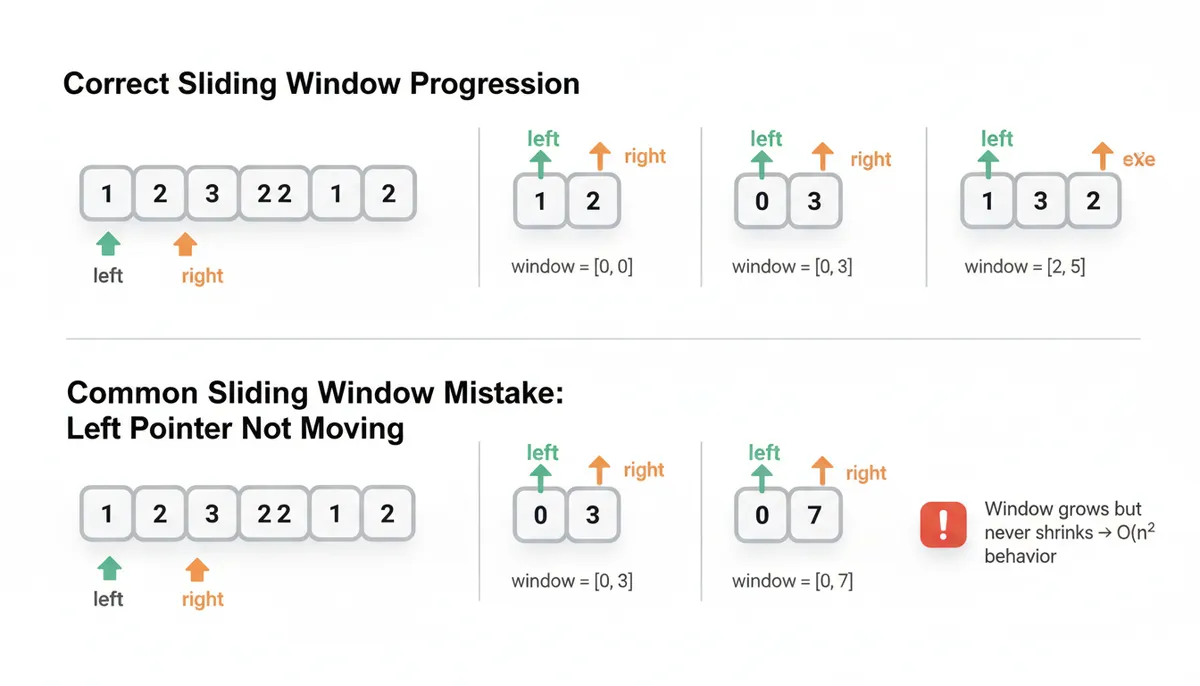
Drawing out how left and right move clarifies why the window must both expand and contract.
10.4 Fix: Make Diagrams a Habit
- Draw arrays with indices, pointers, and windows.
- Draw trees with clear left/right children.
- Draw graphs with nodes and edges labeled.
You don’t need artistic skill—just boxes and arrows.
11. Ignoring Feedback and Reflection
The final, and perhaps biggest, DSA beginner mistake is treating each problem as an isolated event instead of a learning opportunity.
11.1 The Symptom
- You solve a problem, accept the solution, and move on.
- You rarely revisit problems you struggled with.
- You don’t track your common error patterns.
11.2 Why Reflection Matters
Without reflection:
- You repeat the same mistakes (off-by-one, missing edge cases).
- You don’t consolidate patterns.
- Progress feels slow and fragile.
11.3 Fix: Implement a Lightweight Review Loop
After each problem, ask:
- What pattern did this problem use?
- Where did I get stuck? Why?
- What mistake did I make (if any)?
- Misread constraints?
- Chose wrong data structure?
- Missed edge case?
- What will I do differently next time?
Keep a short log. Over time, you’ll see themes like:
- “I often underestimate complexity.”
- “I forget to handle empty inputs.”
- “I misuse hash maps when a heap is better.”
If you use an AI coach or mock interviewer (like Best Ways to Use AI for DSA and Coding Interview Preparation), incorporate its feedback into this log.
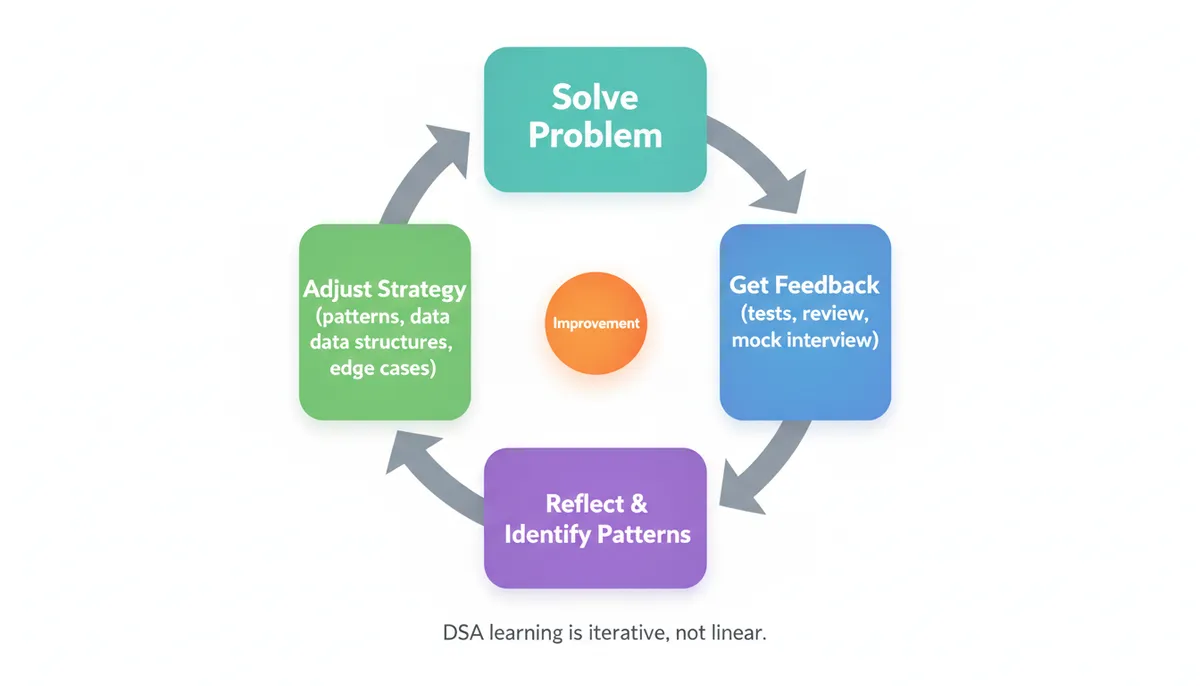
12. Putting It All Together: A Checklist for Avoiding DSA Beginner Mistakes
Here’s a condensed checklist you can use as you practice:
-
Mindset
- Am I learning patterns and invariants, not just solutions?
- Did I understand why this approach works?
-
Complexity & Constraints
- Did I read and use constraints to guide my approach?
- Can I state the time and space complexity of my solution?
-
Data Structures
- Did I choose data structures based on required operations?
- Did I consider alternatives (heap vs sort, deque vs list, etc.)?
-
Process
- Did I clarify the problem and design examples first?
- Did I think of a brute-force solution before optimizing?
-
Edge Cases & Testing
- Did I test empty, small, and extreme inputs?
- Did I check for off-by-one and boundary issues?
-
Code Quality
- Are my variable names descriptive?
- Is my code structured so I can explain it clearly?
-
Practice Environment
- Am I sometimes practicing with a timer?
- Am I practicing communicating my thought process?
-
Recursion & DP
- Did I identify the state, recurrence, and base cases?
- Did I consider memoization or tabulation when subproblems repeat?
-
Visualization
- Did I draw diagrams for non-trivial pointer logic, trees, or graphs?
-
Feedback & Reflection
- Did I log what went wrong and what I learned?
- Do I revisit difficult problems after some time?
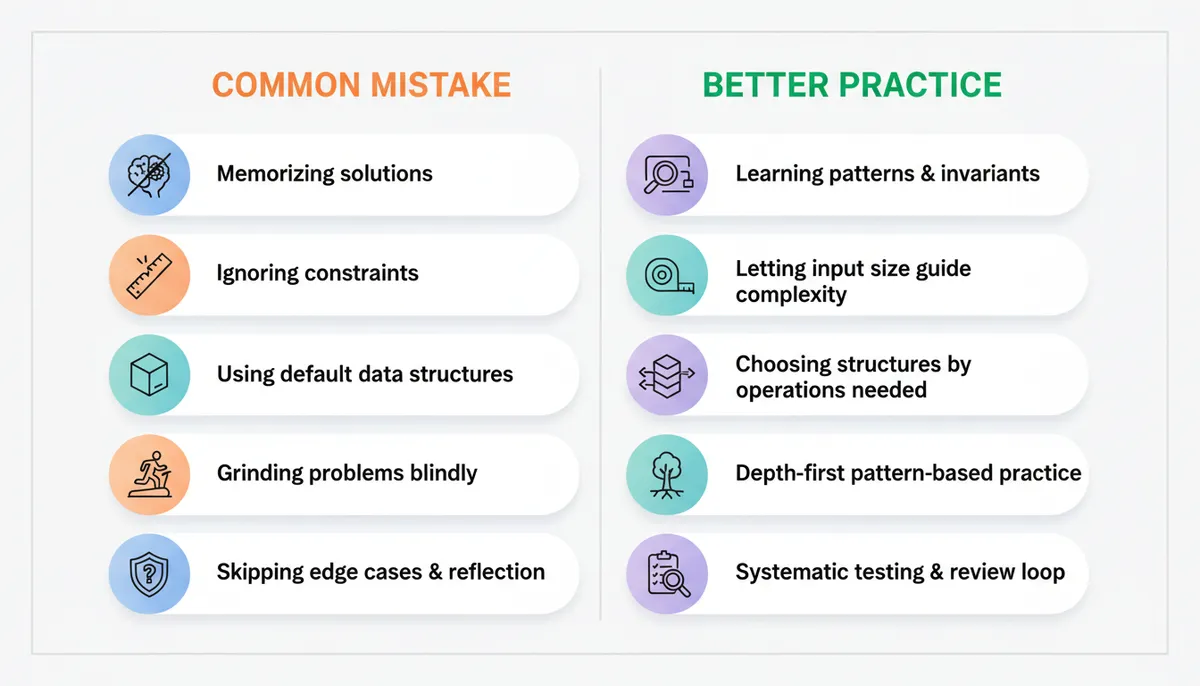
Key Takeaways
- Most DSA beginner mistakes are about approach, not intelligence.
- Focus on patterns, invariants, and trade-offs instead of rote memorization.
- Use a systematic problem-solving process: clarify → example → brute force → optimize → code → test.
- Practice with realistic conditions and deliberate reflection, not just volume.
- Visualize, analyze complexity, and choose data structures intentionally.
If you adopt even a few of these habits, you’ll find that learning data structures and algorithms becomes less about grinding and more about building a durable, engineer-level skill set that serves you well beyond coding interviews.