
DSA
DSA vs Competitive Programming: Which Is Better for Interviews?
If you’re preparing for software engineer interviews today, you’ve almost certainly run into the debate: **DSA vs Competitive Programming**. Some people swea...
If you’re preparing for software engineer interviews today, you’ve almost certainly run into the debate: DSA vs Competitive Programming. Some people swear by LeetCode-style data structures and algorithms. Others insist that only years of competitive programming (CP) will get you into top companies.
The reality is more nuanced.
This article breaks down what interviews actually test, how DSA and competitive programming differ, and how to choose the right approach for coding interview preparation—or combine both efficiently.
We’ll focus on the practical question: for software engineer interviews, where should you invest your time: cp vs dsa?
What Interviewers Actually Care About
Before comparing dsa vs competitive programming, it helps to align on what interviews are optimizing for.
Most technical coding interviews (Big Tech, product companies, startups with structured processes) evaluate:
-
Problem-solving ability
- Can you break a vague problem into smaller parts?
- Do you explore the solution space systematically?
-
Core data structures and algorithms
- Arrays, strings, hash maps, trees, graphs, heaps, dynamic programming, etc.
- Time and space complexity analysis.
-
Code quality
- Readable, maintainable code.
- Edge cases, off-by-one errors, null handling.
-
Communication
- Can you explain your thought process?
- Do you ask clarifying questions?
- Can you justify trade-offs?
-
Speed under constraints
- Typically 30–45 minutes per problem.
- You need to be fast enough, but not contest-fast.
Notice what’s not there:
- Implementing a full segment tree with lazy propagation from scratch in 5 minutes.
- Solving 3 extremely tricky math/number theory problems in 90 minutes.
Those are CP skills. They’re impressive, but often overshoot what interviews require.
This leads to a key insight:
Interviews need DSA fluency plus structured thinking, not necessarily competitive programming mastery.
DSA vs Competitive Programming: What’s the Difference?
What is DSA (Data Structures and Algorithms) in the interview context?
In interview prep, DSA usually means:
- Understanding core data structures:
- Arrays, linked lists, stacks, queues
- Hash maps/sets
- Trees, binary search trees, heaps
- Graphs (adjacency list/matrix)
- Understanding core algorithms:
- Sorting, searching, binary search
- BFS, DFS, shortest paths (Dijkstra), topological sort
- Sliding window, two pointers, prefix sums
- Dynamic programming (1D, 2D, knapsack-style, subsequences)
- Greedy algorithms
- Being able to:
- Recognize patterns
- Choose the right tool quickly
- Implement cleanly under time pressure
This is typically what you see in:
- LeetCode / HackerRank / InterviewBit
- Pattern-based sheets (e.g., 94 DSA patterns across categories)
- Systematic interview prep courses like the Beginner to Advanced DSA Roadmap for Software Engineers in 2026.
What is Competitive Programming?
Competitive programming is a sport.
You solve algorithmic problems under strict time limits and contest rules (e.g., Codeforces, AtCoder, ICPC).
Characteristics:
- Problems are often harder and more math-heavy:
- Number theory (modular arithmetic, combinatorics)
- Advanced DP (bitmask DP, DP on trees)
- Advanced data structures (Fenwick tree, segment tree, sparse table)
- Geometry, string algorithms (Z-function, suffix arrays)
- Environment:
- Very strict time limits (1–3 hours, multiple problems)
- No partial credit: either you pass all tests or you don't.
- Goals:
- Optimize for speed, correctness, and algorithmic depth.
- Maximize rating, ranking, and contest performance.
CP builds strong algorithmic instincts—but not always the exact skills interviews emphasize (like explaining trade-offs, writing production-like code, or collaborating).
DSA vs Competitive Programming for Interviews: A Side-by-Side Comparison
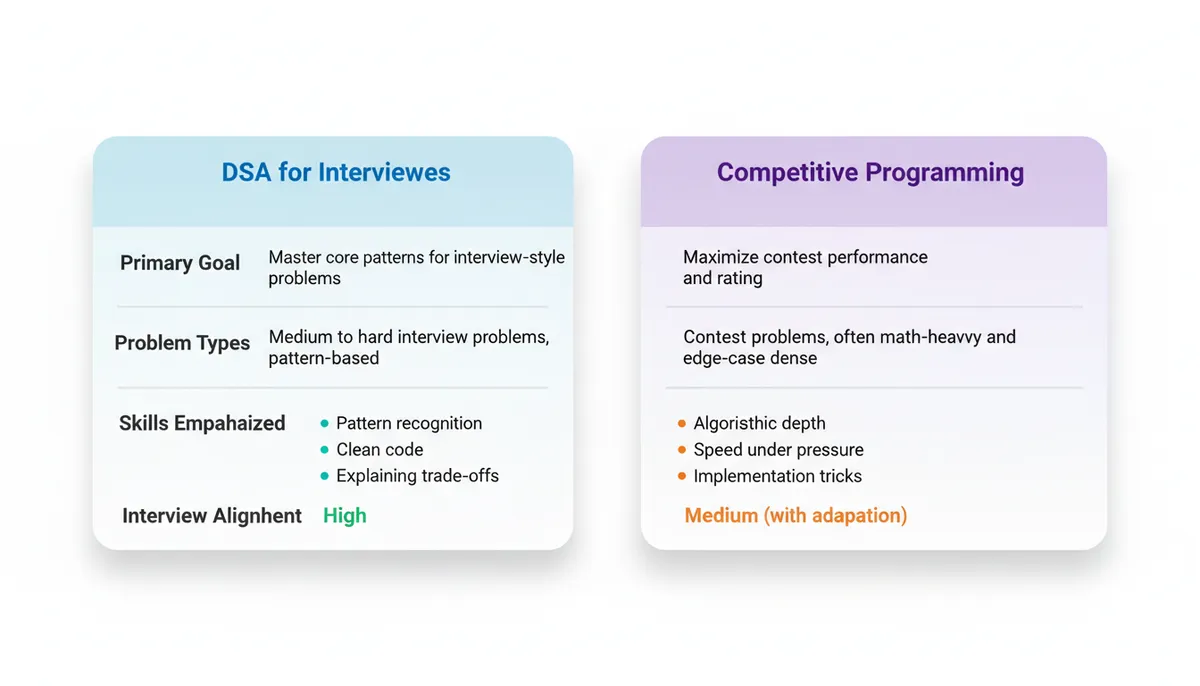
This comparison highlights a crucial point: DSA is directly aligned with software engineer interviews. CP is adjacent—it can help, but it’s not a drop-in replacement.
How Much DSA Do You Actually Need?
Core DSA Topics for Coding Interviews
For most software engineer interviews, you should be fluent in:
-
Arrays & Strings
- Two pointers, sliding window, prefix sums
- Example: “Longest substring without repeating characters”
-
Hash Maps / Hash Sets
- Counting, deduplication, lookups
- Example: “Two Sum”, “Group Anagrams”
-
Linked Lists
- Reversal, cycle detection, merge
- Example: “Merge two sorted lists”, “Detect cycle”
-
Stacks & Queues
- Monotonic stacks, BFS queues
- Example: “Valid parentheses”, “Largest rectangle in histogram”
-
Trees & Binary Trees
- Traversals (inorder/preorder/postorder)
- Recursion patterns, DFS/BFS on trees
- Example: “Binary tree level order traversal”, “Diameter of binary tree”
-
Binary Search
- On arrays, on answer space
- Example: “Search in rotated sorted array”, “Find minimum capacity to ship packages”
-
Heaps / Priority Queues
- Top-k, scheduling, streaming
- Example: “Kth largest element”, “Merge k sorted lists”
-
Graphs
- BFS, DFS, topological sort, connected components
- Example: “Course schedule”, “Number of islands”
-
Dynamic Programming
- 1D DP, 2D DP, subsequences, knapsack-style
- Example: “House robber”, “Longest increasing subsequence”, “Edit distance”
-
Greedy Algorithms
- Interval scheduling, merging intervals
- Example: “Non-overlapping intervals”, “Jump game”
You don’t need to know every exotic algorithm. But you do need strong pattern recognition.
This is where pattern-based learning (e.g., a structured DSA patterns sheet) is more effective than random problem grinding.
Example: Same Problem, DSA vs CP Mindset
Consider a classic interview problem:
Given an array of integers and a target, return indices of the two numbers such that they add up to target.
DSA mindset:
- Recognize the pattern: “two-sum with lookup”
- Use a hash map to store value → index
- Time: O(n), Space: O(n)
PYTHON
You’d also:
- Explain why hash map gives O(1) average lookup.
- Mention edge cases (duplicates, negative numbers).
- Discuss time (O(n)) and space (O(n)).
CP mindset:
- You’d likely solve it similarly, but:
- You might be less explicit about reasoning and trade-offs.
- You might be more focused on I/O speed, custom macros, minimizing code length.
Both solve the problem. But interviews care more about the DSA-style explanation and clarity.
Where Competitive Programming Helps (and Where It Doesn’t)
Strengths of CP for Interviews
Competitive programming can give you:
-
Fast problem parsing
- You quickly understand constraints and edge cases.
- You’re used to reading tricky statements under time pressure.
-
Algorithmic depth
- If asked a slightly unusual problem, you’re less likely to panic.
- You may know advanced techniques that help on harder interview rounds.
-
Implementation speed
- You’re used to coding quickly and debugging under a clock.
-
Comfort with complexity
- Large constraints don’t scare you.
- You naturally think about time and space complexity.
Gaps CP Leaves for Interviews
However, pure CP training often leaves gaps for software engineer interviews:
-
Communication
- CP is solo and silent; interviews are interactive.
- You need to narrate your thinking, not just code.
-
Code style
- CP code is often:
- Short, macro-heavy, less readable.
- Minimal error handling or comments.
- Interviews expect readable, production-leaning code.
- CP code is often:
-
Over-optimization
- You may jump to advanced solutions when a simpler one is enough.
- Interviewers often prefer:
- Start with brute force.
- Optimize step by step.
- Explain trade-offs.
-
Problem type mismatch
- Many CP problems:
- Use heavy math/number theory.
- Use data structures rarely needed in interviews (e.g., persistent segment trees).
- That time might be better spent mastering interview-specific patterns.
- Many CP problems:
If you’re already strong in CP, you’re ahead on raw problem-solving—but you still need to translate that into interview-style thinking and communication.
Common Pitfalls: DSA-Only vs CP-Only Prep
Pitfalls of DSA-Only Preparation
-
Overfitting to platforms
- Memorizing LeetCode solutions without understanding patterns.
- Struggling when a problem looks different from what you’ve seen.
-
Ignoring constraints
- Not checking input sizes, leading to TLE (time limit exceeded) in real interviews.
- Not thinking about worst-case complexity.
-
Weak implementation habits
- Not practicing coding on a whiteboard or plain editor.
- Relying on IDE autocomplete, not writing from scratch.
-
Lack of speed under pressure
- Solving problems leisurely without simulating a 30–45 minute interview environment.
Pitfalls of CP-Only Preparation
-
Underestimating communication
- Not explaining approach before coding.
- Not checking for understanding with the interviewer.
-
Poor code readability
- Using single-letter variable names everywhere.
- Writing dense, macro-heavy code that’s hard to follow.
-
Skipping brute force
- Jumping directly to optimal solution without:
- Establishing a baseline.
- Showing how you arrived at the optimization.
- Jumping directly to optimal solution without:
-
Practicing the wrong problem distribution
- Spending hours on niche topics (e.g., FFT, matrix exponentiation) that rarely appear in interviews.
- Less time on bread-and-butter patterns like sliding windows, tree DFS, or common DP patterns.
How to Choose: DSA vs Competitive Programming for Your Situation
If You’re New to Coding Interviews
Focus 80–90% on DSA, 10–20% on light CP-style practice.
- Build a solid foundation in:
- Basic data structures and algorithms.
- Pattern recognition across common interview topics.
- Use structured sheets or pattern-based roadmaps like the Beginner to Advanced DSA Roadmap for Software Engineers in 2026.
- Once you’re comfortable, occasionally try:
- Timed problems.
- Slightly harder problems to stretch your problem-solving ability.
For most candidates, you don’t need heavy CP to pass interviews at good companies.
If You’re Already a Competitive Programmer
You have a strong base. Optimize for interview alignment:
-
Translate your skills
- Practice explaining your approach before coding.
- Slow down enough to write clean, readable code.
-
Fill DSA gaps
- Review interview-heavy patterns:
- Systematic tree/graph traversal patterns.
- Common DP patterns used in interviews (not just contest DP).
- Practice classic interview problems you might have skipped.
- Review interview-heavy patterns:
-
Practice mock interviews
- Use platforms or peers to simulate real interviews.
- Focus on:
- Communication.
- Trade-off discussions.
- Handling follow-up questions.
A small amount of targeted interview-style practice can turn your CP advantage into a big interview advantage.
If You Have Limited Time (e.g., 4–6 Weeks)
Prioritize DSA patterns and interview-style practice:
-
Weeks 1–2: Core DSA review
- Arrays, strings, hash maps, two pointers, sliding window.
- Trees, recursion, BFS/DFS, basic graphs.
- Simple DP (1D, 2D, subsequences).
-
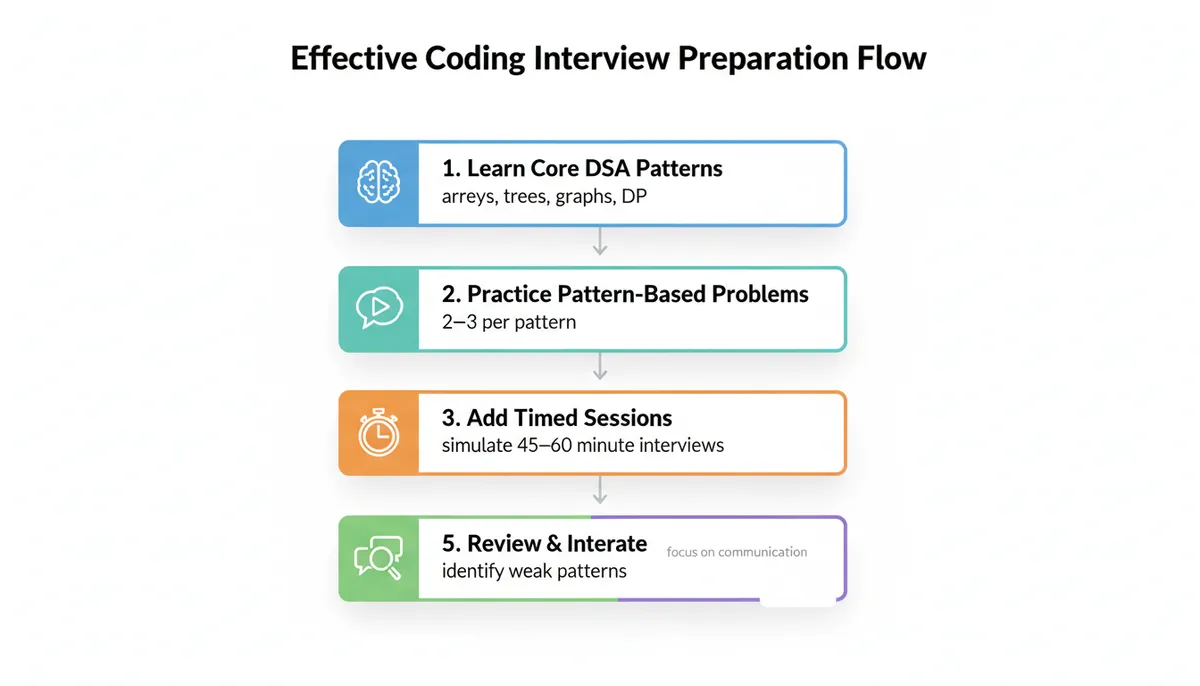
Weeks 3–4: Patterns + timed practice
- Focus on 2–3 patterns per week (e.g., sliding window, backtracking, tree DFS).
- Solve 2–3 problems per pattern.
- Start doing 45–60 minute timed sessions.
-
Weeks 5–6: Mock interviews + polishing
- 4–6 mock interviews (peers, mentors, or tools like an AI interview practice platform).
- Focus on communication, clarity, and handling edge cases.
In this timeline, heavy CP training is usually not the best ROI.
A Practical Hybrid Strategy: Get the Best of Both Worlds
You don’t have to choose strictly between cp vs dsa. A hybrid approach can work well.
Step 1: Master Interview-Focused DSA Patterns
Organize your learning by patterns, not by random problems:
- Sliding window
- Two pointers
- Fast & slow pointers
- Binary search (array + answer space)
- Top-k with heaps
- Backtracking
- Tree DFS/BFS
- Graph traversal and topological sort
- Classic DP patterns
For each pattern:
- Learn the idea.
- Implement 3–5 representative problems.
- Practice explaining the approach out loud.
Step 2: Add Light CP-Style Practice for Problem-Solving Stamina
Once you’re comfortable with core DSA patterns:
- Occasionally solve problems on platforms like Codeforces / AtCoder.
- Focus on:
- Div2 A/B/C level problems (not the hardest ones).
- Reading constraints and designing optimal solutions.
- Implementing quickly and correctly.
This improves:
- Speed under pressure.
- Comfort with tricky edge cases.
- Raw problem-solving ability.
Step 3: Simulate the Interview Environment
Finally, bridge the gap:
-
Use mock interviews (human or AI coach) to:
- Practice thinking aloud.
- Get feedback on clarity and structure.
- Identify weak patterns.
-
In each mock:
- Restate the problem in your own words.
- Ask clarifying questions.
- Start with a brute-force idea.
- Optimize step by step.
- Discuss complexity and trade-offs.
- Handle follow-up variations.
This is the piece many CP-heavy candidates skip—and it’s often the difference between “strong coder” and “strong interview performer.”
Example Walkthrough: Interview vs CP Approach on a Graph Problem
Consider:
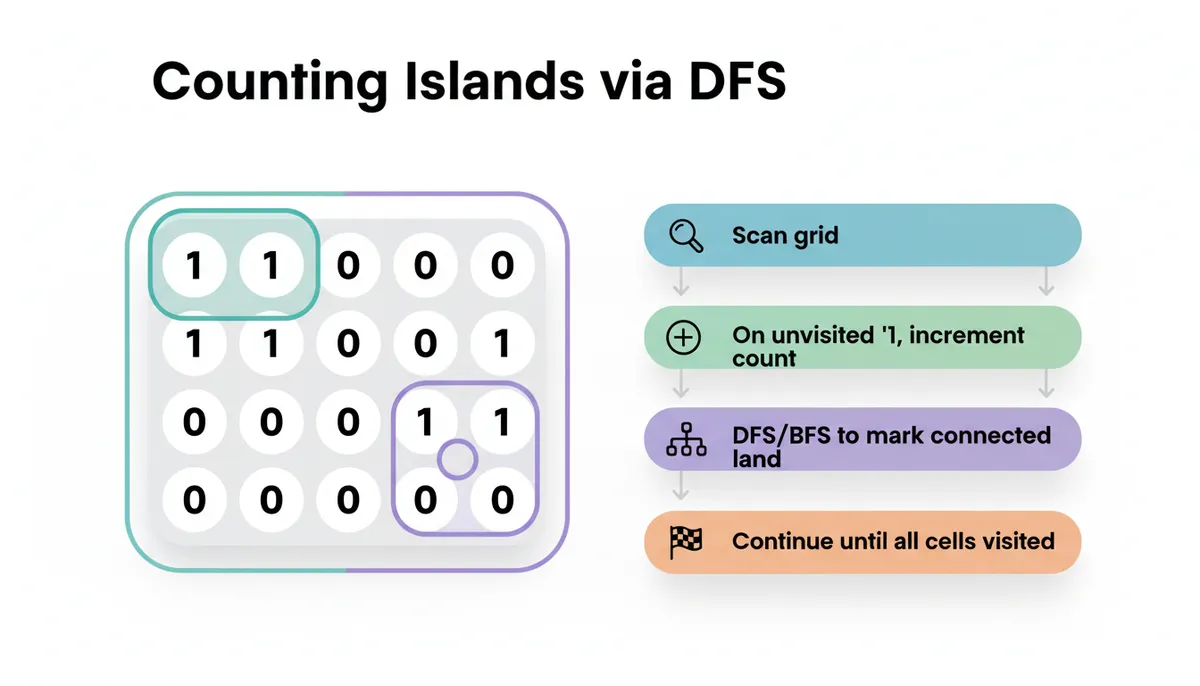
You are given a 2D grid of '1's (land) and '0's (water). Count the number of islands. An island is surrounded by water and is formed by connecting adjacent lands horizontally or vertically.
Interview-style DSA approach:
- Recognize this as a grid traversal / connected components problem.
- Use DFS or BFS to:
- Iterate over each cell.
- When you find a '1' that hasn’t been visited:
- Increment island count.
- Run DFS/BFS to mark all connected '1's as visited.
Pseudocode:
PYTHON
You’d explain:
- Time complexity: O(R * C)
- Space complexity: O(R * C) for visited + recursion stack.
- Possible optimizations (in-place marking to avoid extra visited array).
CP-style add-ons (often unnecessary for interviews):
- Using bitsets to optimize memory.
- Optimizing recursion to iterative stack to avoid stack overflow on large grids.
- Fast I/O (irrelevant in interviews).
The DSA-style explanation + clean code is exactly what interviewers look for.
When Competitive Programming Is Clearly Worth It
There are cases where investing more heavily in CP makes sense:
-
You’re targeting algorithm-heavy roles
- Research teams, algorithm engineering, low-latency trading.
- Some of these explicitly value CP achievements.
-
You enjoy it as a sport
- You like contests for their own sake.
- Then CP is a great way to stay sharp algorithmically.
-
You’re early in your career and have time
- If you’re in university with 2–3 years before serious interviewing:
- CP can build deep problem-solving skills.
- Later, you can layer interview-specific prep on top.
- If you’re in university with 2–3 years before serious interviewing:
Even then, for software engineer interviews, you’ll still need to:
- Practice communication.
- Align with interview problem styles.
- Adjust your coding style.
Best Practices for Coding Interview Preparation (Regardless of DSA vs CP)
Regardless of where you fall on the dsa vs competitive programming spectrum, these practices consistently help:
-
Think in patterns, not problems
- Group problems by underlying technique.
- Build a mental map: “This is a sliding window + hash set problem.”
-
Always do a quick complexity check
- Before coding, estimate:
- Input size.
- Desired time complexity (e.g., O(n), O(n log n)).
- Before coding, estimate:
-
Verbalize your approach
- Treat every practice problem like a mini-interview.
- Explain:
- Brute force.
- Why it’s too slow.
- Optimized approach and why it works.
-
Code as if someone else will maintain it
- Clear variable names.
- Logical structure.
- Handle edge cases explicitly.
-
Simulate constraints
- Use timers.
- Practice in a plain text editor or environment similar to interviews.
- Do full mock interviews periodically.
Key Takeaways: DSA vs Competitive Programming for Software Engineer Interviews
-
Interviews are optimized for DSA fluency, not CP mastery.
- They test core data structures, algorithms, and communication.
- You rarely need advanced contest-only techniques.
-
DSA is the direct path for coding interview preparation.
- Focus on core topics and patterns.
- Practice explaining and coding cleanly.
-
Competitive programming is a powerful but optional accelerator.
- It boosts problem-solving speed and algorithmic depth.
- You must still adapt your style to interview expectations.
-
If time is limited, prioritize DSA patterns and interview-style practice.
- Use CP lightly, if at all, as a supplement.
-
If you’re already strong in CP, you’re ahead—but not done.
- Work on communication, code readability, and interview problem styles.
Ultimately, the “better” choice in the dsa vs competitive programming debate depends on your goals, timeline, and current strengths. For most candidates aiming at software engineer interviews, a DSA-first, CP-as-needed approach is the most efficient path.