
DSA
How to Revise DSA Efficiently Before Interviews
Revising data structures and algorithms a week or two before interviews feels different from learning them the first time. You’re not trying to cover “all of...
Revising data structures and algorithms a week or two before interviews feels different from learning them the first time. You’re not trying to cover “all of DSA” from scratch; you’re trying to stabilize what you already know, fill the highest-impact gaps, and get into interview shape. A good DSA revision strategy is less about grinding random LeetCode and more about deliberate, pattern-based practice.
This guide lays out a concrete, engineering-style plan for last minute DSA revision: what to focus on, how to structure your coding interview revision sessions, and how to use pattern-based learning to build a realistic LeetCode revision plan.
1. Set the Goal of Your DSA Revision (It’s Not “Cover Everything”)
The fastest way to waste your final week is to aim for “complete coverage”. No one masters every LeetCode hard problem before interviews. Strong candidates instead:
- Are solid on core patterns and can recognize them under pressure
- Can implement standard solutions quickly and correctly
- Understand time/space tradeoffs and can communicate them
- Stay calm when a problem is unfamiliar and reduce it to known components
Your DSA revision strategy should optimize for:
- Pattern recognition over problem memorization
- Execution speed over breadth
- Clarity of explanation over clever tricks
Keep this mental model in mind: you’re building a library of reusable templates (patterns) and practicing how to pick and adapt the right template under time pressure.
2. Map the DSA Landscape into Patterns
Instead of a flat list of topics (“arrays, trees, DP, graphs”), think in terms of patterns that repeatedly appear in interview questions.
2.1 Core DSA Categories to Revise
At a minimum, your last minute DSA revision should cover:
- Arrays & Strings
- Hashing / Maps / Sets
- Two Pointers & Sliding Window
- Stacks & Queues
- Linked Lists
- Binary Trees & BSTs
- Heaps / Priority Queues
- Recursion & Backtracking
- Binary Search (on value / answer space)
- Dynamic Programming (1D, 2D, subsequences, knapsack-style)
- Graphs (BFS, DFS, shortest path basics)
But within each, you want to think in patterns, not just data structures.
2.2 Example: Pattern-Based Organization
Here’s how you might break down a few categories:
-
Arrays & Strings
- Two pointers on sorted array
- Fast/slow pointers (cycle detection, middle of list)
- Sliding window (fixed-size, variable-size, with constraints)
- Prefix sums & difference arrays
-
Trees
- DFS traversals (preorder/inorder/postorder, iterative vs recursive)
- BFS level order
- Root-to-leaf path problems
- Lowest Common Ancestor variants
- Binary Search Tree invariants
-
Dynamic Programming
- 1D DP on sequences (climbing stairs, house robber)
- 2D DP on grids (paths, obstacles, DP with directions)
- Subsequence DP (LCS, LIS, edit distance)
- Knapsack-style (subset sum, partition)
Your coding interview revision should revolve around these patterns: for each, know 2–3 canonical problems cold.
3. Build a 7–10 Day LeetCode Revision Plan
You don’t need a perfect schedule, but you do need a deliberate plan. Here’s a template you can adapt.
3.1 Day-Level Structure
For a 7-day intensive revision:
- Day 1–2: Arrays, Strings, Hashing, Two Pointers, Sliding Window
- Day 3: Linked Lists, Stacks, Queues
- Day 4: Trees & BSTs
- Day 5: Heaps, Binary Search, Basic Graphs
- Day 6: Dynamic Programming
- Day 7: Mixed mock interviews + weak-area review
If you have more time (10–14 days), add:
- Extra DP day
- Extra Graphs / Advanced topics day (topological sort, union-find)
- More mock interviews
3.2 Session-Level Structure (2–3 Hours)
Each revision session can follow this pattern:
-
Warm-up (15–20 min)
- Re-implement 1–2 standard templates from memory (e.g., binary search, BFS, sliding window skeleton). See how to identify the right DSA pattern in a coding interview for better pattern recognition.
- No IDE autocomplete; type them out.
-
Focused practice on 1–2 patterns (60–90 min)
- Pick 3–5 problems in the same pattern, varying difficulty.
- For each:
- Spend 5–10 minutes thinking without coding.
- Identify the pattern explicitly (“This is variable-size sliding window with a frequency map”).
- Implement, then review time/space complexity.
-
Retrospective (20–30 min)
- Write down:
- Patterns you recognized
- Mistakes you made
- Any reusable snippets or invariants
- Add 1–2 problems to your “revisit” list (hard but important).
- Write down:
-
Speed round (20–30 min)
- Take 1–2 problems you solved earlier in the week.
- Re-implement from scratch without looking at your old solution, aiming for speed and cleanliness.
This structure aligns with how pattern-based platforms (e.g., a /dsa-patterns-sheet organized by patterns) are designed: revisit, reinforce, and speed up.
4. Pattern-Based DSA Revision Strategy by Topic
Let’s go topic by topic and outline how to revise efficiently and what to practice.
4.1 Arrays, Strings, and Hashing
These are the most common starting points in interviews and the foundation of many patterns.
Key Patterns to Revise
- Two pointers on sorted arrays
- Pair sum, remove duplicates, merge sorted arrays
- Fast/slow pointers
- Cycle detection, middle of list, palindrome checking
- Sliding window
- Longest substring with K distinct characters
- Minimum window substring
- Max sum subarray of size K
- Hash map / set usage
- Two sum
- Longest consecutive sequence
- Anagram grouping
Practice Approach
- For each pattern, pick 2 easy + 2 medium problems.
- Focus on:
- Maintaining window invariants (“window always satisfies constraint X”)
- Updating counts/maps efficiently
- Avoiding off-by-one errors
{{IMAGE: sliding-window-revision | Sliding Window Pattern for DSA Revision | Create a horizontal diagram on white background showing a string "A B C A B B A" as 7 adjacent boxes with light gray borders. Above the boxes, large title "Sliding Window: Longest Substring Without Repeating Characters" in black. Below the string, draw a colored sliding window spanning indices 0–2 first, then 2–5. Use semi-transparent teal (#14b8a6) rounded rectangle for the window, with small labels "start" in green (#10b981) at the left edge and "end" in orange (#f97316) at the right edge, arrows pointing up to respective indices. Under each window, show a small legend box with text "Window chars: {A,B,C}" then "Window chars: {C,A,B}" in dark gray. On the right side, include a vertical note box with blue (#3b82f6) border titled "Invariant" and bullet points: "All chars in window are unique", "Move 'end' to expand", "Move 'start' to restore invariant". Use clean flat design, medium font labels for indices 0–6 below each box.}}
4.2 Linked Lists, Stacks, and Queues
These often appear as pointer-manipulation and simulation problems.
Linked Lists: Must-Know Operations
Be able to implement these from memory:
- Reverse a linked list (iterative and recursive)
- Detect cycle and find cycle start (Floyd’s algorithm)
- Merge two sorted lists
- Find middle node
- Remove N-th node from end
Stacks & Queues: Common Patterns
- Monotonic stack
- Next greater element
- Daily temperatures
- Stack-based parsing
- Valid parentheses
- Evaluate RPN
- Queue / Deque
- Sliding window maximum (deque-based)
For revision, code the “tooling”: generic monotonic stack template, linked list reversal, and re-use them.
4.3 Trees and BSTs
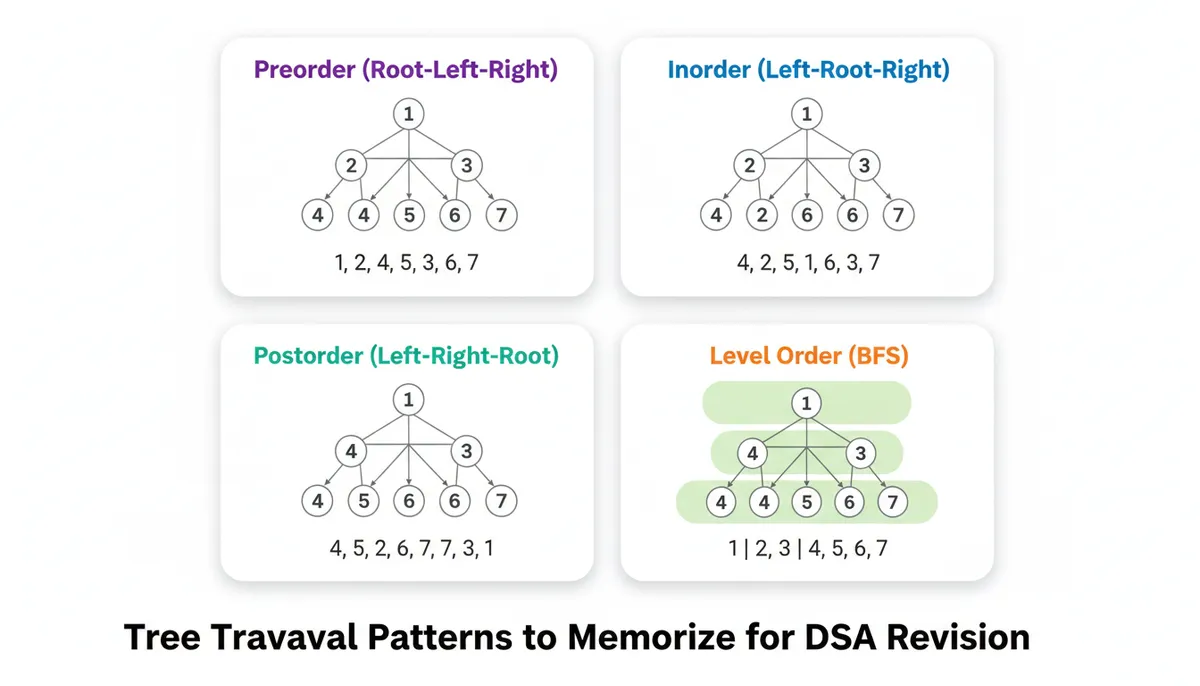
Tree problems are heavily pattern-based. Your goal: see any tree problem and quickly map it to a known traversal pattern.
Core Tree Patterns
-
DFS Traversals
- Preorder, inorder, postorder (recursive and iterative)
- Use these as building blocks for:
- Tree height
- Balanced tree check
- Path sum problems
-
BFS Level Order
- Level order traversal
- Connect nodes at same level
- Zigzag level order
-
Root-to-Leaf Path Problems
- Path sum
- Collect all root-to-leaf paths
- Maximum path sum
-
BST-specific
- Validate BST
- K-th smallest
- Inorder successor
Revision Tactics
- Re-implement all four tree traversals from scratch.
- Pick 5–7 tree problems and classify each:
- “This is DFS with a return value”
- “This is BFS with queue size loop”
- “This is inorder on BST”
- Practice explaining your recursion clearly: base case, recursive case, combination.
4.4 Heaps, Binary Search, and Graphs
These topics often appear in mid/late rounds.
Heaps / Priority Queues
Patterns:
- K-th largest / smallest element
- Merge K sorted lists
- Top K frequent elements
Revision:
- Know when to use min-heap vs max-heap
- Be fluent with your language’s heap API
- Understand time complexity: O(n log k) patterns
Binary Search
Not just on arrays—also on the answer space.
Patterns:
- Classic binary search on sorted array (lower bound, upper bound)
- Binary search on answer:
- Minimum capacity to ship packages within D days
- Koko eating bananas
- Allocate minimum pages / split array largest sum
Key invariant: design good(mid) predicate and maintain correct lo, hi updates.
Graphs
For last minute DSA revision, focus on:
- BFS and DFS on adjacency list
- Connected components
- Shortest path in unweighted graph (BFS)
- Cycle detection in directed graphs (DFS with colors or recursion stack)
- Basic topological sort
4.5 Dynamic Programming (DP)
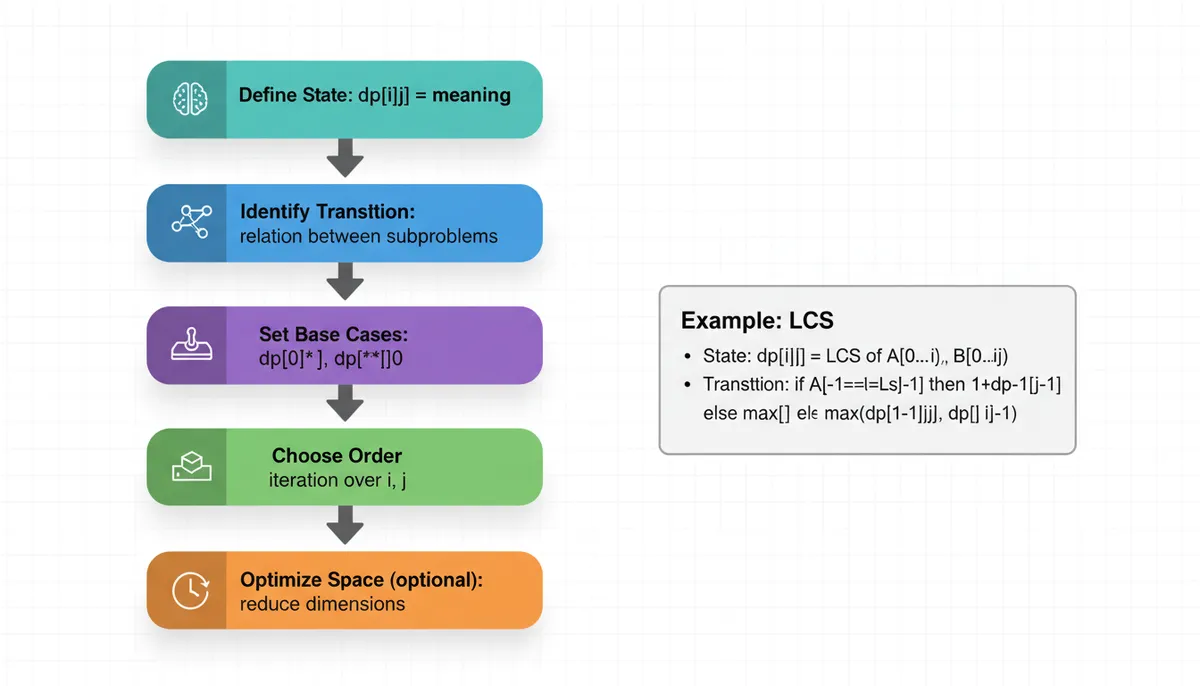
DP is where many candidates lose time. Your goal for DP revision is not to cover every problem, but to master a few representative schemas.
DP Revision Strategy
-
Unify your mental model
- DP = recursion + memoization + overlapping subproblems
- Always ask:
- What is the state?
- What is the transition?
- What is the base case?
-
Cover 3–4 DP families
- 1D DP on index
- Climbing stairs, house robber, Fibonacci
- 2D DP on grid
- Unique paths, grid with obstacles, min path sum
- Subsequence DP
- Longest common subsequence (LCS)
- Longest increasing subsequence (LIS)
- Edit distance
- Knapsack-style
- Subset sum
- Partition equal subset sum
- Practice converting recursion to DP table
Write top-down (memoized recursion), then bottom-up, then space-optimized if applicable.
5. Implement a Daily Coding Interview Revision Loop
Beyond topic-specific strategy, your daily loop matters. Here’s a concrete loop optimized for last minute DSA revision.
5.1 The “3–2–1” Daily Plan
In 2–3 hours, aim for:
- 3 pattern-aligned problems (new or revisited)
- 1 easy (warm-up)
- 2 medium (core practice)
- 2 speed re-implementations of known problems
- 1 mock interview-style problem under time constraint
For each new problem:
- Spend 5–10 minutes understanding and designing.
- State the pattern out loud or in comments.
- Implement in 20–25 minutes.
- Analyze complexity and discuss optimizations.
Mock interview-style problems can be self-timed, with a friend, or via tools that simulate interviewers (e.g., an AI interview practice environment that asks follow-up questions and evaluates explanations).
5.2 Track Patterns, Not Problem IDs
Instead of “I did problem #123”, track:
- Pattern: e.g., “variable-size sliding window with hash map”
- Status:
- “Can do from memory”
- “Need hint”
- “Don’t understand yet”
- Notes:
- Common pitfalls you hit
- Edge cases
This lets you build a pattern mastery map, which is more predictive of performance than a raw problem count.
6. Common Mistakes in Last Minute DSA Revision
Efficient DSA revision is as much about avoiding traps as it is about doing the right things.
6.1 Grinding Random Problems Without a Plan
LeetCode’s “Random” button is tempting, but:
- You switch contexts too often
- You don’t reinforce patterns
- You don’t see systematic improvement
Instead, batch problems by pattern and difficulty.
6.2 Over-Focusing on Hard Problems
Hard problems can be good for learning, but in the final week:
- Most interview questions are easy to medium in difficulty
- You get more return from:
- Speed on medium problems
- Accuracy under pressure
- Clear explanations
Use hard problems sparingly as stretch goals, not core practice.
6.3 Ignoring Implementation Details
Knowing the idea is not enough. Interviewers care about:
- Clean, bug-free code
- Handling edge cases (empty input, single element, duplicates, negative numbers)
- Reasonable variable names and structure
During revision, force yourself to:
- Write full function signatures
- Handle edge cases upfront
- Run through at least one example manually
6.4 Not Practicing Communication
A strong DSA revision strategy includes verbal practice:
- Explain your approach before coding
- Narrate your thought process while coding
- After coding, explain complexity and alternatives
If you’re using an AI or human coach (best ways to use AI for DSA and coding interview preparation style sessions), ask for feedback specifically on communication: clarity, structure, and handling hints.
7. Example: Revising a Pattern End-to-End
Let’s walk through a concrete example: variable-size sliding window.
7.1 Step 1: Recall the Generic Template
In pseudocode:
PYTHON
This is the pattern. Your revision goal: be able to adapt this quickly.
7.2 Step 2: Apply to a Specific Problem
Example: “Longest Substring Without Repeating Characters”
- State: window contains unique characters
- Constraint: no duplicates
is_valid(window)= all counts ≤ 1
Implementation in Python:
PYTHON
- Time complexity: O(n), each char added/removed at most once
- Space complexity: O(min(n, alphabet_size))
7.3 Step 3: Generalize and Compare
Next, solve “Longest Substring with At Most K Distinct Characters”:
- State: count of each character
- Constraint:
len(freq) <= K is_valid(window)=len(freq) <= K
Notice how the same pattern applies with a different constraint. In your notes, list both problems under “variable-size sliding window” and write the invariant for each.
This is how you should structure your LeetCode revision plan: for each pattern, 2–3 problems that share the same skeleton but vary constraints.
8. Time and Space Complexity: Fast Mental Models
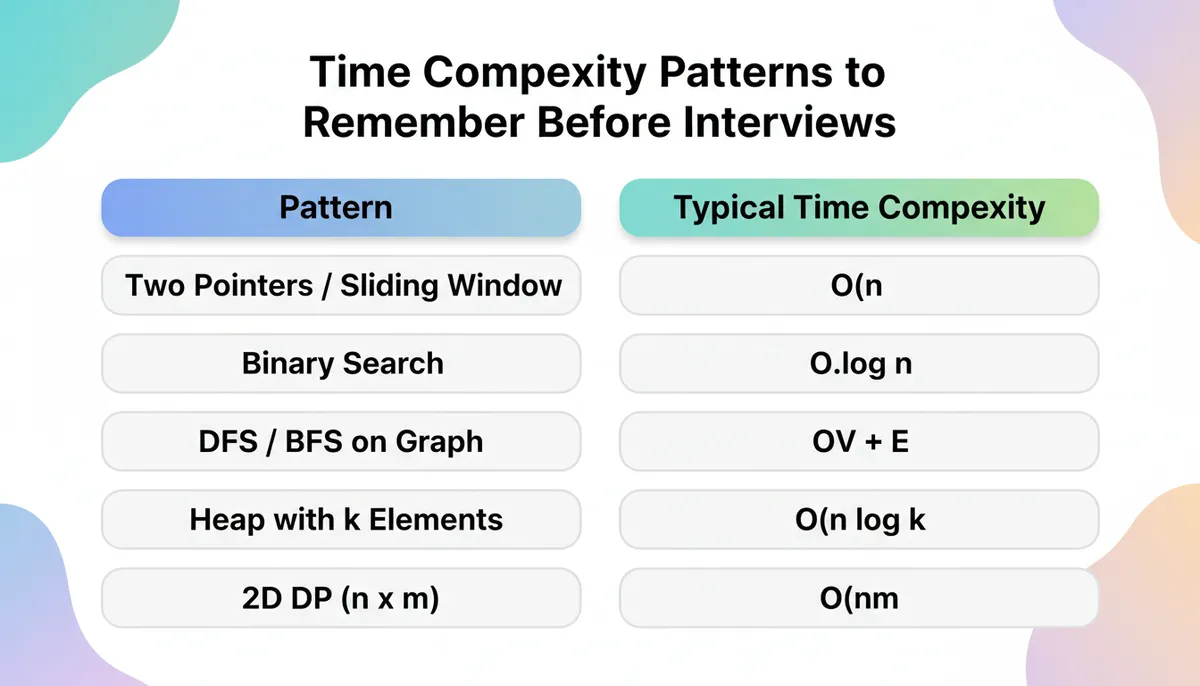
Interviewers expect quick, correct complexity analysis. During revision:
-
For each pattern, memorize its canonical complexity:
- Two pointers / sliding window: O(n)
- Binary search: O(log n)
- BFS/DFS on graph: O(V + E)
- Heap with k elements: O(n log k)
- DP with n × m table: O(nm) time and space (or optimized)
-
Practice deriving complexity, not just reciting:
- Count outer loop iterations
- Count inner loop or data structure operations
- Recognize amortized patterns (e.g., each element enters/leaves window once)
9. Putting It All Together: A Sample 3-Day Intensive Plan
If your interview is very close and you need a compressed last minute DSA revision plan, here’s a 3-day intensive schedule (assume 4–5 hours/day).
Day 1: Arrays, Strings, Two Pointers, Sliding Window
- Warm-up:
- Implement binary search, two pointers for pair sum.
- Practice:
- 2 problems: two pointers (sorted array, linked list fast/slow)
- 3 problems: sliding window (fixed size, variable size, with map)
- Speed:
- Re-implement 2 sliding window problems from memory.
- Mock:
- 1 full-length array/string problem under 35–40 minutes.
Day 2: Trees, Linked Lists, Stacks, Queues
- Warm-up:
- Implement preorder, inorder, postorder traversals.
- Reverse a linked list.
- Practice:
- 3 tree problems (height, path sum, level order)
- 2 stack/monotonic stack problems
- Speed:
- Re-implement linked list cycle detection and tree height.
- Mock:
- 1 tree problem under interview conditions.
Day 3: Heaps, Binary Search, DP, Graphs (Light)
- Warm-up:
- Implement heap usage in your language.
- Implement BFS and DFS on adjacency list.
- Practice:
- 2 binary search on answer problems
- 2 easy/medium DP problems (1D + 2D)
- 1 graph traversal problem
- Speed:
- Re-implement a DP and a BFS problem from memory.
- Mock:
- 1 mixed-topic problem.
Throughout, keep a running list of patterns you feel shaky on and revisit those first each day.
10. Key Takeaways
- An efficient DSA revision strategy is pattern-centric, not problem-centric.
- Organize your coding interview revision around core patterns: two pointers, sliding window, tree traversals, BFS/DFS, binary search, DP schemas.
- Use a structured daily loop: warm-up templates, focused pattern practice, retrospectives, and speed re-implementations.
- Prioritize easy/medium problems for speed and reliability; use hard problems selectively.
- Practice communication and complexity analysis alongside coding.
- Track your progress by pattern mastery, not by LeetCode problem count.
With a focused LeetCode revision plan and deliberate pattern-based practice, your last few days before interviews can significantly improve both your confidence and performance.