
Interview
AI Interview Software for Technical Hiring (2026): A Buyer's Guide
How to choose AI interview software for technical hiring in 2026: four tool categories, eight evaluation criteria, NYC LL144 and EU AI Act, plus a pilot plan.
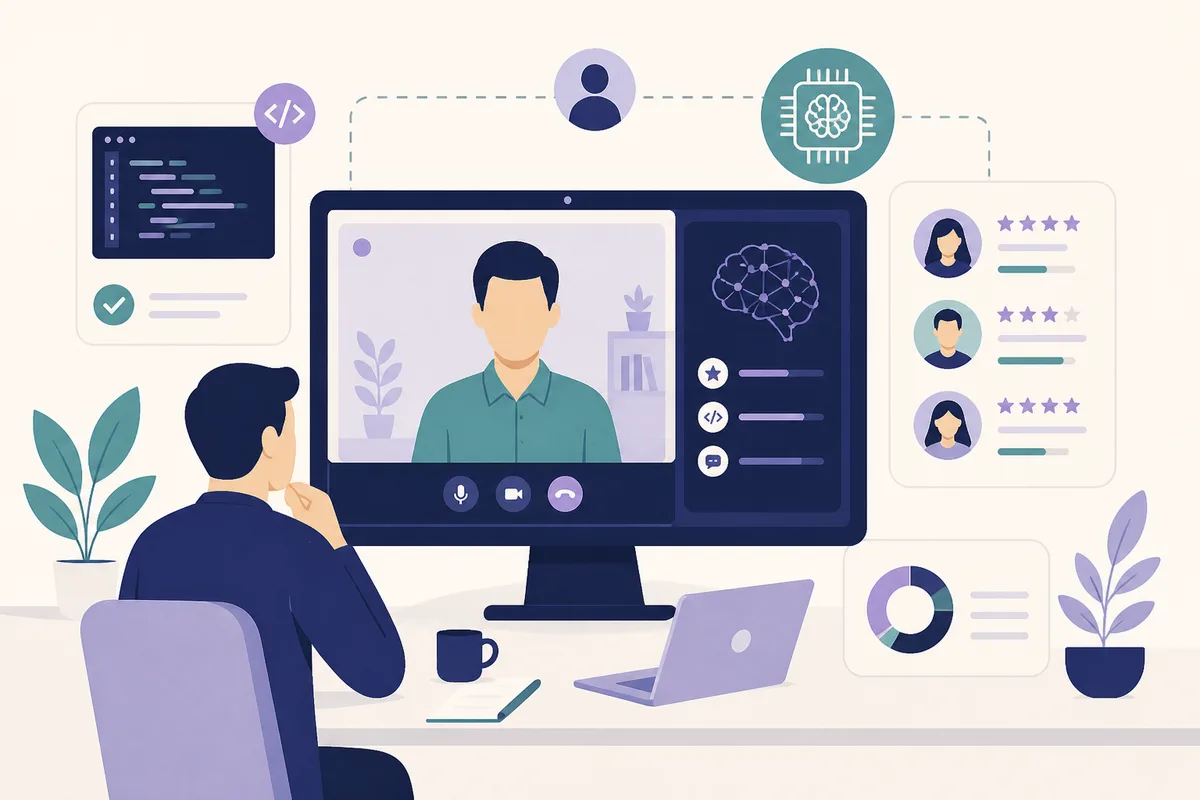
Run first-round technical interviews with an AI interviewer
AI interview software for technical hiring falls into four groups: one-way video screening, conversational AI interviewers, coding assessment platforms, and human interviewers sold as a service. They produce different kinds of evidence, and most teams end up combining two of them. This guide explains what each category does, what to test before you buy, which laws apply as of October 2026, and how to run a pilot that tells you something real.
If you only have a minute, the table below answers the questions buyers search for most.
At a glance
| Question | Short answer |
|---|---|
| What counts as AI interview software? | Tools that run, score or summarize candidate interviews or assessments using AI. Some talk to the candidate, some only grade code, some use AI only to summarize a human interview. |
| Which category fits technical hiring best? | For reasoning and communication signal, a conversational AI interviewer with code execution. For raw skills at volume, an assessment. For calibrated senior signal, human interviewers. |
| Can an AI interviewer replace a human interviewer? | For a first-round screen, often it can carry the load. For final rounds and hiring decisions, keep humans. Nothing in this guide argues for removing human review. |
| What should I verify about scoring? | That a written rubric exists, that dimension scores are tied to evidence from the interview, and that two candidates with the same answers get the same score. |
| Is there regulation? | Yes. NYC Local Law 144 covers automated employment decision tools for NYC candidates. The EU AI Act treats recruitment AI as high-risk. Several US states have added rules. See the legal section. |
| How do I handle cheating? | Design for it: a conversational format that probes reasoning, clear AI-use rules, and proctoring or identity checks where you need them. No tool eliminates it. |
| How long should a pilot run? | Long enough to compare AI-screened candidates to your usual funnel through at least the onsite stage. Define pass criteria before you start. |
The four categories of AI interview software
1. One-way (asynchronous) video interviews
Candidates record answers to preset questions on their own time. Reviewers watch the clips or read transcripts and scores. HireVue is the best-known vendor in this space, and its own site now also describes a voice-based AI Interviewer with follow-up questions, transcripts and rubric-based scoring.
What it is good at: scheduling-free screening for behavioral and motivation questions across high-volume roles. What it is weak at: technical depth. A fixed question list cannot adapt when a candidate says something interesting or wrong. Because these tools have historically analyzed recorded video, they have also drawn the most regulatory attention (see the legal section). For a deeper comparison, see our HireVue alternatives guide.
2. Conversational AI interviewers
These tools hold a spoken (or sometimes typed) conversation, ask follow-up questions based on the answer, and produce a structured report. Several vendors now sell one. CodeSignal lists an AI Interviewer with prebuilt agents for business roles and a custom option, HackerRank describes an agentic AI interviewer called Chakra that observes candidates working on a real-world problem, and HireVue has its AI Interviewer. ThitaHire, our B2B product, sits in this category and is aimed at technical and structured first rounds.
What it is good at: probing reasoning at volume, running the same structure for every candidate, and removing scheduling. What to scrutinize: how follow-ups are generated, whether code is actually executed, and how the final report ties scores to evidence.
3. Coding assessment platforms
Candidates solve problems in a browser IDE, and test cases grade the result automatically. HackerRank and CodeSignal are the main names, and both also offer live interview tools with a shared editor. Both have added AI-assisted modes, where candidates work with an assistant and the interviewer can see the transcript (CodeSignal's announcement).
What it is good at: objective, comparable scores on well-defined problems, cheaply, at scale. What it is weak at: explaining why a candidate wrote what they wrote. An unproctored test also invites AI-assisted answers. See our CodeSignal and HackerRank alternatives guide for how teams combine tests with interviews.
4. Human interviewers as a service
Karat supplies trained interviewers who run structured technical interviews on your behalf. Karat's site says its Interview Engineers conduct every interview so results are consistent across teams. The signal is strong and calibrated, and it costs more per interview than software. Karat does not publish prices on its site; third-party listings describe per-interview pricing, so check current pricing with the vendor. More in our Karat alternatives guide.
What to evaluate (and how to test each)
Do not score vendors from a feature list. Run the same two or three candidates, including a strong one, a weak one and an unusual one, through each tool and compare what you get back.
Signal quality
Ask what decision the output supports. A useful report separates what the candidate said, what they built, and what the tool inferred. Check whether a hiring manager who did not see the interview can tell why a candidate scored as they did. Reports that give a single number with no evidence are hard to defend and hard to calibrate.
Rubric consistency
Request the rubric. Good tools score named dimensions (for example problem solving, code quality, communication, design tradeoffs) against written criteria. Then test consistency: give the tool the same answer twice, and a clearly better and clearly worse answer, and see whether scores move as they should. HireVue's AI Interviewer page describes scores tied to behavioral anchors; whichever vendor you evaluate, ask to see the anchors.
Coding execution
For engineering roles, ask whether code is compiled and run against test cases during the interview, which languages are supported, and whether the interviewer reacts to the result. A conversational tool that only discusses code, without running it, gives you spoken opinions about code that may not work. ThitaHire's site describes an integrated coding and case flow in which reasoning and implementation signals are kept in the feedback; as with any vendor, run it yourself.
System-design coverage
Senior and mid-level hiring depends on design interviews, and most automated tools skip them. Ask whether the candidate gets a canvas or diagramming surface and whether the interviewer questions the design. ThitaHire's site describes an HLD and LLD design canvas. Karat-style human interviews and some live-interview tools can cover design too. Assessments generally do not.
Candidate experience
Candidates drop out of processes that feel like a black box. Take the interview yourself. Check how it starts, whether the AI interrupts, whether it handles accents and pauses, how failure is handled (dropped connection, audio problems), and whether the candidate learns what happens next.
Fraud and integrity
Treat integrity as a design problem rather than a feature checkbox. Questions to ask every vendor:
- What is monitored (screen, camera, audio, browser focus), and is it disclosed to candidates?
- Is identity verified, and how?
- How does the tool treat AI-assistant use? Some platforms now let you permit it deliberately and record the transcript.
- Are flagged sessions escalated to a person, or auto-rejected?
HackerRank describes plagiarism detection and flagging of unauthorized tools; CodeSignal has a cheating and fraud section on its site; neither page we read gave detail on specific detection methods, so ask for documentation. ThitaHire's site does not describe proctoring features, so if proctoring is a requirement, raise it directly with the team. A conversation that probes why a candidate made each choice is itself harder to fake than a fixed test, but it is not a guarantee. Our guide on whether online assessments are proctored covers what candidates should expect.
Bias auditing and legal readiness
Ask for the most recent independent bias audit, the date, the auditor, what categories were tested, and whether the audit covers the specific tool and use case you plan to deploy. A vendor's statement that its scoring is audited is a starting point, not a substitute for your own compliance review. The next section covers which rules apply.
Legal and compliance checklist (as of October 2026)
This is an overview for buyers, not legal advice. Have counsel confirm what applies to your hiring footprint.
NYC Local Law 144
NYC's law on automated employment decision tools says an employer or employment agency may not use such a tool to evaluate a candidate unless it has had a bias audit within the year before use, a summary is publicly available, and candidates receive notice. According to the city's page, the Department of Consumer and Worker Protection enforces it, and its slides say notice goes out 10 business days before use. Law-firm summaries add that audits calculate selection rates and impact ratios by race, ethnicity and sex categories, and that candidates may ask for an alternative process or accommodation. In December 2025 the New York State Comptroller reported that enforcement of the law had been ineffective, which signals more scrutiny rather than less. The law applies based on where the candidate or employer is, so a remote hire living in NYC can bring you into scope.
EU AI Act
The AI Act's Annex III lists AI systems intended for the recruitment or selection of people, including evaluating candidates, as high-risk. Obligations for high-risk systems include human oversight, logging, transparency to affected people and monitoring. The original application date of 2 August 2026 was pushed back: the Digital Omnibus on AI, published in the Official Journal as Regulation (EU) 2026/1744 on 24 July 2026, moved standalone Annex III systems to 2 December 2027, according to law-firm summaries. This is a delay, not a repeal. Separately, Article 5 already prohibits using AI to infer emotions of people in the workplace, except for medical or safety reasons, so ask any vendor whether its scoring uses emotion inference. Verify the dates against the Official Journal text before you plan around them.
Other US rules
- California: Civil Rights Council regulations on automated-decision systems took effect 1 October 2025 and, per law-firm alerts, extend discrimination rules to such tools and require retaining related records for at least four years.
- Illinois: Amendments to the Human Rights Act effective 1 January 2026 bar discriminatory use of AI in employment decisions and require notice; the older AI Video Interview Act requires notice and consent when AI analyzes video interviews.
- Colorado: The state's AI Act has been delayed more than once, and we could not confirm its current effective date, so check the status directly.
- Federal: The EEOC removed its AI technical-assistance documents in January 2025 and in 2025 directed staff to close disparate-impact investigations. Title VII, the ADA and the ADEA still apply, and private lawsuits continue; the Mobley v. Workday case over AI screening was still pending in reports from spring 2026.
Our companion piece, AI interview bias and fairness, goes through the process controls in detail.
Rollout checklist
- Define the decision. What will the tool decide or inform: advance/reject, rank, or route to a human? The more it decides, the more legal exposure.
- Write the rubric before the pilot. Include dimensions and what a strong, borderline and weak answer looks like.
- Map your legal footprint. Where do candidates live, and which laws apply? Collect vendor audit documents.
- Draft candidate notice and consent. Say that AI is used, what it evaluates, how long data is kept, and how to request an alternative or accommodation.
- Set the human review step. Name who reviews AI output, what they see, and what overrides are allowed.
- Take the interview yourself. Recruiters and hiring managers should each sit one round.
- Run a bounded pilot. One role family, one region, a fixed window.
- Decide in advance what success means. See metrics below.
- Plan for accommodations and failures. Have a human fallback for audio problems, disabilities and technical failures.
- Schedule a recurring review. Re-check scoring, audits and complaints on a calendar, not when something breaks.
Pilot metrics that matter
Pick a small set and write down the target before you start.
- Completion rate: the share of invited candidates who finish. A low rate is a candidate experience warning.
- Time to decision: from invite to recruiter decision, compared with your current first round.
- Reviewer agreement: how often a hiring manager independently reaches the same advance/reject call as the AI report. Disagreements are the most useful data you will collect.
- Downstream performance: how candidates the tool advanced do in later rounds, compared with candidates your usual process advanced.
- Adverse-impact check: pass-through rates by group where you have lawful data to measure, reviewed by someone qualified to interpret them.
- Candidate feedback: a short survey after the interview.
- Escalations: how many sessions needed human intervention or an alternative process.
Avoid proxy metrics like "interviews run." Volume tells you the tool works, not that it helps you hire.
Where ThitaHire fits
ThitaHire is our B2B platform for hiring teams. According to the product site, you create role-specific rounds (SDE, data science, AI and LLM, product management, behavioral, HLD and LLD), send candidates an interview link, and candidates complete a voice-led adaptive interview with follow-up questions. Recruiters get dimension-wise scoring and a structured report with strengths, concerns and a recommendation signal, plus hiring analytics. The site describes it as built on thita.ai, our candidate practice platform, which offers a free AI mock interview. It is one option in the conversational AI interviewer category, not a replacement for every other category; pricing, integrations and compliance documentation are things to ask the team about directly.
FAQ
What is AI interview software? It is software that runs, scores or summarizes interviews or assessments using AI. That ranges from one-way video tools to conversational AI interviewers and automated coding tests. Check what the AI actually does in each product, because the label covers very different things.
What is the best AI interviewer for hiring? It depends on the role and the signal you need. For technical roles, prioritize code execution, adaptive follow-ups, rubric-based reports and a human review step. Run the same candidates through two or three tools and compare, instead of trusting rankings, including ours.
Which AI interview companies should I look at? Common names include HireVue, CodeSignal, HackerRank, Karat and, for conversational technical rounds, ThitaHire. Each fits a different need; see our guides to Karat, HireVue and CodeSignal alternatives, and our list of companies using AI interviewers.
Is AI interview software biased? It can be, because scoring models and rubrics can encode bias. Mitigations include structured rubrics, independent bias audits, human review and monitoring pass-through rates. Our fairness guide lists the controls.
Is AI interview software legal? Generally yes, with conditions. NYC requires bias audits and notice for covered tools, the EU treats recruitment AI as high-risk, and several US states have added rules. Confirm your obligations with counsel for each place you hire.
Can AI interview software detect cheating? Some tools flag suspicious behavior, and conversational formats make memorized answers easier to spot, but no tool catches everything. Combine clear rules, probing questions and, where needed, identity checks or an in-person round.
How much does AI interview software cost? Vendors mostly do not publish prices on their sites, and pricing models vary between per-interview, per-seat and per-assessment. Check current pricing with each vendor.
How should we pilot it? Pick one role family, define the rubric and success metrics first, take the interview yourself, and compare AI-screened candidates against your usual funnel through later rounds.
See it before you decide
The fastest way to judge any AI interview tool is to sit the interview yourself. You can try the ThitaHire live demo or contact the team to talk through your roles and screening workflow.
Topics
Related on Thita
Your next step
Run first-round technical interviews with an AI interviewer
ThitaHire runs voice-led, adaptive first rounds for SDE, data science, AI/LLM, PM, behavioural and system design roles, with coding discussion, a design canvas and structured, rubric-based reports for your recruiters.