
Interview
HireVue Alternatives for Technical Roles (2026): One-Way Video vs Adaptive Interviews
HireVue alternatives for technical hiring in 2026: one-way video vs adaptive conversational interviews, a fair comparison table, and what to check first.
Run first-round technical interviews with an AI interviewer
HireVue is built for structured screening at volume across many kinds of roles. For engineering and other technical roles, teams usually look for alternatives because they want to test reasoning, run code and probe design, which a fixed list of recorded questions does not do well. The options fall into two camps: tools that add technical depth to a structured screen, and tools that replace the one-way format with an adaptive, conversational interview. This guide compares them fairly as of October 2026.
At a glance
| Question | Short answer |
|---|---|
| What does HireVue do? | Video and AI interviewing, assessments (including game-based), scheduling and ATS integrations, per HireVue's site. |
| Does HireVue use AI? | Yes. Its site describes an AI Interviewer that runs voice-based screening conversations with follow-up questions and rubric-based scoring. |
| Does HireVue do coding interviews? | Its homepage and AI Interviewer page do not describe a coding product, though technical hiring is mentioned as a use case. Ask the vendor what it offers for engineering roles. |
| Why look at alternatives for technical roles? | To get code execution, design coverage and reasoning probes, which dedicated technical tools emphasize. |
| One-way video vs adaptive interview? | One-way: same questions, no follow-up, easy to review. Adaptive: the AI responds to the answer, so you get depth at some cost to uniformity. |
| What are the main alternatives? | CodeSignal, HackerRank, Karat, and conversational AI interviewers such as ThitaHire. |
| Is HireVue compliant? | HireVue publishes fairness and governance materials; as with any vendor, verify audit documents for your jurisdiction. |
What HireVue is, and what it is built for
HireVue's site lists a family of products: an AI Interviewer, structured video interviewing (with an interview co-pilot that can take notes on Zoom or Teams calls), assessments such as job-related skills tests and game-based assessments, a candidate-matching chat agent, and scheduling and automation with integrations to applicant tracking systems. The site also makes science and governance claims, including validation and fairness studies, an AI explainability statement, and security certifications. We have not independently verified those claims, and we do not repeat the outcome statistics from the site here; request the underlying studies if they matter to your decision.
Historically HireVue was known for one-way video interviews analyzed by algorithms. In early 2021 the company announced it had dropped visual (facial) analysis from its scoring and released a third-party audit by ORCAA, citing language analysis as the more useful signal. That history is part of why regulators and candidates pay close attention to video-based screening. For the candidate-side explanation of what the platform records, see our guide on what HireVue records and tracks and the HireVue interview preparation guide.
HireVue is a strong fit when your priorities are scale, structure, scheduling, ATS connections and a vendor that has invested in compliance documentation. It is less obviously a fit when the first screen needs to test whether a candidate can write and defend working code.
One-way video vs adaptive conversational interviews
The most important difference is whether the interview can respond to the candidate.
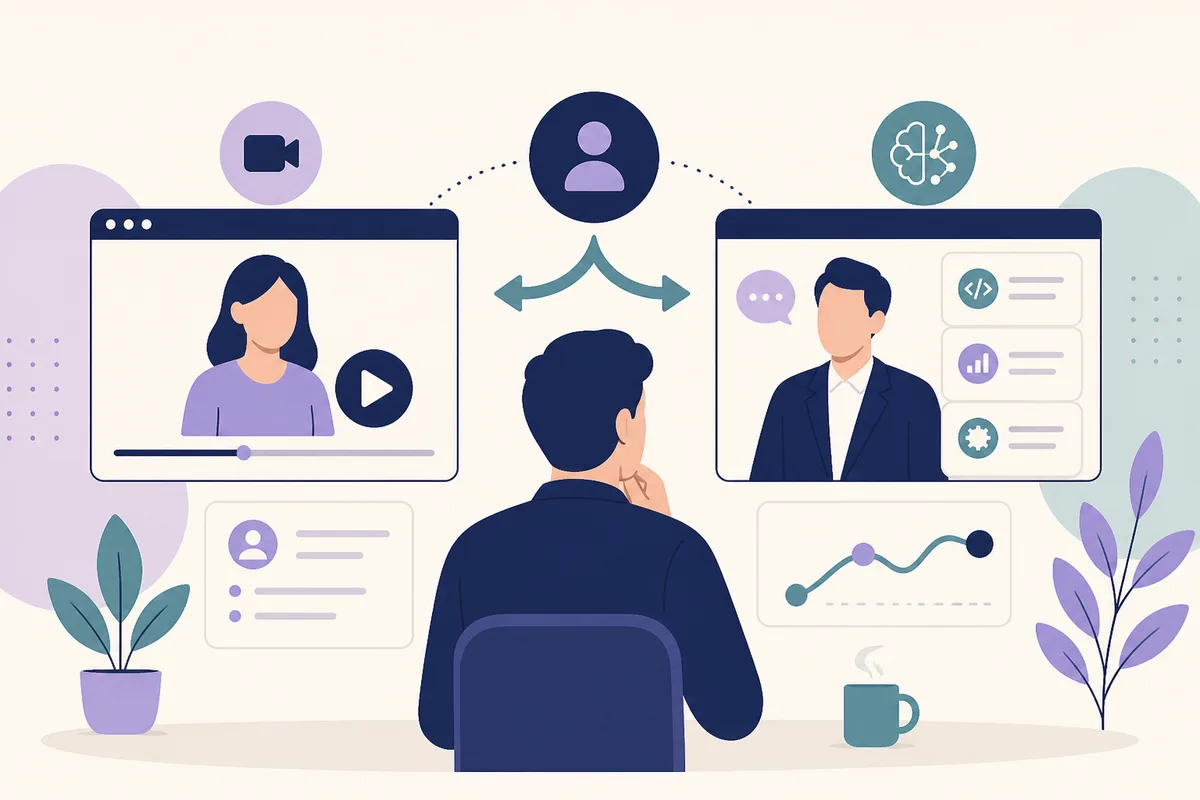
One-way video (asynchronous). Every candidate gets the same questions in the same order and records answers alone. Strengths: comparability, easy review, no scheduling. Limits: no follow-up. If a candidate says "I would use a hash map" the format cannot ask why, what the complexity is, or what breaks at scale. Candidates also often find talking to a camera uncomfortable, which is a candidate-experience cost.
Adaptive conversational interview. An AI interviewer speaks with the candidate and asks follow-ups based on the answer. Strengths: it can test depth, challenge vague answers and run code. Limits: the path through the interview differs per candidate, so consistency depends on rubric quality, and the quality of follow-up questions varies between vendors. You need to test that the scoring stays consistent when the conversation does not.
HireVue's AI Interviewer sits between the two: its page describes a two-way conversation with follow-up questions, reviewable transcripts and scores tied to behavioral anchors. So the real comparison is less "HireVue vs everyone" and more "what does this specific product do for a technical screen."
What technical screening needs that a standard structured screen may not give you
- Code execution. Does the candidate's code compile and run against tests during the interview?
- Reasoning probes. Does the interviewer ask why, and follow up on weak points?
- System design. Is there a surface for drawing and discussing architecture?
- Role fit. Are question sets calibrated for SDE levels, data science, AI and LLM engineering, or product roles rather than generic competencies?
- Evidence in the report. Can an engineering manager see the code and the reasoning behind each score?
If these are your criteria, compare vendors on them directly rather than on general platform breadth.
The alternatives, compared fairly
Descriptions come from each vendor's own site as of October 2026. None of the sites we checked published prices, so check current pricing with each vendor.
| Format | Coding | System design | Notes | |
|---|---|---|---|---|
| HireVue | AI Interviewer (voice conversation), video interviews, assessments | Not described on main pages | Not described | Broad platform, ATS integrations, governance documentation; strongest for structured screening across role types |
| ThitaHire | Voice-led adaptive AI interview with follow-ups | Integrated coding and case flow | HLD/LLD design canvas | Role-specific rounds for SDE, data science, AI/LLM, PM, behavioral; dimension-wise scoring and recruiter reports; integrations, pricing and compliance documentation to confirm with the team |
| CodeSignal | Skills assessments, live interviews in a shared IDE, AI Interviewer | Yes | Not a stated focus | AI-assisted coding assessments and interviews, with transcripts of AI use |
| HackerRank | Screen (tests), live Interview, Chakra agentic AI interviewer | Yes | Not a stated focus | Describes plagiarism detection and flagging of unauthorized tools; scores audited for bias, per its site |
| Karat | Human Interview Engineers conduct interviews | Confirm with vendor | Confirm with vendor | Expert-led model; no list prices on its site. See Karat alternatives |
Which alternative fits which situation
- You like HireVue's structure but need coding. Pair it with an assessment or live-coding tool, or ask HireVue what it offers for engineering roles today.
- You want one tool that tests reasoning, code and design in the first round. Look at conversational AI interviewers, including ThitaHire, and run the same candidates through each.
- You want the least AI. Consider human-led interviews through a vendor like Karat or your own trained interviewers.
- You mostly need auto-graded skills data. CodeSignal or HackerRank assessments are cheaper per candidate but test output more than reasoning; see our CodeSignal and HackerRank alternatives guide.
Compliance questions to ask any video or AI interview vendor
Whichever tool you choose, ask for the following in writing:
- The most recent independent bias audit, with auditor, date and the specific tool and use case covered. NYC Local Law 144 requires an audit within the year before use for covered tools.
- Whether any scoring uses facial or emotion analysis. The EU AI Act already prohibits inferring emotions of people in the workplace outside medical or safety uses, and classes recruitment AI as high-risk.
- Candidate notice and consent language. Illinois's AI Video Interview Act requires notice and consent when AI analyzes video interviews.
- A non-AI or human alternative path, and how accommodations are handled.
- Data retention and deletion.
Our buyer's guide summarizes dates and obligations, and the fairness guide covers process controls. This is general information, not legal advice.
How to run a pilot
Pick one technical role family. Write the rubric first. Run a mix of strong, borderline and weak candidates, or replay anonymized past screens, through each shortlisted tool. Compare reports blind: can an engineering manager reach a decision from the report alone? Track completion rate, time to decision, reviewer agreement and how advanced candidates perform in later rounds. And take each interview yourself.
FAQ
What is the best alternative to HireVue? It depends on what you need. For technical depth, look at CodeSignal, HackerRank, Karat or a conversational AI interviewer like ThitaHire. For broad structured screening across many roles, HireVue may still be the better fit.
Does HireVue use AI? Yes. Its site describes an AI Interviewer that runs voice-based interviews, asks follow-up questions and scores answers against role criteria, and says humans make the final decision.
Does HireVue have a coding assessment? Its main product pages do not describe one. Some HireVue materials cover technical hiring generally, so ask the vendor directly. Candidates preparing for HireVue-based coding screens can read our HireVue coding assessment guide.
Who are HireVue's competitors? For technical hiring: CodeSignal, HackerRank, Karat and AI interviewer products such as ThitaHire. For general high-volume screening, the field is wider than we cover here.
HireVue vs CodeSignal: which should I choose? HireVue focuses on structured interviewing and assessments across role types; CodeSignal focuses on skills assessments, live technical interviews and an AI interviewer. For engineers, CodeSignal's coding tools are the more direct fit; for broad screening, HireVue's platform is wider.
Is a one-way video interview good for engineers? It is good for comparing communication and motivation at scale and weak at testing code and design. Most technical teams add a coding component or use an adaptive interview instead.
Is HireVue biased? HireVue says it runs fairness studies, and publishes governance materials. No vendor can promise freedom from bias, so ask for audit documents and monitor pass-through rates yourself.
What do candidates experience in an AI interview? It varies by product. Candidates can read our guide on how to pass an AI interview, and you should take your own shortlisted interviews to see the same thing.
See an adaptive technical interview from the candidate's seat
If your technical screen needs follow-up questions, code and design in the same conversation, the simplest test is to take one. Try the ThitaHire live demo or contact the team to discuss your roles.
Topics
Related on Thita
Your next step
Run first-round technical interviews with an AI interviewer
ThitaHire runs voice-led, adaptive first rounds for SDE, data science, AI/LLM, PM, behavioural and system design roles, with coding discussion, a design canvas and structured, rubric-based reports for your recruiters.