
Interview
Amazon Coding Interview Questions: Patterns and Prep (2026)
Prepare for Amazon coding interviews with the pattern families behind its DSA-heavy rounds, plus a focused plan for the assessment, live coding and design.
Amazon coding interview questions are best prepared as pattern families, not as a disconnected set of prompts. The technical loop is commonly reported as DSA-heavy: candidates need to recognise a problem shape quickly, choose an approach they can explain, and implement it cleanly while discussing trade-offs. But technical correctness is only part of the outcome. Leadership Principles are reported as assessed throughout the process, including the coding conversations.
Amazon's interview kit holds 268 mapped DSA questions, 16 low-level design problems and 14 system design problems. That depth makes it useful for practising the technical work in the order Amazon’s reported rounds demand: rapid pattern recognition for the online assessment, clear reasoning for live coding, and design communication for more experienced roles.
The useful question is not, “Which Amazon questions should I memorise?” It is: “Which recurring structures can I spot before I start coding?” This guide covers those structures, the reported round shape, the difficulty mix, and a practice plan that builds speed without turning preparation into a rote exercise.
The pattern families that matter most
Amazon’s catalogue is broad, but its DSA questions repeatedly reward a compact set of pattern families. The challenge is rarely knowing that a hash map or graph exists. It is recognising the clue in the wording, selecting the right family, and making the reasoning visible before implementation.
Arrays, strings and hash-based lookups
These problems often begin with large inputs, repeated values, matching conditions, or requests to find a relationship efficiently. The core choice is whether you need a direct lookup, a running state, sorted order, or a bounded window.
Look for phrases such as “first occurrence”, “duplicate”, “frequency”, “pair”, “contiguous”, or “at most”. They often point toward hashing, prefix-style reasoning, two pointers, or a sliding window rather than nested loops.
The important skill is not naming the technique after the fact. It is stating why the naive approach is too expensive, what information must be retained, and how that stored information changes as you scan the input.
Two pointers and sliding windows
This family is especially valuable because it tests recognition speed. When the input is a sequence and the problem asks about a range, substring, subarray, or condition that changes as you move through the data, you should actively test a window-based approach.
A strong explanation sounds simple:
- Define what the current window represents.
- Explain what makes it invalid.
- State which pointer moves to restore validity.
- Describe what result is updated along the way.
That structure keeps you from writing code before you understand the invariant. It also gives an interviewer a way to follow your thinking. For a deeper framework, read how to identify the right DSA pattern in a coding interview.
Trees, recursion and traversal state
Tree problems test whether you can manage state across recursive calls without losing track of what each call promises to return. Before coding, clarify whether you need to explore every node, preserve a path, calculate information from children, or compare branches.
The common mistake is to reach for recursion because the data structure is a tree, then mix global and local state until edge cases become unclear. Instead, say what each recursive call returns and what the parent does with that result.
If the problem needs the shortest route, level-by-level work, or a nearest condition, breadth-first search may be more natural. If it needs exhaustive exploration, path tracking, or post-order aggregation, depth-first search is often the better fit. The guide to graph traversal patterns with DFS and BFS is also useful because the underlying decision is similar.
Graphs, dependencies and search
Graphs can appear openly as networks and dependencies, or indirectly as transformations, relationships, and permitted moves. The recognition question is whether the problem describes states and transitions. If it does, model those first; do not force the input into an array technique merely because it arrived as a list.
Practise explaining the graph construction as carefully as the traversal. What is a node? What is an edge? Is it directed? How do you avoid revisiting work? Those choices often determine whether the code is correct.
Binary search over an answer
Binary search is not just for finding an element in sorted data. In interviews, it often appears when there is a threshold: the smallest feasible value, the largest value that still works, or a condition that changes from false to true only once.
The key is the feasibility function. Can you test a proposed answer efficiently? Is the answer space ordered? If so, binary search may convert an intimidating optimisation problem into a controlled sequence of checks.
Dynamic programming and state reduction
Dynamic programming becomes relevant when a problem has repeated subproblems and a decision at each step affects the future. It is usually less about memorising a recurrence than about defining a state that contains exactly the information needed to move forward.
Start with the brute-force decision tree. Then ask what repeats. Once you can articulate the state, transition, base case, and iteration order, implementation becomes much less mysterious. Dynamic programming pattern practice can help you build that progression deliberately.
Amazon’s reported interview shape
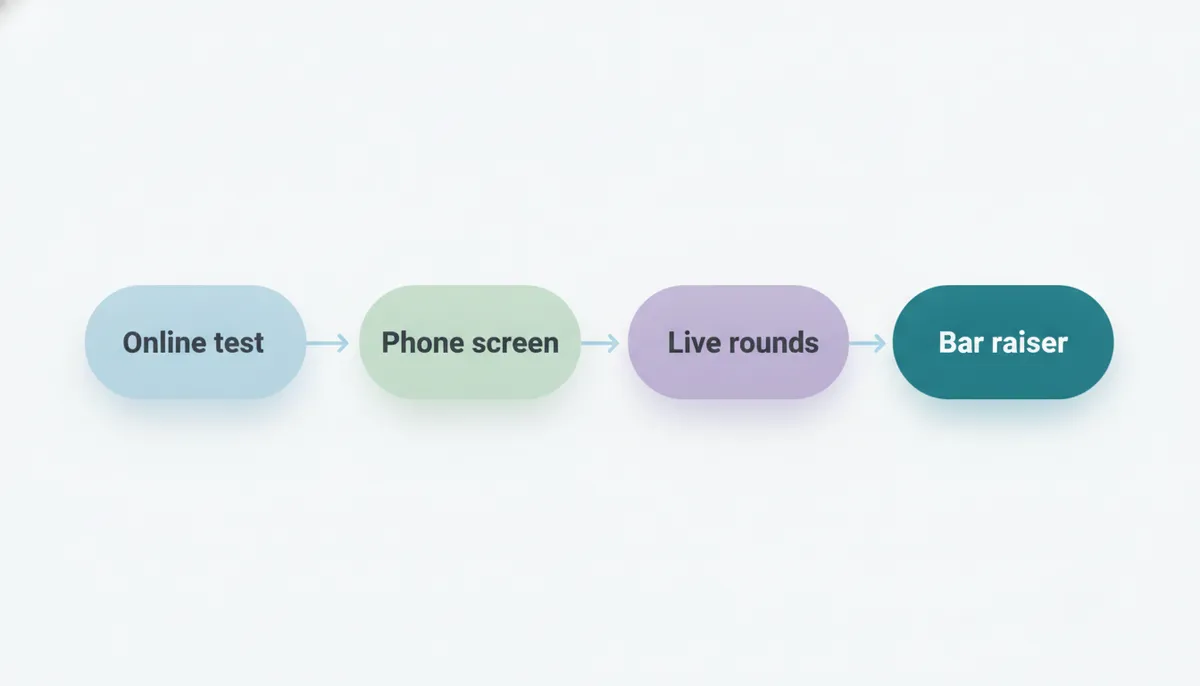
Reported accounts describe an online assessment, a phone screen, a live interview loop, and a Bar Raiser evaluation. Exact sequencing and emphasis can vary by role, level, team, and location, so treat this as a working shape rather than a fixed policy.
The online assessment is commonly reported to contain coding work that rewards fast, reliable pattern selection. For SDE II and above, some recent reports also describe a brief high-level design sketch in the assessment. That addition is estimated, level-specific, and worth confirming with your recruiter rather than assuming it applies to every process.
The phone screen and live coding rounds shift the emphasis from speed alone to communication. You may need to clarify assumptions, outline a brute-force route, improve it, code, and test aloud. The onsite loop is commonly reported to include several technical conversations, with system design more likely at SDE II / L5 and above.
Then there is the Bar Raiser. Reported accounts describe this as a cross-team evaluator with veto authority that the hiring manager cannot overrule. Interviewers are also reported to assess specific Leadership Principles and submit written evidence before the debrief. That is why a technically clean performance can still be insufficient if your examples, ownership, or decision-making do not hold up under probing.
What recognition speed actually means
Recognition speed does not mean instantly recalling a finished solution. It means reducing uncertainty early enough that you have time to reason, implement, test, and communicate.
In a timed coding setting, you want to reach a sensible hypothesis quickly:
- Is this a lookup problem, a range problem, a traversal, or an ordered search?
- What is the simplest correct version?
- Where does the expensive work happen?
- Which invariant proves the improved approach stays correct?
- What edge cases could invalidate the implementation?
That first minute matters. Candidates often lose time by trying to derive a perfect solution in silence. A better approach is to narrate the route: “I can start with this baseline. It repeats work here. A map lets me retain this information, which gives this complexity.” If the interviewer wants a different direction, you discover it early.
Read what interviewers actually look for in live coding interviews before your mock sessions. It is a useful reminder that clarity, testing discipline, and collaboration are assessed alongside the final code.
💡 Pro Tip: Build a pattern journal, not a question log. After each problem, write the trigger, the invariant, the mistake you made, and the signal that should help you recognise the family next time.
Difficulty: where candidates get caught out
Amazon’s technical difficulty is not one uniform level. The assessment tends to reward breadth and speed across familiar DSA structures. Live rounds make the same foundations harder by introducing follow-ups, requiring cleaner explanation, and leaving less room for hidden trial and error.
A candidate can know the major patterns and still struggle if they cannot move between them. For example, an initial array problem may become a streaming problem; a straightforward traversal may gain a constraint that changes the state you must track; a correct solution may need a complexity improvement. Practise the transition, not only the first answer.
For experienced candidates, design broadens the preparation burden. Amazon's interview kit includes the kind of design problem evidenced at Amazon, alongside its DSA coverage. Use the free low-level design sheet to practise class boundaries, responsibilities, and extensibility, then use the free system design sheet to rehearse requirements, scale assumptions, bottlenecks, and trade-offs.
The distinction matters. Low-level design asks whether you can organise behaviour and interfaces in code. System design asks whether you can reason from requirements to components, data flow, failure modes, and operational constraints. What low-level design versus high-level design interviews actually expect explains where each mode fits.
A focused preparation plan
Start with pattern diagnosis
Spend the first part of your preparation rebuilding recognition. Use the free DSA Patterns Sheet to practise by family, rather than selecting problems at random. For each session, choose one family and solve enough variations to see what stays constant.
Do not rush into advanced variants until you can explain the base pattern. A concise explanation of a sliding-window invariant is more valuable than a vague familiarity with several unrelated techniques.
Add timed implementation
Next, introduce a timer. Work in an editor, write complete code, and leave time to test boundary conditions. The code practice workspace is useful for turning theoretical recognition into a repeatable implementation habit.
After each attempt, review more than correctness:
- Did you clarify the input and constraints?
- Did you state complexity before coding?
- Did you test an empty or minimal case?
- Did your variable names communicate the invariant?
- Did you recover clearly when you changed direction?
Rehearse live communication
Then simulate the conversational format. Speak while solving, even when practising alone. Explain your first idea, identify its limitation, and justify the final approach. This feels artificial at first, but it removes the shock of having to narrate under pressure.
An AI interview can help you rehearse coding, system design, and behavioural communication when a practice partner is unavailable. Use it to make your explanations shorter and more structured, not merely to collect another score.
Prepare Leadership Principle evidence
Finally, prepare project stories with the same rigour as your coding work. Reported accounts describe Leadership Principles as assessed across every Amazon round, so do not reserve your examples for one final behavioural conversation.
Choose examples where you made a decision, handled ambiguity, changed course after evidence, owned a difficult outcome, or simplified a process. Be precise about your individual contribution. “We built” is rarely enough when the follow-up is “What did you decide?”
Frequently asked questions
Does Amazon still use an online assessment?
Reported accounts commonly describe an online assessment with coding work. For SDE II and above, some recent reports also describe a brief system-design sketch, but that is an estimated and level-specific detail. Confirm the format with your recruiter.
What patterns should I prioritise for Amazon coding interview questions?
Prioritise hash-based lookup, two pointers, sliding windows, trees, graphs, binary search, and dynamic programming. More important than the list is learning the trigger that identifies each family.
Are Amazon coding rounds mainly about LeetCode-style problems?
The technical rounds are commonly reported as DSA-heavy, but live performance also depends on clarifying, explaining complexity, testing, and responding to follow-ups. Pattern knowledge without communication is incomplete preparation.
How should I practise for the phone screen?
Practise solving aloud. State your assumptions, describe the baseline approach, explain the improvement, and test the code visibly. Aim to make your reasoning easy to assess.
Is system design required for every Amazon software engineering role?
Reported accounts place system design more prominently in SDE II / L5 and above. The exact expectation can vary by level and role, so ask what the loop will assess.
What does the Bar Raiser evaluate?
Reported accounts describe a cross-team Bar Raiser who evaluates technical and Leadership Principle evidence and can veto a hire. Prepare clear examples of ownership, judgement, delivery, and learning from setbacks.
Are Leadership Principles only tested in behavioural rounds?
No. Candidate reports commonly describe Leadership Principles as assessed throughout the Amazon loop, including technical conversations. Treat your communication and project examples as part of every round.
How many problems should I solve before interviewing?
There is no useful universal target. Build confidence across the major families, then focus on faster recognition, clean implementation, and explaining trade-offs under realistic conditions.
What should I do if I get stuck in a live coding round?
Say what you have established, name the uncertainty, and propose the next test or baseline. Silent struggle is difficult to assess; structured recovery demonstrates judgement.
Prepare the technical bar, then rehearse the whole conversation
Amazon preparation works best when you combine pattern fluency with visible reasoning and credible Leadership Principle stories. Technical rounds reward a candidate who can recognise the structure of a problem quickly. The wider loop rewards someone who can explain decisions, test assumptions, and take clear ownership of their work.
Open Amazon's interview kit to work through 268 mapped DSA questions, 16 low-level design problems and 14 system design problems associated with the company. Browse the free sheets, practise implementation under time pressure, and use an AI interview to rehearse the coding, design, and behavioural conversations that turn preparation into interview performance.
Topics
Related on Thita
Your next step
Practise with AI mock interviews
A spoken interview that asks follow-up questions, runs your code and ends with a written report.