
Interview
Amazon Interview Questions and Process: The Complete Guide (2026)
A round-by-round guide to Amazon interview questions, Leadership Principles, the Bar Raiser, difficulty, timelines, and a focused 30-day preparation plan.
Amazon interview questions usually appear across an online assessment, a technical phone screen, and an onsite loop with coding, system design for more experienced roles, and Leadership Principles woven through every conversation. The technical bar is demanding, but the defining feature is the Bar Raiser: a cross-team evaluator reported to have veto power. Prepare algorithms and design, but treat your examples, ownership stories and decision-making as equally important. Amazon's interview kit holds 268 mapped DSA questions, 16 low-level design problems and 14 system design problems to help you practise the technical parts of that loop.
Reported accounts describe a broadly consistent process globally, though exact sequencing, level expectations and timing can vary by team. This guide explains the usual shape, what each stage screens for, why the Leadership Principles matter, and how to prepare over 30 days.
The Amazon interview process at a glance
| Stage | Typical format | What it screens for |
|---|---|---|
| Online assessment | Two coding questions; SDE II+ reports may include a design sketch | Timed coding, problem solving, practical judgement |
| Phone screen | Technical discussion and coding | Communication, fundamentals, structured reasoning |
| Onsite coding | Two to three coding rounds | DSA fluency, complexity analysis, clean implementation |
| System design | One to two rounds for SDE II / L5+ | Scoping, trade-offs, scalable architecture |
| Bar Raiser and LPs | Leadership Principles throughout the loop | Ownership, judgement, evidence from experience |
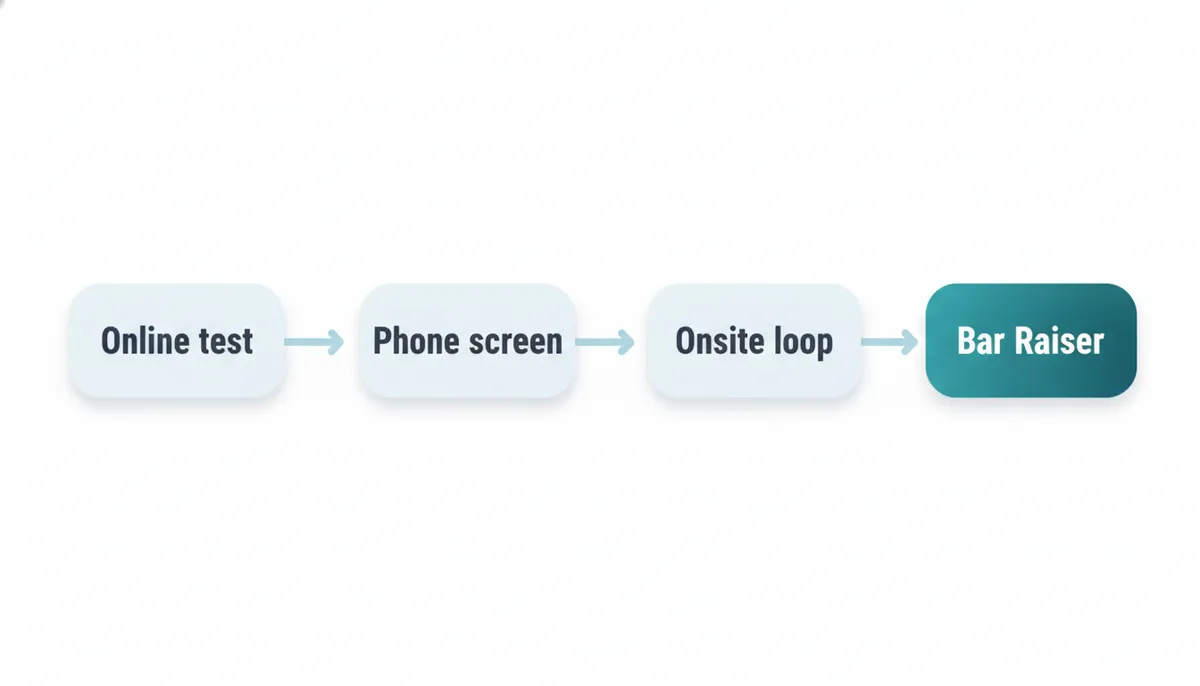
The structure is best treated as an estimated consensus from candidate reports rather than a fixed company policy. A recruiter can confirm the current format for your role, level and location.
Round 1 — online assessment
Reported accounts commonly describe an online assessment with two coding questions. The work is familiar interview material: arrays, strings, hash maps, trees, graphs, sorting, searching and dynamic programming. The challenge is less about obscure theory than recognising the useful pattern quickly, implementing it correctly, and checking edge cases under time pressure.
For SDE II and above, some 2026 reports also describe a short high-level design sketch in the assessment. This is estimated, level-dependent reporting rather than a universal requirement, so do not assume it will appear in every process. If it does, expect an exercise in organising a simple architecture and explaining the major components rather than a full onsite system-design discussion.
The coding portion screens for three things:
- Can you turn a verbal problem into a clear plan before coding?
- Can you choose an efficient enough approach and explain its complexity?
- Can you produce correct, readable code without relying on repeated trial and error?
A pattern-based routine is the most efficient preparation. The DSA Patterns Sheet is free to browse and groups practice by recurring problem shape. Pair it with how to identify the right DSA pattern in a coding interview if you often know the data structures but struggle to select an approach quickly.
💡 Pro Tip: Use a timer from your first practice session. Finishing a solution is not enough; leave time to test empty input, duplicate values, boundary conditions and the complexity you stated.
Round 2 — technical phone screen
The phone screen is commonly reported as a technical conversation with coding. It may feel less formal than an onsite round, but it still checks whether you can reason in public: clarify requirements, compare approaches, write the key logic and recover calmly when prompted.
The important shift is from solitary problem solving to observable engineering judgement. An interviewer cannot award credit for reasoning they never hear. Start with a plain-language restatement of the problem, ask about constraints, outline a baseline approach, then explain why you are choosing the final one.
This stage commonly screens for:
- Problem framing: whether you resolve ambiguity before implementation.
- Communication: whether another engineer can follow your decisions.
- Complexity awareness: whether you can explain time and space costs.
- Adaptability: whether you incorporate a hint without losing the thread.
Read what interviewers actually look for in live coding rounds before your screen. It is especially useful for converting a correct but silent solving style into one an interviewer can assess.
✅ Do: Say what you will test before you run through examples.
❌ Don't: Begin typing immediately and save all explanation for the end.
Rounds 3 and 4 — onsite coding rounds
The onsite loop is commonly reported as four to six interviews, including two to three coding rounds. These are generally DSA-heavy, with the difficulty coming from follow-up questions, tighter expectations around complexity and the need to sustain clear communication across multiple conversations.
Expect the interviewer to care about more than whether your final code works. They may probe why a hash map is appropriate, ask for a lower-memory alternative, alter the input constraints, or ask how your approach behaves at scale. A strong candidate does not need to guess every follow-up; they show a method for evaluating it.
Prepare these rounds around core patterns rather than random volume:
- Hashing, two pointers and sliding windows for array and string work.
- Trees, recursion and graph traversal for structured data.
- Binary search for ordered search spaces and answer-space problems.
- Dynamic programming when a problem has overlapping subproblems and a useful state.
The graph traversal patterns guide and dynamic programming patterns guide are practical refreshers for two areas that reward structured explanation.
For direct technical practice, Amazon's interview kit lets you focus on the company-mapped question set rather than assembling a list from scratch. Use the questions to rehearse not just solutions, but the opening minute of each answer: assumptions, approach, complexity and test plan.
Round 5 — system design for experienced roles
Candidate reports commonly place one to two system-design rounds in Amazon loops for SDE II / L5 and above. The purpose is not to see whether you can recite a perfect architecture. It is to see whether you can turn an ambiguous product prompt into a coherent system, prioritise the important constraints and explain trade-offs.
Start by narrowing the problem. Who uses the system? What is the critical path? What matters most: latency, availability, consistency, cost, privacy, or operational simplicity? Then build from a small viable design towards the components that solve the actual bottlenecks.
Strong answers usually make their reasoning visible:
- Clarify scope and functional requirements.
- Estimate meaningful scale assumptions.
- Sketch the core request flow and data model.
- Identify likely pressure points.
- Explain the trade-offs behind queues, caches, storage and partitioning.
- Discuss failure handling, observability and a sensible next iteration.
The System Design Sheet is free to browse, while the Low Level Design Sheet is free to browse for class-level modelling and object interactions. The distinction matters: low-level design vs high-level design explains what each format is trying to reveal.
For Amazon-specific technical practice, the design problems in Amazon's interview kit represent the kind of design problem evidenced at Amazon. Use them to practise scoping aloud, not to memorise a single canonical diagram.
The Bar Raiser and Leadership Principles
This is the Amazon-specific section candidates cannot treat as an afterthought.
Reported accounts describe the Bar Raiser as a cross-team evaluator, independent of the hiring team, with veto power that the hiring manager cannot overrule. The Bar Raiser is not simply a final culture conversation. Their role is reported to be protecting a consistent hiring bar across teams and checking whether the evidence from the full loop supports the level being considered.
Leadership Principles are also reported to be assessed in every round, not only in a dedicated behavioural interview. Interviewers may be assigned specific Principles, take detailed notes during the discussion and submit written evidence before the debrief. That changes how you should prepare: a polished list of generic stories is not enough if your technical answers show poor ownership, shallow trade-off reasoning or weak response to failure.
For software engineering roles, candidate reports frequently emphasise:
- Dive Deep
- Ownership
- Bias for Action
- Invent and Simplify
- Deliver Results
Prepare stories with a clear structure: context, your specific responsibility, the difficult decision, the action you took, the measurable or observable outcome, and what you learned. Be precise about “I” versus “we”. A collaborative project is good evidence, but Amazon interviewers are reported to probe what you personally noticed, decided and changed.
Practise stories verbally with AI mock interviews. The goal is not to memorise a script. It is to become comfortable supplying evidence when an interviewer asks, “What would you do differently?” or “Why did you choose that approach?”
Is the Amazon interview hard?
Yes. Amazon is technically demanding, but its difficulty is broader than an algorithms test.
How many rounds are there? Reported accounts commonly describe an online assessment, a phone screen and an onsite loop of four to six interviews. The onsite usually includes two to three coding rounds, system design for more experienced candidates, and Leadership Principles assessed throughout. The Bar Raiser is part of that evaluation shape, not a separate technical speciality.
How long does it take? The research does not establish one reliable end-to-end timeline for Amazon. Scheduling, role level, location and team hiring needs can all change the pace. Ask your recruiter for the expected sequence and dates once you enter the process.
What makes the loop hard is the combination: you must solve technical problems, communicate under pressure, show sound engineering judgement and give credible evidence of how you work. Candidates sometimes prepare coding and behavioural material as separate subjects. At Amazon, they overlap. How you clarify a design prompt can demonstrate Dive Deep; how you handle an incomplete coding question can demonstrate Bias for Action.
The practical answer is to train both dimensions every week. Do not postpone Leadership Principle practice until after you feel ready for coding.
A 30-day Amazon preparation plan
Days 1–7 — rebuild DSA pattern recognition
Spend each day on a small number of focused problems. Rotate arrays, hashing, linked lists, trees, graphs and binary search. Before reading an editorial, state the pattern you think applies and why. Use in-browser code practice to keep the feedback loop short.
At the end of each session, explain one completed solution aloud as if an interviewer had interrupted you twice.
Days 8–14 — practise live-round habits
Continue coding, but now add a timer and narration. Take one problem at a time and follow a repeatable sequence: clarify, give a baseline, choose an approach, state complexity, code, test and summarise.
Spend two sessions on graph traversal and two on dynamic programming if those topics are slow for you. The aim is not to cover everything again; it is to remove hesitation from common shapes.
Days 15–21 — add design and Leadership Principles
For SDE II / L5 and above, complete several system-design exercises. Practise requirement gathering, capacity estimates, a core diagram and trade-off discussion. For any level, begin writing stories for Ownership, Dive Deep, Bias for Action and Deliver Results.
Use the Operating Systems Sheet and DBMS Sheet, both free to browse, to refresh the foundations that can strengthen technical discussions about storage, processes, caching and reliability.
Days 22–30 — simulate the full loop
Alternate a timed coding round, a design round or project deep-dive, and a Leadership Principles mock. Review every session using the same questions:
- Did I clarify the problem early?
- Did I state my trade-offs?
- Did I test edge cases?
- Did I explain my personal contribution?
- Did I make a decision when information was incomplete?
In the final days, prioritise consistency over cramming. Solve familiar patterns cleanly, rehearse your strongest stories, and sleep properly before the real loop.
Frequently asked questions
How many coding rounds does Amazon have?
Reported accounts commonly describe two to three coding rounds in the onsite loop, following an online assessment and technical phone screen.
Does Amazon have an online assessment?
Yes. Candidate reports commonly describe two coding questions. For SDE II and above, some reports add a short high-level design sketch, but that addition is estimated and level-dependent.
Are Leadership Principles assessed only in the Bar Raiser round?
No. Reported accounts describe Leadership Principles as assessed throughout the process, including technical conversations.
What is the Bar Raiser interview?
It is a cross-team evaluation role reported to have veto power in Amazon hiring decisions. The Bar Raiser assesses evidence from the loop against Amazon’s hiring bar and Leadership Principles.
Is system design required for Amazon SDE roles?
System design is commonly reported for SDE II / L5 and above. Expectations vary by role and level, so confirm the format with your recruiter.
Which Leadership Principles should software engineers prepare first?
Candidate reports often emphasise Dive Deep, Ownership, Bias for Action, Invent and Simplify, and Deliver Results. Prepare evidence rather than generic definitions.
What DSA topics should I focus on?
Prioritise arrays, strings, hash maps, trees, graphs, binary search and dynamic programming. Pattern recognition and clear explanation matter as much as recall.
Can I use Python for Amazon coding interviews?
Use the language in which you can solve problems accurately, explain trade-offs and write cleanly under time pressure. Fluency matters more than chasing a fashionable choice.
What should I do if I get stuck in a coding round?
State what you know, test a smaller example, explain the baseline approach and ask a focused clarifying question. Silent guessing makes it hard for an interviewer to assess your reasoning.
Where to start
The best Amazon preparation plan combines technical repetition with Leadership Principle evidence. Work through coding patterns until your explanation is as reliable as your implementation, then rehearse design and behavioural answers with the same discipline.
Open Amazon's interview kit to practise the mapped DSA, low-level design and system design problems. The technical sheets are free to browse, and an AI mock interview can help you rehearse the Leadership Principles conversations that often decide the final outcome.
Interview formats can change. Confirm your exact loop, level expectations and schedule with your recruiter before building your final preparation plan.
Topics
Related on Thita
Your next step
Practise with AI mock interviews
A spoken interview that asks follow-up questions, runs your code and ends with a written report.