
Interview
Amazon Machine Coding Round: Complete Preparation Guide (2026)
Prepare for Amazon's machine coding and low-level design work: format, evaluation criteria, time plan, common mistakes, practice plan and FAQs.
The Amazon machine coding round is best understood as part of the technical design bar, not as a standalone language-syntax test. Reported accounts describe a technically DSA-heavy process, with coding and system-design work appearing across the phone screen and onsite loop. For SDE II and above, some reports also describe a short high-level design sketch in the online assessment.
What makes Amazon different is that technical execution is never assessed in isolation. Leadership Principles are reportedly evaluated in every round, including design and coding discussions. Your code, assumptions, trade-offs and responses to feedback all become evidence. That means a clean implementation matters, but so does explaining why you made each decision.
For focused practice, Amazon's interview kit includes 268 mapped DSA questions, 16 low-level design problems and 14 system design problems. This guide focuses narrowly on the machine-coding and low-level design skills that strengthen the technical-design part of the process rather than restating the full interview loop.
Where machine coding and low-level design sit in the Amazon loop
Reported accounts commonly describe an online assessment, a phone screen, then an onsite loop of four to six interviews, followed by the Bar Raiser process. The onsite portion is reported to include two to three coding rounds and one to two system-design rounds for SDE II / L5 and above.
Amazon does not appear to have one universally named, fixed-duration machine coding round in the way some companies do. Instead, the relevant skill can appear inside coding and design prompts: turning an under-specified requirement into a coherent model, writing readable code, defending trade-offs and adapting the design when a new condition appears.
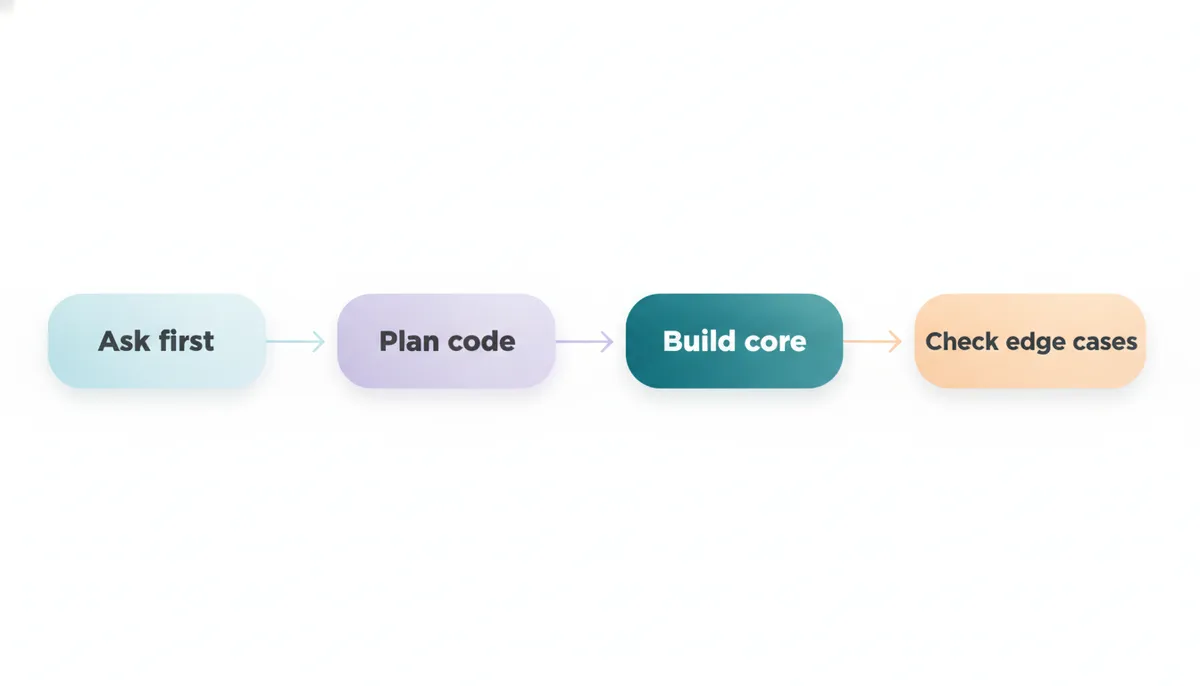
That distinction matters for preparation. Do not wait for a prompt explicitly labelled “machine coding”. Treat every implementation-heavy exercise as a chance to demonstrate the same capabilities:
- clarify what must be built before choosing classes;
- identify the smallest useful domain model;
- separate policy from storage and orchestration;
- write a working core path before adding options;
- explain what you would change if requirements grew;
- connect decisions to customer impact, ownership and delivery.
The broader process also includes behavioural evaluation and Leadership Principles. Use AI mock interviews to rehearse those discussions separately. A technically strong answer can lose force if you cannot explain how you handled ambiguity, prioritised customer needs or changed course after discovering a flaw.
The format: what to expect from an Amazon design-heavy prompt
In an Amazon coding or low-level design exercise, the starting prompt may be deliberately incomplete. You may be asked to model a service, workflow, object interaction or simplified product feature. The interviewer is not merely looking for whether you can name patterns. They are looking for whether you can move from ambiguity to a practical implementation without building an unnecessary framework.
Reported accounts describe system-design work at SDE II / L5 and above, while coding rounds remain a central technical component. In practice, the machine-coding mindset is useful at both levels:
| Prompt stage | What to do | What it demonstrates |
|---|---|---|
| Read the brief | Restate the core user flow and constraints | Clear communication |
| Clarify scope | Ask about invalid states, scale and priorities | Dive Deep |
| Model the domain | Name entities, responsibilities and boundaries | Sound judgement |
| Build the core | Implement the smallest end-to-end path | Deliver Results |
| Test assumptions | Walk through edge cases and failure paths | Ownership |
| Extend carefully | Explain one likely future change | Invent and Simplify |
A useful rule is to build for the requirement in front of you, then show that you understand the next reasonable requirement. Building for ten hypothetical futures is usually less persuasive than delivering one clean, demonstrable flow.
For a refresher on the boundary between object-level design and architecture-level design, read low-level design vs high-level design: what interviews actually expect.
Is there a fixed time limit?
Candidate reports do not establish a universal, separately named Amazon machine coding time limit. Treat the time confirmed by your recruiter and interviewer as the source of truth.
That does not mean you should practise without constraints. A time-boxed session exposes the habit that most often damages otherwise capable candidates: investing too long in an ideal class hierarchy before proving that the basic flow works.
For practice, use the allotted time as a sequence of checkpoints rather than one uninterrupted coding block. The exact minutes will vary, but the order should not.
| Portion of available time | Goal | Output by the checkpoint |
|---|---|---|
| Opening section | Clarify scope and state assumptions | A short list of agreed requirements |
| Early middle | Draw the simplest model | Entities and key interactions |
| Main section | Implement the happy path | Running core behaviour |
| Final middle | Handle important edge cases | Validation and error paths |
| Closing section | Test and discuss trade-offs | Demo, complexity and extensions |
If the interviewer changes the requirement halfway through, avoid treating that as a derailment. Pause, name what changes in the model, explain the smallest safe adjustment, then continue. Adaptation is often more valuable than defending the first design.
What graders reward, in rough order of weight
No public rubric exists, and candidate reports are not a company specification. Still, the recurring signals are consistent enough to guide practice.
1. A correct, usable core flow
The first question is whether the design solves the stated problem. A small working implementation is stronger than an elaborate set of interfaces with no demonstrated behaviour.
Start with the user action that matters most. If you are modelling a booking flow, make one valid booking possible. If you are modelling a cache, support one read and one write path. If you are modelling a task system, create, assign and retrieve a task before adding notifications, permissions or persistence.
2. Clear ownership of responsibilities
Classes should have a reason to exist. Data should live where it is used. Policy should not be scattered through unrelated objects. A design becomes difficult to explain when every class knows about every other class.
Good answers use direct names and obvious responsibilities. They do not create abstractions because a textbook listed them. If a behaviour has only one implementation and no meaningful variation, a plain method may be the best choice.
3. Judgement under ambiguity
Amazon interviewers reportedly assess specific Leadership Principles and submit written evidence before the debrief. In a technical prompt, your assumptions are therefore part of the answer.
State assumptions plainly:
“I will treat this as an in-memory version first. I am prioritising correctness of the main workflow, then I will explain where persistence and concurrency controls would sit.”
That is better than silently choosing an interpretation and hoping it matches the interviewer’s intent.
4. Sensible extension points
A strong low-level design should absorb the next likely change without a rewrite. The key word is likely. You might make pricing strategies interchangeable if multiple pricing rules are plausible. You might isolate a notification interface if the prompt clearly suggests multiple delivery channels.
Do not introduce factories, observers, repositories and strategy objects all at once. The interviewer should be able to see what each abstraction earns.
The Low Level Design Sheet is free to browse and is useful for practising this judgement across different object-modelling problems.
5. Communication and trade-off reasoning
A design interview is observable reasoning. Narrate your choices briefly:
- “I am keeping this in one service because there is one workflow.”
- “I am using a map for lookup because retrieval is the main operation.”
- “I am deferring persistence so we can validate the domain model first.”
- “If writes became concurrent, this state boundary would need protection.”
For a practical framework for speaking while solving, see how to explain your thought process clearly in coding interviews.
6. Readable, testable code
Readable names, small methods, predictable control flow and a few targeted tests make your work easier to trust. This is not about producing production-ready infrastructure in an interview. It is about giving the interviewer confidence that you can deliver maintainable code under ordinary engineering constraints.
Common failure modes in the Amazon machine coding round
Starting implementation before clarifying the workflow
Candidates often hear a familiar problem shape and begin coding immediately. The risk is not simply a wrong answer; it is solving a narrower or different problem than the interviewer intended.
Ask what success looks like, what inputs are valid, what should happen on failure and which requirement matters most. Two or three useful questions are enough.
Designing an entire platform instead of the requested feature
A machine-coding response can fail through over-design. Adding databases, queues, APIs, distributed services or elaborate pattern layers before the core logic exists makes the solution harder to test and harder to discuss.
Keep the first version in memory unless persistence is central to the prompt. Then explain where external boundaries would be added.
Building no runnable path
The most expensive mistake is reaching the end with diagrams and partial classes but no working demonstration. A basic vertical slice gives you something concrete to test, improve and discuss.
Use in-browser code practice to build the habit of completing and checking a small implementation, not merely sketching one.
Treating patterns as decoration
Patterns are tools, not scoring tokens. A strategy interface is useful when behaviour varies. A factory can be useful when object construction is complex. Neither improves a solution merely by appearing in it.
If you cannot explain why an abstraction exists in one sentence, remove it or simplify it.
Ignoring the Leadership Principles signal
Reported accounts describe Amazon Leadership Principles as being assessed in every round. In a technical discussion, this can show up in small moments: whether you investigate an inconsistency, whether you acknowledge a trade-off, whether you prioritise the customer-facing flow, and whether you take responsibility for an error in your own reasoning.
Do not manufacture leadership stories during coding. Instead, show disciplined engineering behaviour: clarify, investigate, decide, test and revise.
A two-week Amazon machine coding practice plan
This plan assumes you already write comfortably in your chosen language. If syntax is slowing you down, simplify the language features you use before adding more design problems.
| Day | Focus | Practice outcome |
|---|---|---|
| 1 | Baseline | Solve one object-modelling prompt without notes |
| 2 | Requirements | Practise asking clarifying questions before coding |
| 3 | Domain models | Model entities, relationships and state changes |
| 4 | Core flows | Build one small end-to-end implementation |
| 5 | Extension points | Add one justified variation to an existing design |
| 6 | Testing | Write checks for invalid inputs and boundaries |
| 7 | Review | Refactor a previous solution for simpler ownership |
| 8 | Timed session | Build a complete core flow under a timer |
| 9 | Communication | Explain every design choice aloud while coding |
| 10 | Design patterns | Apply patterns only where behaviour varies |
| 11 | Failure paths | Add validation, cancellation or conflict handling |
| 12 | Mixed practice | Alternate a DSA question with an LLD prompt |
| 13 | Mock round | Simulate requirements, coding and review discussion |
| 14 | Retrospective | List recurring mistakes and repeat the weakest area |
During the second week, work through Amazon's interview kit rather than picking unrelated prompts at random. The combination of 268 mapped DSA questions, 16 low-level design problems and 14 system design problems lets you keep coding fluency active while building design judgement.
The DSA Patterns Sheet and System Design Sheet are free to browse. Use them to identify whether your weakness is problem recognition, object modelling or explaining system-level trade-offs.
Frequently asked questions
Does Amazon have a dedicated machine coding round?
Reported accounts do not establish one universal, separately named machine coding round. The relevant skills are commonly exercised through coding and design work in the phone screen and onsite loop.
How long is the Amazon machine coding round?
There is no consistently reported fixed duration for a standalone Amazon machine coding round. Confirm the format and timing with your recruiter, then practise using the same constraint.
Is low-level design required for Amazon SDE II?
Reported accounts commonly describe one to two system-design rounds for SDE II / L5 and above. Low-level design skills are useful because implementation details, object boundaries and trade-offs can arise within those discussions.
What should I build first in a design prompt?
Build the smallest working version of the main user flow. A correct core path gives you a foundation for testing, extensions and trade-off discussion.
Should I use design patterns in every answer?
No. Use a pattern when it solves a real variation or complexity in the prompt. Unnecessary abstraction can make a design harder to understand and maintain.
What programming language should I use?
Use the language in which you can write cleanly, debug quickly and explain your choices comfortably. Familiarity is more valuable than using advanced language features.
How important are Leadership Principles in technical rounds?
Reported accounts describe Leadership Principles as assessed across every Amazon interview round, not only in a dedicated behavioural discussion. Your technical reasoning and collaboration style can therefore matter alongside the implementation.
Should I prepare DSA and low-level design separately?
Practise them separately at first, then combine them. DSA develops structured problem solving; low-level design develops modelling and engineering judgement. Both matter in a technically DSA-heavy Amazon process.
What is the best way to practise speaking during coding?
Narrate your assumptions, approach, complexity and next step in short sentences. The goal is not constant talking; it is making your reasoning visible. What interviewers actually look for in live coding rounds offers a useful structure.
Start with the core flow
The Amazon machine coding round is not won by the most elaborate class diagram. It is won by turning an ambiguous prompt into a small, correct, well-explained implementation — then showing enough judgement to evolve it when requirements change.
Start with Amazon's interview kit to practise the 268 mapped DSA questions, 16 low-level design problems and 14 system design problems mapped to Amazon. Then use a timed AI mock interview to rehearse explaining assumptions, responding to follow-up questions and connecting your technical choices to ownership and customer impact.
Interview formats vary by team and level. Confirm the current structure with your recruiter, but prepare the underlying skill: build the core, test it, explain it and improve it with purpose.
Topics
Related on Thita
Your next step
Practise with AI mock interviews
A spoken interview that asks follow-up questions, runs your code and ends with a written report.