
Interview
Atlassian Interview Questions and Process: The Complete Guide (2026)
Understand Atlassian's interview process: Karat screen, coding, system design and Values rounds, what each assesses, difficulty and a focused 30-day plan.
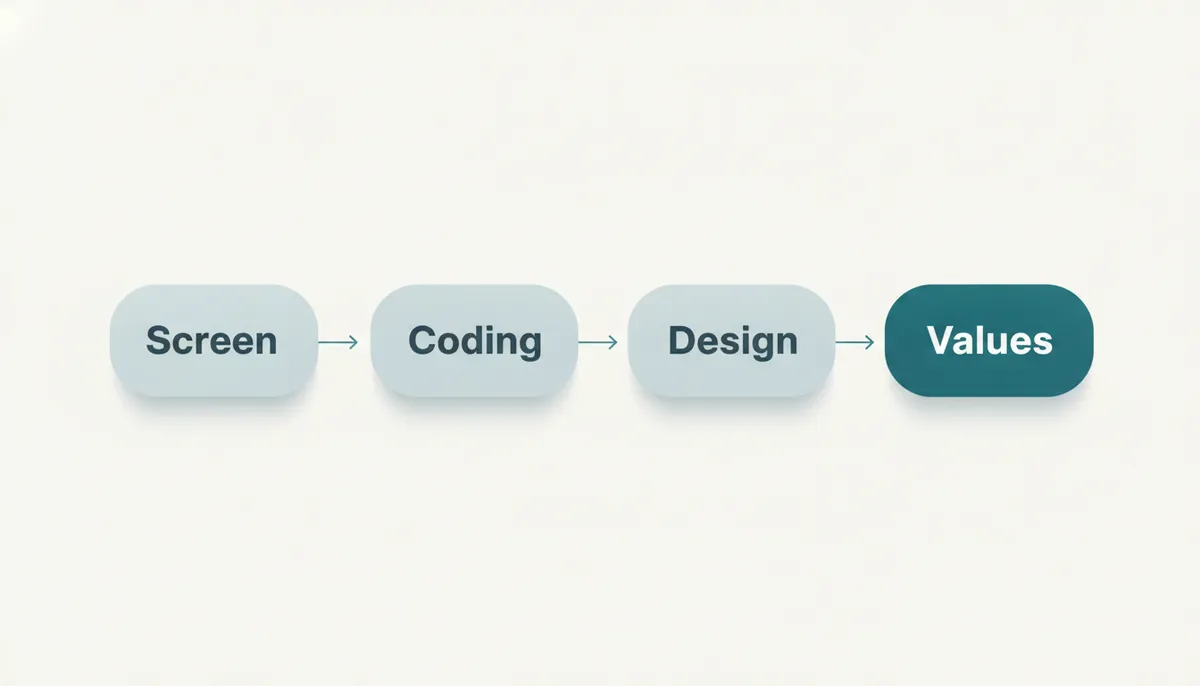
Atlassian interview questions span a Karat-administered technical screen, coding and system-design conversations, and a Values round that reported accounts describe as a genuine hiring gate rather than a routine culture check. The most effective preparation is therefore broad but deliberate: sharpen core coding patterns, revisit operating-system and networking fundamentals for the screen, practise communicating design trade-offs, and prepare concrete stories that show how you work. Atlassian's interview kit holds four mapped DSA questions and four low-level design problems evidenced at Atlassian.
This guide covers the reported loop round by round, what each stage is intended to reveal, why the Values round changes the preparation strategy, and how to organise a month of practice without treating the process as a memorisation exercise.
The process at a glance
| Stage | Round | Format | What it screens for |
|---|---|---|---|
| 1 | Recruiter conversation | Background and role discussion | Role fit, motivation and logistics |
| 2 | Karat technical screen | External interviewer, rapid technical discussion and coding | Fundamentals, problem solving and communication |
| 3 | Coding interviews | Technical conversations with engineers | Correctness, complexity and collaborative reasoning |
| 4 | System design | Discussion-led technical round | Trade-offs, scope and technical judgement |
| 5 | Values round | Structured behavioural discussion | Alignment with Atlassian's stated values |
Reported accounts describe an onsite sequence of four to five rounds after the earlier conversations, although the precise order can vary by team, level and hiring location. Treat this as the common shape, not a fixed company policy, and confirm the current process with your recruiter.
Round 1 — recruiter conversation
The recruiter conversation is usually the entry point into the process. It is where you explain your background, the kind of work you want to do and why the role makes sense for you. It may feel informal, but it sets the narrative that follows you into the loop.
Prepare a concise account of your recent work: the systems you owned, the constraints you faced, the decisions you made and the outcomes. Keep it specific enough that it can survive follow-up questions later. “I worked on a migration” is weak; “I owned the rollout plan, identified a data-consistency risk and changed the cutover strategy” gives an interviewer something concrete to explore.
This is also the right time to ask what level the team is hiring for, whether the technical screen will include fundamentals alongside coding, and what tools or format are expected. You do not need to negotiate the interview through the recruiter, but clarity helps you prepare the right things.
Round 2 — the Karat technical screen
The technical screen is a distinctive part of the reported Atlassian process because it is administered through Karat, a third-party interviewing platform. Reported accounts describe a rapid format that blends operating-system and networking fundamentals with coding.
That mix changes how you should prepare. A candidate who has spent every practice session on arrays and trees may be caught off guard by a short discussion of processes, threads, memory, network behaviour or protocol-level trade-offs. The point is not to recite definitions. It is to show that you can connect core concepts to practical engineering consequences.
For the coding component, use a disciplined live-interview sequence:
- Restate the problem in your own words.
- Ask about inputs, constraints and edge cases.
- Explain a simple approach before jumping to an optimised one.
- State expected time and space complexity.
- Test the solution aloud with a small example.
The DSA Patterns Sheet is free to browse and helps turn an intimidating collection of coding questions into recognisable problem shapes. For the non-coding side of the screen, the Operating Systems Sheet and Computer Networks Sheet are also free to browse, making them useful for targeted revision.
💡 Pro tip: Do not treat fundamentals as a separate memorisation subject. For each topic, practise explaining one consequence. For example: if two threads access shared state, what could go wrong, and what would you consider doing about it?
Karat is also associated in reported accounts with a redo policy for candidates who are unhappy with the experience. That is unusual enough to be worth knowing, but it is not a reason to arrive underprepared. Use it as reassurance that an exceptional technical disruption may not have to define the whole application.
Round 3 — coding interviews
The coding rounds assess more than whether you eventually produce correct code. Interviewers are looking for problem decomposition, complexity awareness, the ability to take feedback and a working style that another engineer could collaborate with.
Expect familiar data-structure and algorithmic territory rather than a completely separate kind of test. The important distinction is that a live interviewer can observe the decisions behind the answer. If you silently explore three approaches and then type the final one, they may see only the last step. If you explain why one approach is too slow and why another better fits the constraints, they can assess your judgement.
This is why candidates who are technically capable still sometimes underperform. Common self-inflicted errors include coding before clarifying the input, optimising prematurely, failing to test boundary cases and going quiet when stuck.
Read what interviewers actually look for in live coding interviews before your mock sessions. The practical standard is simple: make your reasoning easy to follow, not merely your final answer easy to inspect.
✅ Do: Narrate assumptions, alternatives and complexity as you work.
❌ Don't: Write a polished solution in silence and hope the code speaks for itself.
If you need practice with the pressure of explaining while solving, AI mock interviews can help you rehearse a live conversation rather than another solitary problem set.
Round 4 — system design
Reported accounts commonly include a system-design conversation in the Atlassian onsite loop. The expected depth depends on seniority, but the underlying evaluation is consistent: can you turn an ambiguous product need into a coherent technical proposal, make reasonable assumptions and explain the trade-offs?
Start by narrowing the problem. Identify the main user flows, clarify scale where it matters and distinguish functional requirements from reliability, latency or consistency concerns. Then build a simple first version before adding complexity. A clear baseline is more valuable than a sprawling architecture diagram with no argument behind it.
Interviewers are often listening for your ability to prioritise. What must happen synchronously? Which data needs strong consistency? What can be cached, retried or processed later? How will the service behave if a dependency is unavailable? Strong answers make these choices explicit and explain why they suit the stated constraints.
At a lower level, be ready to discuss boundaries between objects and services, ownership of state, interfaces and how a design could accommodate the next likely requirement. Atlassian's interview kit gives you four low-level design problems evidenced at the company, with a useful starting point for practising clear object boundaries and extensibility.
For a framework that separates the two design styles, see low-level design vs high-level design: what interviews actually expect. The Low Level Design Sheet is free to browse if you want structured practice on class design, responsibilities and relationships.
Round 5 — Atlassian's Values round
This is the part of the Atlassian process that should change your preparation plan.
Reported accounts describe the Values round as explicitly mapped to five stated company values, rather than as a generic conversation about whether you would be pleasant to work with. Strong technical performance does not automatically offset weak evidence in this round. The interviewer is looking for how you behave when priorities conflict, how you collaborate, how you respond to feedback and how you make decisions with other people affected by them.
That means vague behavioural preparation is risky. “Tell me about a challenge” is not enough of a prompt to prepare against. Instead, build a story bank that reveals your judgement under pressure.
Prepare examples involving:
- a disagreement where you changed someone’s mind or changed your own;
- a project where customer impact altered a technical decision;
- a difficult trade-off involving quality, speed or scope;
- a mistake you owned and corrected;
- a situation where you improved the work of a team, not just your own output.
Use a clear structure: context, your responsibility, the decision you made, the action you took and the result. Then add reflection. What did you learn, and what would you do differently? That final part often separates a rehearsed anecdote from evidence of mature judgement.
This values-led evaluation is unusually explicit in the reported Atlassian loop. At many companies, candidates can treat behavioural questions as an isolated final conversation. Here, prepare for a structured assessment against stated values and take it as seriously as the coding work.
Is the Atlassian interview hard?
Yes, but the challenge is broader than raw algorithmic difficulty.
The reported process has several distinct technical demands: coding fluency, enough operating-system and networking knowledge to handle a rapid technical screen, and the ability to reason through a system-design discussion. Candidates also need to communicate continuously rather than merely arrive at answers.
The difficult part for many applicants is the Values round. It is not a casual culture-fit chat tacked onto the end of the loop. Reported accounts describe it as a meaningful assessment where technically strong candidates can still be rejected. Preparation that focuses entirely on coding leaves a real part of the loop to chance.
How many rounds are there? Reported accounts commonly describe a recruiter conversation, a Karat technical screen and an onsite loop of four to five rounds covering coding, system design and values-based behavioural evaluation.
How long does the process take? There is no reliable single timeline in the available accounts. Scheduling, team needs and level can all affect the pace, so ask your recruiter for the expected sequence and decision window.
The right mindset is not “master every possible question”. It is “show consistent engineering judgement in each format”. That is a more achievable goal and much closer to what the loop is designed to assess.
A 30-day Atlassian preparation plan
Week 1 — establish coding rhythm
Spend the first week rebuilding speed on core coding patterns. Focus on recognising the shape of a problem, explaining the approach before coding and testing edge cases aloud.
Use shorter, frequent sessions rather than occasional marathons. Alternate between solving independently and rehearsing the explanation you would give an interviewer. The guide to identifying the right DSA pattern in a coding interview is useful if you often know the concepts but struggle to select an approach quickly.
Week 2 — revise practical fundamentals
Shift part of your time to operating systems and networking. Review processes and threads, synchronisation, memory basics, HTTP, networking layers, latency, reliability and common failure modes.
Do not aim to become an academic lecturer. Aim to explain a concept plainly, recognise where it appears in real systems and reason through a follow-up question. Spend the rest of the week maintaining coding practice so speed does not fade.
Week 3 — practise design and trade-offs
Work through low-level design problems in a discussion-first format. Before writing classes or methods, state the responsibilities, identify what may vary and explain how your design could change.
Then practise a higher-level design conversation from a blank page. Establish requirements, propose a simple architecture, identify bottlenecks and discuss trade-offs. The quality of the explanation matters as much as the diagram.
Use Atlassian's interview kit to work through the four mapped DSA questions and four low-level design problems evidenced at Atlassian. After each attempt, identify one decision you would explain more clearly in a live interview.
Week 4 — integrate and rehearse
Use the final week to simulate the loop. Run one coding mock where you speak throughout, one fundamentals review session, one design conversation and one behavioural mock.
For the Values round, write your stories as bullet points rather than scripts. Scripts become brittle when an interviewer changes the question. A story bank lets you adapt while keeping ownership, actions and reflection clear.
💡 Pro tip: Record one behavioural rehearsal. You will quickly notice where you overuse “we”, skip the decision you personally made or spend too long on background before reaching the substance.
Frequently asked questions
Does Atlassian use Karat for technical interviews?
Reported accounts describe a Karat-administered technical screen after the recruiter conversation. It combines rapid operating-system and networking discussion with coding.
What does the Karat screen assess?
It assesses practical fundamentals, coding ability and communication under interview conditions. Prepare to explain concepts, reason about trade-offs and solve a coding problem aloud.
Does Atlassian ask coding questions?
Yes. Reported accounts describe coding as part of both the technical screen and the onsite process. Focus on clear reasoning, correctness, complexity and edge-case testing.
Is system design part of the Atlassian interview process?
Commonly, yes. Reported accounts include a system-design round in the onsite loop. The level of depth can vary with the role and seniority.
What is the Atlassian Values round?
It is a values-based behavioural interview mapped to Atlassian's stated values. Reported accounts stress that it is not simply a standard culture-fit conversation.
Can strong coding performance compensate for a weak Values round?
Do not assume so. Reported accounts describe the Values round as a genuine evaluation where technical strength alone may not decide the outcome.
How should I prepare behavioural stories for Atlassian?
Prepare specific examples about ownership, collaboration, disagreement, customer impact, mistakes and difficult trade-offs. Emphasise what you personally did and what you learned.
How many rounds does Atlassian have?
The commonly reported shape is a recruiter conversation, a Karat technical screen and an onsite loop of four to five rounds. Exact sequencing can vary.
What should I ask the recruiter before preparing?
Ask about the role level, expected interview format, whether the technical screen includes fundamentals, the likely onsite sequence and the anticipated scheduling window.
Where to start
Atlassian preparation works best when you treat technical and values-based performance as one connected story: you can solve problems, explain your choices, collaborate through ambiguity and reflect honestly on your work.
Start with Atlassian's interview kit for the four mapped DSA questions and four low-level design problems evidenced at Atlassian. Use the free-to-browse sheets for coding and fundamentals revision, then practise explaining your decisions in an AI mock interview.
Finally, confirm the current interview structure with your recruiter. Reported candidate experiences are useful for preparation, but the role and team you are interviewing for should guide the final details.
Topics
Related on Thita
Your next step
Practise with AI mock interviews
A spoken interview that asks follow-up questions, runs your code and ends with a written report.