
Interview
Behavioral Interviews for Engineers: Real Questions and Strong Answers
Most engineers prepare intensely for system design and coding rounds—and then get blindsided by the behavioral interview. The questions sound deceptively sim...
Most engineers prepare intensely for system design and coding rounds—and then get blindsided by the behavioral interview. The questions sound deceptively simple (“Tell me about a time you disagreed with your manager”), yet they often determine the final hiring decision. Behavioral interviews are where companies assess how you actually operate in a team: how you debug messy situations, handle conflict, and make tradeoffs under pressure.
This guide walks through behavioral interviews for engineers in a practical, engineering-focused way. We’ll cover the underlying model interviewers use, the STAR method, real questions with strong sample answers, and patterns you can reuse across companies and levels.
What is a Behavioral Interview in Engineering?
A behavioral interview is a structured conversation where the interviewer asks about your past experiences to predict your future behavior. Instead of hypothetical questions (“What would you do if…?”), you’ll hear:
- “Tell me about a time you…”
- “Give me an example of when…”
- “Describe a situation where…”
For engineering roles, behavioral interviews focus on:
- Ownership and accountability
- Communication and collaboration
- Dealing with ambiguity
- Conflict and disagreement
- Learning from failure
- Leadership (with or without title)
- Delivering impact, not just writing code
The underlying assumption: past behavior is the best predictor of future behavior.
The Framework: Using the STAR Method Effectively
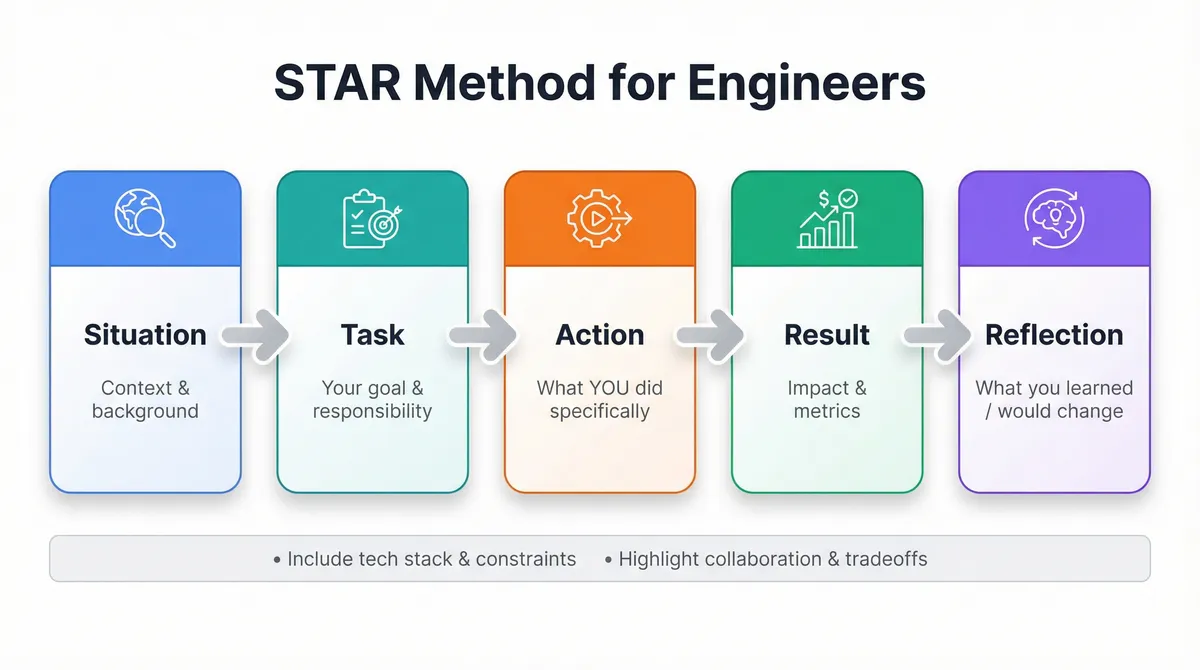
Most companies implicitly or explicitly evaluate answers using the STAR method:
- Situation – Context and background
- Task – Your responsibility or goal
- Action – What you did
- Result – Outcome, metrics, and learnings
Used well, STAR turns vague stories into clear, structured answers.
The STAR Method for Engineers
For engineering interviews, augment STAR with two extra dimensions:
- Tech context: stack, constraints, scale, and tradeoffs
- Reflection: what you’d do differently, what you learned
You can think of it as: STAR + Tech + Reflection
Example: Weak vs Strong STAR Answer
Question: “Tell me about a time you had to work under a tight deadline.”
Weak answer (unstructured)
“I had this project with a really tight deadline. We all worked really hard and stayed late a few nights. It was stressful, but we got it done and the stakeholders were happy.”
Strong answer (STAR + Tech + Reflection)
-
Situation:
“At my previous company, we were migrating our payments service to a new provider. Two weeks before launch, legal changed some compliance requirements, and we had to support additional validation flows before the go-live date.” -
Task:
“As the engineer owning the payment validation service (Node.js + PostgreSQL, ~2k TPS), I was responsible for designing and implementing the new validation logic without impacting latency or blocking the migration timeline.” -
Action:
“I broke the work into three parts: schema changes, validation logic, and rollout.- I proposed a schema change that stored normalized compliance attributes to avoid multiple joins.
- I added feature flags around the new validation paths, so we could dark-launch and gradually ramp traffic.
- To gain time, I aligned with QA and DevOps on a parallel test plan: they started with contract tests while I finished the edge cases.
- I also scheduled a 15-minute daily sync with stakeholders to surface risks early and avoid surprise scope changes.”
-
Result:
“We shipped on time, and our p95 latency increased by only 8 ms, within the 10 ms budget. There were zero payment failures attributable to the new logic in the first month. The feature-flagged rollout also let us quickly disable one non-critical validation path when a third-party API had a partial outage.” -
Reflection:
“In retrospect, I would have pushed earlier for a standard template for compliance changes, since ad-hoc requests tend to arrive late. I later worked with legal and product to define a checklist that reduced last-minute surprises on future projects.”
Notice how the strong answer:
- Gives concrete technical context
- Shows ownership and coordination
- Quantifies impact
- Includes a learning moment
Core Behavioral Themes in Engineering Interviews
Most behavioral interview questions for engineers map to a small set of underlying themes. Recognizing these patterns makes preparation much easier.
1. Ownership and Accountability
What interviewers look for
- Do you take responsibility end-to-end?
- Do you own outcomes, not just code?
- Do you follow through when things go wrong?
Common questions
- “Tell me about a time you owned a project from start to finish.”
- “Describe a situation where you made a mistake. What did you do?”
- “Tell me about a time something went wrong in production.”
Strong answer characteristics
- You clearly owned or stepped up to own the problem.
- You didn’t deflect blame.
- You took corrective and preventive actions.
- You talk about impact on users/business, not only technical details.
2. Collaboration and Communication
What interviewers look for
- Can you work effectively with PMs, designers, other engineers?
- Can you explain complex topics clearly?
- Do you listen and adjust based on feedback?
Common questions
- “Tell me about a time you had to work with a difficult teammate.”
- “Describe a time you had to explain a technical concept to a non-technical stakeholder.”
- “Tell me about a time you unblocked someone else.”
Strong answer characteristics
- Shows empathy and active listening.
- Highlights specific communication strategies (docs, diagrams, async updates).
- Balances technical rigor with clarity for the audience.
3. Dealing with Ambiguity
What interviewers look for
- Can you move forward when requirements are unclear?
- How do you reduce uncertainty?
- Do you ask good questions and make reasonable assumptions?
Common questions
- “Tell me about a time you had to work with ambiguous requirements.”
- “Describe a situation where you had to make a decision with incomplete data.”
Strong answer characteristics
- You actively clarified scope (questions, documents, prototypes).
- You identified and prioritized unknowns.
- You made reversible decisions where possible.
4. Conflict and Disagreement
What interviewers look for
- Can you disagree professionally?
- Do you separate ideas from people?
- Do you know when to commit even if you disagree?
Common questions
- “Tell me about a time you disagreed with your manager.”
- “Describe a time you had a conflict with a teammate. How did you handle it?”
Strong answer characteristics
- You focus on the technical or product issue, not personalities.
- You use data, experiments, or prototypes to resolve disagreements.
- You show willingness to commit to a decision once made.
5. Learning, Growth, and Failure
What interviewers look for
- Do you learn from mistakes?
- Do you seek feedback?
- Do you improve systems and processes after incidents?
Common questions
- “Tell me about a time you failed.”
- “Describe a time you received critical feedback.”
- “Tell me about something you’re trying to improve about yourself.”
Strong answer characteristics
- The failure is real and non-trivial.
- You take responsibility and show insight into root causes.
- You implemented changes that prevented recurrence.
Real Behavioral Interview Questions with Strong Sample Answers
Below are realistic engineering behavioral questions with sample answers using the STAR method. Adapt them to your own experiences; don’t memorize them verbatim.
Question 1: Ownership – “Tell me about a time you owned a project end-to-end.”
Sample answer (Senior IC perspective)
-
Situation:
“At my last company, our API response times were degrading as our customer base grew. P95 latency for a key endpoint had gone from 150 ms to over 400 ms over six months, and we were getting complaints from enterprise customers.” -
Task:
“As a senior backend engineer, I volunteered to lead a performance initiative to bring p95 back under 200 ms without adding significant infrastructure cost.” -
Action:
“I started by instrumenting detailed traces with OpenTelemetry to identify hotspots. We discovered that a fan-out pattern to three downstream services was the main culprit.- I proposed introducing a read-optimized denormalized view in Redis for the most common query path, updated via a background worker.
- I wrote an RFC describing the design, tradeoffs (eventual consistency vs latency), and rollout plan, and circulated it across backend, SRE, and product.
- I implemented the caching layer and added metrics to track cache hit ratio and staleness.
- I coordinated with SRE to run a load test in a staging environment and tuned TTLs and batch sizes based on results.
- We rolled out gradually behind a feature flag, starting with 5% of traffic.”
-
Result:
“Within three weeks, we reduced p95 latency from ~420 ms to 130 ms for the endpoint, and our Redis costs were offset by being able to downsize two application instances. We also reduced timeouts by 60%. I documented the pattern as a reusable ‘read-optimized view’ design that two other teams later adopted.” -
Reflection:
“One thing I’d improve is involving the analytics team earlier. They later asked for additional logging fields we could’ve added during the initial implementation instead of a follow-up change.”
Question 2: Conflict – “Tell me about a time you disagreed with your manager.”
Sample answer
-
Situation:
“On a previous team, we were building a new onboarding flow for our SaaS product. My manager wanted to skip adding automated tests for the first version to hit a tight deadline.” -
Task:
“As the engineer responsible for the onboarding backend, I felt that shipping without tests would increase long-term risk, especially since onboarding is critical for conversion.” -
Action:
“I scheduled a short 1:1 with my manager to discuss it.- I started by acknowledging the deadline pressure and business importance of the launch.
- I then presented data: in the past year, three major incidents were caused by changes in flows without tests, leading to about 12 hours of combined downtime.
- I proposed a compromise: we’d limit automated tests to the highest-risk paths (account creation, billing setup) and use contract tests instead of full end-to-end tests to keep them fast to implement.
- I estimated that this would add about one extra day to the schedule, and I committed to working with QA to parallelize test writing with manual exploratory testing.”
-
Result:
“My manager agreed to the scoped-down test plan. We launched only one day later than initially planned, and we had no major regressions in the first three months, despite shipping several iterations. The limited but targeted tests caught a billing edge case before it reached production.” -
Reflection:
“This reinforced for me that disagreements go better when framed around shared goals and data, not opinions. I also learned to come with concrete alternatives, not just objections.”
Question 3: Ambiguity – “Describe a time you had to work with unclear requirements.”
Sample answer (Mid-level engineer)
-
Situation:
“At a previous startup, we were asked to ‘improve user engagement’ on our dashboard, but the product requirements were vague and priorities kept shifting.” -
Task:
“I was assigned as the primary engineer to implement the first iteration of improvements, but I needed clearer scope to avoid building features that might be thrown away.” -
Action:
“I proposed a short discovery phase before implementation.- I partnered with the PM to define a concrete goal: increase weekly active usage of the dashboard by 15% over two months.
- I pulled metrics from our analytics system and identified that most drop-off happened after the first week.
- I suggested two lightweight experiments: (1) a guided tour for new users, and (2) a ‘recent activity’ widget.
- I implemented both behind experiment flags and set up event tracking to measure impact.
- I also documented assumptions and success criteria in a short design doc that we shared with stakeholders.”
-
Result:
“The guided tour increased week-2 retention by 10%, while the activity widget had negligible impact. Because we framed them as experiments, it was easy to iterate: we doubled down on improving the tour and dropped the widget. We ultimately achieved a 17% increase in weekly active usage over the next quarter.” -
Reflection:
“I learned the value of making ambiguity explicit and turning it into hypotheses and experiments, rather than trying to guess what stakeholders want.”
Question 4: Failure – “Tell me about a time you made a mistake in production.”
Sample answer
-
Situation:
“Earlier in my career, I deployed a change to our job scheduler that unintentionally doubled the number of scheduled jobs for some users.” -
Task:
“As the engineer who made the change, I needed to mitigate the impact quickly and prevent it from happening again.” -
Action:
“As soon as we noticed the spike in job volume:- I immediately reverted the deployment and paused the scheduler to stop creating new jobs.
- I worked with another engineer to write a cleanup script that deduplicated jobs based on user ID and timestamp.
- I posted updates in our incident channel every 10–15 minutes so stakeholders knew what was happening.
- After the incident, I led a blameless postmortem: we identified that the root cause was a missing idempotency check and lack of tests for the specific edge case.
- I added an idempotency key and wrote tests for the affected code path. We also updated our deployment checklist to include a dry-run mode for scheduler changes.”
-
Result:
“We fully resolved the incident within two hours, with no permanent data loss. Some users experienced duplicate notifications, and customer support handled a small number of tickets. We haven’t had a similar incident with the scheduler since.” -
Reflection:
“I learned to treat incidents as system failures, not individual failures, and to build guardrails—like idempotency and dry-runs—around sensitive components.”
How to Prepare Strong Behavioral Stories (Like You Prepare for DSA)
You wouldn’t walk into a coding interview without practicing patterns. Behavioral interviews benefit from the same pattern-based preparation.
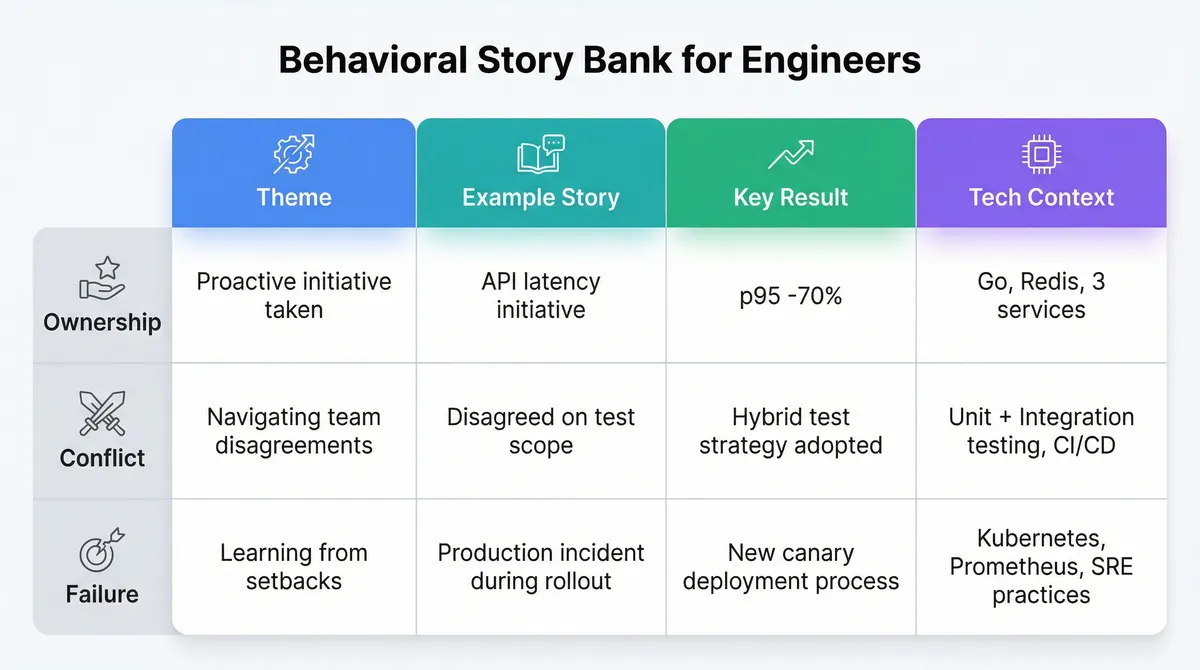
Step 1: Build a Story Bank
List 8–12 experiences you can talk about. Aim for variety:
- A big project you led or heavily contributed to
- A time you improved performance or reliability
- A conflict or disagreement
- A production incident or outage
- A failure or mistake
- A time you mentored someone
- A time you dealt with ambiguous requirements
- A time you improved a process or tooling
For each story, jot down bullet points in STAR format. You don’t need a script, just structured notes.
Step 2: Map Stories to Common Question Types
Most behavioral questions are variations of the same patterns. For each story, tag it with themes:
- Ownership
- Conflict
- Ambiguity
- Leadership
- Failure
- Collaboration
- Impact
One story can cover multiple themes. For example, the “API latency initiative” story covers ownership, impact, and collaboration.
Step 3: Add Metrics and Specifics
Strong stories are concrete:
- Latency reduced from 450 ms → 180 ms
- Error rate dropped from 2% → 0.2%
- Build time decreased from 40 min → 15 min
- On-call pages per week reduced from 10 → 3
If you don’t have exact numbers, approximate honestly (“roughly 30–40% faster”, “about half as many incidents”).
Step 4: Practice Out Loud
Behavioral answers are about communication as much as content. Practice:
- Keeping answers within 2–3 minutes
- Staying structured (STAR)
- Emphasizing your role (“I did…”) while acknowledging the team
- Avoiding tangents and deep technical rabbit holes unless asked
You can simulate this with peers, or with tools that provide AI mock interviews and feedback on clarity and structure.
Advanced Tips: Answering Like a Senior Engineer
For senior and staff-level roles, expectations are higher. Interviewers look for:
- System-level thinking
- Cross-team influence
- Balancing tech and business tradeoffs
- Mentoring and multiplying others
Here’s how to reflect that in behavioral answers.
1. Emphasize “Why”, Not Just “What”
Don’t just describe what you implemented. Explain:
- Why you chose a particular design
- What tradeoffs you considered
- How you aligned with product/business goals
Example:
Instead of “I added caching to speed up the endpoint”, say:
“I considered three options—SQL index tuning, denormalization, and caching. Given our read-heavy pattern and tolerance for slight staleness, caching gave us the best latency improvement per unit of complexity. We aligned with product on a 5-minute staleness budget, which let us keep the design simpler.”
2. Show How You Multiply Impact
Include examples where you:
- Created reusable libraries or patterns
- Improved CI/CD, testing, or observability
- Mentored junior engineers
- Drove cross-team initiatives
Example snippet:
“After resolving the incident, I documented a runbook and created a standard dashboard template. Two other teams adopted the same pattern, which reduced their time-to-diagnose during later incidents.”
3. Demonstrate Healthy Conflict and Alignment
Senior engineers are expected to navigate disagreement constructively:
- Show that you invite diverse opinions.
- Highlight how you converged on a decision.
- Mention when you committed despite disagreement.
Example snippet:
“Although I initially disagreed with the chosen direction, once we decided, I made sure my team had what they needed to execute. I also tracked the outcome so we could revisit the decision with data.”
Common Mistakes in Behavioral Interviews (and How to Fix Them)
Mistake 1: Being Too Vague
- “We improved performance.”
- “It went well.”
- “We had some issues, but we fixed them.”
Fix: Add specifics.
- What exactly did you do?
- How much did metrics change?
- What was the scale (requests per second, data size, team size)?
Mistake 2: Telling “We” Stories Only
Overusing “we” makes it hard to evaluate your contribution.
Fix: Use “we” for team context and “I” for your actions.
- “As a team, we decided to… I personally implemented… I also drove…”
Mistake 3: Over-indexing on Technical Detail
Diving into low-level implementation details that don’t matter to the behavioral question.
Fix: Stay at the right level of abstraction.
- Focus on decisions, tradeoffs, collaboration, and impact.
- Offer technical depth as a follow-up: “I can go deeper into the implementation if that’s useful.”
Mistake 4: Dodging Failure Questions
Saying you’ve never failed, or giving a “fake failure” (“I work too hard”).
Fix: Choose a real, bounded failure.
- Something that had consequences but wasn’t catastrophic.
- Show what you learned and how you changed behavior or systems.
Mistake 5: Ignoring Reflection
Ending at “and then we shipped” without insights.
Fix: Add one or two sentences of reflection:
- “This changed how I approach…”
- “Since then, I always…”
- “We updated our process to…”
Best Practices and Actionable Tips
Here’s a concise checklist you can use while preparing.
Before the Interview
-
Prepare your story bank
- 8–12 stories covering ownership, conflict, ambiguity, failure, impact, collaboration, leadership.
-
Structure in STAR
- For each story, write S/T/A/R bullets + tech context + reflection.
-
Research the company’s values
- Many companies publish their leadership principles or values.
- Map your stories to those themes.
-
Practice out loud
- Time yourself: aim for 2–3 minutes per answer.
- Record or use an AI coach to get feedback on clarity and structure.
During the Interview
-
Clarify the question
- “Do you prefer an example from my current role or earlier in my career?”
- “Is it okay if I use a project that’s more infra-focused?”
-
Pick the right story
- Choose one that matches the theme: conflict, ambiguity, failure, etc.
- Avoid repeating the same story for multiple questions if possible.
-
Use STAR explicitly in your mind
- Think: S → T → A → R → Reflection.
- Don’t skip Result or Reflection.
-
Watch for interviewer cues
- If they seem lost, simplify.
- If they lean in on technical details, go deeper.
After the Interview
-
Write down what you used
- Which stories you told, what landed well, what felt weak.
-
Iterate
- Refine stories with clearer metrics or better framing.
Key Takeaways
- Behavioral interviews for engineers are structured assessments of how you work: your ownership, collaboration, decision-making, and learning.
- The STAR method, extended with technical context and reflection, is the most effective way to structure your answers.
- Prepare a story bank of 8–12 experiences mapped to core themes: ownership, conflict, ambiguity, failure, leadership, collaboration, and impact.
- Strong answers are specific, metric-driven, and reflective, and they balance the “I” (your contributions) with the “we” (team context).
- Avoid common pitfalls: vague answers, only “we” stories, too much low-level detail, and dodging real failures.
With the same deliberate practice you apply to algorithms and system design, you can make behavioral interviews another area where you perform with confidence and clarity.