
Interview
Bloomberg Machine Coding Round: Preparation Guide (2026)
Prepare for Bloomberg's machine coding and low-level design work: Superday format, evaluation priorities, timed-build strategy, mistakes and a two-week plan.
The Bloomberg machine coding round is best prepared for as practical, discussion-led engineering work rather than as another algorithm puzzle. Reported accounts describe Bloomberg Superdays as a sequence of back-to-back coding, system-design and behavioural conversations. The exact arrangement varies, and accounts do not consistently identify a separate, fixed-length machine-coding round. But candidates should expect practical coding and low-level design judgement to appear within that technical work.
That distinction matters. A clean data-structures solution demonstrates problem solving; a practical design exercise asks whether you can turn an incomplete requirement into understandable, working software while explaining your choices. For targeted practice, Bloomberg's interview kit holds 126 mapped DSA questions and five low-level design problems evidenced at Bloomberg.
This guide focuses on the machine-coding and low-level-design skills that can surface in Bloomberg’s technical Superday work. For the broader sequence of recruiter screens, phone interviews and Superday conversations, use the Bloomberg interview-process pillar page rather than treating this article as a full-loop guide.
Where machine coding sits in Bloomberg’s interview process
Reported accounts describe an initial recruiter conversation, followed by one or two coding phone screens, then a Superday containing several back-to-back conversations. Technical coding, system design and behavioural assessment are commonly reported as part of that day.
The important preparation implication is that practical design work is not safely separable from the rest of the technical evaluation. You may begin with a coding prompt and be asked to discuss classes, state, failure cases, APIs or how a component would evolve. You may receive a design-oriented prompt and need to write enough code or pseudocode to make the design concrete.
This is especially relevant at Bloomberg because the product environment naturally rewards precision: market data, real-time updates, correctness, clear interfaces and systems that colleagues can understand. That does not mean every prompt is financial-domain specific. It does mean vague reasoning, untested assumptions and fragile state management can be costly in an interview conversation.
Think of the Bloomberg machine coding round as a practical engineering test with three layers:
- Can you identify the core user flow from an incomplete prompt?
- Can you model the right objects, responsibilities and state?
- Can you produce or describe code that works, then defend sensible trade-offs?
The Low Level Design Sheet is free to browse if you need to rebuild the vocabulary behind these decisions: composition, interfaces, encapsulation, state transitions and extensibility.
Format and time limit: what is known, and how to prepare anyway
There is no consistently reported standalone time limit for a Bloomberg machine-coding round. Reported accounts describe a Superday with several back-to-back interviews, but the allocation for any practical coding or low-level-design segment can differ by role, level and interviewer.
Do not let that uncertainty lead to open-ended practice. The useful constraint is not guessing an exact clock; it is learning to deliver a complete core solution early enough that you can explain, test and improve it before the conversation ends.
A typical practical prompt may give you a small domain and a few operations: register an entity, accept an action, calculate an outcome, retrieve a result, or manage updates over time. The prompt may leave important details unstated. That is intentional. The interviewer is assessing whether you surface ambiguity before it turns into an implementation mistake.
Ask concise questions before you write code:
- What is the central workflow that must work first?
- Which inputs are valid, invalid or repeated?
- Is state held in memory for this exercise?
- What should happen when an operation cannot be completed?
- Which future requirement would the interviewer most reasonably add?
Then state a narrow first version: “I will build the core flow in memory first, show it working, and then explain how I would extend it.” That creates a shared plan and prevents overbuilding.
For a useful contrast between class-level design and architecture-level design, read low-level design versus high-level design in interviews. Bloomberg Superday accounts commonly mention system design as well, so experienced candidates should be ready to shift from object design to broader architecture when the discussion requires it.
What graders actually reward
No public rubric defines the Bloomberg machine coding round. Still, reported technical interviews and practical coding conventions point to a reliable order of priorities. In rough order of weight, optimise for the following.
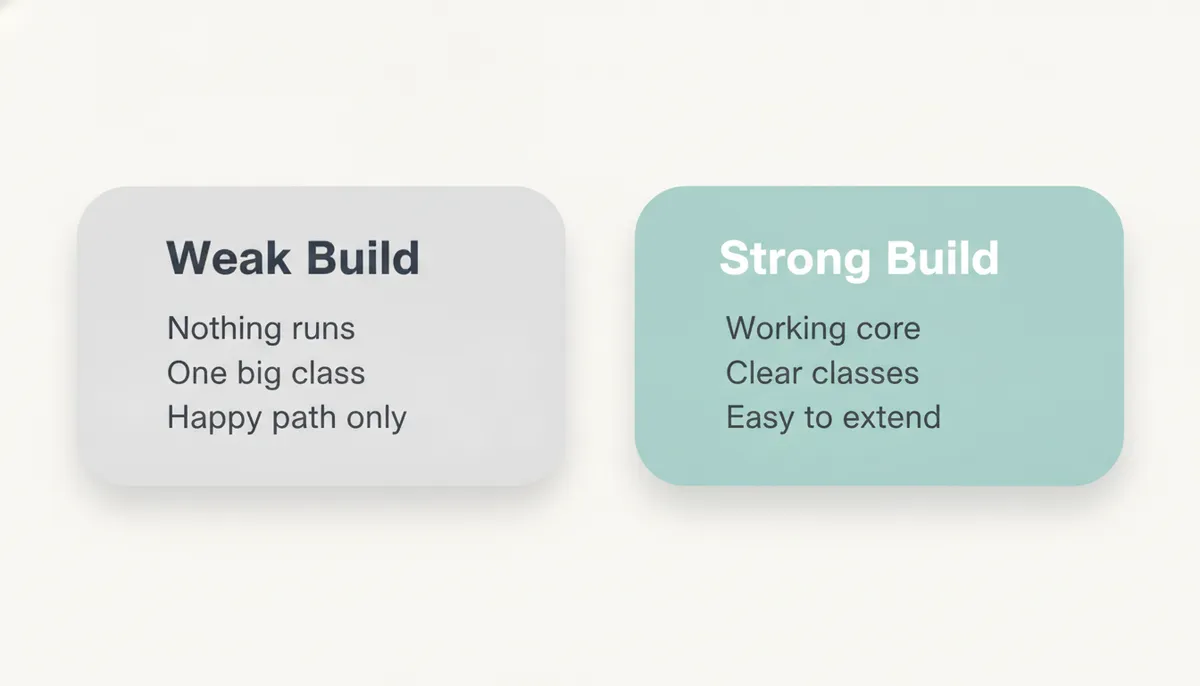
A working core flow
First, the solution must do the primary job. A compact program that handles the requested workflow correctly is stronger than an elaborate design that never reaches execution. If the exercise involves state, show how state changes. If it involves a calculation, show an example input and output. If it involves a command, show success and failure behaviour.
Clear modelling and responsibility boundaries
Your classes should have reasons to exist. A domain object owns domain state; a service coordinates a workflow; a repository-like component owns retrieval if persistence is in scope. Avoid one oversized class that reads input, validates it, performs all business logic and formats output.
The goal is not to recite object-oriented principles. It is to make the code easier to change without making it harder to read.
Sound handling of assumptions and edge cases
Interviewers notice whether you ask about duplicate requests, missing identifiers, invalid transitions, empty collections and boundary values. You do not need to implement every hypothetical scenario. You do need to recognise which cases could compromise correctness.
Say what you are choosing: “For this first version, I will reject duplicate IDs,” or “I will treat this as an idempotent update.” Clear assumptions demonstrate engineering judgement.
Extensibility where change is plausible
A good design anticipates one likely extension, not every extension imaginable. If pricing rules may vary, an interface can be justified. If notification channels may grow, separating delivery from business logic can be sensible. If nothing varies, a simple class is usually better.
This is where candidates often lose points through overengineering. Patterns are tools, not decoration. A factory, strategy or observer abstraction should answer a concrete change you expect, not signal that you know its name.
Readable code and explainable decisions
Use names that reveal intent. Keep methods short enough to describe in one sentence. Narrate transitions between steps: requirement, model, implementation, test, trade-off. The interviewer cannot reward reasoning they cannot hear.
The guide to explaining your thought process clearly in coding interviews is worth practising alongside design exercises. Communication is not separate from technical performance in a live round.
Testing and a credible next step
End by exercising the main path and at least one edge case. If there is no execution environment, walk through the calls as though you were a test harness. Then offer one measured improvement: persistence, concurrency control, caching, observability or a new rule type, depending on the prompt.
How to structure the available time
Since Bloomberg does not have a consistently reported fixed machine-coding duration, use stages rather than minute targets. Adjust the pace to the time your interviewer gives you, but preserve the order below.
| Stage | What to do | What a strong outcome sounds like |
|---|---|---|
| Opening | Clarify the workflow, constraints and assumptions | “I will start with the core operation and keep state in memory.” |
| Early build | Name the main entities and implement the happy path | “These objects separate state, rules and orchestration.” |
| Middle check | Run or trace the primary flow | “This input produces the expected state change.” |
| Edge-case pass | Handle the most consequential invalid or repeated cases | “This prevents an inconsistent update.” |
| Final discussion | Explain one extension and one trade-off | “If rules vary, I would isolate that behaviour behind an interface.” |
The trap is spending the opening stage designing a perfect hierarchy. In a time-constrained conversation, delay sophistication until the core flow exists. Your first implementation should be deliberately small, legible and testable.
Practise this sequence in in-browser code practice, then compare your choices with the editorials in Bloomberg's interview kit. The point is not to memorise a canonical design; it is to recognise why a particular boundary or abstraction earns its complexity.
The failure modes that matter most
Building a framework instead of a solution
Candidates sometimes create multiple interfaces, factories and layers before implementing the requested operation. The result may look sophisticated but gives the interviewer no evidence that the system works.
Build the simplest version that meets the stated requirement. Add an abstraction only when you can name the variation it handles.
Treating ambiguities as private decisions
Practical prompts are frequently incomplete. Quietly assuming whether updates are mutable, whether duplicates are allowed or how failures are represented can send your implementation down the wrong path.
Ask. If time is short, state the assumption and invite correction. That is faster than rewriting later.
Leaving no running demonstration
Code that has not been exercised is an unfinished answer. Even a lightweight driver, a short sequence of method calls or a verbal walkthrough is valuable. It exposes errors and shows you think beyond compilation.
Mixing unrelated responsibilities
A single class that owns validation, business rules, storage and output formatting becomes difficult to explain and harder to extend. Split responsibilities when the split makes the flow clearer; do not split merely to increase the class count.
Ignoring correctness under change
A solution can work once and still be fragile. Consider repeated calls, invalid state transitions, ordering, null or empty inputs, and values at boundaries. You do not need exhaustive production hardening, but you should identify the risks.
Going silent after writing code
The interviewer needs your rationale. Explain why you chose a map rather than a list, why a rule belongs in one class, and what you would change if scale or concurrency became relevant. Speak in short checkpoints rather than narrating every keystroke.
Preparing technical work but not behavioural evidence
Reported Bloomberg accounts repeatedly flag genuine interest in Bloomberg’s mission and behavioural fit as meaningful factors, even for technically strong candidates. Prepare concise project stories that show ownership, precision, collaboration and how you handled a difficult decision. You can rehearse those conversations with an AI mock interview.
A two-week Bloomberg machine coding practice plan
First week: build design fluency
Early week — model small domains. Pick a compact problem and spend time only on requirements, entities, operations and state transitions. Before coding, write a few sentences explaining the core workflow. This teaches you to begin with a model rather than a class diagram.
Middle week — implement complete first versions. Build small, in-memory systems with a driver or tests. Focus on one happy path and a few meaningful failure paths. Resist the urge to add persistence, APIs or frameworks unless the prompt requires them.
Later week — study patterns in context. Browse the free Low Level Design Sheet and revisit design patterns through the question: what change does this pattern make cheaper? The design patterns for interviews guide can help you distinguish useful abstractions from decorative ones.
End of week — retain DSA sharpness. Bloomberg’s technical loop also includes coding interviews. Use the free DSA Patterns Sheet for short, focused sessions on recognition, complexity analysis and explaining an approach before implementation.
Second week: practise under interview conditions
Early week — rehearse the opening. Take unfamiliar prompts and limit yourself to clarifying questions, a verbal plan and a minimal object model. The goal is to become comfortable saying “I will begin with this scope” rather than disappearing into design.
Middle week — complete timed simulations. Use the duration supplied by your practice setting and follow the stage table above. Finish a working core flow before adding improvements. Record yourself explaining decisions, then listen for vague language and unexplained leaps.
Later week — review and rebuild. Revisit designs that felt awkward. Do not merely read a better answer; rebuild the core flow from scratch and articulate why each responsibility lives where it does.
Final preparation — combine formats. Alternate a DSA session, a practical design session and a behavioural rehearsal. Bloomberg's interview kit gives you the company-mapped material to organise that technical practice around.
Frequently asked questions
Is there a separate Bloomberg machine coding round?
Reported accounts do not consistently describe a separate standalone machine-coding round. They commonly describe coding and system-design work within a Bloomberg Superday, so prepare for practical low-level design alongside live coding.
How long is the Bloomberg machine coding round?
There is no consistently reported fixed duration for a standalone Bloomberg machine-coding exercise. Confirm the format and timing with your recruiter, then practise delivering a working core solution early in the allotted time.
What should I build first in a practical coding exercise?
Build the smallest end-to-end version of the primary workflow. Show it working, then handle the most meaningful edge cases and discuss extensions.
Does Bloomberg test low-level design?
Bloomberg’s reported technical process includes coding and system design, and the kind of low-level design problem evidenced at Bloomberg is useful preparation for practical class and object-design discussions.
Should I use design patterns in every answer?
No. Use a pattern when it supports a real variation or responsibility boundary. Plain, readable code is stronger than unnecessary abstraction.
Do I need to know financial systems?
You should be ready to discuss correctness, real-time updates and precise data handling, but do not assume every prompt requires finance-specific knowledge. Clarify the domain requirements instead of guessing.
How should I handle an incomplete prompt?
Ask focused questions about the core workflow, invalid inputs, state ownership and the most likely extension. State any remaining assumptions aloud before coding.
Does DSA still matter for Bloomberg?
Yes. Reported accounts describe coding phone screens and coding work during Superday. Keep problem-solving, complexity analysis and communication sharp alongside low-level-design practice.
How do I prepare for the behavioural part of Superday?
Prepare specific stories about ownership, collaboration, mistakes, technical decisions and why Bloomberg’s work interests you. Rehearse answers aloud so they sound concrete rather than memorised.
Start with complete, explainable solutions
The strongest preparation for the Bloomberg machine coding round is not collecting more patterns. It is repeatedly taking an imperfect prompt, clarifying it, building a correct core flow and explaining what you would improve next.
Open Bloomberg's interview kit to practise the 126 mapped DSA questions and five low-level design problems evidenced at Bloomberg. Pair that work with the free-to-browse DSA Patterns Sheet, focused low-level-design practice, and an AI mock interview for technical and behavioural rehearsal.
Confirm the final Superday format with your recruiter. Then prepare for the part you can control: clear thinking, working code, sound judgement and an explanation the interviewer can follow.
Topics
Related on Thita
Your next step
Practise with AI mock interviews
A spoken interview that asks follow-up questions, runs your code and ends with a written report.