
Interview
Box Interview Questions and Process: The Complete Guide (2026)
A practical guide to Box software engineering interviews: likely rounds, coding and design preparation, communication practice, and a focused 30-day plan.
Box interview questions are best prepared for as a modern software engineering loop: expect an initial screen, a coding evaluation, deeper technical discussion that may include design, and a behavioural conversation about your work. Reported accounts for Box are thin and vary by team, so confirm the exact format with your recruiter early. Start with transferable coding skills, practise explaining decisions aloud, and use Box's interview kit to work through 3 mapped DSA questions associated with Box.
The useful goal is not predicting an exact agenda from incomplete reports. It is becoming reliable at the skills interviewers can assess across formats: recognising a problem shape, writing correct code, discussing trade-offs, and giving specific examples of ownership.
The process at a glance
There is no well-sourced company-wide sequence, named ritual, platform, or fixed timetable for Box software engineering interviews. This table is a preparation map for the general shape of a modern engineering loop, not a claim that every Box candidate will see every stage.
| Stage | Likely format | What to prepare | What it screens for |
|---|---|---|---|
| Initial screen | Conversation with a hiring contact | Experience, interests, availability | Role fit and communication |
| Technical screen | Live coding or shared-editor discussion | Core DSA patterns and complexity | Problem solving and clarity |
| Technical loop | Coding and technical discussion | Code quality, testing, design judgement | Engineering depth |
| Design discussion | System or component-level conversation | Requirements, trade-offs, structure | Technical judgement |
| Behavioural conversation | Project and collaboration discussion | Ownership stories and reflection | Teamwork and impact |
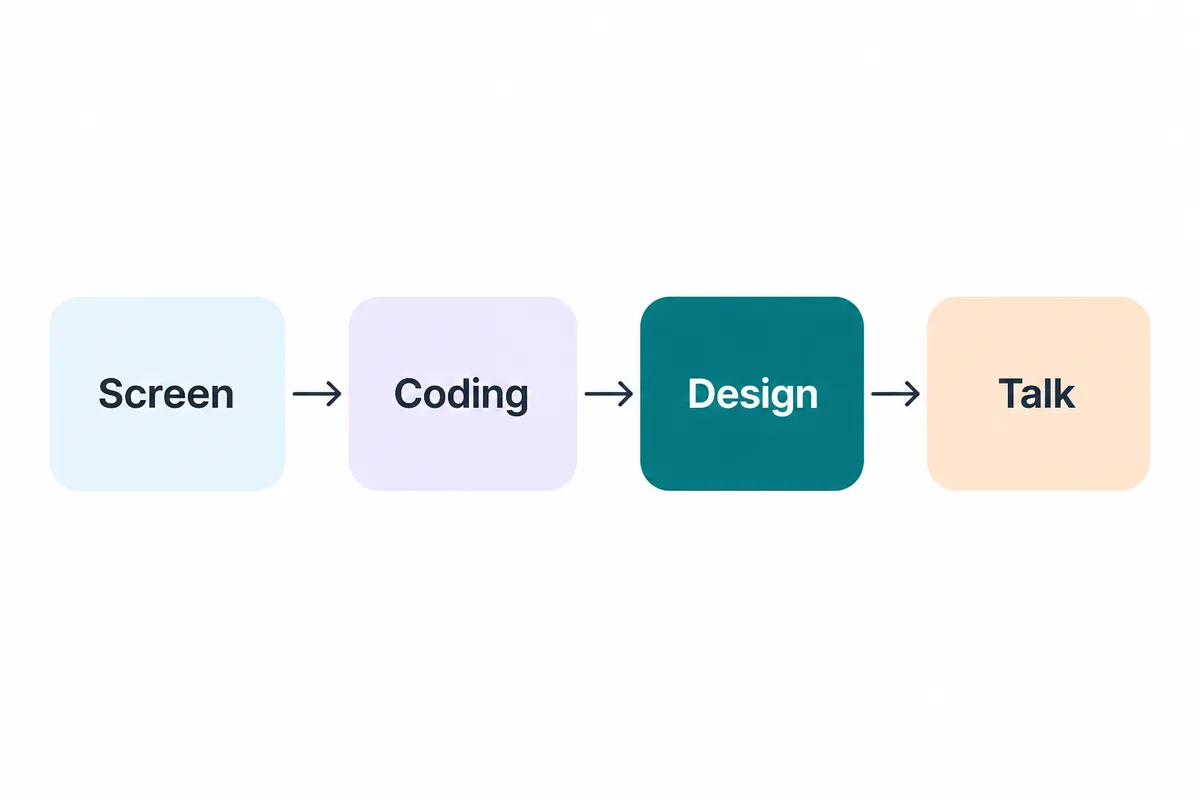
Ask your recruiter which stages are planned, whether the technical interview is live coding or discussion-led, whether design is expected at your level, and which language or environment will be used. Those questions are more useful than guessing from a generic process page.
Round one — the initial screen
An initial conversation generally establishes whether your experience lines up with the team’s needs and whether both sides want to continue. It may cover your current role, the systems you have worked on, why you are considering a move, and the type of engineering work you want next.
Do not treat this as a formality. Your answers can shape the later conversation. If you describe yourself as the owner of a service, feature, migration, or reliability improvement, be ready for follow-up questions on the decisions, setbacks, and results.
Prepare a short version of your career story: the problem you solve now, work you are proud of, the challenge you want next, and why Box interests you. Keep it direct. A clear answer makes it easier for the interviewer to understand where you could add value.
What this screens for: communication, motivation, level alignment, and whether your experience supports the role.
Round two — the technical coding screen
A technical screen commonly tests your ability to turn an ambiguous programming prompt into a correct and efficient solution. Even when the question itself is manageable, the interviewer is assessing your working process: whether you clarify constraints, choose a suitable data structure, explain complexity, and test edge cases.
The fastest route to improvement is pattern recognition rather than memorising isolated answers. Look for signals in the prompt. A sorted input may suggest binary search or two pointers. Repeated lookups may suggest a hash map. A request for the best, shortest, or longest result can point towards dynamic programming, greedy reasoning, or graph search.
The free-to-browse DSA Patterns Sheet organises practice by recurring problem shape. For a stronger way to build recognition speed, read how to identify the right DSA pattern in a coding interview.
Use a repeatable interview sequence:
- Restate the task and clarify an important constraint.
- Describe a straightforward approach before selecting a better one.
- Explain why the selected approach is preferable.
- State time and space complexity.
- Test boundary conditions before declaring the solution complete.
Reasoning that stays in your head is difficult to credit. A candidate who makes their thinking visible gives the interviewer evidence of how they would work with engineers on a real problem.
What this screens for: coding ability, complexity reasoning, debugging habits, and technical communication.
Round three — deeper technical discussion
Later technical conversations often go beyond solving a single prompt. You may be asked to extend a solution, discuss larger inputs, handle a failure case, or explain how another engineer could maintain the code.
This is where a correct answer can still be incomplete. A happy-path implementation is a starting point. Be ready to discuss naming, separation of responsibilities, input validation, tests, and the trade-off between a fast solution and a maintainable one.
Practise in an environment where you can run code, inspect failures, and revise your approach. In-browser code practice helps build that loop: write, run, receive feedback, and improve. The aim is not perfect production code immediately; it is a dependable habit of reaching working code and then improving it.
For Box-focused practice, work through Box's interview kit. Solve each mapped question first under a timer, then repeat it as a communication exercise where you explain your choices without notes. That second pass often reveals whether you understand the approach or merely remember it.
What this screens for: implementation discipline, adaptability, testing judgement, and clear technical explanation.
Round four — design and engineering judgement
Design may appear as a dedicated discussion or as a follow-up within a coding interview. Current research does not establish a fixed Box-specific design stage, so prepare for both possibilities rather than assuming it will be absent.
Early-career design questions often focus on component boundaries: classes, interfaces, state, errors, and how a design changes when requirements change. Experienced candidates may need to discuss services, data ownership, APIs, performance, reliability, and operational trade-offs.
Start with requirements, not diagrams. Establish what the system must do, who uses it, what matters most, and what can reasonably be assumed. Then propose a small first version and explain how it could evolve.
The free-to-browse Low Level Design Sheet supports class-level preparation, while the free-to-browse System Design Sheet helps with broader service-level reasoning. If you are unsure which depth suits your level, low-level design vs high-level design explains the distinction.
What this screens for: structured thinking, maintainability, trade-off awareness, and the ability to make assumptions explicit.
Round five — the behavioural conversation
Most engineering processes include a conversation about collaboration, ownership, feedback, conflict, and judgement. It may be a separate stage or appear throughout technical discussions. Prepare for it with the same seriousness as coding.
Choose stories that demonstrate different strengths:
- A difficult technical decision you owned.
- A project that did not go to plan.
- A disagreement you handled constructively.
- A process or system you improved.
- Feedback that changed how you work.
Use a simple structure: context, responsibility, action, result, and learning. Be precise about your contribution. “We” is appropriate for team outcomes, but interviewers still need to understand what you decided, built, influenced, or learned.
An AI mock interview is useful for practising these answers aloud. The value is noticing where your story becomes vague, overly technical, or unclear about your personal ownership.
What this screens for: collaboration, self-awareness, ownership, and professional judgement.
Named Box rituals: what is actually known
No sourced company-specific named ritual, special platform, fixed duration, or signature interview format is available for Box in the current research. It would be misleading to claim otherwise.
This makes recruiter questions especially valuable. Ask:
- Which interview stages are confirmed?
- Is the coding work live, take-home, or discussion-led?
- Is design expected for this role and level?
- Will the interview use a shared editor or your local environment?
- How deeply should you expect to discuss past projects?
Turn the answers into a preparation plan. A confirmed coding screen means more timed shared-editor practice. A technical deep dive means revisiting systems from your own work. A design conversation means rehearsing requirements and trade-offs. A behavioural focus means refining stories about collaboration and ownership.
Is the Box interview hard?
Box can be challenging for the same reason most software engineering interviews are challenging: you need to demonstrate coding skill, engineering judgement, and communication in a limited setting. The bigger difficulty is often switching between these modes without losing clarity.
How many rounds are there? Current reported accounts do not provide a reliable Box-wide count. The process can vary by team, role, level, and hiring need. Confirm the planned stages with your recruiter.
How long does it take? There is no reliable company-wide timetable in the available research. Ask for an expected schedule, but continue preparing while dates are being arranged.
Uncertainty does not require unfocused preparation. Build a coding baseline, practise design discussion at the right level, and prepare specific project stories. Those investments remain useful whether the process is compact or extended.
A 30-day Box interview preparation plan
Days one to seven — rebuild coding fluency
Review arrays, strings, hash maps, linked structures, trees, graphs, recursion, and sorting. Focus on recognising patterns before writing code. Complete short timed sessions and explain complexity aloud.
Use the free-to-browse DSA Patterns Sheet as a structured index instead of selecting random prompts. If graphs are a weak point, revise graph traversal patterns for DFS and BFS.
Days eight to fourteen — practise the interview conversation
Continue coding, but make communication the explicit goal. Before every solution, state assumptions. During implementation, explain key choices. After coding, test edge cases and discuss improvements.
Read what interviewers actually look for in live coding rounds and turn its advice into a routine you can use under pressure.
Days fifteen to twenty-one — add design judgement
Practise turning a vague requirement into components, responsibilities, and test cases. For more experienced roles, add service boundaries, data flow, reliability, and scaling trade-offs.
Avoid aiming for elaborate diagrams. A small coherent design and a credible explanation of how it evolves are usually more persuasive than naming every possible pattern or technology.
Days twenty-two to thirty — rehearse the whole loop
Alternate coding, design, and behavioural practice. Run timed mock sessions. Choose project stories that show ownership and reflection. Revisit Box's interview kit and solve the mapped questions without reviewing earlier notes.
In the final days, reduce new material and increase rehearsal. You want reliable execution: clarify, plan, implement, test, explain, and reflect.
The Box-specific advantage: prepare for the briefing, not rumours
For Box, the strongest company-specific preparation move is to turn a vague process into a useful briefing when you speak to the recruiter. Do not fill the information gap with assumptions from another company’s process.
Prepare questions, note the answers, and translate them into action. If coding is the immediate hurdle, prioritise timed pattern practice. If design is confirmed, practise requirement gathering and trade-offs. If project depth is emphasised, revisit technical decisions from your own work.
This is specific to the available Box research: the reliable signal is not a named ritual, but the importance of confirming the real format with the people arranging your loop. That gives you a more precise plan than speculation can.
Frequently asked questions
What kinds of Box interview questions should I expect?
Prepare for coding problems, complexity discussion, technical depth from past work, possible design discussion, and behavioural questions. Confirm the precise format with your recruiter because company-specific reports are limited.
Does Box have a coding interview?
A technical coding evaluation is common in software engineering hiring, so it is sensible to prepare for one. Current reports do not establish a universal Box platform or question style.
How many rounds does the Box interview process have?
There is no reliable company-wide round count in the available research. It can vary by role, level, and team. Ask your recruiter for the stages planned for your process.
Is system design needed for Box interviews?
Design preparation is valuable, especially for experienced roles, but research does not confirm a universal Box design round. Prepare design depth appropriate to your level and ask whether it is included.
How should I prepare for Box coding questions?
Practise core patterns, explain your reasoning aloud, state complexity, and test edge cases. Box's interview kit provides a focused starting point for mapped DSA practice.
What should I ask the Box recruiter?
Ask about stages, technical format, expected language or environment, whether design is included, and how deeply you should discuss past projects.
What matters most in a live coding interview?
Clear reasoning, a sensible approach, correct implementation, complexity awareness, and testing. Interviewers need to see how you work, not only the final code.
How do I prepare behavioural answers for Box?
Prepare specific stories about ownership, collaboration, setbacks, conflict, and learning. Make your contribution clear and practise saying your answers aloud.
Should I use my strongest programming language?
Yes. Use the language in which you can write idiomatic code, manage edge cases, and explain your choices confidently, unless the recruiter gives a specific constraint.
Where to start
Begin with skills that remain useful across variations of the Box loop: pattern recognition, clear coding communication, practical design judgement, and specific project stories.
Open Box's interview kit to practise the mapped DSA questions associated with Box. Then use the free-to-browse System Design Sheet for broader design practice and rehearse your communication with an AI mock interview.
Interview formats vary by team and level. Confirm the structure with your recruiter, then use that information to make your preparation focused rather than speculative.
Topics
Related on Thita
Your next step
Practise with AI mock interviews
A spoken interview that asks follow-up questions, runs your code and ends with a written report.