
Interview
Capital One Interview Questions and Process: The Complete Guide (2026)
Capital One interview questions explained: Power Day rounds, the business case study, difficulty, timelines, and a focused 30-day preparation plan.
Capital One interview questions commonly span coding, system design, a business case study and behavioural discussion, brought together in a reported Power Day format. Candidate accounts describe initial screens followed by a four-to-six-hour block that tests whether you can solve technical problems, explain trade-offs in business terms and communicate like an engineer who can influence decisions. The most distinctive preparation task is the case study: do not treat it as an afterthought beside coding.
For coding preparation, Capital One's interview kit holds 10 mapped DSA questions. Use it to practise recognising common problem shapes, then rehearse explaining your choices aloud: Power Day is not simply a silent problem-solving test.
The Capital One interview process at a glance
Reported accounts describe a sequence of screens followed by Power Day. The exact agenda can vary by role, level and team, so confirm the format with your recruiter once your interviews are scheduled.
| Stage | Reported format | What it screens for | How to prepare |
|---|---|---|---|
| Initial screens | Early conversations and technical evaluation | Role fit, technical baseline, communication | Know your projects and core coding patterns |
| Power Day: coding | Live technical problem solving | Data structures, complexity, implementation | Narrate your approach and test edge cases |
| Power Day: system design | Design discussion | Trade-offs, scale thinking, structured communication | Start with requirements before components |
| Power Day: business case | Business-focused case study | Product sense, prioritisation, commercial judgement | Make assumptions explicit and defend choices |
| Power Day: behavioural | Experience and collaboration discussion | Ownership, influence, values and self-awareness | Prepare specific stories from your work |
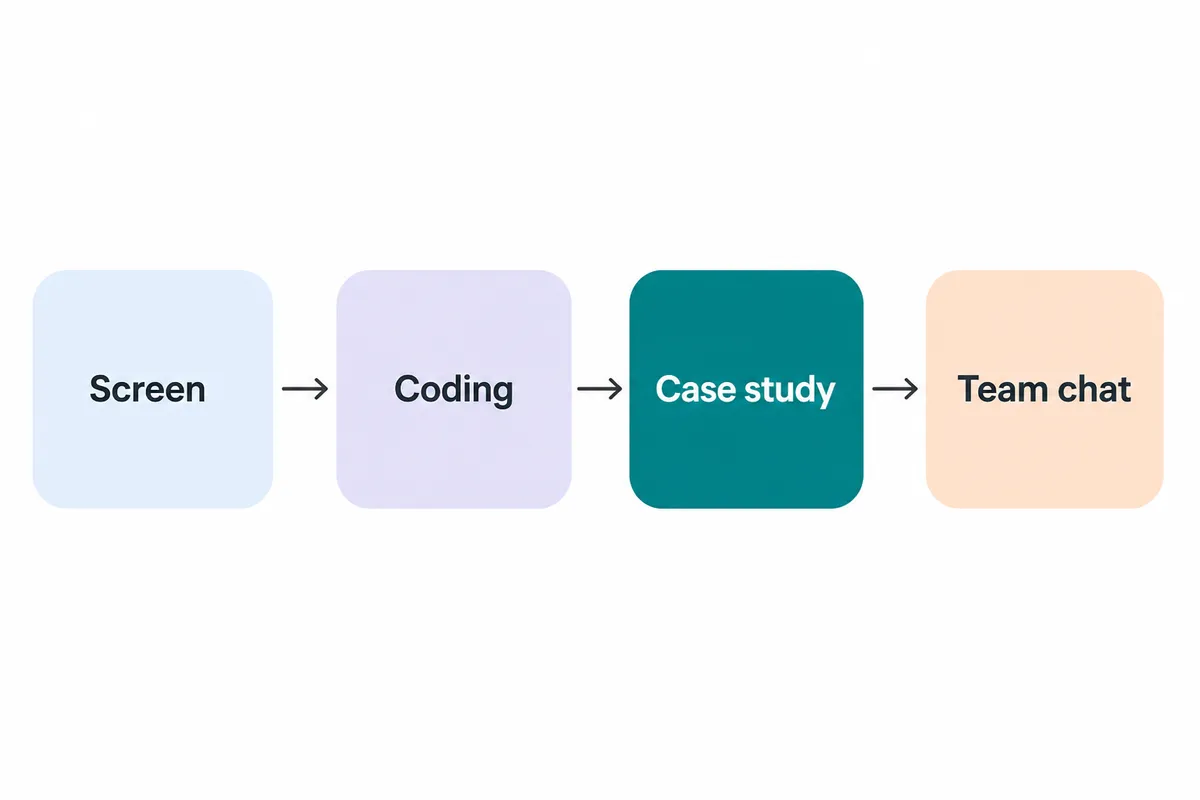
The important caveat is that this is a reported shape, not a company-published script. Treat it as a useful preparation model rather than a promise that every candidate will receive the same sequence.
Initial screens — establish your technical and role baseline
Reported accounts describe screens before Power Day. These early conversations usually establish whether your experience, communication and technical foundations fit the role before the company commits to the longer final-stage block.
For software engineering candidates, prepare for a blend of résumé discussion and coding fundamentals. Be ready to explain a project beyond its headline: what problem it solved, what you personally owned, the constraints you worked within, a decision you changed and what you learned from an incident or failure.
For technical questions, focus on the repeatable habits that make an interviewer confident:
- Clarify inputs, constraints and expected output before proposing a solution.
- State a straightforward approach before jumping to an optimised one.
- Explain time and space complexity in plain language.
- Test boundary cases instead of assuming the happy path is enough.
- Keep the interviewer involved in your reasoning.
The DSA Patterns Sheet is free to browse and is useful here because it organises preparation around recognisable solution patterns rather than an unstructured list of problems. If pattern recognition is the part you find hardest, read how to identify the right DSA pattern in a coding interview.
💡 Pro tip: A screen can turn on communication as much as correctness. Pause briefly, state your plan, then write code. An interviewer can assess reasoning they can hear.
Power Day coding — solve clearly, not just correctly
The coding portion of a reported Capital One Power Day checks conventional software engineering problem solving: breaking down a prompt, selecting suitable data structures, implementing reliably and discussing complexity.
A strong answer is usually a sequence, not a sudden solution:
- Restate the problem and identify ambiguous requirements.
- Work through a small example by hand.
- Describe the simplest viable approach.
- Improve it if the constraints justify doing so.
- Code in readable pieces.
- Walk through test cases, including awkward inputs.
Candidates often lose ground by treating live coding as an online judge. A correct final answer matters, but so does whether your approach is maintainable, whether you recover from a mistake and whether you can respond thoughtfully to follow-up questions.
Practise coding in an environment that makes you verbalise the decisions behind your code. In-browser code practice can help turn passive recognition into active implementation, while what interviewers actually look for in live coding rounds explains the signals interviewers can observe during the session.
The 10 mapped DSA questions in Capital One's interview kit are a focused place to rehearse that process. Do not memorise solutions. After each problem, explain why your chosen structure fits and what would change if the input constraints changed.
Power Day system design — show structured judgement
Reported accounts include a system design discussion within Power Day. This round is less about producing a perfect diagram and more about making your thinking inspectable.
Start by asking what success means. Who uses the system? What actions matter? What scale or reliability expectations should shape the design? Which constraints are fixed, and which can be treated as assumptions? A candidate who begins with questions often creates a better design than one who immediately lists databases, queues and caches.
A dependable structure for the discussion is:
- define functional and non-functional requirements;
- identify the main entities and request flows;
- propose a simple baseline architecture;
- locate bottlenecks or failure modes;
- introduce components only when they solve a stated problem;
- discuss trade-offs rather than presenting every choice as universally correct.
For junior roles, the discussion may lean more towards component boundaries, APIs and data modelling. More experienced roles can place greater weight on reliability, capacity, consistency and operational trade-offs. The System Design Sheet is free to browse if you need a structured way to revisit those foundations.
Avoid turning every design into a catalogue of distributed systems terms. Good system design is prioritisation: explain what you would build first, what you would defer and why that sequence makes sense. For a clearer distinction between design levels, see low-level design vs high-level design: what interviews actually expect.
Power Day business case study — the Capital One-specific round to prioritise
The business case study is the part of Capital One's reported loop that should change how you prepare. Many engineering interview processes contain coding and behavioural sessions. A case study inside the final block asks you to connect technical thinking to a business decision under uncertainty.
Candidate reports describe this as a distinct Power Day component rather than a disguised coding exercise. The goal is not to have insider financial knowledge or to invent a grand strategy. It is to demonstrate sound judgement: understand the problem, choose useful assumptions, identify relevant data, compare options and recommend a path with clear reasoning.
A useful case-study response has five moves.
Frame the objective. Ask what outcome the business is trying to improve. Is the aim growth, customer experience, risk reduction, efficiency or retention? Do not optimise a metric before checking that it is the right metric.
Separate facts from assumptions. You will not have all the data. Say what you know, what you would want to know and what assumption you are making to keep moving. This is much stronger than pretending the prompt is fully specified.
Create a decision framework. Break the situation into customer segments, possible interventions, costs, risks and success measures. A simple framework is easier to follow and challenge than a complicated answer delivered as a stream of ideas.
Make a recommendation. Interviewers are not looking for endless caveats. Choose an option, explain why it wins under the stated assumptions and acknowledge its principal downside.
Describe validation. Explain what you would measure after launch, what result would cause you to revise the plan and how you would limit risk while learning.
This round rewards the same core habit as technical design: make trade-offs explicit. In system design, you might compare consistency and availability. In a case study, you might compare speed of rollout, customer value, operational cost and risk. The vocabulary differs; the judgement is related.
⚠️ Common mistake: Giving a polished answer before asking a question. A case study is deliberately incomplete. Treating ambiguity as something to resolve with sensible questions is part of the evaluation.
Power Day behavioural discussion — make ownership credible
The behavioural portion of Power Day checks how you work when the technical answer is not enough. Prepare stories that show ownership, collaboration, disagreement, learning and delivery under constraints.
Use a clear structure: situation, task, actions, result and reflection. The reflection is crucial. A candidate who can explain what they would do differently usually sounds more self-aware than one who tells a flawless story with no lessons.
Choose examples where your contribution is precise. Replace “we improved the service” with what you noticed, what decision you influenced, what you implemented and what changed afterwards. If you led only part of the work, say so plainly. Specificity builds trust.
An AI interview is useful for practising these answers aloud, especially if you tend to give answers that are technically accurate but too long or too abstract. Keep each story adaptable: one project can demonstrate ownership in one question and conflict resolution in another, but only if you can discuss the details naturally.
Is the Capital One interview hard?
Yes, chiefly because Power Day combines several kinds of reasoning in one extended block. Coding preparation alone is not enough if you have not practised design communication, business judgement and project storytelling.
How many rounds are there? Reported accounts describe screens followed by Power Day. Power Day combines coding, system design, a business case study and behavioural discussion. The exact schedule can vary by role and team.
How long does it take? Power Day is commonly reported as a four-to-six-hour block. Current candidate reports do not establish one reliable end-to-end timeline for every Capital One team, so ask your recruiter about scheduling and decision timing.
The difficulty is therefore broad rather than narrowly algorithmic. Candidates who prepare only for coding can be surprised by the context switching. Candidates who structure their preparation around the whole block are better positioned to stay composed.
A 30-day Capital One preparation plan
Week 1 — rebuild coding fluency
Review core patterns and solve problems under a light timer. Focus on arrays, strings, hash maps, trees, graphs, recursion and complexity analysis. After each solution, give yourself a short spoken explanation as if an interviewer had asked why your approach works.
The graph traversal patterns guide is useful if BFS and DFS choices still feel uncertain. Aim for reliable fundamentals, not obscure tricks.
Week 2 — practise technical communication
Continue coding, but make communication the main constraint. Clarify the prompt, state a brute-force approach, improve it and test aloud. Add system design practice: take an everyday product feature and define requirements before drawing components.
The Computer Networks Sheet and DBMS Sheet are free to browse when you need to refresh the foundations behind design conversations.
Week 3 — train for the case study
Spend several sessions on business cases. Pick a customer problem, define an objective, list assumptions, identify trade-offs and make a recommendation. Record yourself answering one case prompt, then listen for unsupported claims, missing metrics and conclusions that arrive too late.
Also draft your behavioural stories. Prepare examples involving a difficult decision, a conflict, an ownership moment, a setback and an improvement you initiated.
Week 4 — simulate Power Day
Run integrated practice. Start with a coding problem, move to a design prompt, then answer a case study and a behavioural question. The goal is not exhaustion for its own sake; it is learning to reset your attention between different modes of thinking.
Return to Capital One's interview kit for the 10 mapped DSA questions, and use an AI mock interview to rehearse the explanations that turn preparation into interview performance.
Frequently asked questions
What is Capital One Power Day?
Reported accounts describe Power Day as a four-to-six-hour interview block containing coding, system design, a business case study and behavioural discussion. The agenda can vary by role and team.
Does Capital One ask coding questions?
Candidate reports describe a coding component within Power Day. Prepare data structures, complexity reasoning, implementation and the ability to explain your solution aloud.
Does Capital One include system design?
Reported Power Day formats include a system design discussion. Prepare to clarify requirements, propose a baseline design and explain trade-offs.
What is the Capital One business case study?
It is a business-focused interview component reported within Power Day. It evaluates how you frame ambiguity, use assumptions, prioritise options and make a defensible recommendation.
Is the business case study technical?
It can involve technical context, but it is not primarily a coding round. Focus on structured thinking, customer impact, metrics, risks and trade-offs.
How should I prepare for Capital One behavioural questions?
Prepare specific stories about ownership, collaboration, disagreement, setbacks and delivery. Practise saying them aloud so your role and reflection are clear.
How many interview rounds does Capital One have?
Reported accounts describe preliminary screens followed by Power Day, which includes several interview components. Confirm your exact itinerary with your recruiter.
How long is Capital One Power Day?
Candidate reports commonly describe a four-to-six-hour block. Your own schedule may differ, so verify the details before the interview.
What should I study first for a Capital One software engineering interview?
Start with coding fundamentals, then add system design, case-study practice and behavioural stories. The challenge is integrating all four, not treating any one as optional.
Where to start
Capital One's reported Power Day format rewards candidates who can move from code to design to business judgement without losing structure. Begin with your coding baseline, but reserve real preparation time for the case study and behavioural discussions that make this loop distinctive.
Open Capital One's interview kit to practise the 10 mapped DSA questions. The sheets are free to browse, and an AI interview can help you rehearse coding explanations, design trade-offs, case-study structure and behavioural stories before the real conversation.
Interview formats change. Use reported accounts as a preparation guide, then confirm your current Power Day agenda, timing and role expectations directly with your recruiter.
Topics
Related on Thita
Your next step
Practise with AI mock interviews
A spoken interview that asks follow-up questions, runs your code and ends with a written report.