
Interview
Cisco Interview Questions and Process: The Complete Guide (2026)
Prepare for Cisco interview questions with a round-by-round guide to coding, networking MCQs, technical screens, onsite interviews, and difficulty.
Cisco interview questions commonly combine coding with computer-science fundamentals that many software interview loops leave until later. Reported accounts describe an online assessment containing coding problems alongside networking, operating-systems and database MCQs, followed by technical screens and an onsite loop. Prepare for both: practise pattern recognition for coding, explain trade-offs aloud, and refresh networking fundamentals before the assessment. For the coding side, Cisco's interview kit holds 17 mapped DSA questions for focused practice.
The important distinction is that Cisco is not reported as a pure DSA loop. A candidate who can solve an array problem but cannot explain TCP, caching, process scheduling or database basics may struggle before the deeper interviews even begin. This guide covers the reported process, what each stage screens for, how difficult it is likely to feel, and how to prepare over 30 days.
The Cisco interview process at a glance
| Stage | Reported format | What it screens for | How to prepare |
|---|---|---|---|
| Online assessment | HackerRank, coding plus MCQs | Coding fluency and CS foundations | Timed problems and fundamentals revision |
| Recruiter screen | Initial conversation | Role fit, communication, motivation | Clear project and role narrative |
| Technical screens | One or two discussions on Webex | Coding, projects and engineering judgement | Explain solutions before coding |
| Onsite loop | Several technical and behavioural conversations | Depth, collaboration and role alignment | Rehearse coding, systems and project stories |
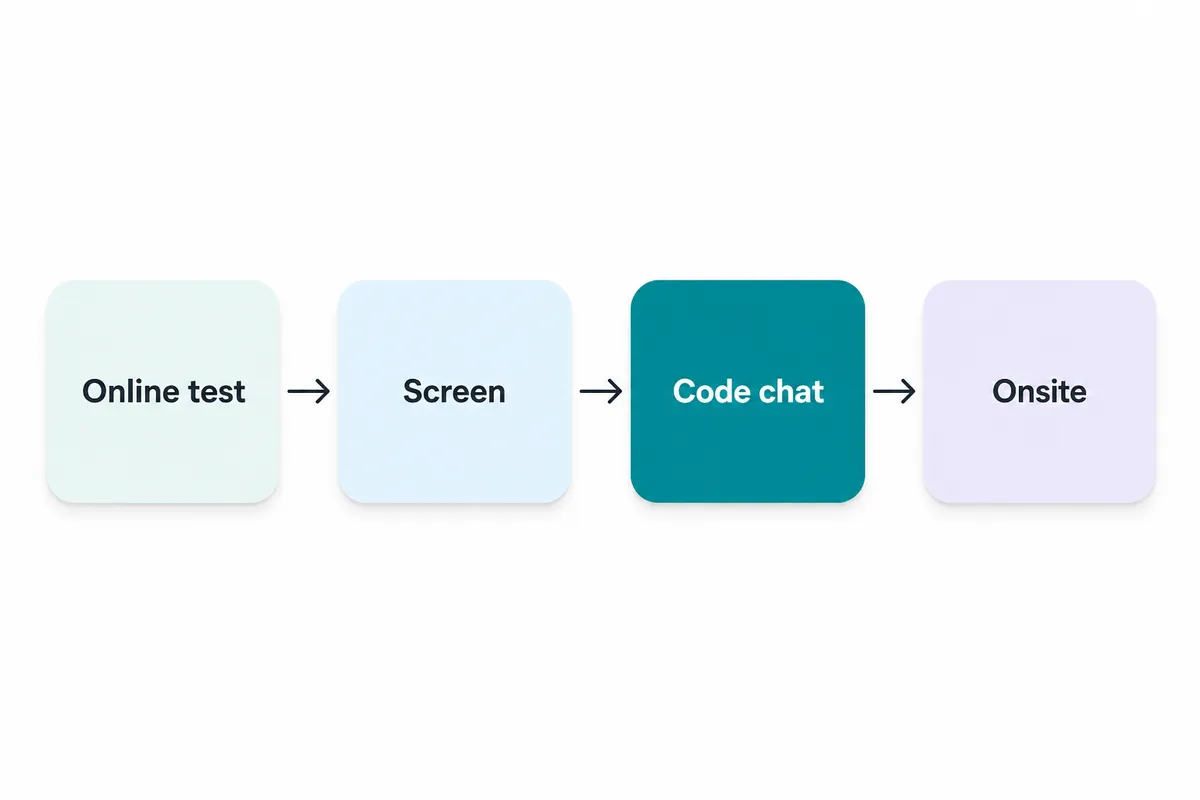
Reported accounts describe this as a broad software engineering process rather than a fixed script. The exact sequence, interviewers and technical emphasis can vary by team, seniority and location. Treat the outline as a useful preparation model, then confirm the format with your recruiter once you enter the process.
Round 1 — online assessment
The online assessment is the most Cisco-specific technical filter in the reported process. Candidate accounts describe a HackerRank test lasting around 70 to 90 minutes, with two or three coding questions and roughly 40 multiple-choice questions across networking, operating systems and databases.
That combination changes how you should prepare. In a conventional coding assessment, you can spend nearly all of your preparation time on problem patterns. At Cisco, coding still matters, but the MCQ section rewards breadth and retrieval speed. You need to recognise a coding pattern quickly enough to leave time and mental energy for fundamentals.
For coding, expect standard data-structure and algorithm work: arrays, strings, hash maps, trees, graphs, sorting and complexity analysis are sensible areas to revise. The DSA Patterns Sheet is free to browse and helps organise practice by recurring problem shape rather than by a long, unstructured list.
For the MCQs, revise the ideas that are easy to vaguely remember but harder to distinguish under time pressure:
- TCP versus UDP and when delivery guarantees matter
- DNS, HTTP, TLS and common network-layer responsibilities
- processes, threads, memory and scheduling
- normalisation, indexing, transactions and query performance
- caches, locks, race conditions and basic distributed-systems trade-offs
The goal is not to memorise every protocol detail. It is to connect definitions to engineering consequences. If an MCQ asks why an application is slow, you should be able to reason from latency, network calls, locking, disk access or query plans rather than relying on recall alone.
💡 Pro Tip: Do timed mixed practice. Spend part of a session on coding and part on fundamentals. Switching between the two is itself a skill, and it is closer to the reported Cisco assessment than practising either category in isolation.
Round 2 — recruiter screen
The recruiter screen is usually your first chance to establish the context around the role. It is not generally a deep technical examination, but it can influence how well your experience is understood before the technical interviews.
Prepare a concise explanation of what you build, the kinds of systems you have worked on, and why the Cisco role makes sense for you. Avoid a generic answer such as “I want to work at a large technology company.” Connect your interests to the role’s likely engineering surface: networking, collaboration products, cloud infrastructure, security, enterprise software or developer platforms, depending on the team.
This is also the practical moment to ask about the loop. Clarify whether there is an assessment, whether interviews are remote, whether system design is expected for the level, and what language options are available for coding. Those questions do not make you look unprepared; they help you prepare accurately.
Keep your project story concrete:
- What problem existed?
- What did you personally own?
- What technical choice did you make?
- What trade-off did you accept?
- What changed after the work shipped?
That structure will help again in later technical and behavioural discussions.
Round 3 — technical screens
Reported Cisco processes include one or two technical screens, often conducted on Webex. These conversations commonly test whether you can reason in real time, write or discuss code clearly, and connect your experience to engineering fundamentals.
The coding portion is rarely only about reaching a correct answer. An interviewer can assess much more from the route you take:
- Do you clarify requirements before choosing a data structure?
- Can you give a simple approach before jumping to the optimal one?
- Do you explain time and space complexity?
- Can you test edge cases without being prompted?
- Do you respond productively when a requirement changes?
Use a visible structure in every live problem: restate, clarify, outline, code, test, then review complexity. Our guide to what interviewers actually look for in live coding rounds explains why this communication matters as much as the final implementation.
Cisco’s networking emphasis can also show up through follow-up questions. A coding question about communicating services, for example, may lead naturally into questions about retries, timeouts, load balancing or how a client and server exchange data. You do not need to force networking into every answer. But when it is relevant, show that you can move from a local function to the environment where that function runs.
✅ Do: Say what you are assuming, especially when a question leaves constraints open.
❌ Don’t: Write silently for several minutes and hope the final code speaks for itself.
For speaking practice, how to explain your thought process clearly in coding interviews offers a practical framework you can reuse.
Round 4 — onsite interviews
Reported accounts describe an onsite loop of several conversations, commonly mixing coding, technical depth, project discussion and behavioural evaluation. The exact mix is team-dependent, so senior candidates and candidates joining infrastructure-heavy teams should be ready for more system and domain depth than entry-level candidates.
A coding interview in this stage may raise the bar from the assessment because the interviewer can probe your reasoning, ask for a better complexity bound or introduce a follow-up constraint. This is where recognising familiar patterns quickly becomes valuable. If graph traversal is a weak point, revise DFS and BFS graph traversal patterns before practising under a timer.
A design or systems discussion may examine how you approach an engineering problem with incomplete requirements. Start by defining the user or system goal, ask about scale and failure modes, then make deliberate choices. A good answer does not need every possible component. It needs a coherent core design, explicit trade-offs and sensible next steps.
Project discussions are equally important. Be ready to go below the résumé bullet point:
- Why did you choose that data model or interface?
- What production issue did you encounter?
- How did you measure success?
- What would you change if the system had more users or more traffic?
- How did you disagree, decide and collaborate?
Use the AI mock interview to rehearse coding explanations, system-design discussions and behavioural stories aloud. Rehearsal is especially useful if you usually prepare by reading solutions silently: an interview tests what you can communicate under pressure, not what you recognise afterwards.
Cisco’s distinctive challenge: networking fundamentals at every stage
The feature that makes Cisco interview preparation different is the MCQ half of the initial test and the reported recurrence of networking fundamentals throughout the process.
Many candidates compartmentalise preparation: DSA for coding interviews, networking for coursework or certification study, databases for a separate round. Cisco’s reported loop rewards joining those areas. A practical engineering answer often depends on understanding the boundary between code and the system around it.
Suppose you are asked to build a client that calls a service. A coding-only answer might focus on data structures and request handling. A stronger engineering discussion could mention timeouts, retries, connection failures, idempotent operations, backoff, observability and what happens when the network is slow rather than fully unavailable.
That does not mean you should recite protocol facts whenever you see a coding problem. It means you should be able to explain the real-world assumptions behind your solution.
Use the Computer Networks Sheet, Operating Systems Sheet and DBMS Sheet for free-to-browse fundamentals revision. Build short notes in your own words for concepts you regularly confuse. For example, contrast a process with a thread, a clustered index with a non-clustered index, or flow control with congestion control.
This preparation is specific to Cisco because the reported assessment explicitly combines these disciplines. It also makes you a stronger candidate in technical conversations where an interviewer asks not merely whether code works, but how it behaves in a production environment.
Is the Cisco interview hard?
Cisco interviews are moderately difficult for candidates with balanced preparation, but they can feel unexpectedly hard for people who have prepared only DSA.
How many rounds are there? Reported accounts describe an online assessment, recruiter screen, one or two technical screens, and an onsite loop of three to five conversations. Team and level variation matters, so confirm your own schedule with the recruiter.
How long does it take? The research does not establish a dependable end-to-end timeline. Avoid planning around an assumed duration; instead, start fundamentals revision as soon as you apply and use recruiter conversations to understand the expected pace.
The coding bar is likely to feel familiar if you have practised standard patterns and can discuss complexity. The differentiator is breadth. You must move between a timed coding problem, networking concepts, operating-systems knowledge, database fundamentals and project depth without treating any one of them as an afterthought.
That makes the loop less about obscure puzzles and more about engineering range. The strongest preparation is therefore structured, mixed and spoken aloud.
A 30-day Cisco preparation plan
Days 1–7 — rebuild coding pattern recognition
Work through core patterns: hash maps, two pointers, sliding window, binary search, stacks, queues, trees and graphs. Focus on identifying the pattern before writing code. The Cisco interview kit provides 17 mapped DSA questions to anchor your company-focused practice.
For each solution, state the brute-force approach, the improved approach and both complexity bounds. Use Code Practice for timed implementation sessions after you have revised the pattern.
Days 8–14 — refresh the MCQ subjects
Split your revision between networking, operating systems and databases. Do not try to cover every textbook chapter. Prioritise concepts that support engineering reasoning: TCP connections, HTTP, DNS, process versus thread, virtual memory, locks, transactions, indexes and isolation.
At the end of each day, explain five concepts aloud without notes. If you cannot explain a term simply, revisit it. The assessment may be multiple choice, but later interviews reward understanding rather than memorised wording.
Days 15–21 — combine coding with technical discussion
Alternate a timed coding problem with a short systems discussion. After solving a problem, ask yourself: what changes if the input becomes a stream, if requests can fail, or if several users access the system at once?
Practise narrating your approach from the first minute. This is the week to remove silent-coding habits and make clarification, complexity analysis and edge-case testing automatic.
Days 22–30 — simulate the full loop
Run several realistic rehearsals. Start with a mixed coding-and-fundamentals session. Follow it with a project deep-dive and a behavioural conversation. Keep your answers specific: name the constraint, decision, outcome and lesson.
Use an AI mock interview for live-pressure practice, then review where your explanations became vague or overly detailed. In the final days, revise your weaker areas rather than adding entirely new topics.
💡 Pro Tip: Keep a “mistake log” with three columns: knowledge gap, reasoning gap and communication gap. A wrong answer caused by forgetting a networking fact needs different work from a correct answer explained unclearly.
Frequently asked questions
What types of Cisco interview questions should I expect?
Reported accounts describe coding questions alongside networking, operating-systems and database fundamentals. Later stages may include live coding, project discussion, technical depth and behavioural evaluation.
Does Cisco have an online assessment?
Candidate reports commonly describe a HackerRank assessment with coding questions and MCQs. Confirm the current format with your recruiter because processes can vary.
How should I prepare for Cisco networking questions?
Revise TCP, UDP, DNS, HTTP, TLS, routing basics, latency, retries and failure handling. Focus on explaining why a concept matters in a real system.
Are Cisco coding questions mainly DSA?
Coding is a meaningful part of the reported process, particularly in the online assessment and technical screens. Prepare standard data structures, algorithms and complexity analysis.
How many interview rounds does Cisco have?
Reported accounts describe an assessment, recruiter screen, one or two technical screens and an onsite loop of three to five conversations. The exact count varies by role and team.
Does Cisco ask operating-systems and database questions?
Reported online assessments include MCQs on operating systems and databases alongside networking questions. These subjects can also support follow-up discussion in technical interviews.
How hard is the Cisco online assessment?
It can be challenging because it mixes timed coding with broad technical fundamentals. Candidates who prepare only coding patterns may find the MCQ portion difficult.
Should I prepare system design for Cisco?
Prepare system-design reasoning if you are interviewing for an experienced role or an infrastructure-oriented team. Start with requirements, scale, failure modes and trade-offs rather than memorising diagrams.
What should I say in a Cisco project interview?
Explain your personal contribution, the constraints you faced, decisions you made, measurable outcomes and what you would change. Be prepared to discuss technical trade-offs in detail.
Where to start
Start with the two areas Cisco’s reported process makes most visible: coding fluency and engineering fundamentals. Build speed on recurring DSA patterns, then make networking, operating systems and databases part of your daily revision rather than a last-minute checklist.
Open Cisco's interview kit to practise the 17 mapped DSA questions associated with Cisco. Pair that work with the free-to-browse fundamentals sheets and an AI mock interview when you are ready to rehearse your explanations under pressure.
Interview formats change by team and level. Confirm the current round structure, tools and expectations with your recruiter before the process begins.
Topics
Related on Thita
Your next step
Practise with AI mock interviews
A spoken interview that asks follow-up questions, runs your code and ends with a written report.