
Interview
Citadel Interview Questions and Process: The Complete Guide (2026)
Citadel interview questions and process explained: the online assessment, onsite preparation, difficulty, timelines, and a practical 30-day study plan.
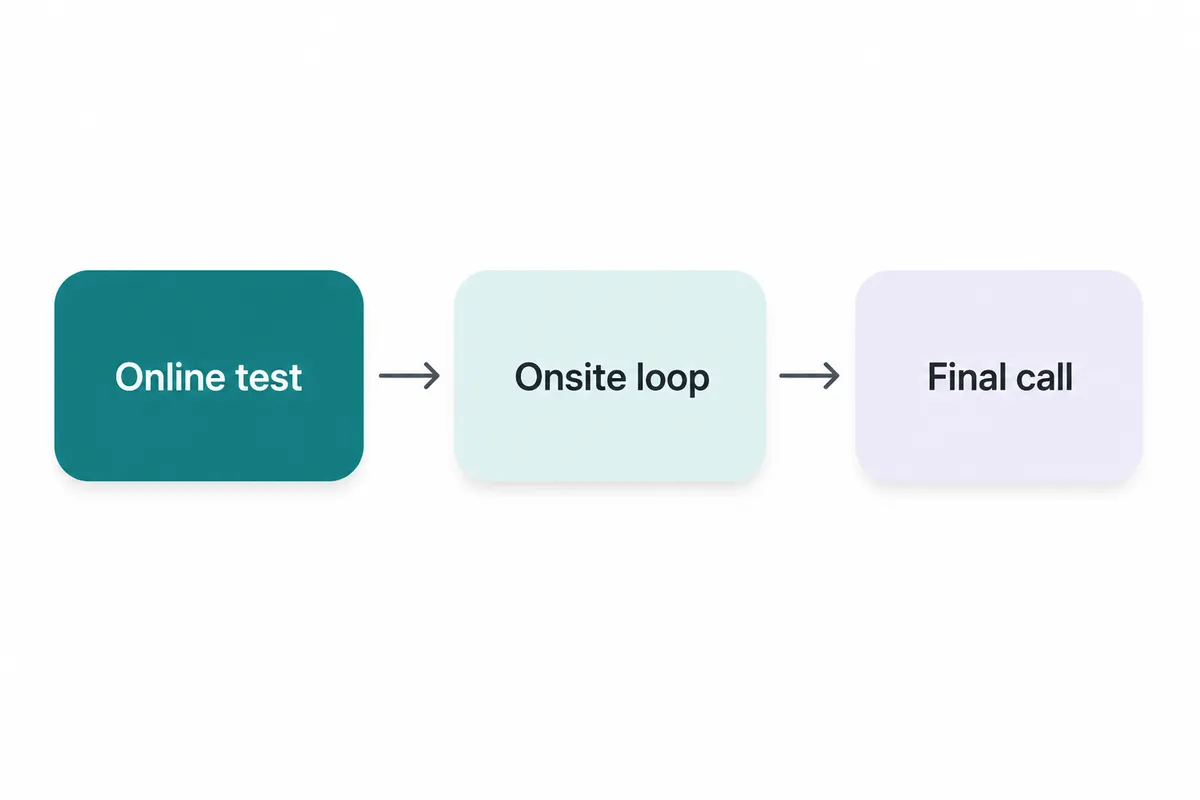
Citadel interview questions are best approached as a two-part process: a HackerRank online assessment followed by an onsite. Reported accounts suggest the online assessment is the decisive early gate for many new-grad candidates, so fast, accurate coding under time pressure deserves serious preparation before you focus on the onsite. The exact onsite format can vary by role and team, but candidates should be ready to explain their reasoning, write correct code, discuss trade-offs, and communicate clearly.
For structured technical preparation, Citadel's interview kit holds nine mapped DSA questions. Use it to practise recognising common coding patterns, then rehearse your explanation and debugging process under interview-like conditions.
The Citadel process at a glance
| Stage | Reported format | What it screens for | How to prepare |
|---|---|---|---|
| Online assessment | HackerRank coding test | Speed, correctness, pattern recognition | Timed coding practice and edge-case checking |
| Onsite | Technical interview loop | Coding judgement, communication, role fit | Live problem solving, clear explanations, project depth |
Reported accounts are anecdotal rather than a company-published specification. Treat this as the likely shape, not a guaranteed script, and confirm the current format with your recruiter.
Round 1 — the online assessment
The HackerRank online assessment is the most important part of the Citadel process to prepare for early. Candidate reports describe it as the gate that decides most new-grad outcomes: if you do not clear it, the onsite never becomes relevant. That does not mean the onsite is easy; it means your preparation needs to match the funnel.
The assessment is fundamentally a coding test. You need to turn a problem statement into a correct, efficient solution, implement it cleanly, and handle the cases hidden tests are designed to catch. The useful skills are transferable across many technical screens:
- recognising whether a problem calls for hashing, sorting, two pointers, a graph traversal, dynamic programming, or another familiar approach;
- selecting a data structure that makes the required operations efficient;
- stating time and space complexity before committing to an implementation;
- testing boundary cases before submitting; and
- recovering calmly when the first approach is not strong enough.
The biggest distinction between practising casually and preparing for an online assessment is the clock. A solution you can derive eventually is not necessarily a solution you can deliver after reading a dense prompt, deciding on an approach, and debugging it under pressure.
Start with the free-to-browse DSA Patterns Sheet, which groups problems by the underlying technique rather than leaving you to infer a pattern from a random list. Pair it with Citadel's interview kit when you want a company-mapped set to work through.
A strong assessment routine looks simple:
- Read the full prompt before coding.
- Say, or write down, the brute-force idea first.
- Identify the constraint that makes brute force too slow.
- Choose the data structure or pattern that removes that bottleneck.
- Test empty input, repeated values, very small input, and the largest plausible input.
- Leave a few minutes for a final compile and submission check.
💡 Pro tip: Do not spend the first part of the test chasing a perfect solution in your head. Get to a viable approach quickly, then improve it if the constraints demand it. Unsubmitted insight earns no credit.
For pattern recognition practice, read how to identify the right DSA pattern in a coding interview. It is especially useful if you regularly understand a solution after seeing it but struggle to identify it independently.
Round 2 — the onsite
Reported accounts describe an onsite after the HackerRank stage, but they do not establish a stable, company-wide breakdown of individual onsite interviews. The honest preparation strategy is therefore not to memorise an invented sequence. It is to prepare for the skills that a modern software engineering onsite commonly tests: solving a coding problem live, communicating technical decisions, discussing your experience, and responding productively when an interviewer changes a requirement or challenges an assumption.
Live coding differs from an online assessment in one major way: the interviewer can see your process. They are not only evaluating the final code. They can also observe whether you clarify ambiguity, compare approaches, reason about complexity, test your work, and respond to feedback.
What the onsite screens for
Clear problem solving. A strong candidate does not rush from prompt to code. They restate the problem, ask about constraints, offer an initial approach, and explain why it is appropriate. This makes your reasoning legible and gives the interviewer an opportunity to correct a misunderstanding before it becomes a costly implementation detour.
Technical judgement. Good interview code is not merely code that passes an example. It uses sensible names, avoids unnecessary complexity, handles meaningful edge cases, and fits the stated constraints. If there is a trade-off between memory and speed, explain it rather than hoping the interviewer infers that you noticed it.
Communication under pressure. Silence makes it difficult for an interviewer to assess your reasoning. Narrate the important decisions: what you are optimising for, why you rejected an alternative, and what you will test. The goal is not constant talking. It is making your judgement visible.
Depth in your own work. Expect questions that explore projects on your CV. Be ready to distinguish your personal contribution from the team’s work, explain a difficult decision, describe a failure or trade-off, and say what you would improve with more time.
Our guide to what interviewers actually look for in live coding interviews explains the signals behind these habits in more detail.
✅ Do: Pause before coding to confirm constraints and state your plan.
❌ Don’t: Treat clarification as a sign of weakness. Building the wrong solution quickly is still building the wrong solution.
Citadel’s distinctive preparation problem: the early gate
Many software interview guides tell candidates to distribute preparation evenly across every later-stage interview. That is not the most useful starting point for Citadel candidates when reported accounts repeatedly point to the HackerRank assessment as the real early filter for new grads.
This changes how you should allocate your first preparation week. Before spending hours on elaborate system-design diagrams or polishing a broad set of behavioural stories, make sure you can consistently complete timed coding problems. The assessment is where speed, implementation reliability, and pattern recall meet.
A sensible priority order is:
- Build fluency with core coding patterns.
- Practise completing problems in one sitting.
- Review mistakes by category: pattern choice, implementation, complexity, or testing.
- Move to live explanation and mock interviews.
- Prepare project stories and role-specific technical depth for the onsite.
This is not an argument to neglect the onsite. It is an argument to prepare for the sequence candidates actually face. A candidate who is excellent at explaining distributed systems but cannot clear an early coding screen has prepared out of order.
Use Citadel's interview kit as a focused practice set, then extend your work with free-to-browse in-browser code practice. For graph-heavy uncertainty, the guide to DFS and BFS graph traversal patterns is a practical refresher on one of the most reusable interview families.
Is the Citadel interview hard?
Yes, particularly because the process places a meaningful technical gate early.
The challenge is not necessarily a single exotic question. It is the combination of speed, accuracy, and composure. Timed coding assessments reward candidates who can identify familiar structures quickly and write dependable code without relying on a long debugging cycle. The onsite then asks you to make that reasoning understandable to another engineer.
How many rounds are there? Reported accounts establish a HackerRank online assessment followed by an onsite, but do not provide a reliable, universal count for the onsite interviews. Team and role variation are real, so ask your recruiter for the current schedule.
How long does the process take? Candidate reports place the new-grad process at roughly six to eight weeks and experienced-hire processes at roughly four to six weeks. These are reported timelines, not guarantees; hiring needs, team availability, and scheduling can change the pace.
The practical takeaway is to begin early. If you wait until an invitation arrives to start timed preparation, you may have little time to fix the habits that cause assessment failures: slow pattern recognition, incomplete testing, and code that works only for the example.
A 30-day Citadel preparation plan
Days 1–7 — build pattern recall
Work on core DSA patterns daily. Focus on recognising the structure before looking for a solution: arrays and strings, hash maps, two pointers, sliding windows, binary search, trees, graphs, heaps, and dynamic programming.
Keep a brief error log. After each problem, note whether you missed the pattern, chose the wrong data structure, made an implementation mistake, or failed to test an edge case. This is more valuable than simply recording whether you solved it.
The dynamic programming patterns guide can help if DP is a recurring weak point.
Days 8–14 — practise under a clock
Shift from untimed learning to timed sessions. Simulate the assessment environment: read the prompt once, avoid external help, write complete code, and test before the timer ends.
After each session, review your code for avoidable friction. Were variable names unclear? Did you write a complicated loop where a standard library structure would have helped? Did you forget an empty-input case? Faster coding usually comes from reducing these repeated errors, not from typing faster.
Days 15–21 — make your reasoning audible
Start doing live-style practice. Before writing code, spend a short period explaining the brute-force route, the better approach, complexity, and test cases. Record yourself if necessary. Listening back makes vague explanations obvious.
An AI mock interview is useful for rehearsing the conversational part of technical problem solving. You want to be comfortable receiving a prompt, clarifying it, thinking aloud, and adapting without becoming defensive.
Days 22–26 — strengthen onsite readiness
Prepare project stories that demonstrate ownership, technical judgement, collaboration, and learning. For each project, be able to answer:
- What problem were you solving?
- What specifically did you own?
- Which trade-off was hardest?
- What went wrong?
- What would you change now?
Also revisit computer science fundamentals relevant to your target role. The free-to-browse operating systems sheet and DBMS sheet can help you refresh concepts that often appear in technical discussion.
Days 27–30 — simulate the full experience
Run a realistic rehearsal: one timed coding session, one live explanation session, and one project-depth discussion. Do not use the final days to learn entirely new topics. Consolidate what you already know, sleep properly, and rehearse a calm opening for a technical round.
💡 Pro tip: In the final week, prioritise clean execution. A well-explained medium-difficulty solution with careful testing is a better rehearsal than a difficult problem you abandon halfway through.
Frequently asked questions
What is the Citadel interview process for software engineers?
Reported accounts describe a HackerRank online assessment followed by an onsite. The precise onsite schedule can vary by role and team, so confirm the current process with your recruiter.
Does Citadel use HackerRank?
Candidate reports describe a HackerRank online assessment as the early technical stage.
Is the Citadel online assessment important?
Yes. Reported accounts suggest it is the main early gate for many new-grad candidates, making timed coding preparation particularly important.
How hard are Citadel interview questions?
The difficulty comes from the need to solve coding problems accurately and efficiently under time pressure, then communicate your reasoning clearly in later interviews.
How long does the Citadel hiring process take?
Reported timelines are roughly six to eight weeks for new grads and roughly four to six weeks for experienced candidates. Actual timing varies.
How should I prepare for a Citadel coding assessment?
Practise core DSA patterns under timed conditions, state time and space complexity, and test edge cases before submitting. Review mistakes by cause rather than only by outcome.
What should I do if I get stuck in a live coding interview?
Explain what you know, identify the bottleneck in your current approach, and ask a focused clarifying question. Staying engaged is better than going silent.
Should I prepare behavioural answers for the Citadel onsite?
Yes. Prepare detailed examples from your projects that show ownership, collaboration, technical decisions, setbacks, and learning.
Do I need to memorise every algorithm?
No. Prioritise pattern recognition and implementation fluency. You should understand when to use common approaches and be able to explain the trade-offs.
Where to start
Citadel preparation starts with the early technical gate: practise timed coding until recognising a pattern, choosing an approach, and testing your code become repeatable habits rather than a stressful improvisation.
Open Citadel's interview kit to work through the nine mapped DSA questions, then use the free-to-browse DSA Patterns Sheet to strengthen the wider pattern library behind them. When you are ready to practise explaining your decisions, use an AI mock interview and treat every answer as a communication exercise as well as a coding exercise.
Interview formats change. Confirm the current round structure, platform, and scheduling details with your recruiter before the process begins.