
Interview
Common Technical Interview Mistakes That Reject Strong Candidates
Technical interviews are designed to filter out unprepared candidates. Unfortunately, they often filter out strong ones too.
Technical interviews are designed to filter out unprepared candidates. Unfortunately, they often filter out strong ones too.
Engineers who ship reliable systems, lead projects, and deeply understand their stack still walk out of software interviews with rejections they don’t fully understand. The problem is rarely raw ability. It’s usually a specific set of technical interview mistakes: subtle coding interview errors, miscommunication patterns, and process missteps that interviewers are trained to notice.
This guide breaks down those mistakes in detail—what they look like in practice, why they trigger interview rejection, and how to fix them with concrete habits. The focus is on systematizing good interview behavior the way you’d systematize good engineering practices.
1. The Meta-Mistake: Treating Interviews Like Exams, Not Collaborative Debugging Sessions
Most strong candidates fail not because they can’t solve problems, but because they’re solving them in the wrong “mode.”
In real work, you:
- Ask clarifying questions
- Talk through tradeoffs
- Iterate on design
- Check edge cases with teammates
In many interviews, the same engineer:
- Stays silent, “thinking hard”
- Jumps into code without clarifying
- Optimizes prematurely
- Treats the interviewer as a judge, not a collaborator
Interviewers are evaluating how you think, not just whether you reach the final answer.
What interviewers actually look for
Across companies, technical interviewers tend to evaluate:
-
Problem understanding
Do you restate the problem, clarify constraints, and identify edge cases before coding? -
Approach and tradeoffs
Do you choose a reasonable algorithm or design and explain why? -
Code quality
Is your code readable, logically structured, and correct on non-trivial cases? -
Verification and testing
Do you test your code with examples, including edge and corner cases? -
Collaboration and communication
Can you explain your thinking clearly and respond to hints?
Most of the “common technical interview mistakes” are just failures in one of these dimensions.
2. Silent Thinking and Poor Communication
Strong engineers are often used to thinking deeply before speaking. In interviews, that can look like not knowing what to do.
Mistake: Long silent gaps with no visible reasoning
You get a problem, think quietly for 5–10 minutes, and only speak when you’re ready to code. To you, this is “being thoughtful.” To the interviewer, this is a black box.
Why this leads to rejection
- Interviewers can’t evaluate your reasoning process.
- If you go down a wrong path, they can’t course-correct early.
- It can be misread as lack of confidence or knowledge.
Better pattern: “Narrated thinking”
Turn your internal monologue into an external one.
Example structure:
-
Restate the problem
“Let me restate to ensure I understand: we’re given an array of integers and a target sum, and we need to return indices of two numbers that add up to the target. Each input has exactly one solution, and we can’t reuse the same element, correct?” -
Clarify constraints
“What’s the typical input size? Are the numbers bounded? Do we care about returning any valid pair or a specific one?” -
Outline candidate approaches
“I see at least two approaches:- Brute force: check all pairs — O(n²) time, O(1) space.
- Use a hash map to store seen numbers and their indices — O(n) time, O(n) space. Since we likely care about efficiency for large n, I’d go with the hash map approach.”
-
Ask for alignment
“Does that approach sound reasonable, or would you like me to explore the brute force version first?”
This pattern keeps the interviewer in the loop and gives them opportunities to guide you. Practicing this style can be enhanced by using mock interviews or simulators that provide real-time feedback, similar to the benefits discussed in AI Mock Interviews vs Real Interviews: Do They Actually Help?.
3. Jumping Into Code Without Clarifying the Problem
Another frequent coding interview error: writing code for a problem that wasn’t actually asked.
Mistake: Skipping clarification and assumptions
Examples:
- Not asking if the input can be empty
- Assuming the data is sorted when it’s not
- Ignoring constraints like memory limits or latency requirements
Why this leads to rejection
Building the wrong thing quickly is not better than building the right thing a bit slower. Interviewers want to see product thinking and defensive engineering.
A simple clarification checklist
Before writing code, ask a few targeted questions:
-
Input / output shape
- “Can the input be empty or null?”
- “Can there be duplicates?”
- “What should I return if there’s no valid solution?”
-
Constraints
- “What’s the maximum size of the input?”
- “Are there any performance or memory constraints I should keep in mind?”
-
Variants / corner cases
- “Is the array guaranteed to be sorted?”
- “Can the graph be disconnected?”
Over time, you’ll recognize patterns. Many platforms (including pattern-based sheets like The 90 DSA Patterns That Cover 99% of Coding Interviews) help you build these mental templates.
4. Over-Focusing on the “Right” Algorithm and Under-Focusing on Correctness
Strong candidates often know “the textbook answer” but lose points on implementation details.
Mistake: Having the right idea but buggy code
You correctly identify that a problem is a variant of “merge intervals” or “binary search,” but:
- Off-by-one errors
- Wrong loop conditions
- Mishandled edge cases (e.g., empty input, single element, all identical elements)
Interviewers care deeply about whether you can translate ideas into working code.
Example: Classic off-by-one in binary search
PYTHON
The code above looks reasonable but will index out of range when right starts at len(nums).
Corrected version with explanation
PYTHON
Time complexity: O(log n), Space: O(1).
Best practice: Verbal dry runs
After coding, explicitly walk through:
-
Simple case
- “Let’s test with nums = [1, 3, 5, 7], target = 5.”
-
Edge case
- Empty input
- Single-element input
- Target at beginning/end
- Target not present
-
Pathological case
- All elements equal
- Maximum input size (conceptually)
This not only catches bugs but signals to the interviewer that you care about correctness. For mastering these patterns, consider following a Beginner to Advanced DSA Roadmap for Software Engineers in 2026 to build strong fundamentals.
5. Ignoring Time and Space Complexity Tradeoffs
Technical interviews are partly about algorithmic reasoning under constraints. Strong candidates sometimes under-communicate their understanding of complexity.
Mistake: Not stating or mis-stating complexity
Common patterns:
- Implementing a hash-map solution but never mentioning O(n) time / O(n) space
- Saying “this is efficient” without quantifying
- Ignoring space tradeoffs entirely
Why it matters
Complexity discussions show:
- You can reason about scalability
- You understand tradeoffs and can justify design decisions
- You’re not just pattern-matching but actually analyzing
Example: Two-sum complexity comparison
Brute force:
PYTHON
- Time: O(n²) — nested loops over the array
- Space: O(1)
Optimized (hash map):
PYTHON
- Time: O(n)
- Space: O(n)
You don’t need to give a lecture on big-O, but you should say something like:
“This runs in O(n) time because we scan the array once and each hash lookup is O(1) on average. Space is O(n) for the hash map. That’s a tradeoff versus the O(1) space / O(n²) time brute force approach.”
6. Over-Engineering or Premature Optimization
Strong engineers sometimes fall into “system design mode” during coding interviews.
Mistake: Solving a bigger problem than asked
Examples:
- Designing a generic, extensible framework when a simple function is enough
- Adding configuration layers, abstractions, or patterns that obscure the main logic
- Optimizing micro-details before having a correct baseline
Why this leads to rejection
- You run out of time before having a working solution.
- Interviewers can’t see your core problem-solving ability.
- It suggests difficulty scoping work to what’s actually needed.
Better approach: Progressive refinement
-
Start with the simplest correct solution
Even if it’s not optimal, get something working. -
Then improve performance / structure
Once correctness is established, discuss and implement optimizations. -
Discuss, don’t overbuild
Sometimes it’s enough to say:
“If we needed to handle 10x more data, I’d switch from this O(n²) solution to an O(n log n) approach by sorting first and using two pointers.”
This pattern mirrors real engineering: first make it work, then make it right, then make it fast.
7. Poor Use of the Whiteboard / Editor: Messy State and No Structure
Even strong coders can struggle when moved from their IDE to a plain editor or whiteboard.
Mistake: Writing code as a continuous stream
Symptoms:
- No function signature until halfway through
- Variables introduced without clear purpose
- No whitespace, no separation of logical blocks
- Hard-to-follow loops and conditions
Why this hurts
Interviewers have to parse your code as you write it. Messy structure makes it harder to follow your logic and catch bugs.
Simple structural habits that help
- Start with the function signature and docstring/comment
PYTHON
-
Use clear variable names
start,end,current_intervalinstead ofs,e,tmp
-
Separate logical sections with blank lines and comments
- Sort input
- Initialize result
- Iterate and merge
PYTHON
This is easier for both you and the interviewer to reason about.
8. Mishandling Hints and Feedback
How you respond to hints is one of the strongest signals in a technical interview.
Mistake: Ignoring or resisting hints
Patterns:
- Interviewer suggests: “What if you tried sorting first?” and you say “That’s not necessary” without reasoning.
- You treat hints as criticism instead of collaboration.
- You continue down a dead-end path after multiple nudges.
Why this leads to rejection
Interviews simulate real-world collaboration. Ignoring feedback suggests you might be difficult to work with or slow to adapt.
Better pattern: Integrate hints explicitly
When you get a hint:
-
Acknowledge and restate it
- “Right, sorting could help simplify the merging logic.”
-
Connect it to your current approach
- “I was trying to track intervals in a map, but sorting by start time would let us handle overlaps in a single pass.”
-
Pivot decisively
- “Let me adjust my approach: I’ll sort the intervals first, then iterate and merge.”
This shows you can course-correct, a critical skill in real engineering work.
9. Neglecting Edge Cases and Testing
Many interview rejections boil down to: “Candidate had the right idea but didn’t demonstrate attention to detail.”
Mistake: Stopping at the first working example
Example pattern:
- You test your code on the example given in the prompt.
- It works.
- You say “I think that’s it” and stop.
Why this is risky
Real bugs rarely show up in the “happy path” example. Interviewers expect you to actively search for breaking cases.
Systematic edge case checklist
After coding, quickly walk through:
- Empty input
- “What if the array is empty?”
- Single element
- “What if there’s just one interval?”
- All identical elements
- “What if all values are the same?”
- Already optimal / worst case
- “What if intervals are already non-overlapping?”
- “What if every interval overlaps with every other?”
Example testing narration:
“Let me test a few cases.
- Given intervals [[1,3],[2,6],[8,10],[15,18]], we expect [[1,6],[8,10],[15,18]].
- Edge case: empty list -> should return [].
- Single interval [[5,7]] -> [[5,7]].
- Fully overlapping [[1,10],[2,3],[4,8]] -> [[1,10]].
These all look correct with the current implementation.”
This is fast, signals rigor, and frequently catches subtle bugs.
10. Behavioral and Communication Pitfalls That Sink Strong Coders
Even if your code is solid, interview rejection can happen due to non-technical signals.
Mistake: Underselling your experience
In “tell me about a project” or “behavioral” segments:
- Being too vague: “I worked on a microservices migration.”
- Not specifying your personal contribution.
- Focusing only on tech stack, not outcomes or tradeoffs.
Better pattern:
- Situation: “Our monolith API was hitting latency issues under peak load.”
- Task: “I was responsible for redesigning the user profile service.”
- Action: “I introduced a read-through cache with Redis, defined SLAs, and added tracing.”
- Result: “P99 latency dropped from 900ms to 200ms, and we reduced DB load by ~40%.”
Mistake: Overly defensive about mistakes
If you hit a bug or get stuck:
- Don’t blame the problem or environment.
- Don’t insist your code is correct when tests show otherwise.
Instead:
- “Good catch, I see the bug now—this condition should be
<not<=. Let me fix that.” - “I didn’t consider that edge case initially. Here’s how I’d adjust the logic.”
This frames you as someone who improves through feedback, not someone who gets stuck defending their first attempt.
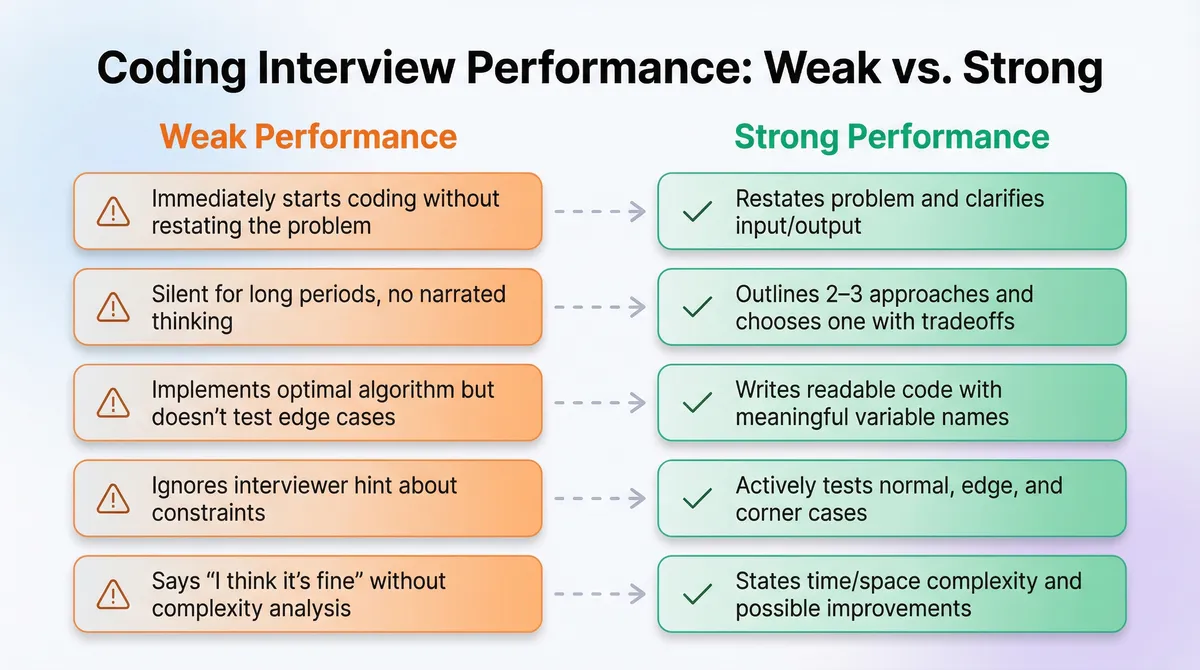
11. Example: From Weak to Strong Interview Performance
To make this concrete, here’s a side-by-side comparison of behaviors on a typical array problem.
12. Systematic Checklist: Avoiding Common Technical Interview Mistakes
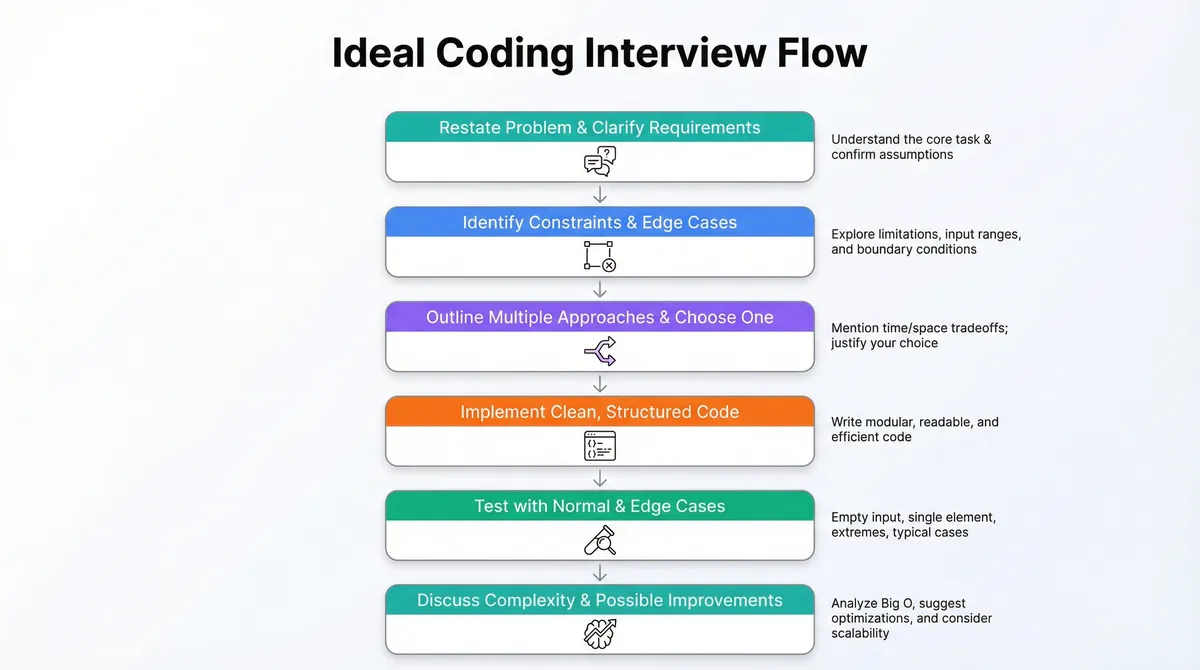
Here’s a compact checklist you can mentally run before and during each interview.
Before the interview
- Practice pattern-based DSA problems rather than random questions (e.g., sliding window, two pointers, BFS/DFS, dynamic programming).
- Do at least a few mock interviews with real-time feedback (peer, mentor, or tools like AI Interview Practice: Free Mock Interview Simulator with Real-Time Feedback for Technical Interviews).
- Review common edge cases for core data structures (arrays, strings, trees, graphs).
During the interview
-
Understand and clarify
- Restate the problem in your own words.
- Ask about input size, constraints, and edge behaviors.
-
Plan before coding
- Brainstorm at least two approaches (brute force vs optimized).
- Discuss time/space tradeoffs aloud.
- Confirm with the interviewer which approach to implement.
-
Code with structure
- Start with a clear function signature and docstring/comment.
- Use descriptive variable names and logical sections.
- Keep the interviewer updated as you implement.
-
Test thoroughly
- Run through the example given.
- Add your own edge cases.
- Fix bugs calmly and narrate your reasoning.
-
Communicate like a teammate
- Treat hints as collaboration, not criticism.
- Be honest about what you know and don’t know.
- Show how you’d improve or extend the solution with more time.
13. Key Takeaways
- Many strong engineers are rejected not for lack of skill, but due to specific, repeatable technical interview mistakes.
- The biggest failure modes are about process and communication, not just algorithms:
- Silent problem solving instead of narrated reasoning
- Skipping clarifications and edge cases
- Under-communicating complexity and tradeoffs
- Mishandling hints and feedback
- Treat interviews as collaborative debugging/design sessions, not exams.
- Build habits: clarify, plan, code clearly, test systematically, and discuss complexity.
The same discipline you apply to production systems—clear design, defensive coding, careful testing, and effective collaboration—translates directly into stronger performance in software interviews. If you can make those behaviors explicit under time pressure, you’ll convert more of your real-world strength into actual offers.