
Interview
Dropbox Interview Questions and Process: The Complete Guide (2026)
Prepare for Dropbox interview questions with a practical guide to the CodeSignal build-up assessment, technical screens, onsite rounds, and a 30-day plan.
Dropbox interview questions are best prepared for as a build-and-explain exercise, not as a list of unrelated coding puzzles. Reported accounts describe an online assessment, technical screens and an onsite loop, with a distinctive 90-minute CodeSignal exercise in which roughly four tasks build on one another: you begin with a working system, then add persistence, concurrency and further features. Prepare by practising clean implementation, safe incremental changes, complexity reasoning and clear communication alongside core data-structure patterns.
For company-mapped practice, Dropbox’s interview kit holds four mapped DSA questions. Use it to practise the coding patterns associated with Dropbox, then rehearse explaining your choices under realistic constraints.
The Dropbox interview process at a glance
Reported accounts describe the following broad sequence. Exact formats, interviewers and sequencing can vary by role and team, so use this as a preparation map rather than a fixed script. Confirm the details of your own process with your recruiter.
| Stage | Format | What it screens for | How to prepare |
|---|---|---|---|
| Online assessment | Progressive CodeSignal build exercise | Implementation discipline, testing, adapting code | Build in small increments and preserve working code |
| Technical screens | Live technical discussion and coding | Problem solving, clarity, complexity reasoning | Narrate your plan before and during coding |
| Onsite loop | Multiple conversations with engineers and hiring stakeholders | Technical depth, collaboration, judgement and role fit | Practise coding, design discussion and project stories |
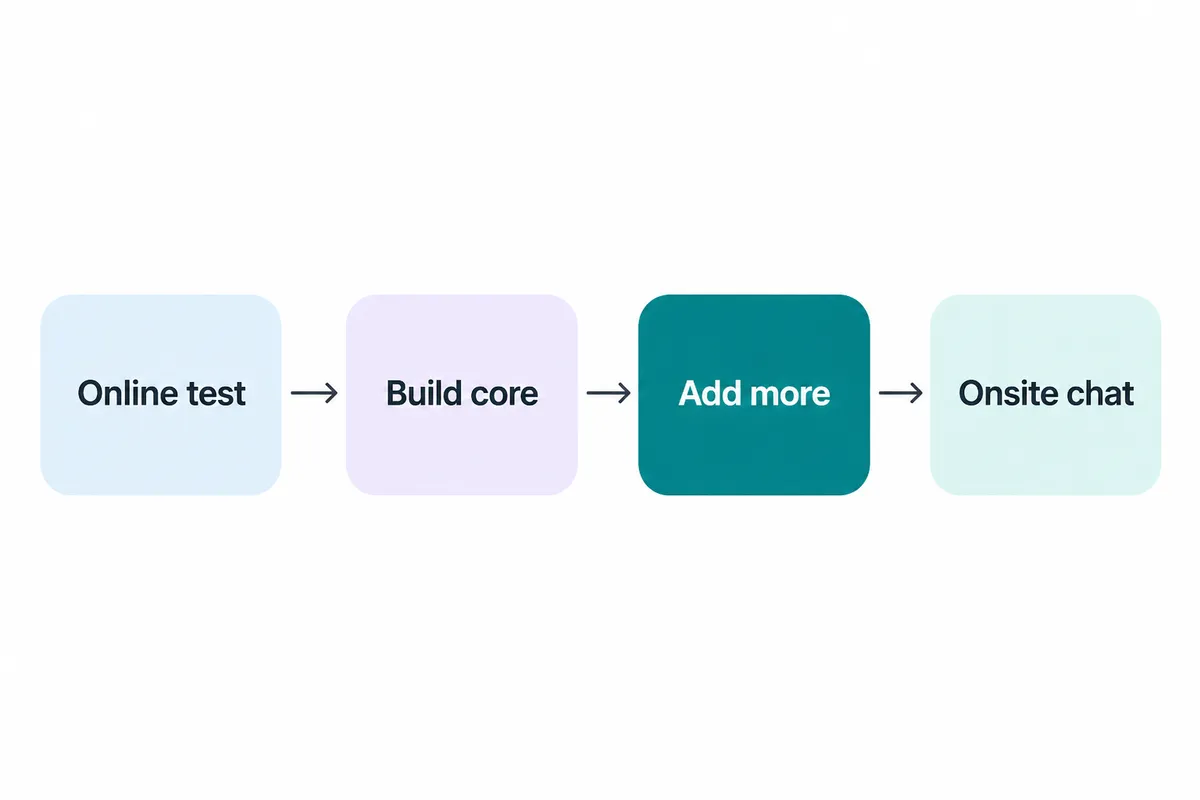
The central preparation lesson is simple: do not treat the assessment as a sprint through disconnected questions. The reported format rewards candidates who can make an initially small program work, retain control of it, and extend it without breaking earlier behaviour.
Stage one — the progressive CodeSignal assessment
The most distinctive reported part of the Dropbox process is a 90-minute CodeSignal assessment with approximately four connected tasks. Rather than resetting for a fresh puzzle each time, you implement an initial system and progressively extend it. Reported additions include persistence, concurrency and new features.
That format changes what good preparation looks like.
In a conventional coding assessment, it is possible to solve one question messily, submit it, and start again with a blank slate. In a progressive exercise, early decisions follow you. A rushed data model, unclear naming or a hidden assumption can make the next task much harder than it needs to be. The assessment therefore screens for more than finding an efficient algorithm. It also tests whether you can create code that is understandable enough to change.
Start by identifying the smallest valid version of the system. Define the essential state, write the core operations, and check that the basic flows work before adding sophistication. When a later requirement appears, pause before editing. Ask what has changed, what must remain true, and where the new behaviour belongs.
The DSA Patterns Sheet is free to browse and useful for sharpening the pattern recognition needed when the exercise contains lookup, ordering, queueing or state-management work. For the communication side, read how to explain your thought process clearly in coding interviews.
💡 Pro tip: Preserve a working version before each significant extension. Even if the environment does not offer version control, make changes in small, testable steps. A modest feature that works is more valuable than an ambitious addition that destabilises the whole solution.
What this stage screens for
Incremental engineering. Can you turn a vague request into a small working implementation, then revise it as requirements evolve?
State management. Can you choose data structures that make the current task clear without making the next one impossible?
Testing habits. Do you verify existing behaviour after changing code, including edge cases such as empty input, duplicate actions and invalid requests?
Practical judgement. Can you distinguish a useful abstraction from an abstraction that consumes time without helping the task?
The best answer is rarely the most elaborate design. It is a working, readable solution that makes its trade-offs visible.
Stage two — technical screens
Reported accounts describe technical screens after the online assessment. Specific question formats are not consistently documented, so it is safer to prepare for the transferable skills that live engineering interviews commonly reward: clarifying a prompt, structuring a solution, analysing complexity, writing correct code and responding constructively to follow-up questions.
This is where candidates often lose credit by solving privately. An interviewer cannot assess reasoning they cannot hear. Begin with a short restatement of the problem and ask about constraints that would materially change the solution. Then name the straightforward approach, explain why it is insufficient if necessary, and describe the improved approach before you code.
A useful live-coding rhythm is:
- Clarify the input, output and edge cases.
- Give a brief plan and its expected complexity.
- Write the smallest correct implementation.
- Test with an ordinary case and a boundary case.
- Discuss improvements only after correctness is secure.
For a deeper breakdown, what interviewers actually look for in live coding rounds explains why communication, testing and recovery from mistakes matter as much as the final code.
What this stage screens for
Technical screens usually reveal whether you can collaborate while solving. Interviewers are looking for evidence that you can take feedback, notice a faulty assumption and adjust without becoming defensive or silent.
Practise problems aloud, including the moments where you are uncertain. Say, “I see two possible directions; I’ll compare their time and space costs,” rather than disappearing into the editor. That is closer to the work of an engineer than presenting a memorised answer.
Use Dropbox’s interview kit for focused DSA practice, and use the Code Practice workspace to rehearse implementing and testing solutions in one sitting.
Stage three — the onsite loop
Reported accounts describe an onsite stage following the earlier assessments and screens. The available reports do not establish a dependable company-wide breakdown of individual onsite rounds, so avoid assuming that every Dropbox team uses the same sequence. Your recruiter is the best source for the current format, role expectations and any team-specific emphasis.
Preparation should nevertheless cover the areas that commonly surface in a modern software engineering onsite: coding, design judgement, project depth and collaboration. The goal is not to memorise an answer for every possible prompt. It is to build a repeatable way of working when the prompt is incomplete.
For coding, retain your live-round routine: clarify, plan, implement, test and discuss complexity. For design-oriented conversation, explain how you divide responsibilities, how data moves through the system, which failures matter and what you would defer until requirements are clearer. The System Design Sheet is free to browse if you need structured practice in discussing trade-offs at a higher level.
For project discussion, prepare examples that show your own contribution. Choose projects where you can explain:
- the problem and the users affected;
- the decision you personally owned;
- a constraint or failure you encountered;
- the outcome and what you would change next time.
What this stage screens for
The onsite is where isolated coding ability becomes an engineering signal. A strong candidate can make technical decisions legible to others, acknowledge uncertainty, and connect implementation details to product or operational consequences.
This also means that vague project stories are risky. “We improved reliability” is not an answer on its own. Be ready to say what changed, why the earlier approach failed, what metric or observation informed your decision, and what you learned.
A realistic AI mock interview can help you practise both technical explanation and behavioural follow-ups when you do not have a peer available.
The Dropbox-specific challenge: extending code without losing control
Many interview processes test whether you can solve a problem. Dropbox’s reported CodeSignal format adds a more workplace-like question: can you keep solving after the requirements change?
The progressive structure matters because it exposes a common weakness in puzzle-first preparation. Candidates may be excellent at producing a compact solution to a fixed prompt, yet struggle when asked to preserve earlier behaviour while adding persistence, coordinating concurrent work or expanding a feature set.
Treat every practice session as a sequence rather than a one-shot solution. After finishing a problem, impose a change:
- add a second type of user or object;
- make an operation safe to repeat;
- store and reload state;
- add parallel requests;
- introduce an audit trail or query requirement.
Then inspect your first design honestly. Did your names still make sense? Did you couple unrelated behaviour? Could you test the new path without rewriting everything?
This exercise is specific to the kind of progressive build problem evidenced at Dropbox. It teaches you to optimise for change, not merely for the first accepted submission.
The Low Level Design Sheet is free to browse and can help you practise separating responsibilities, choosing interfaces carefully and avoiding unnecessary complexity. The useful standard is not “use more patterns”; it is “make the next change safer”.
Is the Dropbox interview hard?
It can be hard because the process appears to combine algorithmic fluency with practical implementation discipline. The CodeSignal build-up exercise is especially demanding for candidates who have practised only isolated interview questions. You need to manage time, retain a working program and adapt to new requirements without a restart.
How many rounds are there? Reported accounts reliably establish an online assessment, screens and an onsite, but they do not provide a stable company-wide count for every role and team. Ask your recruiter which stages apply to your process.
How long does it take? The reported assessment lasts 90 minutes. A dependable end-to-end timeline is not established in the available accounts, and team hiring needs can materially affect scheduling.
The good news is that the hardest parts are trainable. You do not need to predict every feature request. You need a method for handling one: clarify the change, protect the existing core, implement the smallest viable extension and test it.
A 30-day Dropbox interview preparation plan
Days one to seven — rebuild coding fundamentals
Practise core DSA patterns: arrays, hash maps, two pointers, sorting, stacks, queues, trees and graphs. Focus on recognising the shape of a problem quickly, then explaining your selected approach in plain language.
Use the free DSA Patterns Sheet to organise practice by reusable pattern rather than by a random list. If graphs need attention, graph traversal patterns: DFS and BFS offers a focused refresher.
Days eight to fourteen — practise progressive implementation
Build small programs from an empty file. Start with a narrow requirement, get it running, then add one change at a time. Do not begin with an elaborate class hierarchy. Begin with a core flow you can demonstrate.
At the end of each session, write down what you would change if the system needed persistence, parallel access or a new user workflow. This reflection builds the habit the progressive assessment rewards.
Days fifteen to twenty-one — add time pressure
Run timed practice sessions. Allocate an opening segment for understanding the task, most of the session for implementation, and a protected final segment for testing and cleanup.
Practise narrating key decisions aloud: your data model, why you chose a structure, what could fail, and what you would do next if the requirements expanded. Avoid filling every silence; clear, purposeful narration is enough.
Days twenty-two to thirty — simulate the whole loop
Alternate among coding, progressive builds, design discussion and project stories. Do at least two mock sessions in which you must explain your work to another person or an AI interviewer.
Return to Dropbox’s interview kit for the four mapped DSA questions, and treat each as an opportunity to practise communication as well as correctness. Finish the month by preparing concise stories about ownership, conflict, a difficult technical decision and a project that did not go as planned.
Frequently asked questions
What is the Dropbox CodeSignal assessment like?
Reported accounts describe a 90-minute exercise with around four connected tasks. You build an initial system and extend it with later requirements rather than solving unrelated puzzles.
Does Dropbox use separate coding questions in the assessment?
The reported format is progressive: the tasks build on the same implementation. Prepare to preserve earlier behaviour while adding features.
What should I practise for Dropbox interview questions?
Practise DSA patterns, clean implementation, testing, complexity analysis and explaining your reasoning. Progressive build exercises deserve dedicated practice.
How many interview rounds does Dropbox have?
Reported accounts describe an online assessment, screens and an onsite. A fixed company-wide count is not reliably established, so confirm your own sequence with the recruiter.
Is the Dropbox interview process difficult?
The process can be challenging because it combines coding fundamentals with practical software changes under time pressure. The progressive assessment is a distinct skill from isolated puzzle solving.
How long is the Dropbox online assessment?
Candidate reports describe a 90-minute CodeSignal assessment.
How should I handle changing requirements in a coding interview?
Restate the change, identify what existing behaviour must remain intact, make the smallest safe modification, and test old and new flows. Do not rewrite working code unless the new requirement genuinely demands it.
Should I focus on low-level design for Dropbox?
It is useful to practise code structure and change-friendly design because the reported assessment adds features to an existing solution. Keep that work grounded in a functioning implementation.
How do I prepare for the onsite?
Prepare to code aloud, discuss technical trade-offs and explain your projects with specific examples of ownership and impact. Confirm team-specific expectations with your recruiter.
Start with the work that compounds
The best Dropbox preparation is not a last-minute attempt to memorise more questions. It is repeated practice at building a small working solution, explaining it clearly and extending it safely when the prompt changes.
Open Dropbox’s interview kit to practise the four mapped DSA questions, use the free sheets to strengthen your foundations, and book an AI mock interview when you are ready to rehearse under pressure.
Interview processes change, and reported formats vary by role and team. Confirm your current sequence with your recruiter, then prepare for the transferable skills that make every stage easier: clear reasoning, correct code, thoughtful testing and calm adaptation.
Topics
Related on Thita
Your next step
Practise with AI mock interviews
A spoken interview that asks follow-up questions, runs your code and ends with a written report.