
Interview
eBay Coding Interview Questions: Patterns and Preparation (2026)
Prepare for eBay coding interviews with pattern families, assessment strategy, live-round habits, and a focused practice plan for technical rounds.
The useful way to prepare for eBay coding interview questions is not to memorise isolated prompts. It is to recognise the problem shapes that repeatedly turn up in assessment-style coding and live technical discussion: lookup-heavy array work, windowed scans, ordered search, traversal, recursion, and optimisation under constraints.
eBay's interview kit holds 36 mapped DSA questions and one low-level design problem. That mix makes the preparation priority clear. Build speed in core algorithmic pattern families first, then make sure you can explain your choices clearly when the format moves from a quiet assessment to a conversation with an interviewer.
The goal is not merely to reach a correct answer. It is to identify the right approach early, communicate why it fits, implement it without avoidable defects, and test it like an engineer.
The eBay pattern mix: what to prepare for first
A company-tagged collection is most useful when it tells you where to place your attention. For eBay, the strongest signal is broad DSA coverage rather than a narrow speciality. That calls for pattern-led practice: learn to classify the prompt before writing code.
The core families worth prioritising are below. These are families of reasoning, not a question list.
Arrays, strings, and hash-based lookup
Many interview problems begin with a sequence and an apparently simple request: find, group, count, compare, or validate. The important decision is often whether repeated scanning is acceptable or whether a hash map or set turns the work into a single pass.
Recognise this family when the prompt mentions duplicates, frequencies, pairs, membership, matching, grouping, or fast lookup. Before coding, ask what information you will need again later and whether you can record it while scanning.
A hash-based approach is not automatically correct. It has a memory cost, and sometimes sorting or a two-pointer scan is cleaner. The point is to name the trade-off rather than reaching for a familiar data structure by reflex.
Two pointers and sliding windows
A sorted collection, a contiguous range, or a constraint over a substring often points towards a moving-boundary technique. Two pointers are useful when the answer emerges from comparing positions. Sliding windows are useful when the prompt asks about a contiguous segment that must meet or maintain a condition.
If you read “longest”, “shortest”, “contiguous”, “at most”, “distinct”, or “within a range”, pause before using nested loops. There may be a window hiding in the wording.
The tricky part is usually not starting the window. It is knowing when to shrink it, what state must be updated, and which invariant stays true throughout the loop. State that invariant out loud in a live round: “This window contains no repeated characters,” for example. It helps the interviewer follow your logic and gives you a test for your own code.
Binary search and ordered decisions
Binary search is more than searching a sorted array for a target. It is a way to find a boundary in a decision space: the first acceptable value, the last valid position, or the smallest capacity that makes a condition feasible.
Candidates often recognise only the textbook version and miss the broader form. Train yourself to look for monotonicity. If one answer works and every larger answer also works, or if one answer fails and every smaller answer also fails, there may be a binary-searchable boundary.
The binary search patterns guide is useful for separating ordinary lookup from boundary-search reasoning. During practice, do not stop at “I know this is binary search”. Say what changes at the boundary and why the search interval remains valid after every update.
Trees, graphs, and traversal
When a prompt describes relationships rather than a flat collection, draw the structure. Hierarchies, dependencies, connected components, routes, prerequisites, and transformations frequently become tree or graph traversal problems once the representation is clear.
The key choice is often between depth-first and breadth-first search. Depth-first search naturally explores branches and supports recursive state. Breadth-first search naturally explores by layers and supports shortest-path reasoning in an unweighted graph.
The DFS and BFS pattern guide explains the practical distinction. In an interview, say what your visited set means, when a node is marked, and how you handle disconnected input. These details distinguish a remembered template from a solution you genuinely control.
Recursion, backtracking, and dynamic programming
Some prompts ask you to generate valid choices, explore combinations, or maximise an outcome across overlapping subproblems. The brute-force solution is often easy to describe but too expensive to run.
Start by identifying the decision at each stage. What are the choices? What must be restored after exploring one choice? What repeated state appears across different paths? Those questions separate backtracking from dynamic programming.
Dynamic programming becomes less mysterious when you define three things plainly: the state, the transition, and the base case. The dynamic programming patterns guide is a useful reference for practising that translation from recurrence to code.
Intervals, sorting, and greedy choices
A schedule, range, meeting, booking, or timeline often becomes easier after sorting. Once events are ordered, adjacent comparison can reveal overlap, gaps, merge opportunities, or a greedy choice that remains safe.
Do not call an approach greedy merely because it feels efficient. Explain the reason the local choice cannot hurt the global result. If you cannot justify that, test whether a dynamic programme or a different ordering is needed.
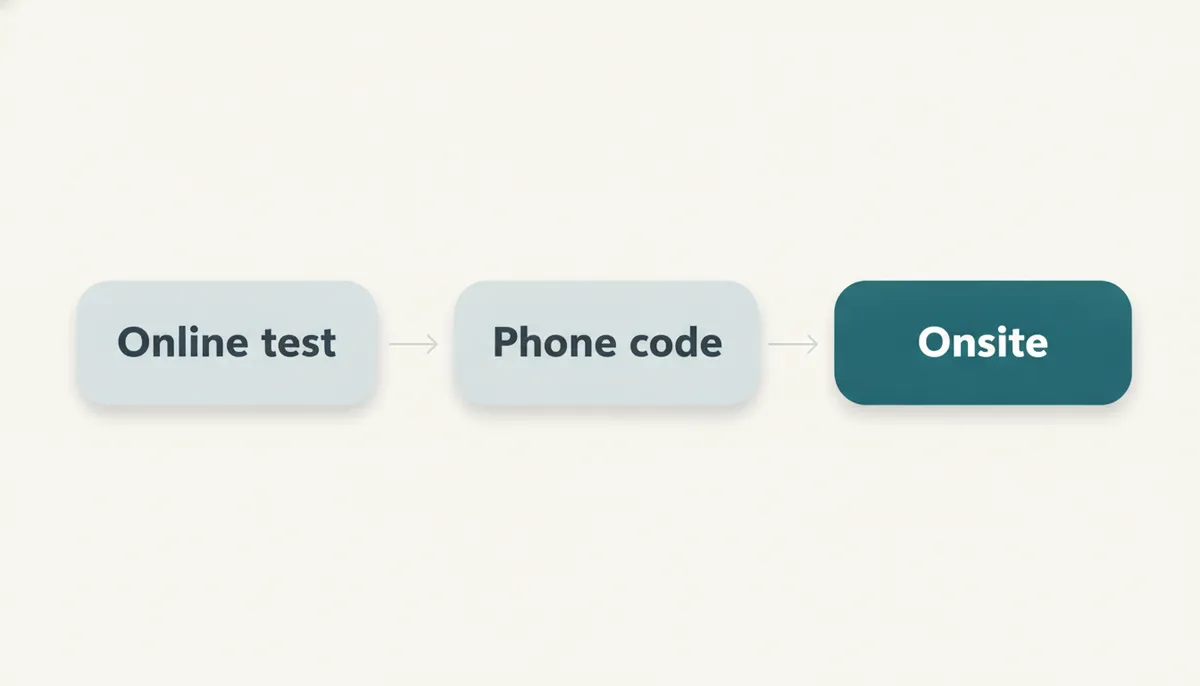
Assessment practice: optimise for recognition speed
An online assessment changes the problem. You are not only solving; you are allocating attention under a timer, without an interviewer to clarify your interpretation or redirect a weak approach.
Recognition speed means reaching a sensible classification quickly enough to preserve time for implementation and checking. It does not mean rushing into code. A fast solver spends an initial moment asking:
- Is this a lookup problem, a window, a traversal, or an optimisation problem?
- What is the brute-force approach?
- Which constraint makes brute force unsafe?
- Which data structure removes that bottleneck?
- What edge case is most likely to expose a bug?
That diagnostic routine prevents a common failure mode: spending too long coding an approach that should have been discarded after a complexity estimate.
The DSA Patterns Sheet is free to browse and is built for this kind of classification practice. Work by family for a while, then deliberately mix families. Grouped practice teaches the mechanics; mixed practice teaches recognition. You need both.
A productive assessment session has a clear review loop. Attempt a problem without looking at guidance. When you finish, inspect not just whether your answer works but whether you saw the pattern early enough. If you needed several false starts, record the wording that should have alerted you next time. Over time, you build a personal pattern dictionary: “contiguous plus constraint suggests window”, “relationships suggest graph”, “minimum feasible value suggests a boundary search”.
Use in-browser code practice for short timed sessions. Keep the timer honest. The point is to rehearse decisions under pressure, not to produce a perfect study record with unlimited retries.
Live coding: the interviewer must hear your reasoning
A live technical round assesses a broader set of behaviours than an assessment. Correctness still matters, but the interviewer can now see how you turn an incomplete prompt into an engineering solution.
A reliable live-round sequence looks like this:
Clarify the contract. Repeat the input and output in your own words. Ask about duplicates, invalid input, ordering, mutability, and expected constraints where they materially change the solution.
Offer the direct approach first. A brief brute-force explanation shows that you understand the search space. Then explain why it is too slow or too memory-heavy when constraints demand a better method.
Name the better pattern. State the data structure or algorithmic family and why it changes the complexity. Avoid presenting a polished answer as if it appeared instantly; the interviewer is evaluating judgement, not theatre.
Code in small sections. Use meaningful names, keep control flow readable, and narrate the state you are maintaining. If you change direction, explain why.
Test deliberately. Walk through a normal example, then choose cases that challenge your assumptions: empty input, a single element, repeated values, extreme boundaries, and no valid answer.
The most valuable habit is verbal structure. Instead of silently typing, say: “I will use a map to store the earliest position for each value,” or “I am shrinking the left side until the invariant is restored.” That narration makes your reasoning creditable.
For more on this, read what interviewers actually look for in live coding rounds and how to explain your thought process clearly in coding interviews.
Low-level design: prepare for a different kind of discussion
Alongside its DSA material, eBay's interview kit includes one low-level design problem. Treat that as a prompt to rehearse class-level design habits as well as algorithmic recall.
Low-level design is about translating requirements into responsibilities. Strong answers tend to make the core entities obvious, give each object a focused role, and leave room for likely changes without building a framework for imaginary future requirements.
Start by clarifying the main flow. Then identify the objects that own state, the services that coordinate behaviour, and the interfaces that are justified by variation. Talk through trade-offs rather than claiming there is one universally correct design.
The Low Level Design Sheet is free to browse, and it is useful for practising these decisions in a structured way. If you are unsure where class-level design ends and architecture-level system design begins, low-level design versus high-level design provides a clear distinction.
For this type of round, avoid two opposite errors. The first is coding immediately without agreeing on responsibilities. The second is spending so long inventing abstractions that no concrete flow exists. Begin with a small working model, explain the extension points, and only add complexity when a requirement earns it.
A focused preparation plan
Build the foundation
Start with arrays, strings, hash maps, stacks, queues, linked lists, trees, and graphs. The aim is fluency with the operations and complexity of each structure. If you regularly need to pause and remember whether an operation is constant or linear time, pattern recognition will remain slower than it should be.
Work through a family at a time until the basic moves feel natural. Then revisit it through mixed sets so you must identify the family from the prompt alone.
Train recognition under time pressure
Choose a small set of sessions each week for timed work. Read the prompt, write down the likely pattern before coding, and review whether that first classification was right.
Do not measure progress only by solved problems. Measure the time taken to identify the approach, the number of implementation errors, and the quality of your final explanation. Those are closer to what an assessment or live round actually exposes.
Rehearse communication
Once each week, solve aloud. Explain assumptions, complexity, variable roles, and test cases as if someone were listening. It will feel unnatural initially. That is precisely why it needs practice.
An AI mock interview can help simulate the conversational pressure: being interrupted, receiving a follow-up, defending a choice, and recovering from an imperfect first answer. The ability to recover calmly is often more important than producing an instant ideal solution.
Add design without neglecting DSA
Keep your algorithmic practice as the main thread, while reserving time to practise the design problem in the kit. Sketch the object model, identify responsibilities, and explain how you would handle a reasonable change in requirements.
The System Design Sheet is also free to browse if you want to strengthen broader design vocabulary. Keep the distinction clear: low-level design is about code structure and object interactions; high-level design is about services, scale, data flow, and system boundaries.
Run a final rehearsal
Before the interview, do a realistic sequence: timed coding, a live-style explanation of a fresh prompt, and a design discussion. Review where you lost time. Was it pattern selection, syntax, edge cases, or communication? Fix the bottleneck, not merely the topic that felt most comfortable.
Common mistakes to avoid
Practising by topic label only. Knowing that you are doing “graphs day” is useful early on, but it does not replicate the interview. Eventually, prompts must arrive mixed.
Skipping the brute-force explanation. Interviewers want to see that you can evaluate alternatives. A concise baseline makes your optimisation credible.
Treating complexity as an afterthought. State the time and space cost before coding, then revisit it after implementation. This catches accidental nested work and unnecessary storage.
Ignoring edge cases until the end. Mention them while designing. If duplicates change the logic, that is not a final test detail; it is part of the algorithm.
Overengineering design. Patterns are tools, not decoration. Add an abstraction because behaviour varies, not because a named pattern sounds impressive.
Solving silently. A technically correct answer that is impossible to follow is difficult to assess. Make the structure of your thinking visible.
Frequently asked questions
What should I study for eBay coding interview questions?
Prioritise core DSA pattern families: hash-based lookup, two pointers, sliding windows, binary search, traversal, recursion, dynamic programming, and interval reasoning. Then practise explaining your approach out loud.
Are eBay coding interviews only about algorithms?
Algorithmic problem solving should be the main focus of the available eBay material. The kit also includes a low-level design problem, so it is worth preparing to discuss responsibilities, object interactions, and trade-offs.
How do I improve pattern recognition?
Practise grouped problems to learn a technique, then switch to mixed practice so you must classify the prompt yourself. Review the clues that should have led you to the right family sooner.
What does recognition speed mean in an assessment?
It means identifying a viable problem family quickly enough to leave time for implementation and testing. It does not mean writing code before you understand the constraints.
Should I memorise solutions?
No. Memorised code is fragile when the wording changes. Memorise the reasoning cues, invariants, complexity trade-offs, and implementation patterns instead.
How should I communicate in a live coding round?
Clarify assumptions, describe the baseline approach, explain the improved pattern, state complexity, narrate important state changes, and test edge cases aloud.
How should I practise low-level design?
Start from the main user flow, identify entities and responsibilities, explain where behaviour may vary, and avoid unnecessary abstractions. Focus on clarity and justified trade-offs.
What if I get stuck during a coding interview?
Say what you have ruled out, return to the constraints, and propose a smaller example. A structured recovery is much stronger than silent guessing.
Should I practise with a timer?
Yes. Timed practice reveals whether the issue is knowledge, recognition, implementation speed, or testing discipline. Keep some untimed sessions for deeper learning as well.
Start with the patterns that matter
The fastest route to stronger performance is not collecting more prompts. It is becoming quicker at seeing what a prompt is really asking, then showing your reasoning clearly enough for an interviewer to trust it.
Open eBay's interview kit to work through the 36 mapped DSA questions and one low-level design problem associated with eBay. Use the free-to-browse DSA Patterns Sheet to strengthen recognition across families, and rehearse your delivery with an AI mock interview.
Confirm the exact format, expectations, and interview sequence with your recruiter, then prepare for both parts of the challenge: solving the problem and making your solution easy to evaluate.
Topics
Related on Thita
Your next step
Practise with AI mock interviews
A spoken interview that asks follow-up questions, runs your code and ends with a written report.