
Interview
eBay Interview Questions and Process: The Complete Guide (2026)
Prepare for eBay interview questions with guidance on coding, low-level design and behavioural rounds, a practical 30-day plan and focused practice.
eBay interview questions are best prepared in three parallel tracks: practise coding patterns until you can explain them clearly, build confidence with low-level design trade-offs, and prepare concrete stories about your work. The precise sequence varies by role, team and location, so confirm the format with your recruiter. For focused technical practice, eBay's interview kit holds 36 mapped DSA questions and 1 low-level design problem evidenced at eBay.
This guide gives you a practical way to prepare for the full loop without pretending that every eBay team runs an identical process. Use the round map to plan your work, then adapt it when you receive recruiter guidance.
The process at a glance
The table below is a preparation map rather than a fixed company script. Treat each stage as a round type you may need to handle, not as a promise about the order, number or timing of interviews.
| Stage | Likely format | What to prepare | What it screens for |
|---|---|---|---|
| Recruiter conversation | Background and role discussion | Career summary, interests, availability | Role alignment and communication |
| Coding assessment or screen | Timed or live coding | Core DSA patterns and clean implementation | Problem solving and complexity awareness |
| Technical coding interview | Collaborative live problem solving | Clarification, narration, testing | Reasoning, coding quality and collaboration |
| Low-level design discussion | Classes, objects and interactions | Responsibilities, interfaces and trade-offs | Practical design judgement |
| Hiring-manager or behavioural conversation | Project and experience deep dive | Ownership stories and decisions | Scope, communication and team fit |
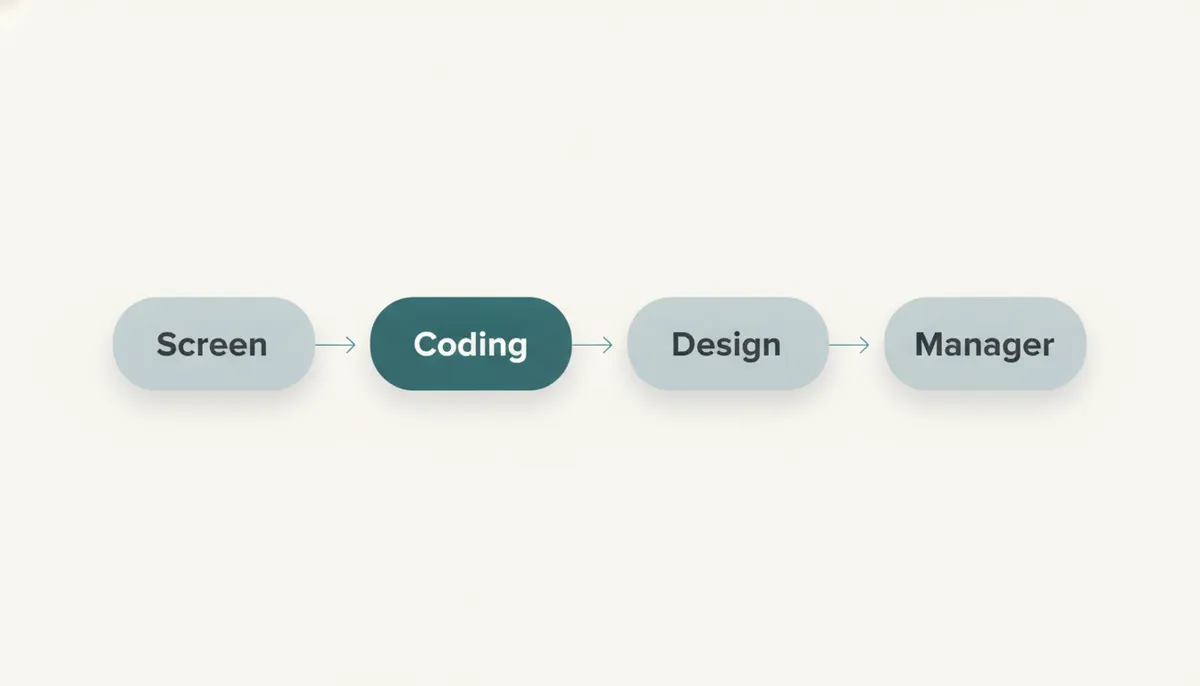
The useful mindset is simple: prepare the skills, then let recruiter information determine the final emphasis. A role that is more implementation-focused may spend more time on coding; an experienced role may place more weight on design and project depth.
Round 1 — recruiter conversation
A recruiter conversation is usually your first chance to understand what the team actually needs. It is also your chance to remove uncertainty from your preparation plan.
Have a concise answer ready for three questions: what you work on now, what kind of problems you enjoy solving, and why this role is a sensible next step. Avoid delivering a chronological résumé. Instead, connect your experience to the role: systems you owned, technical decisions you made, and outcomes you can describe clearly.
Use this conversation to ask practical questions. Is there an assessment? Will the technical conversation include coding, design or both? What level is the role calibrated for? Which language and interview environment will be used? These questions are not administrative details; they determine how you allocate preparation time.
What it screens for: clarity, motivation, role alignment and whether you can communicate your background without drifting into vague claims.
💡 Pro Tip: Prepare a sixty-second introduction and a longer three-minute version. The shorter one opens the conversation; the longer one is useful when a recruiter asks about a relevant project.
Round 2 — coding assessment or technical screen
Whether this happens as an online assessment or a live screen, the coding portion is where interviewers establish your baseline. Expect familiar data-structure and algorithm shapes rather than a test of obscure trivia: arrays, strings, hash maps, stacks, queues, trees, graphs, searching and dynamic programming are all worth revising.
The highest-leverage skill is pattern recognition. Before writing code, identify the structure of the problem. Is it a sliding-window problem? Does a hash map remove repeated work? Is a graph traversal needed? Can binary search turn a repeated decision into a logarithmic one?
The DSA Patterns Sheet is free to browse and groups practice by the underlying pattern, which is more useful than treating every question as unrelated. For a practical method, read how to identify the right DSA pattern in a coding interview.
What it screens for: how quickly you turn an unfamiliar prompt into a workable approach, whether you understand time and space complexity, and whether your implementation survives edge cases.
A strong answer has a visible structure:
- Restate the problem and clarify constraints.
- Describe a straightforward solution first if it helps establish the trade-off.
- Explain the improved approach before coding.
- State complexity in plain language.
- Test ordinary, boundary and empty cases aloud.
✅ Do: narrate the decisions an interviewer cannot see from your editor.
❌ Don't: jump into code before you can explain why the chosen data structure fits.
For practice that feels closer to an interview editor, use in-browser code practice. The goal is not merely reaching accepted output; it is producing readable code you can defend under questions.
Round 3 — the live coding interview
A live coding round is different from solving alone. The interviewer is assessing how you collaborate around a problem, not just the final result on the screen.
Start by asking questions that change the solution: input range, duplicate handling, ordering requirements, error cases and expected complexity. Then think aloud. A short running commentary makes your assumptions testable and lets the interviewer redirect you early if needed.
When you finish the main implementation, do not stop. Walk through an example, test edge conditions and ask whether the interviewer would like an optimisation or extension. This last part often reveals more engineering maturity than the first solution.
The guide to what interviewers actually look for in live coding rounds explains why communication, testing and recovery from a mistake matter alongside correctness.
What it screens for: collaborative problem solving, code organisation, debugging habits and how you respond when the first approach needs adjustment.
A useful rehearsal constraint is to speak throughout your practice session. It may feel artificial at first, but it exposes gaps fast. If you cannot explain a decision simply, you may not yet understand it well enough to defend in an interview.
Round 4 — low-level design
Low-level design is about the code-level structure of a system: which objects exist, what each one owns, how they interact and how the design changes when a requirement changes.
The question is not whether you know a catalogue of patterns. It is whether you can use abstraction with judgement. A clean design gives each class a focused responsibility, keeps behaviour near the data it operates on, and introduces an interface only when something genuinely varies.
The kind of design problem evidenced at eBay is best approached as an exercise in disciplined trade-offs. Start small. Identify the core entities and the main user flow. Make that flow work. Then discuss extensions: new rules, different strategies, additional storage needs or conflicting constraints.
eBay's interview kit gives you a company-focused place to practise the low-level design problem evidenced at eBay alongside the mapped coding questions. The Low Level Design Sheet is also free to browse when you want to revise the broader vocabulary of objects, interfaces and relationships.
For a clearer distinction between class-level and architecture-level work, see low-level design vs high-level design: what interviews actually expect.
What it screens for: decomposition, responsibility boundaries, extensibility, sensible trade-offs and the ability to explain why a design is appropriate rather than merely elaborate.
⚠️ Important: Do not spend the whole round drawing an idealised hierarchy. Start with the smallest useful model, validate it against the main flow, and add complexity only when a requirement earns it.
Round 5 — hiring manager and behavioural discussion
Technical ability gets you through technical rounds. Project depth and judgement often determine whether the interviewer can imagine you operating effectively on the team.
Prepare stories from your own work, not polished generalities. Good topics include a difficult technical decision, a production issue, a disagreement you resolved, a project that changed direction, an improvement you initiated and a mistake from which you learned. In each story, distinguish your personal contribution from the team’s work.
A reliable structure is situation, task, action, result and reflection. Spend most of your time on action: what you noticed, what options you considered, what you chose and why. End with an honest reflection about what you would change next time.
Use AI mock interviews to rehearse behavioural answers aloud. The aim is not to memorise scripts. It is to become comfortable giving specific, structured answers under follow-up questions.
What it screens for: ownership, communication, technical judgement, learning habits and level fit.
Named rituals and process variations
No named eBay-specific ritual is established in the supplied round-mix research for this guide. That does not mean every team follows the same format; it means it would be misleading to attach a branded process step to eBay without reliable support.
Instead, treat recruiter information as the source of truth for your loop. Ask about the interview format, whether there is a separate assessment, whether design is expected, and whether the manager conversation is evaluative or introductory. Then reshape your final week around those answers.
This flexibility is itself useful interview preparation. Requirements change during real engineering work; being able to gather missing context, make a plan and communicate assumptions is a skill that carries across every round.
Is the eBay interview hard?
It can be demanding because it tests more than one skill at once: coding fluency, clear technical communication, design judgement and evidence of ownership. Candidates often underestimate the transition between solving a problem privately and solving one collaboratively while explaining each decision.
How many rounds are there? There is no reliable fixed round count in the research supplied for this guide. The practical preparation map includes recruiter, coding, design and behavioural stages, but your role and team determine which appear and how they are combined.
How long does it take? A fixed end-to-end timeline is not established here either. Confirm scheduling expectations with your recruiter rather than planning around an assumed date.
The good news is that these skills reinforce one another. Explaining a coding solution improves your design discussion. Reviewing trade-offs improves your project stories. Timed practice makes uncertainty feel manageable.
A 30-day preparation plan
Days 1–7 — rebuild coding foundations
Choose a language you can write fluently without looking up syntax. Revise arrays, strings, hash maps, stacks, queues, linked lists, trees and graphs. Work by pattern, not by random volume.
Practise one timed problem each day, then spend as long reviewing it as you spent solving it. Write down the clue that should have led you to the pattern. The graph traversal patterns guide is useful if graph questions are a weaker area.
Days 8–14 — practise interview communication
Keep solving coding problems, but make every session verbal. State assumptions, propose an approach, name complexity and test edge cases. Record yourself once or twice if possible; unclear explanations are easier to notice when you hear them back.
Use the 36 mapped DSA questions in eBay's interview kit to focus your practice around questions connected to the company. Alternate between familiar patterns and problems that force you to slow down and reason from first principles.
Days 15–21 — build design judgement
Study low-level design through implementation, not diagrams alone. Take a small domain, identify entities and responsibilities, then add one changing requirement at a time. Ask: what would break if a new rule appeared? Which part should own that rule? Is an interface helping or merely adding ceremony?
The Low Level Design Sheet is free to browse. If you expect more architecture-oriented discussion at your level, the System Design Sheet is free to browse too.
Days 22–26 — rehearse projects and behavioural answers
Select four stories that show different strengths: ownership, conflict resolution, technical depth and learning. Practise answering follow-up questions, especially “what did you do?” and “what would you change now?”
Keep answers specific. Metrics can help when you know them, but do not invent them. A precise description of a decision and its consequences is more credible than a polished but empty success story.
Days 27–30 — simulate the loop
Run a realistic rehearsal each day: one coding session, one design discussion or implementation exercise, and one behavioural answer. Review mistakes without trying to fix everything at once.
On the final day, revisit your notes, confirm logistics, prepare questions for the interviewer and stop cramming early enough to rest. A calm, structured explanation is worth more than one final exhausted problem.
What is specific about preparing for eBay?
eBay is a marketplace with a broad product surface: listings, search, buying, selling, trust, payments and post-purchase experiences all create engineering problems where correctness and user confidence matter together.
That makes product context useful in your interview answers. When discussing a design, do not treat the system as an abstract collection of classes. Ask who relies on it, what can go wrong for a buyer or seller, and where rules need to be explicit. A design that considers validation, state changes, auditability and clear failure behaviour is easier to justify than one focused only on happy-path code.
You do not need to pretend you know internal eBay architecture. You do need to demonstrate the habits relevant to marketplace engineering: make assumptions visible, protect important state transitions, define ownership clearly and explain the trade-off between a quick implementation and a durable one.
Frequently asked questions
What should I study for eBay interview questions?
Prepare coding patterns, low-level design fundamentals and behavioural stories from your own projects. Prioritise clear explanation as well as correct answers.
Does eBay ask coding questions?
eBay's interview kit holds 36 mapped DSA questions, making coding-pattern practice a useful part of preparation.
Should I prepare low-level design for eBay?
Yes. The kit includes 1 low-level design problem evidenced at eBay. Practise explaining responsibilities, interfaces and trade-offs, not merely naming patterns.
How many eBay interview rounds are there?
A fixed count is not established in the supplied research. Confirm the planned stages with your recruiter because role, team and location can affect the format.
Is there an eBay online assessment?
The supplied research does not establish a standard assessment format for eBay. Ask your recruiter whether an assessment is part of your process.
How difficult are eBay coding interviews?
Difficulty depends on the role and interviewer, but preparation should focus on recognising common patterns, writing correct code and communicating your reasoning clearly.
What programming language should I use?
Use the language in which you can write clean, tested code most comfortably. Fluency and communication matter more than choosing a fashionable language.
How should I prepare for behavioural questions?
Build specific stories around ownership, conflict, setbacks, technical decisions and impact. Practise answering follow-up questions aloud through AI mock interviews.
Should I practise system design as well?
For experienced roles, broader system-design preparation can be valuable. Revise how to clarify requirements, make trade-offs and discuss reliability, scale and failure modes.
Where to start
Start with the technical areas you can practise directly, then use recruiter guidance to tune the final plan. Work through eBay's interview kit for 36 mapped DSA questions and 1 low-level design problem evidenced at eBay. Pair that work with the free-to-browse DSA Patterns Sheet, timed coding practice and a behavioural mock interview.
The strongest preparation is deliberate rather than frantic: explain your reasoning, test your code, make trade-offs explicit and arrive ready to discuss work you genuinely owned.
Topics
Related on Thita
Your next step
Practise with AI mock interviews
A spoken interview that asks follow-up questions, runs your code and ends with a written report.