
Interview
Fintech Interview Process: The Complete Guide (2026)
Learn the typical fintech interview process, from timed coding screens to compressed final days, practical API work, design and behavioural preparation.
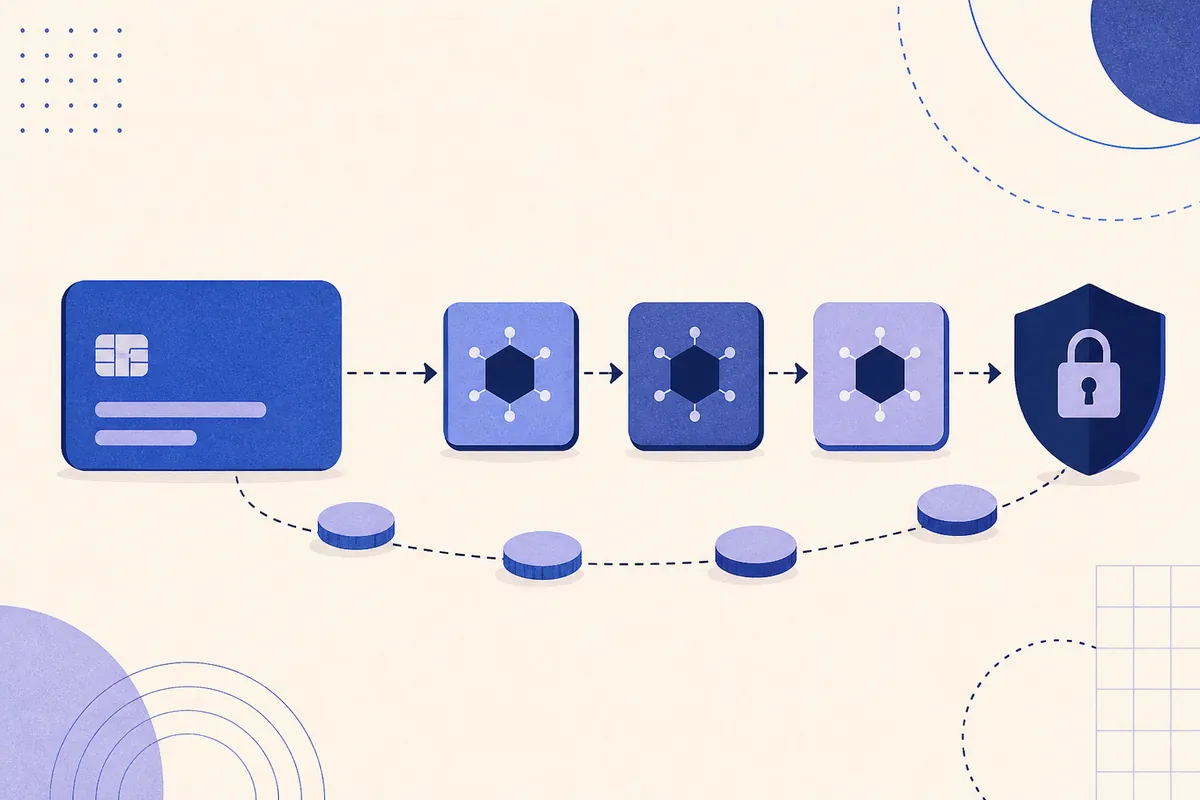
The typical fintech interview process starts with a timed coding screen, moves into live technical evaluation, and ends in a compressed set of interviews covering engineering judgement, domain awareness and behavioural evidence. Compared with a generic product-company loop, fintech processes more often put candidates through proctored platforms, asynchronous video steps or concentrated final days. The technical work is still grounded in data structures and algorithms, but payment reliability, data integrity, APIs, debugging and practical systems thinking can matter as much as reaching a clean coding solution.
Treat the sequence as a working shape, not a promise. Reported accounts vary by level, team, location and hiring channel. What is consistent is that fintech interviewers need evidence that you can make careful engineering decisions when money movement, customer trust and operational risk are involved.
| Company | What our kit holds for them | Kit page |
|---|---|---|
| Paypal | 20 mapped DSA questions, 1 low-level design problem, 1 system design problem | Paypal interview kit |
| Square | 5 mapped DSA questions | Square interview kit |
| Affirm | 2 mapped DSA questions | Affirm interview kit |
| Visa | 2 mapped DSA questions | Visa interview kit |
| Stripe | 2 system design problems | Stripe interview kit |
| Robinhood | 1 mapped DSA question | Robinhood interview kit |

The shared fintech interview shape
The common pattern is less about a fixed set of rounds than a progression in evidence. Early stages establish that you can code under constraints. Middle stages test whether you can explain your choices and work through ambiguity with another engineer. Final stages ask whether your technical decisions remain sound when the product involves transactions, customer data, external partners or systems that cannot casually fail.
Reported accounts describe several recurring stages.
The timed online screen
For many fintech and payments roles, the first technical filter is a timed platform exercise before a candidate speaks to an engineer. Reported platforms include HackerRank and CodeSignal. The questions tend to test familiar coding-interview material: arrays, strings, hash maps, sorting, trees, graphs, intervals and dynamic programming.
The important distinction is not that these subjects are unique to fintech. It is that the screen is often proctored or tightly timed, so recognition speed and implementation discipline matter immediately. You need to identify a workable pattern, communicate your assumptions where the platform allows it, and leave time to test boundary cases.
Prepare this stage by grouping problems around reusable approaches rather than working through an unstructured list. The DSA Patterns Sheet is free to browse and is useful for building that recognition habit. If choosing an approach still feels slow, read how to identify the right DSA pattern in a coding interview before returning to timed practice.
A strong screen attempt is not necessarily the cleverest solution. It is a solution that is correct, explainable and checked. Candidates often lose ground by coding immediately, discovering a flaw late, and then trying to repair the implementation without a clear plan. Start by naming the inputs, constraints and likely edge cases. Then choose the simplest approach that meets the expected complexity.
The live coding conversation
Reported accounts describe a technical screen after the online test at several companies in this segment. This is where an interviewer can assess something a platform cannot: whether you reason collaboratively.
Expect the conversation to cover more than the final code. An engineer may ask why a hash map is appropriate, what happens with an empty input, how the solution changes at larger scale, or whether a different representation would improve clarity. Core computer science topics can also appear around the coding task, including object-oriented design, operating systems and networking.
The strongest approach is visible reasoning:
- Clarify the problem before selecting a structure.
- State a brute-force path briefly, then explain why you are improving it.
- Say the time and space trade-off before writing the implementation.
- Test at least one ordinary case and one awkward edge case aloud.
- Respond to hints as new information, not as evidence that your original plan has failed.
This is especially important in financial products, where a technically plausible answer can still raise concerns if it casually ignores duplicate events, invalid state or partial failure. You do not need to force payment terminology into every coding exercise. You do need to show that correctness includes the surrounding assumptions.
For a fuller guide to this format, see what interviewers actually look for in live coding rounds. Practise saying your reasoning out loud, then use an AI mock interview to make that explanation feel natural under interruption.
Core CS and engineering fundamentals
Fintech interviews can broaden from pure data structures into the foundations behind production systems. Reported Visa accounts, for example, describe discussion of core computer science alongside coding. Across payments and trading-adjacent engineering work, it is sensible to be ready to explain the basics rather than recite definitions.
Review what happens across a process boundary, how threads differ from processes, where memory is managed, and why a network request can fail even when your code is correct. Be prepared to discuss object ownership, error handling, retry behaviour and the difference between a local success and a durable result.
This is not an invitation to over-engineer a short interview question. The goal is judgement: knowing which failure modes are relevant, which assumptions need checking, and which details can wait. The Operating Systems Sheet and Computer Networks Sheet are free to browse for focused revision. Use them to close gaps that might otherwise surface when an interviewer follows up on your code.
Database reasoning also fits naturally here. Transactional products need engineers who can think about data consistency, schema choices, indexing and recovery without treating storage as an invisible detail. The DBMS Sheet is free to browse and gives you a concise route through the concepts most likely to support a technical discussion.
Practical design and systems judgement
As the process progresses, the question often changes from “can you solve this puzzle?” to “how would you build and operate this?” In a payments setting, a design conversation can touch on reliability, data integrity, distributed components, external integrations and operational trade-offs.
A useful answer begins with the user flow and the system boundary. Identify who calls the service, what state is created or changed, which dependencies sit outside your control, and how you would observe a failure. Then separate requirements into the ones that affect the design now and the ones you would clarify before committing to an architecture.
For a transaction-like flow, strong candidates commonly make room for questions such as:
- What makes a request safe to repeat?
- Which record is the source of truth?
- What happens if a partner responds late or not at all?
- How do users learn whether an operation completed?
- Which events need auditability?
- Where do you trade immediate response time for reliable processing?
You do not need to announce every possible failure mode. That can sound performative and make a straightforward discussion harder to follow. Prioritise the risks that follow directly from the prompt, explain your chosen boundary, and be explicit about what you would monitor.
The System Design Sheet is free to browse for practising these conversations. If you are uncertain whether a prompt is asking for class-level code structure or service-level architecture, low-level design vs high-level design: what interviews actually expect explains how to distinguish them.
Behavioural, project and final-day interviews
Reported accounts describe compressed final stages across financial services and fintech: a Superday in some organisations, a Power Day at Capital One, or a group of back-to-back interviews under another name. Rather than treating this as one long technical round, prepare for a shift in evaluation. The panel may want technical depth, but it also needs evidence that you can own work, make decisions under pressure and collaborate across product, operations, risk or partner teams.
Project depth is central. Prepare stories where you can answer all of the following clearly:
- What was the problem, and why did it matter?
- What did you personally decide or implement?
- Which technical trade-off did you make?
- What went wrong, and how did you respond?
- What changed because of your work?
- What would you do differently now?
Avoid vague “we” language when the interviewer asks about your contribution. Team context matters, but ownership should remain visible. A good answer acknowledges the people involved while making your judgement and actions specific.
Reported accounts also suggest that asynchronous video is more common in finance-related hiring than in a typical product-company loop. Treat a recorded response as an interview, not as an informal form to rush through. Use a clear structure, answer the question directly, and leave enough time to give a concrete example.
Where fintech loops genuinely diverge
Stripe: practical engineering rather than a classic DSA sequence
Stripe is the segment’s clearest exception. Its reported interview structure is deliberately not a conventional stack of algorithm rounds. The onsite is reported to include practical coding, a Bug Squash debugging round, system design, an API-integration exercise where using real documentation is encouraged, and behavioural evaluation. Reported accounts describe Bug Squash as side-by-side debugging of a real historical bug in an open-source project, in the language you choose, with your usual tools available.
That changes preparation substantially. A candidate who only drills coding puzzles may arrive fluent in patterns but underprepared to inspect unfamiliar code, use documentation efficiently or reason about an external API. Practise reading before writing: locate the failing behaviour, form a hypothesis, test it, and explain the evidence that changed your mind.
For the design part, focus on interfaces, failure handling, observability and developer experience. Be ready to make an integration understandable to the next engineer who encounters it, not merely functional in a happy-path demo. The Stripe interview kit is the direct next step for candidates preparing its design work.
Robinhood: a reported Karat technical screen
Robinhood has a reported distinction before its later rounds: a technical phone screen delivered by Karat, with coding and a short behavioural component. That matters because the format may feel more structured than an informal call with an internal engineer.
Prepare for a clear opening, concise clarification, visible reasoning and a deliberate close. Explain your complexity, test the code, and reserve time to ask a question if the format permits. Do not let a polished interview style become a substitute for actual implementation; the screen still evaluates whether your solution works.
If you learn that your process includes this format, start with companies that use Karat interviews, then use the more detailed Karat interview preparation guide. Both are useful for understanding the interview rhythm without assuming that every client process is identical.
Affirm: a reported choice in the technical screen
Reported accounts describe an unusual choice at Affirm’s technical-screen stage: candidates may be offered either live coding or a take-home format. If that choice is available to you, choose based on the evidence you can produce most reliably, not the format that sounds less intimidating.
Choose live coding if you can think aloud, code steadily and recover well from interviewer questions. Choose a take-home if you are stronger when you can structure your work independently, write careful tests and document trade-offs. Either route still requires fundamentals. A take-home is not a reason to neglect algorithmic thinking, and live coding is not a reason to skip code quality.
Affirm’s product domain also makes clear reasoning about customer impact worthwhile. When discussing a design or project, connect technical decisions to reliability, understandable user outcomes and the safe handling of important state.
PayPal and Visa: reliability makes the technical context sharper
Reported accounts for PayPal describe technical evaluation with an emphasis on payment reliability, data integrity and distributed systems. Reported Visa accounts combine coding with broader core computer science discussion. These are not interchangeable company scripts, but they point to a shared preparation lesson: fintech engineering interviews reward candidates who can connect fundamentals to consequences.
When a prompt involves a payment-like flow, do not rush into a broad architecture diagram. First establish what must remain correct. Then explain how your data model, service boundaries and recovery plan support that requirement. If an interviewer asks about a timeout or duplicate request, answer with a concrete path rather than a slogan about reliability.
For coding-focused PayPal preparation, use the dedicated PayPal coding interview questions and patterns guide alongside the company kit.
A preparation path for fintech interviews
A practical preparation plan should mirror the changing evidence the process asks for.
Start with coding fluency. Spend your first block on common patterns, implementation accuracy and timed review. Use the free DSA Patterns Sheet to organise practice around recognition rather than random volume. After each problem, write down the clue that should have led you to the pattern faster.
Add spoken technical practice. Solve fewer problems silently. Instead, simulate a live screen: clarify, narrate the approach, state complexity, code, test and summarise. The AI mock interview is useful for rehearsing that sequence when you need realistic interruption and feedback.
Build systems judgement. Work through design prompts involving a request, state change, background processing and an external dependency. Use the free System Design Sheet, but keep your answers grounded in requirements. A design answer improves when every component exists for a reason you have already explained.
Rehearse debugging and integrations where relevant. This is essential for Stripe-style practical work and valuable for any fintech role. Read an unfamiliar codebase, reproduce a fault, inspect logs or tests, and make the smallest safe fix. Separately, practise using API documentation to answer a real implementation question rather than memorising endpoint names.
Finish with project stories. Prepare examples for ownership, disagreement, delivery pressure, failures and a decision you would revise. Keep each story concrete and technically credible. A behavioural answer is stronger when it includes the trade-off you saw and the evidence that guided your decision.
Finally, confirm the current format with your recruiter. Processes change by team and level, and a recruiter can tell you whether to prioritise a platform screen, a practical exercise, a design conversation or a final-day panel.
Frequently asked questions
What is the usual fintech interview process for software engineers?
Reported accounts commonly describe a timed online coding screen, a live technical conversation, further technical or design evaluation, and a compressed final stage containing behavioural and role-fit interviews. Exact sequencing varies by company, role and location.
Are fintech coding interviews harder than product-company coding interviews?
The underlying subjects are often familiar interview material. The difference is usually the context: timed platforms, proctoring, practical follow-ups and stronger interest in correctness, reliability and data handling. Preparation should cover both problem solving and explanation.
Do fintech companies ask system design questions?
System design can appear, particularly as seniority increases or where the role involves distributed services. Payments context makes reliability, external dependencies, durable state and observability useful areas to practise.
What should I study for a payments engineering interview?
Study data structures and algorithms, networking, operating systems, databases and system design. Then practise applying those foundations to reliable state changes, retries, partner integrations and clear user outcomes.
Is an asynchronous video interview common in fintech?
Reported accounts suggest asynchronous video steps appear more often in finance-related processes than in many generic product-company loops. Prepare concise behavioural examples and record practice answers before the real submission.
How should I prepare for a fintech final day?
Expect back-to-back conversations that combine technical judgement, project depth and behavioural evidence. Refresh coding fundamentals, rehearse a design prompt, and prepare specific stories about ownership, trade-offs and setbacks.
Is Stripe’s interview process similar to other payments companies?
Not closely. Stripe’s reported structure emphasises practical coding, debugging, API integration, system design and behavioural evaluation rather than a classic DSA-led sequence. Prepare for hands-on engineering work, not coding puzzles alone.
What should I do if my Robinhood screen is run by Karat?
Practise a structured live-coding format: clarify the task, narrate your approach, implement carefully, test edge cases and communicate clearly. Review Karat-specific preparation guidance, but confirm the current format with your recruiter.
How can I practise behavioural answers for fintech roles?
Choose projects where you made a meaningful technical decision, handled a failure or worked across functions. Explain the context, your personal contribution, the trade-off and the result. Rehearse aloud until the story remains clear without sounding memorised.
Topics
Related on Thita
Your next step
Practise with AI mock interviews
A spoken interview that asks follow-up questions, runs your code and ends with a written report.