
Interview
Gojek Machine Coding Round: Preparation Guide (2026)
Prepare for the Gojek machine coding round with a practical time plan, grading rubric, failure modes, a two-week practice plan and focused FAQs for candidates.
The Gojek machine coding round is the part of preparation where knowing design principles is not enough. You need to turn an incomplete prompt into a small, running program while making your reasoning visible: clarify the rules, choose a sensible model, build the critical flow, test it, and explain what you would improve with more time.
That combination is why machine coding can feel harder than a conventional coding exercise. You are not merely finding an algorithm. You are making engineering decisions under a clock.
This guide focuses only on that low-level design and machine-coding preparation. For practice on the kinds of design problems evidenced at the company, Gojek’s interview kit holds four low-level design problems. The wider interview loop can vary by role, level, team and hiring location, so use the process overview on the pillar page alongside recruiter guidance rather than treating any public account as a fixed script.
Where the machine coding round sits in preparation
Public interview reports do not establish one stable, company-wide Gojek sequence or a reliable time limit for this round. That is normal: machine coding formats are often adjusted by team, seniority and interviewer preference. Confirm the order, duration, permitted tools, language expectations and submission format with your recruiter.
What is stable from a preparation perspective is the role the round plays. It is different from a data structures and algorithms screen. A coding screen usually rewards finding an efficient solution to a bounded problem. A machine-coding task tests whether you can take a product-shaped requirement and organise code that could plausibly become part of a service.
Expect the prompt to leave some details open. That does not mean you should invent every possible requirement. It means you should identify which missing details affect the design, ask about those first, state sensible assumptions, and then move forward.
A useful mental model is:
- Coding puzzles test whether you can find and implement an approach.
- Machine coding tests whether you can create a maintainable model around a core workflow.
- Low-level design discussion tests whether you can explain why that model will survive change.
The three overlap, but machine coding forces you to demonstrate them in executable form. If you are also preparing for live coding, read what interviewers actually look for in live coding interviews. The communication habits described there matter just as much when the prompt is object-oriented.
Format and time limit: how to prepare without guessing
Because a verified Gojek-specific duration is not available, prepare for a short, time-boxed implementation exercise rather than anchoring your practice to a claimed number of minutes. Ask your recruiter whether the assessment is live, collaborative, take-home, editor-based, repository-based or discussion-led.
Your preparation should cover the format that most commonly exposes weak spots:
- A problem statement describes a small system or workflow.
- You clarify the main use cases and a few high-value edge cases.
- You identify entities, state and operations.
- You implement the happy path before polishing abstractions.
- You demonstrate the program through a driver, tests or clear sample flows.
- You explain trade-offs, constraints and the next change you would support.
The implementation does not need production infrastructure. In fact, adding databases, frameworks, queues or APIs when the prompt does not require them can distract from the real evaluation. In-memory data structures, a clean command-line driver and a few purposeful tests are often enough to show that the design works.
Before the interview, practise saying this early:
“I’ll first confirm the core flow and constraints. Then I’ll model the smallest version that works, implement it, and leave time to test and discuss extensions.”
That sentence signals structure without pretending the requirements are already complete.
For broader practice, the Low Level Design Sheet is free to browse. Use it to build fluency with responsibilities, interfaces, state transitions and extension points before you attempt timed solutions.
What graders reward, in rough order of weight
Exact rubrics are interviewer-specific, but machine-coding graders generally reward outcomes in a predictable order. Clean patterns matter, but they are not a substitute for a working core flow.
| Priority | What is being assessed | What good evidence looks like |
|---|---|---|
| Highest | Working core behaviour | The main user flow runs correctly from start to finish |
| High | Problem understanding | You ask useful questions and state assumptions clearly |
| High | Responsibility placement | Classes have focused jobs and state lives in sensible places |
| Medium | Change readiness | A likely next requirement can be added without a rewrite |
| Medium | Code clarity | Names, methods and control flow are easy to follow |
| Lower | Demonstration and testing | You show important paths, failures and edge cases |
The most important distinction is between simple and simplistic.
A simple design has only the abstractions it needs. It may contain a few classes, direct method calls and ordinary collections, but its responsibilities are clear. A simplistic design mixes validation, storage, orchestration and output in one large class because separating them felt slower.
The opposite mistake is overengineering: factories, observers, strategy objects and layers of indirection added before any varying behaviour exists. Design patterns are tools for managing change, not a checklist. If you need a refresher on when patterns earn their place, design patterns for interviews is a useful companion.
For the Gojek-focused set, return to Gojek’s interview kit after each attempt. Compare your choices with a worked solution, but do not simply memorise class diagrams. The useful lesson is why a responsibility belongs in one place rather than another.
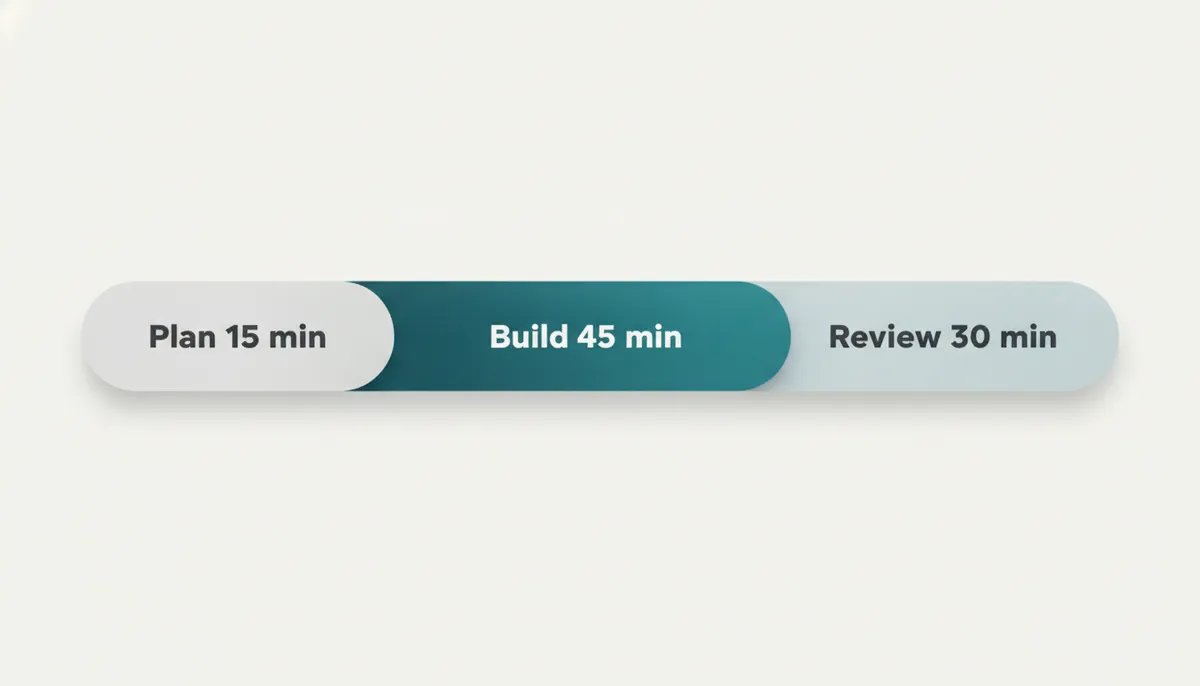
A practical time structure for the available window
Do not spend the opening stretch trying to foresee every extension. The safest approach is to earn a working baseline early, then improve it.
Use percentages rather than a fixed minute-by-minute schedule until the recruiter confirms the time limit.
| Share of time | Focus | Output before moving on |
|---|---|---|
| First 15% | Clarify and scope | Core use cases, assumptions and non-goals |
| Next 15% | Sketch the model | Entities, responsibilities and key interactions |
| Next 40% | Build the core | A runnable happy path with essential validation |
| Next 15% | Test and repair | Edge cases, state errors and broken flows |
| Final 15% | Explain and extend | Trade-offs, limitations and one sensible extension |
First: clarify only what changes the design
Ask about identity, ownership, ordering, capacity, concurrency, cancellation, invalid inputs and persistence only when they materially affect the model. Avoid turning clarification into an interrogation.
For example, if a task involves allocating a resource, useful questions might include:
- Can the same resource be allocated twice?
- Can an allocation be cancelled?
- Is ordering important?
- Are we modelling one location or many?
- Should invalid operations return an error or be ignored?
Then state your assumptions. Interviewers can work with a reasonable assumption; they cannot easily assess code built silently around an unknown one.
Next: draw the smallest meaningful model
Identify nouns first, then verbs. Nouns often become entities or value objects. Verbs often reveal service methods or domain behaviour. Keep orchestration separate from the object that owns the rules.
A good initial sketch might include:
- domain objects that hold state;
- a service that coordinates the workflow;
- a repository-like in-memory component only if lookup or storage needs separation;
- a driver or test harness that proves the flow.
Do not write every method before coding. The sketch should guide implementation, not become a miniature specification document.
Then: build the happy path
Your first executable version should support the main action from input to result. Compile and run it early. A candidate who discovers a broken object relationship halfway through the assessment has time to fix it only if they tested before the final minutes.
Use the final section to add validation, handle the most relevant edge cases and explain extensions verbally. A clean explanation of what you deliberately left out is stronger than rushed, unfinished code.
Failure modes that sink otherwise capable candidates
Building an elegant design that never runs
This is the central failure mode. Candidates spend too long naming classes and debating abstractions, then reach the end with disconnected code. A machine-coding task is an implementation round first. Get the main flow running before improving architecture.
Treating assumptions as invisible
An under-specified prompt is not a licence to make silent decisions. If your design assumes a single user, a single city, no cancellation or unlimited capacity, say so. Otherwise the interviewer cannot distinguish a considered boundary from an overlooked requirement.
Making one class do everything
A large controller object that validates input, stores data, applies business rules and prints output is quick to begin and painful to extend. Split responsibilities when the split clarifies ownership. You do not need many classes; you need the right boundaries.
Adding patterns by name rather than need
A strategy interface with one implementation does not demonstrate sophistication. Neither does a factory that creates one object type. Explain the variation you anticipate before introducing an abstraction to manage it.
Ignoring unhappy paths
You do not need to implement every rare scenario, but you should cover failures that threaten correctness: duplicate actions, invalid state changes, missing entities and capacity limits. Mention anything you have consciously excluded.
Going silent while coding
Narrate the decision points: why a collection was chosen, why validation belongs in an entity, what trade-off you are making, and what you would revisit with more time. This is especially important when you simplify the design.
For rehearsing that narration, AI mock interviews can help you practise explaining decisions under follow-up questions. The goal is not a polished speech. It is clear, calm engineering judgement.
A two-week practice plan
This plan assumes focused daily practice. Adapt the session length to your schedule, but keep the sequence: untimed understanding first, timed execution second.
Week one: build reliable design habits
Day one — model before code. Take a small workflow and list entities, operations, invariants and assumptions. Do not code until you can explain who owns each rule.
Day two — focused classes. Implement a compact system with separate domain objects and an orchestration layer. Review every method: does it belong where it lives?
Day three — state changes. Practise modelling transitions such as create, update, cancel, allocate or release. Add guards that prevent invalid changes.
Day four — collections and lookups. Build an in-memory repository or catalogue. Focus on identifiers, duplicate handling and clear error paths.
Day five — extension exercise. Start with a minimal solution, then add one new requirement after the fact. Notice where your original design resists change.
Day six — read and compare. Attempt one of the problems in Gojek’s interview kit, then compare your model with the editorial. Write down one design decision you would retain and one you would change.
Day seven — explain aloud. Redo a familiar problem without rushing. Talk through assumptions, boundaries and trade-offs as though an interviewer is listening.
Week two: practise under realistic pressure
Day eight — timed core flow. Use a timer and aim to produce running code before the halfway point.
Day nine — timed edge cases. Repeat with deliberate attention to duplicate actions, invalid inputs and state consistency.
Day ten — refactoring drill. Begin with straightforward code, then improve one responsibility boundary without changing behaviour.
Day eleven — unfamiliar prompt. Choose a problem you have not seen. Spend the opening section of the timer clarifying and sketching, then commit.
Day twelve — communication rehearsal. Practise narrating every decision point. Ask a friend to interrupt with “why?” and “what if this changes?”
Day thirteen — full simulation. Run one complete mock: clarification, design, implementation, tests and extension discussion. Avoid external help.
Day fourteen — review, not volume. Revisit mistakes from the previous sessions. Make a personal checklist of recurring issues: late testing, unclear assumptions, giant classes or unnecessary abstractions.
Keep algorithmic skills active too. The DSA Patterns Sheet is free to browse, and how to identify the right DSA pattern in a coding interview can help keep your problem-recognition habits sharp without taking attention away from design practice.
Frequently asked questions
What is the Gojek machine coding round?
It is a machine-coding and low-level design preparation focus: taking a small, under-specified problem, designing a model and producing working code within a time box. Confirm the exact format with your recruiter.
How long is the Gojek machine coding round?
A reliable company-wide time limit is not established in public reports. Ask your recruiter about the duration, platform, tools and whether the task is live or take-home.
What should I build first?
Build the main user flow first. Your program should demonstrate the core action working before you invest in refinements, rare edge cases or elaborate abstractions.
Should I use design patterns?
Use a pattern when it handles a real variation or separates a responsibility cleanly. Do not introduce one merely to show that you know its name.
How much code is expected?
Enough code to demonstrate the important workflow, validation and basic behaviour. A small executable solution with clear boundaries is stronger than a large unfinished codebase.
Should I use a framework or database?
Only if the prompt requires it. For many interview exercises, in-memory state and a simple driver are sufficient and let you focus on the design being assessed.
What language should I choose?
Choose the language in which you can work most fluently and test quickly. Familiarity with collections, object modelling and debugging matters more than language fashion.
How do I handle unclear requirements?
Ask concise questions that affect the model, then state assumptions and proceed. Do not wait for a complete specification; the ability to work through ambiguity is part of the evaluation.
What is the biggest mistake to avoid?
Finishing without a runnable core flow. Time-box design discussion, compile early and leave time to test.
Start with a runnable baseline
The best preparation for the Gojek machine coding round is repeated practice at turning a vague prompt into a small working system. Clarify the core rules, model only what is needed, get the happy path running, then improve the design with the time that remains.
Open Gojek’s interview kit to work through the four low-level design problems evidenced at Gojek. Pair that practice with the free-to-browse Low Level Design Sheet, and use AI mock interviews to rehearse the explanation and follow-up discussion that turns code into a convincing interview performance.
Topics
Related on Thita
Your next step
Practise with AI mock interviews
A spoken interview that asks follow-up questions, runs your code and ends with a written report.