
Interview
Goldman Sachs Interview Questions and Process: The Complete Guide (2026)
Goldman Sachs interview questions and process explained: OA, CoderPad, Superday, team-fit and MD rounds, plus a practical 30-day preparation plan.
Goldman Sachs interview questions typically appear across an online assessment or HireVue, a CoderPad technical screen, a Superday with coding, system-design, SDLC and behavioural conversations, then team-fit and Managing Director discussions. Reported accounts describe a loop that tests more than algorithmic speed: candidates need to explain technical decisions, connect their experience to engineering delivery, and show credible seniority in later conversations. For targeted coding practice, Goldman Sachs's interview kit holds 45 mapped DSA questions and 3 low-level design problems evidenced at the company.
This guide covers the complete reported process, what each stage is trying to learn, how difficult the loop feels in practice, and how to prepare over 30 days without treating every round as the same kind of interview.
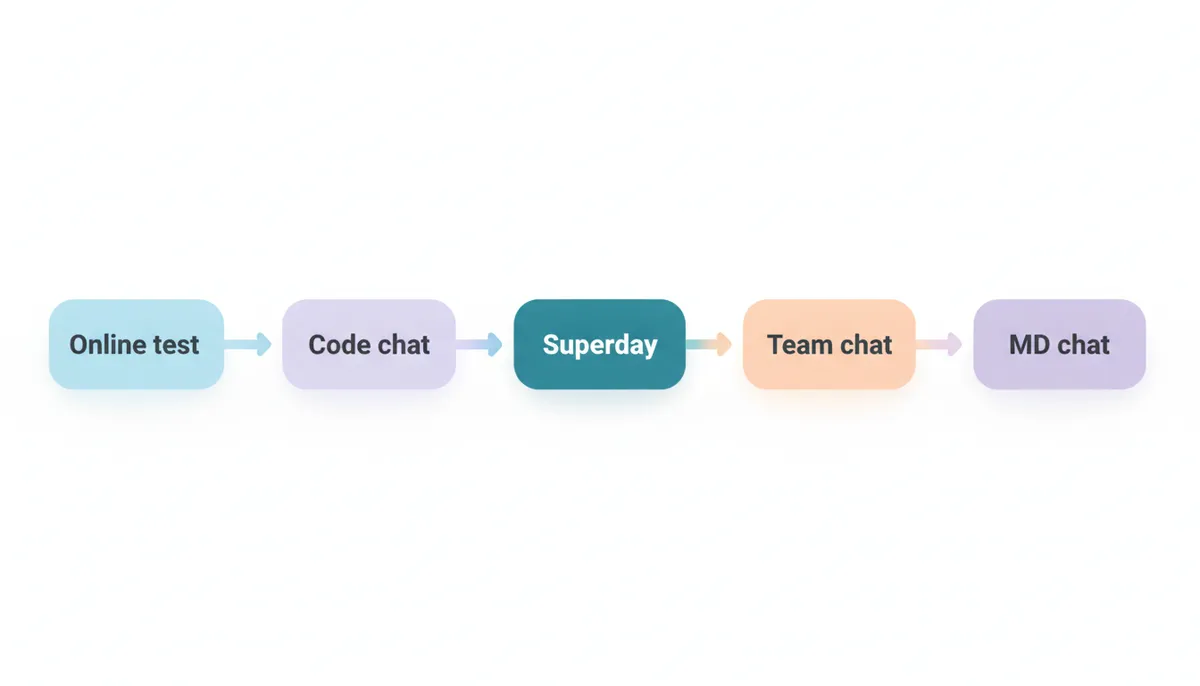
The Goldman Sachs interview process at a glance
| Stage | Common format | What it screens for |
|---|---|---|
| Online assessment or HireVue | Initial assessment before live technical interviews | Baseline coding ability, communication and readiness |
| CoderPad technical screen | Live coding conversation | Problem solving, code clarity and reasoning aloud |
| Superday | Three to five interviews | DSA, system design, SDLC knowledge and behavioural judgement |
| Team-fit discussion | Conversation with the prospective organisation | Collaboration style, interests and role alignment |
| Managing Director round | Final senior-stakeholder discussion | Career maturity, seniority signal and overall fit |
Reported accounts describe this as the usual shape rather than a fixed policy. The sequence, number of Superday interviews and emphasis by level can vary with the team, location and role. Confirm the exact schedule with your recruiter before building a calendar around it.
The key preparation mistake is assuming that every technical stage is a LeetCode-style test. Coding matters throughout the process, but Superday also introduces system-design and SDLC/process questions. The later discussions then test whether your experience supports the level you are pursuing.
Round 1 — online assessment or HireVue
Goldman Sachs candidates commonly report either a HackerRank online assessment or HireVue at the start of the process. These are different formats, but they serve a similar purpose: they help the company assess whether to invest in a longer technical loop. For campus Engineering roles, Goldman Sachs's own HackerRank guide lists a 30-minute Software Fundamentals challenge for everyone, a 45-minute Software Diagnostics challenge for Engineering roles, and a 22-minute math challenge for Quantitative Strategist roles. See our Goldman Sachs HackerRank guide for prep by section.
Where the first step is coding-led, prepare for standard data-structures-and-algorithms work under time pressure. You need a reliable way to move from an unfamiliar prompt to a correct solution, explain complexity and test edge cases before submission. Use the DSA Patterns Sheet, which is free to browse, to organise practice around recurring problem shapes rather than an unstructured list of questions.
Recognition speed is valuable here. Arrays, strings, hash maps, trees, graphs, searching and dynamic programming are broad foundations worth revisiting, but the important habit is naming the approach before implementing it. If a problem is really a sliding-window or graph-traversal problem, recognising that early saves time and reduces avoidable rewrites.
For a framework for this decision, read how to identify the right DSA pattern in a coding interview.
💡 Pro Tip: Treat the first few minutes as planning time, not dead time. Restate the input, clarify assumptions, identify constraints, then choose the simplest approach that fits them.
Round 2 — the CoderPad technical screen
The CoderPad screen is where a submitted solution becomes an observed working session. Reported accounts describe a technical conversation centred on coding, with the interviewer able to see not just the result but your process.
This round screens for four things:
- Can you break down a problem before reaching for code?
- Can you communicate an approach clearly enough for someone else to follow?
- Can you produce readable, correct implementation?
- Can you respond constructively when the interviewer changes a constraint or asks a follow-up?
A candidate who quietly writes a correct answer gives away useful evidence. Speak through your initial approach, say what time and space complexity you expect, and narrate the test cases you are using to validate the code. This is not performance for its own sake; it lets the interviewer assess your engineering judgement.
Practise the mechanics in an environment where you have to write and run the code yourself. Code Practice is free to browse and is useful for rehearsing implementation, debugging and explanation in the same sitting. For a deeper look at the live format, see what interviewers actually look for in live coding rounds.
✅ Do: Explain the brute-force option briefly, then explain why you are choosing a better approach.
❌ Don't: Jump directly into code and wait until the end to explain what you built.
Round 3 — Superday technical interviews
Superday is the centre of the Goldman Sachs process. Reported accounts commonly describe three to five interviews grouped together, covering DSA, system design, SDLC or engineering-process questions, and behavioural discussion.
That mix matters. A candidate can be strong in coding and still underperform by treating design or delivery questions as an afterthought.
Coding within Superday
The coding interview continues to assess core problem-solving ability, but it often has less room for silent trial and error than an online assessment. The interviewer is looking for a disciplined sequence: clarify, propose, compare options, implement, test and discuss trade-offs.
Use Goldman Sachs's interview kit to practise the 45 mapped DSA questions in a company-focused set. Do not simply read solutions. Before opening an editorial, write down the pattern you think applies, the data structure you would use and the edge cases most likely to break your first implementation.
System design and low-level design
Goldman Sachs Superday accounts also describe an explicit system-design interview. At more experienced levels, expect to discuss how a service should behave under real engineering constraints: interfaces, data flow, reliability, scaling choices, failure cases and operational trade-offs.
The useful preparation question is not “Which architecture diagram should I memorise?” It is “Can I make and defend a sequence of sensible decisions when requirements are incomplete?”
Start by practising structured design conversations:
- Clarify users, core actions and boundaries.
- Identify the main data and interactions.
- State the first workable design.
- Surface likely bottlenecks or failure modes.
- Improve the design in response to scale or reliability requirements.
The System Design Sheet is free to browse for broad architecture practice, while the Low Level Design Sheet is free to browse for class-level design work. The 3 low-level design problems evidenced at Goldman Sachs are best used to practise how you justify boundaries, responsibilities and extension points rather than memorising a particular implementation.
For context on what changes between design levels, read low-level design vs high-level design: what interviews actually expect.
SDLC and process questions
SDLC questions distinguish a candidate who can solve an isolated problem from one who can help ship and maintain software. Be ready to discuss how you approach code review, testing, deployments, incidents, requirements changes, quality trade-offs and collaboration across functions.
These questions are not invitations to recite a textbook lifecycle. They are opportunities to show that you understand engineering as a sequence of decisions with consequences. Use examples from your own work: a release that needed safeguards, a bug that changed your test strategy, or a technical decision that required alignment with other people.
If fundamentals feel rusty, the Operating Systems Sheet is free to browse. Focus on explaining concepts in practical terms: what happens, why it matters, and what trade-off it creates for the system you are describing.
Round 4 — team-fit conversations
After Superday, reported accounts describe team-fit conversations that help establish where you could work and whether the role matches your experience. This is not merely a casual chat. It is where technical capability meets working style, domain interest and expectations for the role.
Prepare a concise account of what you want to work on and why. You do not need to claim lifelong expertise in financial services. You do need to show that you have thought about the environment: engineering systems where reliability, controls, data handling and careful delivery matter.
Also prepare project stories with clear personal ownership. For each story, be able to answer:
- What was the problem and why did it matter?
- What did you personally decide or deliver?
- What trade-off did you make?
- What went wrong or changed?
- What would you do differently now?
Avoid hiding behind “we”. Teamwork matters, but interviewers need to understand your individual contribution.
Round 5 — the Managing Director round
The Managing Director, or MD, round is Goldman Sachs-specific in the reported interview process and adds a final career and seniority layer beyond the technical Superday. It is the named ritual candidates should prepare for separately.
An MD is unlikely to be interested in a rehearsed catalogue of generic strengths. The conversation is more likely to assess whether your trajectory, judgement and communication fit the level and organisation. Expect questions about your motivations, difficult decisions, leadership without authority, professional standards and the kind of work you want to own.
The best preparation is evidence, not slogans. Build several stories that show how you handled ambiguity, influenced a decision, learned from a failure, improved a process or took responsibility when outcomes were uncertain. Keep each story specific enough to withstand follow-up questions.
Use AI Interview to rehearse behavioural answers aloud. The goal is not to memorise a script; it is to become comfortable giving direct, structured answers under scrutiny.
Is the Goldman Sachs interview hard?
Yes — chiefly because it is broad.
The technical bar includes coding, design and SDLC/process reasoning, while the later team-fit and MD conversations introduce a separate test of communication and career maturity. Candidates who prepare exclusively for DSA questions can be caught off guard by the need to discuss systems, delivery practices and their own project decisions in depth.
How many rounds are there? The reported process includes an initial assessment, a CoderPad screen, a Superday containing three to five interviews, then team-fit and MD discussions. The exact total is not fixed because stages can be combined, adapted or varied by role.
How long does it take? The research does not establish one reliable end-to-end timeline. Scheduling depends on the team and hiring process, so ask your recruiter when Superday, team matching and final decisions are likely to occur.
The practical takeaway is simple: prepare for the loop as a mixed evaluation. Coding fluency gets you through the technical conversation; clear judgement and credible experience help you convert the later stages.
A 30-day Goldman Sachs preparation plan
Days 1–7 — rebuild coding foundations
Work through core DSA patterns daily. Alternate between recognising the pattern and implementing it under a timer. After each problem, explain your solution aloud as if an interviewer had asked why it works.
Prioritise clean fundamentals over obscure techniques. Review arrays, strings, hash maps, trees, graphs, binary search and dynamic programming according to your weaker areas. Graph traversal patterns: DFS and BFS is useful if graph questions are a weak point.
Days 8–14 — practise live coding behaviour
Move from solving alone to simulating a CoderPad conversation. Begin each session by clarifying the problem, describing a naive option, selecting an approach and stating complexity before you type.
Use at least part of each session for review. Read your code as an interviewer would: are names clear, are edge cases handled, and does the implementation match the algorithm you described?
Days 15–21 — add design and SDLC preparation
Practise talking through a system from requirements to trade-offs. Keep the first version simple, then add detail when the requirement justifies it. Rehearse low-level design by identifying entities, responsibilities and changes that might force your design to evolve.
Study practical SDLC topics alongside design: testing strategy, deployment safety, monitoring, incident response and code review. These are easier to discuss convincingly when connected to real examples from your own work.
Days 22–30 — Superday and MD rehearsal
Create mixed mock sessions: one coding conversation, one design discussion, one SDLC deep dive and one behavioural interview. Review your project stories until you can describe personal ownership without drifting into vague team language.
Return to Goldman Sachs's interview kit for timed practice across the 45 mapped DSA questions and 3 low-level design problems evidenced at the company. Finish each practice session by writing down one improvement for your reasoning, communication or code quality.
💡 Pro Tip: In the final week, do not maximise volume. Rehearse transitions: moving from coding to explanation, from a system diagram to a trade-off, and from a project summary to your personal contribution.
What makes Goldman Sachs interviews distinctive?
The Goldman Sachs loop is distinctive because Superday does not end the evaluation. Reported accounts describe both team-fit discussions and a Managing Director round after the concentrated technical interviews.
That structure changes how you should prepare. At companies where the final decision is largely the aggregation of technical interviews, candidates can focus heavily on coding and design performance. Here, technical preparation still matters, but it must be paired with a coherent professional narrative: why this role, what level of ownership you have demonstrated, how you make decisions, and how you communicate with stakeholders beyond your immediate engineering team.
The MD round should not be treated as a final formality. It is the point where your technical performance, project history and judgement need to form a consistent picture.
Frequently asked questions
What are the main Goldman Sachs interview questions?
Reported Goldman Sachs interviews include DSA coding questions, system-design discussion, SDLC and engineering-process questions, plus behavioural and project-depth questions.
Does Goldman Sachs use an online assessment?
Yes, for many roles. Campus Engineering candidates take a HackerRank assessment (30-minute Software Fundamentals, plus a 45-minute Software Diagnostics challenge for Engineering roles), per Goldman's own guide. Some candidates report HireVue at this stage instead.
What is the Goldman Sachs CoderPad interview?
It is a live technical screen where you solve and explain coding problems with an interviewer. Communication, complexity reasoning and code clarity matter alongside correctness.
What happens during Goldman Sachs Superday?
Superday commonly contains three to five interviews covering a mix of coding, system design, SDLC/process topics and behavioural assessment.
Does Goldman Sachs ask system-design questions?
Yes. Reported accounts describe an explicit system-design round within Superday, particularly relevant to experienced engineering candidates.
What is the Goldman Sachs MD round?
The Managing Director round is a final senior-stakeholder conversation that assesses career maturity, communication, judgement and fit for the role and level.
How should I prepare for Goldman Sachs coding rounds?
Practise common DSA patterns, explain your reasoning aloud, state complexity before coding and test edge cases methodically. Timed live-style practice is more useful than passive solution reading.
How many rounds does Goldman Sachs have?
The reported sequence includes an assessment, CoderPad screen, three to five Superday interviews, team-fit discussions and an MD round. Exact round counts vary.
How should I prepare for the behavioural rounds?
Prepare specific stories about ownership, setbacks, trade-offs, collaboration and impact. Focus on what you personally did, not only what your team achieved.
Where to start
Start with the technical fundamentals, then make your preparation look like the actual loop: coding explanation, design trade-offs, SDLC discussion and behavioural answers. A strong solution is necessary, but it is not enough if you cannot explain the judgement behind it.
Open Goldman Sachs's interview kit to practise the 45 mapped DSA questions and 3 low-level design problems evidenced at Goldman Sachs. Then use AI Interview to rehearse the technical and behavioural conversations that sit around the coding work.
Interview processes change by team and level, so use this guide as the reported shape of the loop and confirm your own schedule with the recruiter.
Topics
Related on Thita
Your next step
Practise with AI mock interviews
A spoken interview that asks follow-up questions, runs your code and ends with a written report.