
Interview
Goldman Sachs Machine Coding Round: Preparation Guide
Prepare for the Goldman Sachs machine coding round with a practical rubric, timed plan, common mistakes, two-week schedule and focused LLD practice.
The Goldman Sachs machine coding round is best prepared for as a practical design exercise: take an incomplete requirement, turn it into a small working program, explain the choices you made, and show that the design can absorb change.
Reported accounts describe a Goldman Sachs process with an online assessment or HireVue stage, a CoderPad technical screen, then a Superday containing several conversations across DSA, system design, SDLC and behavioural assessment. A distinct machine-coding round is not consistently named in those accounts, so treat practical coding and low-level design as preparation for the design-oriented technical discussion rather than as a guaranteed standalone stage. For the wider technical preparation hub, start with Goldman Sachs's interview kit, which holds 45 mapped DSA questions and three low-level design problems.
This guide stays focused on the practical coding and low-level design skills that can strengthen your Superday performance. For the broader interview process, use the Goldman Sachs kit as your starting point rather than treating this article as a description of every stage.
Where practical design sits in the Goldman Sachs process
The reported sequence places technical evaluation before and during Superday:
| Stage | Commonly reported format | Why it matters for practical design preparation |
|---|---|---|
| Online assessment or HireVue | Initial screening | Establishes a baseline before live technical assessment |
| CoderPad technical screen | Live coding and discussion | Tests whether you can reason clearly while writing code |
| Superday | Several rounds covering DSA, system design, SDLC and behavioural topics | Design judgement, engineering process and communication can all surface here |
| Team-fit and MD discussion | Career, role and seniority signals | Tests how you explain experience, decisions and working style |
The important implication is that you should not prepare for Goldman Sachs as though every technical conversation is a LeetCode exercise. DSA still matters, particularly for the initial screen and coding discussion. But candidates also need to show that they can shape maintainable software, make sensible assumptions, and discuss delivery decisions.
For DSA recognition speed, the DSA Patterns Sheet is free to browse. For practical class design and object-oriented exercises, the Low Level Design Sheet is also free to browse.
What format should you expect?
Because reported accounts do not establish a fixed, separate Goldman Sachs machine-coding time limit, avoid preparing around a single assumed duration. Confirm the exact format with your recruiter when you are invited to interview.
A practical coding or design-oriented technical exercise commonly has this shape:
- You receive a short problem statement with deliberately incomplete details.
- You clarify the core flows and assumptions before writing much code.
- You model entities, state and responsibilities.
- You implement the smallest useful version first.
- You walk the interviewer through trade-offs, edge cases and likely extensions.
- You discuss how the code would change if requirements grew.
That differs from pure low-level design on a whiteboard. In a code-first exercise, an interviewer can assess your naming, boundaries, error handling, testability and ability to finish. In a discussion-led design exercise, the code may be secondary, but the same judgement is still visible in your interfaces and trade-offs.
The most useful mindset is: build for the present requirement, leave clear seams for the next one. Do not try to create a framework for every possible future. Do not hard-code a design that collapses as soon as the interviewer adds one realistic variation.
For a concise explanation of the distinction between class-level and architecture-level design, read low-level design vs high-level design: what interviews actually expect.
What graders are likely to reward
The exact scorecard is not published, but practical coding and design interviewers generally reward visible engineering judgement more than decorative complexity. In rough order of weight, focus on the following.
1. A correct core flow
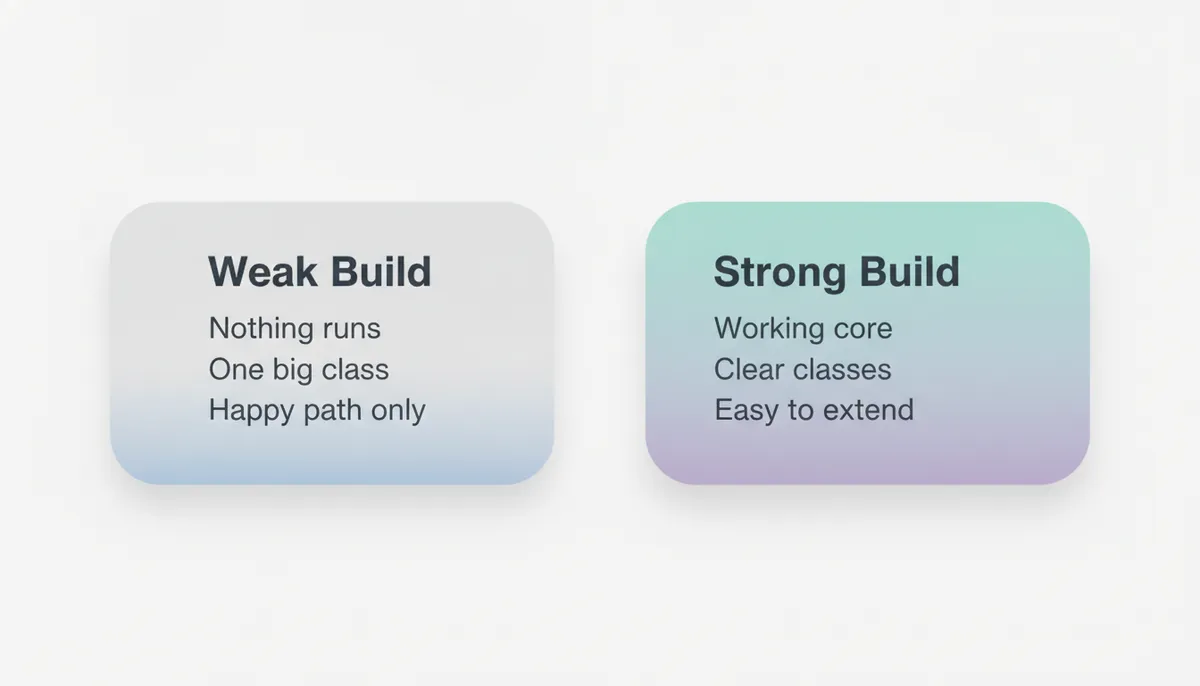
Can the program perform the main task end to end? A simple working solution is the foundation for everything else. If a prompt involves creating, updating and retrieving an object, those operations should work before you introduce advanced patterns.
A candidate who finishes a small, coherent solution has something concrete to explain and improve. A candidate with an ambitious but incomplete hierarchy leaves the interviewer guessing.
2. Clear responsibilities
Can you explain why each class, module or function exists? Good designs make responsibilities easy to locate:
- domain objects hold domain state;
- services coordinate business actions;
- repositories or stores own persistence concerns;
- interfaces appear where behaviour may genuinely differ.
This is not about memorising the “right” pattern. It is about ensuring that a change has an obvious home.
3. Requirements handling and sensible assumptions
Under-specified prompts reward candidates who ask useful questions. Before coding, clarify the happy path, rules that cannot be violated, expected inputs, and what is deliberately out of scope.
If time is limited, state an assumption clearly and proceed. For example: “I will keep data in memory for this exercise, but I will isolate storage behind an interface so the core logic does not depend on that choice.” That shows movement without pretending the ambiguity does not exist.
4. Extensibility without overengineering
Interviewers often add a requirement after you have described a baseline. They may ask what happens when there are multiple strategies, new user types, additional states or another notification channel.
The strongest answer is usually an incremental change. Add an interface because several behaviours now vary. Add a policy object because rules are growing. Do not introduce factories, observers and abstract base classes before the problem gives them a job.
5. Readable implementation
Readable code signals professional habits. Use names that reveal intent, keep methods focused, avoid duplicated business rules, and separate setup code from domain logic. You do not need a production repository structure; you do need code that another engineer can follow quickly.
The practical mechanics of narrating decisions are covered in how to explain your thought process clearly in coding interviews.
6. Verification and communication
A short driver program, a few targeted tests, or a narrated walkthrough of important cases can materially improve an otherwise ordinary solution. It demonstrates that you do not assume code works because it compiles.
Talk while you work. Explain the problem back, identify the first version, announce changes in direction, and mention trade-offs. Interviewers cannot award credit for reasoning they never hear.
How to structure the available time
Use proportions rather than a rigid minute-by-minute script. The actual slot can vary, but the sequence should remain stable.
| Portion of the session | Your objective | What to say or do |
|---|---|---|
| Opening | Clarify the target | Repeat the core flow, ask about rules and state assumptions |
| Early build | Deliver the smallest working path | Create the key entities and implement the happy path |
| Middle | Strengthen boundaries | Separate responsibilities, handle important edge cases |
| Final build | Verify behaviour | Run a driver or tests and fix obvious defects |
| Closing discussion | Show judgement | Explain trade-offs, next extensions and what you would improve |
The trap is spending too much of the opening designing. A brief plan is valuable; a long architecture monologue is not. Write enough structure to make the first implementation safe, then get the code moving.
A useful personal rule is this: by the middle of the exercise, you should have a demonstrable core flow. If you cannot run or trace anything by then, reduce scope. Cut optional features before you cut correctness.
Practise this approach with Goldman Sachs's interview kit, then repeat the same problem later under a timer. The aim is not to memorise a solution. It is to make prioritisation automatic.
Failure modes that cost otherwise strong candidates
Starting with patterns instead of requirements
Candidates sometimes hear “low-level design” and immediately reach for Strategy, Factory, Observer or a large inheritance tree. That is backwards. Start with the user action and business rule. Introduce a pattern only when the requirement creates variation it can manage.
Building abstractions with no changing behaviour
An interface with one implementation is not automatically bad, but it needs a reason. If you cannot name the likely variation or testing boundary it enables, it may be ceremony rather than design.
Solving an unasked problem
Adding authentication, databases, concurrency, caching and distributed messaging to a small in-memory exercise is usually a poor trade. Mention such considerations in the closing discussion if relevant, but do not let them prevent the core flow from working.
Leaving the happy path unfinished
A half-complete “scalable” system is weaker than a modest system that works. Deliver the main scenario first. Then add validation, alternative flows and extension points according to the time left.
Writing silently
Live interview performance is not judged only through the final code. Silence hides your ability to clarify, prioritise and recover. If you discover a flaw, say so and correct it. That is often evidence of sound engineering judgement, not a failure.
Ignoring SDLC questions
Reported Goldman Sachs Superdays include SDLC and process questions alongside technical topics. Be ready to discuss testing, code review, incident learning, deployment safety and how you make trade-offs with a team. A well-designed class diagram is stronger when you can explain how it would be shipped and maintained.
For more on the live-coding behaviours interviewers can observe, see what interviewers actually look for in live coding interviews.
A two-week practical coding plan
Week one: build the design habit
First half of the week — model before coding. Choose small domains such as bookings, inventory, payments or task management. Spend a short period writing assumptions, entities and core methods before implementation. The goal is to distinguish essential objects from imagined ones.
Second half of the week — finish complete solutions. Implement end-to-end versions of design problems. Include a driver or tests for the main flow. Afterwards, ask yourself: where would a new requirement enter, and would the change be local or scattered?
Use the Code Practice workspace for implementation repetition. The Operating Systems Sheet and DBMS Sheet are free to browse if you need to refresh the fundamentals that can surface in SDLC-oriented discussion.
Week two: simulate the interview
First half of the week — work under constraints. Alternate between fresh prompts and previously attempted ones. On fresh prompts, prioritise communication and a working core. On repeats, focus on improving the design without making it ornate.
Second half of the week — rehearse explanation. Complete practical coding exercises, then spend time explaining your solution aloud: requirements, assumptions, data model, complexity where relevant, testing approach and extension choices. Record yourself or use an AI interview to practise technical and behavioural discussion.
Keep DSA active throughout both weeks. Goldman Sachs candidates should be able to move between algorithmic problem solving and practical engineering judgement without treating them as unrelated skills.
Frequently asked questions
Is there a separate Goldman Sachs machine coding round?
Reported accounts consistently describe a CoderPad screen and Superday technical discussions covering DSA, system design and SDLC. They do not consistently identify a separate machine-coding round, so confirm the interview format with your recruiter.
Where does practical design appear in the process?
It is most relevant to the live technical screen and the design or SDLC-oriented discussions reported within Superday. The precise division of topics can vary by role and team.
How long is the Goldman Sachs machine coding round?
A fixed standalone time limit is not established in the reported accounts used here. Ask your recruiter for the format, tools and duration for your specific interview.
Should I prioritise DSA or low-level design?
Prepare both. Reported Goldman Sachs Superdays include DSA and explicit system-design discussion, while practical coding preparation improves your ability to demonstrate implementation and design judgement.
What should I build in a practical coding exercise?
Build the smallest complete version of the main user flow. Model the important entities, enforce core rules, and demonstrate the result before adding optional features.
Which language should I use?
Use the language in which you can write clean, idiomatic code and explain decisions confidently. Fluency, testing ability and speed of implementation matter more than chasing a fashionable language.
How much object-oriented design knowledge is enough?
Know how to assign responsibilities, use composition sensibly, identify changing behaviour and keep dependencies manageable. You do not need to force every named design pattern into a solution.
How should I prepare for SDLC questions?
Prepare examples from your work involving testing, review, deployment, debugging, reliability and trade-offs. Explain what you personally decided, what changed after feedback, and what you learned.
Do behavioural answers matter for Goldman Sachs?
Yes. Reported Superday formats include behavioural discussion, and later team-fit and MD conversations add career and seniority signals. Prepare clear examples of ownership, collaboration and judgement.
Start with a complete practical loop
The best preparation for the Goldman Sachs machine coding round is not a library of class diagrams. It is repeated practice at turning a brief, imperfect prompt into working code while explaining every important decision.
Open Goldman Sachs's interview kit to work through the 45 mapped DSA questions and three low-level design problems. Combine that with the free-to-browse design and fundamentals sheets, then use an AI interview to rehearse the technical explanation and behavioural conversation that surround the code.
Confirm the exact round structure, tools and timing with your recruiter. Then practise the one habit that transfers across every format: deliver a working core early, and make your reasoning easy to assess.
Topics
Related on Thita
Your next step
Practise with AI mock interviews
A spoken interview that asks follow-up questions, runs your code and ends with a written report.