
Interview
Google Interview Questions and Process: The Complete Guide (2026)
Google interview questions explained: every round, the Hiring Committee, difficulty, timeline, and a practical 30-day preparation plan for software engineers.
Google interview questions are still primarily a test of structured problem solving: reported accounts describe coding rounds that reward clear reasoning, sound complexity analysis and reliable implementation under time pressure. For experienced engineers, system design and Googleyness also matter, while a separate Hiring Committee reviews the interview packet before making the final decision. To practise the technical material, Google's interview kit holds 188 mapped DSA questions, 11 low-level design problems and 8 system design problems evidenced at Google.
This guide covers the reported loop in order, what each stage is trying to establish, how difficult the process tends to feel, and a practical month-long plan.
The Google interview process at a glance
| Stage | Format | What it screens for |
|---|---|---|
| Resume screen | Recruiter review | Relevant experience and role fit |
| Online assessment | Commonly reported for L3 and new-grad roles | Timed coding fundamentals |
| Technical phone screen | Live coding discussion | Communication, problem solving and code quality |
| Onsite coding | Two to three coding rounds | DSA fluency and reasoning under pressure |
| System design | Commonly reported from L4, consistent from L5 | Scalable technical judgement |
| Googleyness | Dedicated discussion round | Collaboration, leadership and judgement |
| Hiring Committee | Independent packet review | Consistent hiring standard |
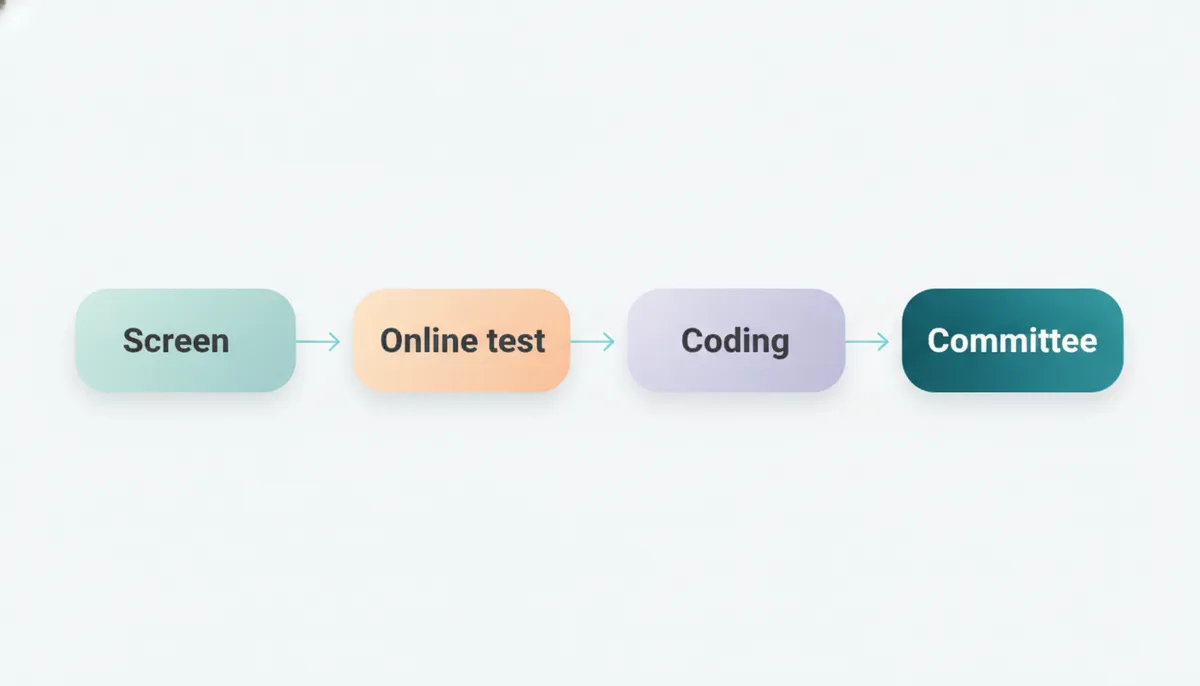
Reported accounts describe variation by level, team, location and hiring need. Treat this as the common shape of the loop rather than a fixed policy, and confirm your own process with the recruiter.
Resume screen — relevance before the loop begins
The resume screen is not a technical round, but it determines whether the rest of the process starts. Recruiters are generally looking for evidence that your experience maps to the role: production ownership, technical depth, measurable impact and a progression that makes sense for the level.
This is also where candidates often understate work that later becomes valuable in Googleyness and system-design conversations. A bullet saying “improved service performance” is weaker than one that makes the scope clear: what you changed, why it mattered, what constraints you worked within and what happened afterwards.
Before applying, prepare concise explanations for your two strongest projects. You will use them repeatedly later in the loop.
Online assessment — a level-dependent coding filter
An online assessment is commonly reported for L3 and new-grad candidates, while reports say it is often skipped for L4 and above. Where it appears, its job is straightforward: establish a baseline of timed coding ability before investing interviewer time.
Expect familiar data-structure and algorithm shapes rather than a test of obscure tricks. The useful preparation is not trying to memorise individual prompts. It is becoming faster at recognising the underlying pattern, stating the appropriate complexity and implementing without avoidable bugs.
The DSA Patterns Sheet is free to browse and groups practice by recurring problem shape. If pattern recognition feels inconsistent, start with how to identify the right DSA pattern in a coding interview.
💡 Pro Tip: Use a timer before interview week. A correct solution that arrives too late to test edge cases is not a reliable assessment strategy.
Technical phone screen — can you think aloud?
The technical phone screen is commonly reported as a live coding conversation. It examines the same fundamentals as an assessment, but the visible part of your process now matters as much as the final code.
A strong answer usually has a clear sequence:
- Restate the problem and clarify assumptions.
- Describe a simple approach before jumping to an improved one.
- Explain the chosen data structures and time complexity.
- Write readable code while narrating decisions.
- Test normal, boundary and failure cases aloud.
Google interview questions often feel harder when candidates work silently. The interviewer cannot give credit for reasoning they cannot see, and silence makes it difficult to distinguish deliberate thinking from being stuck. Read what interviewers actually look for in live coding rounds before practising your next mock.
✅ Do: Say what you are testing and why.
❌ Don’t: Treat a hint as a failure. Incorporate it calmly, then explain the revised approach.
Onsite coding rounds — the technical core
Reported Google loops commonly include two or three onsite coding rounds of roughly forty-five minutes each. This is the technical centre of the process and the part that makes Google feel DSA-heavy.
The screen is not merely whether you can reach an answer. Interviewers are commonly reported to assess whether you can move from a brute-force idea to a more efficient approach, reason about trade-offs, produce correct code, and recover cleanly if your first path is imperfect.
Practise a repeatable live-round routine:
- Spend the opening minutes clarifying input, output and constraints.
- State a baseline approach so the optimisation has context.
- Name the invariant or key observation behind the better solution.
- Keep implementation simple enough to explain.
- Reserve time for tracing examples and edge cases.
For targeted technical practice, Google's interview kit lets you work through the mapped DSA set by pattern and review the reasoning after each attempt. Use in-browser code practice to rehearse implementation and feedback loops without changing tools.
System design — scaling your reasoning for the level
System design is reported from L4 upwards and consistently present from L5. This round is less about arriving at one canonical diagram than demonstrating how you make technical decisions when requirements are incomplete.
A productive answer begins by narrowing the problem. Ask about scale, read and write patterns, latency expectations, consistency needs, failure tolerance and the most important user journeys. Then propose a simple end-to-end design before going deep on storage, APIs, caching, partitioning, queues or observability.
The interviewer is looking for judgement. Can you explain why a relational store is adequate before introducing a more complex option? Can you identify the bottleneck that matters first? Can you describe what fails, what degrades gracefully and what you would measure?
The kind of design problem evidenced at Google can be useful practice, but avoid learning designs as scripts. The System Design Sheet and Low Level Design Sheet are free to browse, and low-level design vs high-level design explains where the expectations diverge.
Googleyness — collaboration is assessed deliberately
Googleyness is commonly reported as a dedicated round and as a dimension assessed across the wider loop. It is not a generic invitation to say that you enjoy teamwork. Reported accounts describe questions designed to uncover how you work through ambiguity, conflict, influence without authority, learning and leadership.
Prepare stories that show decisions rather than only outcomes. A useful structure is:
- the context and constraint;
- the action you personally took;
- the disagreement, risk or trade-off involved;
- the result and what you learned.
Choose examples where the result was not perfect as well as examples where it was. Thoughtful reflection often signals stronger judgement than a polished success story with no tension in it.
An AI interview can help you practise behavioural answers aloud, especially if you tend to give a project summary rather than a specific account of your contribution.
Hiring Committee — Google’s distinctive final review
The Hiring Committee is the part of Google’s process that would not appear in most company interview loops. Reported accounts describe a review by senior engineers who did not interview the candidate themselves. They assess a recruiter-assembled packet that can include interview feedback, the CV and recruiter notes.
That separation changes how to prepare. A warm conversation with one interviewer is useful, but it is not the decision. Your evidence needs to be consistent across the packet: coding feedback should support your technical level, system-design feedback should show appropriate scope, and Googleyness answers should reinforce leadership and judgement.
Reported dimensions include role-related knowledge, general cognitive ability, leadership and Googleyness. The practical implication is simple: do not optimise for one impressive moment. Build a coherent record across the loop.
There is also a narrowly scoped reported change to be aware of. Candidate accounts describe a pilot code-comprehension round for L3 and L4 candidates on selected US teams. It reportedly involves reading an unfamiliar codebase, finding issues and discussing improvements with Gemini available as an assistant. This pilot is reported to add a round rather than replace the traditional no-AI algorithm round, so it should not be treated as a universal Google policy.
Is the Google interview hard?
Yes. Google’s process is difficult less because every question is exotic and more because it expects consistency across several distinct skills: coding fluency, communication, design judgement and behavioural maturity.
How many rounds are there? Reported accounts describe a resume screen, a level-dependent online assessment, a technical phone screen, then an onsite sequence of roughly four to six back-to-back interviews before Hiring Committee review. The exact mix varies by level.
How long does it take? End-to-end timelines are commonly reported as eight to twelve weeks. Scheduling, team alignment and committee review can all affect that range.
For L3 and new-grad candidates, the technical challenge is usually concentrated in coding fundamentals and live explanation. For L4 and above, the bar broadens: you need to show that you can reason about larger systems and make sound trade-offs without overcomplicating the design.
A 30-day Google interview preparation plan
Days 1–7 — rebuild coding fundamentals
Review arrays, strings, hash maps, linked lists, trees, graphs, recursion and binary search. Do fewer problems, but insist on explaining the pattern, complexity and edge cases after every solution. Read graph traversal patterns with DFS and BFS if graph questions are a weak point.
Days 8–14 — practise pattern recognition under time pressure
Alternate between familiar and unfamiliar problem shapes. Start every attempt by naming the likely pattern before coding. Use timed sessions, then review why your first instinct was right or wrong. The goal is quicker diagnosis, not a larger list of completed questions.
Days 15–21 — add system design and communication
For experienced roles, practise one design prompt every other day. Start from requirements, create a simple baseline, then discuss scale and trade-offs. On coding days, record yourself explaining your approach. Notice where you become vague, silent or overly detailed.
Days 22–26 — simulate the loop
Run full mock sessions: one phone-screen-style coding round, two onsite-style coding rounds, one design discussion and one Googleyness conversation. Use the AI interview for rehearsal, then write down the moments where your explanation lost structure.
Days 27–30 — consolidate rather than cram
Revisit missed patterns, your strongest projects and your core design frameworks. Do not spend the final days chasing harder and harder questions. Focus on execution: clear opening questions, verbal reasoning, clean code and a calm testing routine.
Frequently asked questions
What types of Google interview questions should I expect?
Reported accounts describe coding questions focused on data structures and algorithms, plus system design for more experienced roles and Googleyness discussions.
Does Google have an online assessment?
It is commonly reported for L3 and new-grad candidates. Reports say L4 and above often skip it.
How many coding rounds does Google have?
Reported onsite loops commonly include two or three coding rounds, in addition to any technical phone screen or level-dependent assessment.
Is system design required at Google?
It is reported from L4 upwards and consistently present from L5. Confirm the expected level and round mix with your recruiter.
What is Googleyness?
It is a commonly reported evaluation of collaboration, leadership, judgement, learning and how you handle ambiguous situations. It may appear as a dedicated round and across the loop.
Who makes the final hiring decision?
Reported accounts describe an independent Hiring Committee review rather than a decision made solely by the interviewers.
How long does the Google process take?
Reported end-to-end timelines commonly run eight to twelve weeks, though scheduling and team needs can change that.
Should I practise low-level design for Google?
It can be useful, particularly where the role expects object-oriented design judgement. Match the depth of your preparation to the level and role description.
Is the code-comprehension round part of every Google loop?
No. It is reported as a pilot for L3 and L4 candidates on selected US teams, not as a universal process change.
Where to start
Google rewards candidates who can make their thinking legible: recognise the problem shape, explain the trade-off, write dependable code and show sound judgement when the problem is incomplete.
Start with Google's interview kit for 188 mapped DSA questions, 11 low-level design problems and 8 system design problems evidenced at Google. Combine that with the free-to-browse DSA Patterns Sheet, structured design practice and an AI interview to rehearse the technical and Googleyness discussions.
Interview processes change, so use this guide as a preparation map and confirm your own round structure with your recruiter.
Topics
Related on Thita
Your next step
Practise with AI mock interviews
A spoken interview that asks follow-up questions, runs your code and ends with a written report.