
Interview
Google Machine Coding Round: Format, Prep and Rubric (2026)
Prepare for Google's practical coding and low-level design expectations: reported format, a timed plan, scoring priorities, mistakes and two-week practice.
The phrase “Google machine coding round” can be slightly misleading. Reported accounts do not usually describe a separately named, India-style machine coding round in the Google loop. Instead, Google candidates commonly encounter timed coding interviews alongside a system-design discussion at more experienced levels. The preparation overlap is still substantial: you need to turn a vague prompt into clean code, make sensible assumptions visible, explain trade-offs, and keep the solution adaptable without overbuilding it.
That is why low-level design practice remains valuable. Google's interview kit contains 188 mapped DSA questions, 11 low-level design problems, and 8 system design problems to help you practise the technical surfaces reported in Google interviews.
This guide focuses narrowly on the practical coding and class-design skills often grouped under the Google machine coding round search term. For the wider sequence of screens, coding rounds, design rounds and Googleyness evaluation, use the main Google interview-process guide rather than treating this page as a description of the entire loop.
Where practical design sits in the Google loop
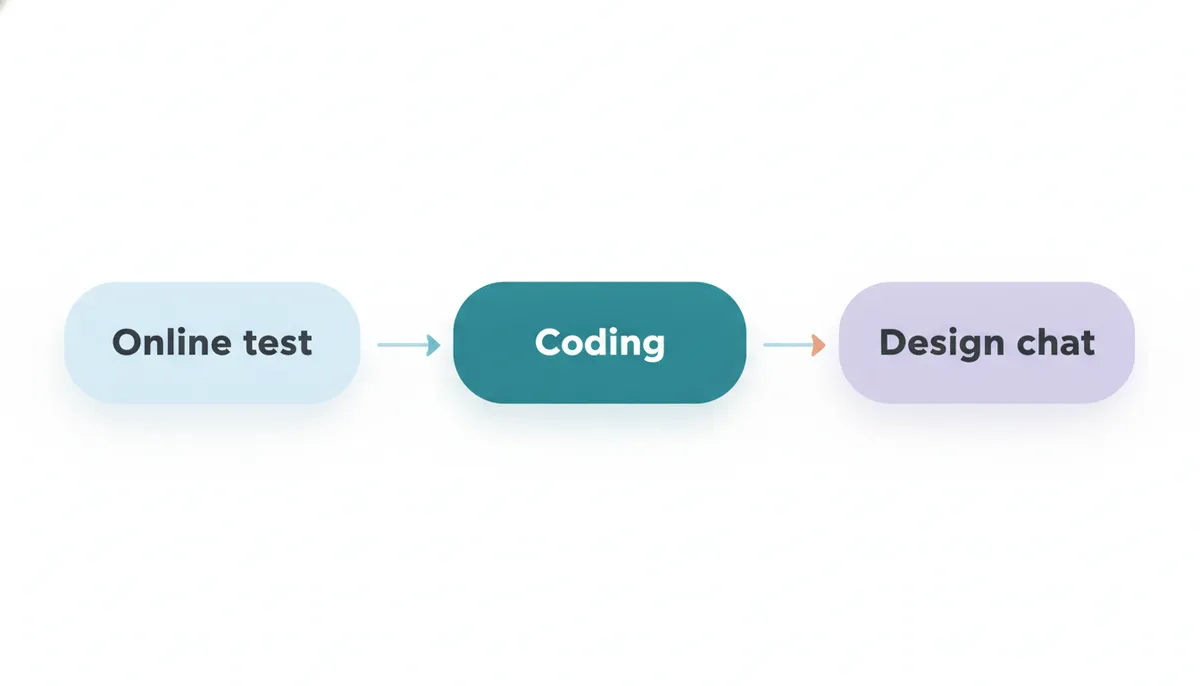
Reported accounts describe a resume screen, an online assessment for L3 and new-grad candidates, a technical phone screen, then an onsite loop of four to six back-to-back interviews. Candidates at L4 and above are commonly reported to skip the online assessment.
Within the onsite, reported formats usually include two to three coding rounds at roughly 45 minutes each, one system-design round, and one Googleyness-focused conversation. System design is reported from L4 upwards and is consistently present from L5. The exact mix can vary by level and team, so confirm the format with your recruiter.
For practical preparation, there are two adjacent skills to separate:
| Interview surface | What you are doing | Why machine-coding practice helps |
|---|---|---|
| Timed coding | Solve a constrained problem and write correct code | It builds implementation speed, testing habits and clear narration |
| Low-level design | Model entities, responsibilities and changing behaviour | It builds judgement about classes, interfaces and boundaries |
| System design | Discuss services, data flow and trade-offs at scale | It tests a broader architectural view |
A Google coding problem is not automatically a low-level design problem. Equally, a low-level design exercise is not an excuse to skip correctness, complexity or edge cases. The useful preparation strategy is to train both: solve well-defined coding prompts efficiently, then practise organising code when requirements become less complete.
A separate note on a newer reported format: candidate accounts describe a pilot code-comprehension round for L3 and L4 candidates on selected US teams. It is reported as a 60-minute exercise involving an unfamiliar codebase, bugs, design discussion and suggested improvements, with Gemini available as an assistant. This is a pilot rather than a universal Google policy, and reported accounts say it adds to the loop rather than replacing the traditional no-AI algorithm round.
What a Google-style practical coding evaluation rewards
Google’s interview feedback is ultimately reviewed beyond the interview panel. Reported accounts describe a Hiring Committee of senior engineers who did not interview the candidate reviewing the recruiter-assembled packet. That makes consistently observable evidence important: a correct answer matters, but so does the reasoning that lets an interviewer defend the assessment.
For a practical coding or low-level design exercise, use this rough order of priorities.
1. Correctness and a working core flow
The first job is to solve the stated problem. Your main path should execute, your outputs should make sense, and your handling of edge cases should not be an afterthought.
For a design-oriented task, define a thin vertical slice: create the key objects, support the main user action, and demonstrate it with a small driver or test. Do not spend half the available time modelling rare states before the core interaction works.
2. Clear reasoning and assumption management
Interviewers cannot award credit for reasoning they cannot hear. Start by restating the objective, identify ambiguous requirements, and state any assumption you need to make.
A useful sequence is:
- Clarify the user flow.
- Name the constraints that change the solution.
- Offer a simple approach.
- State complexity or design trade-offs.
- Code the smallest complete version.
- Test it aloud.
This is especially important when a prompt could be interpreted in several ways. A candidate who asks one crisp question and proceeds is easier to assess than someone who silently invents a product specification.
3. Sensible decomposition
Good low-level design is not a contest to produce the most classes. It is the ability to put each responsibility in a place that makes sense.
Look for natural nouns, actions and variations:
- Nouns often become domain objects.
- Actions often become methods or services.
- Changing behaviour may justify an interface.
- Stored state should have an obvious owner.
- Rules that span several objects may belong in a coordinator.
If a class is responsible for validation, persistence, pricing, notifications and output formatting, split it. If an interface has one implementation and no plausible variation, keep it simple unless the prompt explicitly points towards extension.
4. Extension under one realistic change
A strong interviewer follow-up is often: “What if we add this requirement?” You do not need to pre-implement every future feature. You do need to show where it would go.
For example, if a booking workflow later supports several allocation policies, isolate the policy behind a small interface. If a user can receive notifications through different channels, avoid hard-coding email logic inside the core domain object. Explain the boundary, then return to the problem at hand.
The Low Level Design Sheet is free to browse and is useful for seeing how common design variations alter responsibilities without requiring a rewrite.
5. Readable, testable code
Names should reveal intent. Methods should be short enough to explain. Public APIs should be small. A few focused tests or a simple driver are more persuasive than claims that the code “should work”.
This is not about ornamental patterns. It is about making your implementation reviewable while you are still in the room.
How to use a 45-minute coding window
Reported Google coding rounds are commonly around 45 minutes. That is a different constraint from a 90-minute machine coding exercise, but the operating principle is identical: establish a correct core before investing in polish.
| Time | Focus | Deliverable |
|---|---|---|
| First 5 minutes | Clarify and frame | Restated problem, assumptions, examples |
| Minutes 5–12 | Choose approach | Data model or algorithm, complexity, plan |
| Minutes 12–30 | Build the core | Working happy path |
| Minutes 30–38 | Test and repair | Edge cases, dry run, bug fixes |
| Final 7 minutes | Improve and discuss | Trade-offs, extension path, questions |
For a class-design prompt, draw a tiny model before typing: the main entities, their key fields and the direction of the important calls. Keep it deliberately incomplete. The sketch is a thinking tool, not a diagram to admire.
For an algorithmic prompt, do not begin with the optimal solution if you cannot explain it. A clear baseline can validate your interpretation and give you something to improve. State why it is insufficient, then move to the better approach.
💡 Pro Tip: Reserve the final minutes on purpose. Candidates often use every second to type and leave no time to run examples. A clean explanation of one edge case can change the interviewer’s confidence in the entire solution.
The failure modes that cost otherwise strong candidates
Coding before understanding the contract
A prompt may hide choices about invalid input, duplicate actions, ordering, ownership or lifecycle. If you code immediately, you can spend twenty minutes implementing the wrong semantics.
Ask only questions that alter the design. Do not turn clarification into stalling. Once you have enough information, state the assumption and move.
Building an enterprise framework for a small problem
Factories, observers, repositories and strategy objects are useful when they correspond to genuine variation. They become a liability when introduced by reflex.
Over-abstraction creates more code to debug, more concepts to explain, and more ways for the main flow to fail. Prefer a direct implementation first. Extract an abstraction when a concrete extension justifies it.
Treating code quality as a final-minute activity
Messy names and tangled control flow make your own debugging harder. Write readable code from the beginning: use meaningful names, preserve one responsibility per method where practical, and avoid large blocks of repeated branching.
The goal is not perfection. It is code that you can safely change after an interviewer adds a requirement.
Forgetting to test the awkward cases
After the happy path, test boundaries: empty collections, repeated calls, unavailable resources, invalid identifiers, and state transitions that should be rejected. Say what you are testing and why.
This habit transfers directly to live coding. Read what interviewers actually look for in live coding rounds for a fuller explanation of how communication, debugging and recovery shape the evaluation.
Going silent after a nudge
A hint is not necessarily a bad sign. It can be an invitation to show how you incorporate new information. Repeat the implication of the hint, explain what you would change, and make the change deliberately.
Defensiveness is worse than revising your solution. Good engineering includes updating a plan when evidence changes.
Confusing low-level and high-level design
Class design answers questions such as “Which object owns this state?” and “How do these behaviours vary?” System design answers questions such as “Which service stores this data?” and “How does the system scale?” Both matter, but they require different depth.
If you are unsure where the boundary lies, low-level design versus high-level design explains what interviewers generally expect from each format.
A two-week Google machine coding practice plan
This plan assumes you already have basic fluency in one interview language. If you do not, reduce the number of problems and spend the first sessions becoming comfortable with collections, sorting, strings, error handling and testing in that language.
Days 1–3: Build a repeatable design routine
Choose three low-level design prompts and complete them without a timer. For each one:
- write down assumptions before coding;
- identify the main domain objects;
- implement one complete flow;
- add a small driver or tests;
- list one extension you deliberately deferred.
Use Google's interview kit to work through the 11 low-level design problems evidenced at Google. Compare your solution to the editorial after finishing, rather than reading it first.
Days 4–5: Rebuild for simplicity
Take two earlier solutions and rewrite them from an empty file. Your aim is not novelty; it is reduction. Can you create the same working core with fewer moving parts? Can each object’s purpose be described in one sentence?
Read design patterns for interviews as a vocabulary guide, but use patterns only when the prompt creates the variation they address.
Days 6–7: Add timed coding discipline
Complete two 45-minute coding sessions. Spend the first minutes verbalising your plan, then implement and test. Record yourself if possible. Listen for silent gaps, unexplained leaps and assumptions you never stated.
The DSA Patterns Sheet is free to browse and helps you practise recognition rather than memorising isolated solutions. Google’s technical loop remains commonly reported as DSA-heavy, so do not let design practice displace core coding fluency.
Days 8–10: Practise changing requirements
Choose three design problems. At the halfway point, introduce a change yourself: a new payment rule, a second allocation policy, cancellation, expiry, priority or multiple notification channels.
Then answer three questions aloud:
- What must change?
- What remains unchanged?
- What would you avoid generalising until it is needed?
This is the fastest route to better abstraction judgement.
Days 11–12: Simulate the interview
Run two full sessions with a friend, or use an AI mock interview. One should be a 45-minute coding problem; the other should be a practical design prompt. Ask the mock interviewer to interrupt with ambiguity and one late requirement.
Treat the feedback as data. If you repeatedly run out of time, narrow the initial scope. If your code works but your explanation is weak, practise the first five minutes separately until your opening becomes automatic.
Days 13–14: Consolidate rather than cram
Review recurring mistakes, rewrite one weak solution, and do one final mixed session. Keep the last day lighter. Prepare a checklist: clarify, plan, state trade-offs, build the core, test, discuss extension.
For architecture-level preparation at L4 and above, the System Design Sheet is also free to browse. Keep this separate from class design: a strong answer begins by recognising which level the prompt actually demands.
Frequently asked questions
Does Google have a separate machine coding round?
Reported accounts do not commonly describe a separately named machine coding round. They more often describe timed coding rounds and, from L4 upwards, a system-design round. Machine-coding practice is still useful for building clean code under ambiguity.
How long are Google coding rounds?
Candidate reports commonly describe onsite coding rounds at about 45 minutes each. Exact timing can vary, so confirm the format with your recruiter.
Is low-level design required for Google L3 roles?
Reported accounts consistently place system design from L4 upwards, with stronger consistency from L5. Practical coding skills still matter at L3, but the precise design depth varies by interview and team.
What should I prioritise: DSA or low-level design?
For most Google software engineering candidates, prioritise DSA first because the technical loop is commonly reported as coding-heavy. Add low-level design practice to improve code organisation, extension reasoning and implementation judgement.
What do interviewers look for besides correct code?
Clear communication, sensible assumptions, complexity reasoning, testing and the ability to respond to new information all matter. Explain your choices as you make them.
Should I use design patterns in every solution?
No. Use a pattern when behaviour genuinely varies or a requirement makes the separation worthwhile. Unnecessary abstraction can make a small solution slower to build and harder to explain.
What is the reported Google code-comprehension round?
It is a reported pilot for L3 and L4 candidates on selected US teams, not a universal round. Accounts describe reading and debugging an unfamiliar codebase with Gemini available, while the traditional no-AI algorithm round remains in the same loop.
How should I practise explaining my solution?
Narrate every practice session: clarify the prompt, describe your approach, state trade-offs, and test aloud. How to explain your thought process clearly in coding interviews offers a practical structure.
Start with the technical fundamentals
The best preparation for the Google machine coding round search intent is not to predict a single question format. It is to become reliable under a clock: clarify quickly, choose a proportionate design, implement a working core, test it, and explain what you would change next.
Open Google's interview kit to practise the 188 mapped DSA questions, 11 low-level design problems, and 8 system design problems associated with Google. The sheets are free to browse, and an AI mock interview can help you rehearse the communication that turns a good solution into a credible interview performance.
Topics
Related on Thita
Your next step
Practise with AI mock interviews
A spoken interview that asks follow-up questions, runs your code and ends with a written report.