
Interview
Google System Design Interview Guide (2026)
Prepare for Google's system design interview with round expectations, product-domain prompts, answer frameworks, and a focused preparation plan for L4+.

A Google system design interview is less about producing a perfect architecture diagram and more about showing how you make sound engineering decisions under ambiguity. The interviewer is looking for a candidate who can turn a broad product request into requirements, constraints, components, failure modes and trade-offs — while keeping the conversation structured.
Reported accounts describe Google as a DSA-heavy loop, particularly at junior levels. System design is reported from L4 upwards and is consistently present from L5. For candidates preparing across the technical loop, Google's interview kit holds 188 mapped DSA questions, 11 low-level design problems and 8 system design problems evidenced at Google.
This guide focuses on the design round: when it applies, the product territory that makes Google-flavoured design questions feel natural, what stronger answers do differently, and how to prepare without turning every practice session into an unfocused architecture lecture.
Where system design fits in Google's interview loop
Candidate reports commonly describe a process with a resume screen, an online assessment for L3 and new-graduate candidates, a technical phone screen, and an onsite loop. The online assessment is reported to be skipped for L4 and above in many cases.
The onsite is commonly reported as four to six back-to-back conversations. It generally includes coding rounds, a system design round for experienced candidates, and a Googleyness conversation. The final decision is reported to go through a Hiring Committee rather than being made solely by the interviewers you met.
That distinction matters. A strong design interview does not need to be a dramatic performance. It needs to create credible written evidence that you can reason at the level being assessed: clarify a problem, make choices deliberately, explain their consequences, and respond constructively when requirements change.
| Level | Commonly reported design expectation |
|---|---|
| L3 / new graduate | Coding is usually the main technical focus; design may be lighter or absent |
| L4 | System design may appear, especially for candidates with relevant experience |
| L5 and above | System design is consistently reported as part of the loop |
| Senior roles | Greater emphasis on scope, trade-offs, reliability and technical leadership |
Treat this as the usual shape, not a fixed policy. Team, role and hiring needs can alter the loop. Your recruiter is the best source for the process attached to your application.
The Google product territory to understand
Google operates products where usefulness depends on serving a huge number of requests quickly, correctly and safely. That makes search, video delivery, maps, messaging, storage, advertising and collaboration useful mental territory for practice.
You do not need insider knowledge of any one product. You do need comfort with the engineering forces that such products create:
- Read-heavy traffic: many users retrieving content, results or metadata at once.
- Latency sensitivity: an answer arriving late can be nearly as bad as no answer at all.
- Global reach: users, data and failures exist across regions.
- Ranking and relevance: returning any result is not enough; returning a useful result matters.
- Freshness: some data can be cached for a long time, while other data must update quickly.
- Reliability: large systems must degrade gracefully rather than fail all at once.
- Privacy and access control: user data, permissions and retention rules shape the design.
The kind of system design problem evidenced at Google often rewards candidates who can identify those forces early. A URL shortener, for example, is not just a database exercise. It becomes a conversation about read patterns, cache behaviour, abuse prevention, redirect latency and durable mapping storage. A video platform is not just upload and playback; it raises questions about encoding, storage, delivery, recommendations and creator workflows.
The goal is not to force every prompt into a Google product analogy. It is to develop instincts for systems with massive audiences, uneven traffic, global distribution and demanding user expectations.
For structured high-level practice, the System Design Sheet is free to browse. Use it to build a repeatable approach rather than memorising diagrams.
What a strong Google system design answer does differently
Candidates often know the same building blocks: load balancers, caches, queues, databases, replicas and content delivery networks. The difference is in how they use them.
They clarify before they design
A weak answer begins with services and databases. A strong answer spends the opening minutes narrowing the problem.
Ask about the primary user flow, expected scale, read and write mix, latency target, data durability, consistency needs and important exclusions. You are not delaying the design; you are preventing a design for the wrong problem.
Useful questions sound practical:
- Which operation matters most to the user?
- Is global availability required from the first version?
- How fresh must results be?
- Can updates be eventually consistent?
- What happens if one region becomes unavailable?
- Which metrics define success?
Then state the assumptions you will use. This gives the interviewer something concrete to challenge and lets you revise without appearing lost.
They establish a simple core before adding scale
Start with the smallest credible version: clients, an API, core services, storage and the main data flow. Explain how a request enters, where state lives and how the response returns.
Only then add the scaling mechanisms justified by your assumptions. A cache should solve a stated read problem. A queue should absorb a stated burst or separate slow work from a user-facing request. Replication should answer an availability or read-scale need.
This sequencing makes your answer legible. It also protects you from a common failure mode: naming every distributed-systems component you know without explaining why it belongs.
They use numbers to guide judgement
You do not need perfect capacity arithmetic. You do need enough rough estimation to make the architecture believable.
Estimate requests per second, storage growth, object size, hot-key risk or bandwidth where it changes a decision. If the system receives mostly reads, say why caching is likely valuable. If writes arrive in bursts, explain why asynchronous processing may help. If data is regional, explain how that affects placement.
A rough number paired with a clear conclusion is more valuable than a detailed calculation that does not influence the design.
They discuss trade-offs rather than claiming universal answers
There is rarely one correct database, consistency model or cache strategy. Strong candidates explain the cost of a choice.
For example:
- A cache improves latency but introduces invalidation and stale data.
- Synchronous writes simplify immediate correctness but can hurt tail latency.
- Eventual consistency improves availability and throughput but changes the user experience.
- Partitioning improves scale but complicates cross-partition queries and rebalancing.
The interviewer is assessing your judgement, not whether you can say “eventual consistency” at the right moment.
They finish with failure, observability and evolution
Many otherwise good answers stop after the happy path. Better answers reserve time for what happens when the system is busy, partially broken or evolving.
Discuss rate limits, retries, timeouts, dead-letter handling, monitoring, alerts and the most important service-level signals. Then identify the next bottleneck: hot partitions, cache churn, slow fan-out, storage cost or regional failover.
This is where an architecture becomes an operated system.
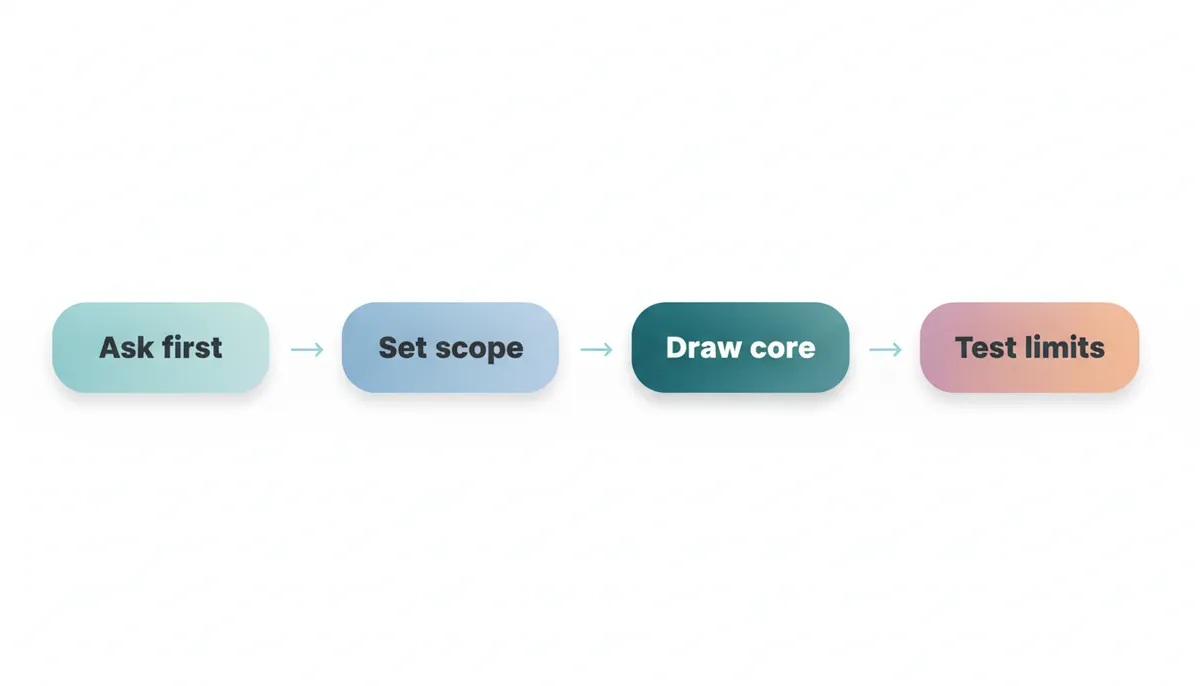
A dependable framework for the round
Use a framework that keeps the conversation moving while leaving room for judgement.
First, define the problem. Summarise the user-facing goal and ask clarifying questions. State what you will not cover if the scope is broad.
Second, list functional and non-functional requirements. Separate what the system must do from how well it must do it. Availability, latency, durability, privacy and cost all belong here.
Third, estimate scale. Use simple assumptions. Identify whether reads, writes, storage or network delivery dominate.
Fourth, draw the core path. Cover client, API, services, storage and the main request flow. Keep names plain and avoid splitting one service into many before there is a reason.
Fifth, deepen the important component. The interviewer may steer you towards feed generation, search indexing, cache invalidation, upload processing or data partitioning. Go deep where the system’s risk is concentrated.
Finally, close with trade-offs and failure modes. Explain what you would monitor, how the design degrades and what you would improve at the next order of scale.
This framework is useful for both whiteboard-style interviews and practice sessions. For a clear comparison of component-level and architecture-level discussions, read low-level design vs high-level design: what interviews actually expect.
Common mistakes to avoid
Jumping into the diagram. A technically impressive design can still miss the prompt. Clarify first.
Overbuilding the first version. Ten services do not prove maturity. A small core with a justified path to scale is usually stronger.
Ignoring data. Say what is stored, how it is keyed, what needs indexing, and how data changes over time.
Using vague scale language. “It should scale” is not a design decision. Name the pressure and the mechanism that addresses it.
Treating trade-offs as admissions of weakness. Trade-offs are evidence that you understand production engineering.
Forgetting communication. Pause after each major section. Invite questions. If the interviewer redirects you, adapt openly rather than defending a prepared script.
Practise saying your reasoning aloud. The same principle matters in coding rounds, as explained in how to explain your thought process clearly in coding interviews.
A four-week Google system design preparation plan
Week 1: Build the foundations
Learn the vocabulary well enough to use it precisely: caching, partitioning, replication, queues, rate limiting, consistency and failover. Do not aim to memorise every pattern. Aim to explain what problem each tool solves and what new problem it creates.
The DBMS Sheet and Computer Networks Sheet are free to browse and useful for revisiting the database and network fundamentals behind design decisions.
Week 2: Practise structured prompts
Work through broad prompts such as a feed, file store, chat service, search feature or notification platform. Use the same framework every time: requirements, estimates, core path, deep dive, trade-offs.
Review your answer afterwards. Did every component serve a stated need? Did you leave enough time for failures and evolution? Could another engineer implement the first version from your explanation?
Midway through preparation, use Google's interview kit to connect design practice with the wider technical preparation plan. The kit holds 188 mapped DSA questions, 11 low-level design problems and 8 system design problems evidenced at Google.
Week 3: Add pressure and feedback
Set a timer and practise complete answers aloud. A good target is to reach the basic design early enough that the remaining conversation can explore scale and trade-offs.
Use AI mock interviews to rehearse responding to follow-up questions. The point is not to recite a polished monologue. It is to become comfortable revising a decision when new constraints arrive.
Keep coding skills active as well. Google’s technical loop is still commonly reported as DSA-heavy, so use the free-to-browse DSA Patterns Sheet to maintain pattern recognition.
Week 4: Simulate the complete conversation
Alternate full design mocks with focused drills: estimate traffic, design a cache policy, choose a partition key, explain consistency, or handle a regional failure.
Also prepare for the rest of the loop. Review past projects deeply, including the decisions you made, mistakes you corrected and outcomes you can quantify. Googleyness is reported as a dedicated conversation and as something assessed across the loop, so thoughtful collaboration and intellectual honesty matter alongside technical depth.
Frequently asked questions
Does Google ask system design questions?
Candidate reports commonly describe a system design round for L4 and above, with it consistently present from L5. Exact scope varies by level and team.
Is system design required for Google L3 candidates?
Coding is commonly reported as the main technical focus for L3 and new-graduate candidates. System design expectations tend to rise at L4 and beyond.
What does Google assess in a system design interview?
Clear requirements gathering, scalable architecture, data modelling, trade-offs, reliability, communication and the ability to adapt when constraints change.
What kinds of system design problems should I practise?
Prioritise systems involving search, feeds, storage, messaging, maps, video delivery, notifications and large-scale request handling. Focus on transferable engineering decisions, not memorised answers.
How long is the Google system design round?
Reported onsite rounds are commonly around forty-five minutes, but format and timing can vary. Confirm the details with your recruiter.
Do I need to draw a perfect diagram?
No. A simple diagram that supports a clear explanation is better than a detailed drawing you cannot defend. Make data flow and component responsibilities easy to follow.
How detailed should capacity estimation be?
Use rough estimates that change your design decisions. The interviewer is usually more interested in your reasoning than exact arithmetic.
Should I discuss databases and caches in every answer?
Only when they solve a requirement you have identified. Explain why data needs persistence, indexing, caching, replication or partitioning.
How should I prepare for the coding rounds alongside design?
Keep a separate DSA routine. Pattern recognition, clear communication and complexity reasoning remain central to the reported Google loop.
Where to start
The best preparation is repeated, structured practice: start simple, explain every component’s purpose, and spend time on the trade-offs that emerge when the system scales or fails.
Open Google's interview kit for 188 mapped DSA questions, 11 low-level design problems and 8 system design problems evidenced at Google. Combine that with the free-to-browse System Design Sheet and an AI mock interview to practise the discussion, follow-ups and technical judgement that a strong system design answer requires.
Topics
Related on Thita
Your next step
Practise with AI mock interviews
A spoken interview that asks follow-up questions, runs your code and ends with a written report.