
Interview
How to Prepare for Technical Interviews in 30 Days: A Practical Plan
Most people underestimate how much focused technical interview preparation they can do in 30 days—and overestimate how much they need to “know everything.” A...
Most people underestimate how much focused technical interview preparation they can do in 30 days—and overestimate how much they need to “know everything.” A good 30 day interview plan is not about cramming every data structure; it’s about deliberate practice on the right patterns, under realistic constraints.
This guide lays out a practical, day-by-day framework for technical interview preparation in 30 days: what to study, how to practice coding interviews efficiently, and how to avoid the common traps that waste time.
We’ll assume you’re targeting software engineer interviews that include coding interviews (LeetCode-style), system design (for mid/senior), and behavioral rounds.
1. Principles of Effective 30-Day Technical Interview Preparation
Before the schedule, you need a strategy. A 30 day interview plan has three constraints:
- Limited time – you can’t cover everything.
- High variance in questions – you can’t memorize solutions.
- Real-world evaluation – you’re judged on reasoning, not just answers.
So your plan should optimize for:
1.1 Pattern-based learning over question memorization
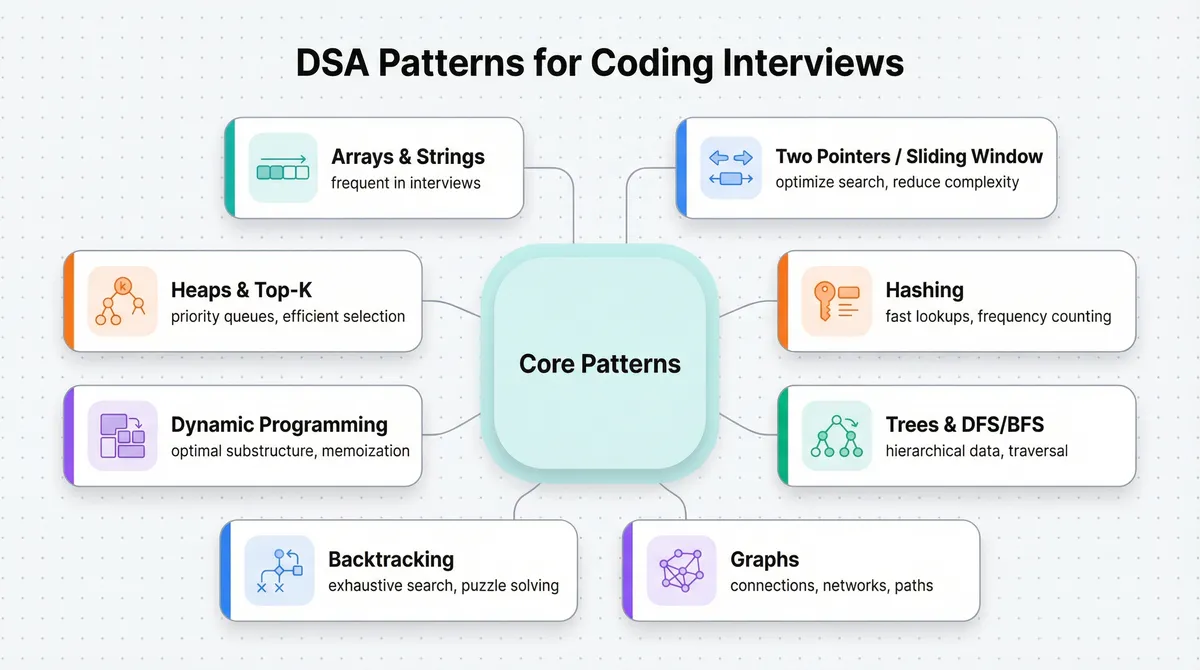
Most coding questions are variations of a limited set of patterns: sliding window, binary search, fast & slow pointers, trees with DFS/BFS, backtracking, DP, etc.
If you recognize the pattern, you drastically reduce the time from problem to solution. That’s why a pattern-based sheet (like a curated The 90 DSA Patterns That Cover 99% of Coding Interviews) is more useful than a random list of 500 questions.
1.2 Iterative loops of “learn → code → review → simulate”
Each concept should go through a tight feedback loop:
- Learn: Understand the pattern and when to use it.
- Code: Implement 2–4 problems applying that pattern.
- Review: Analyze solutions, edge cases, complexity.
- Simulate: Explain the solution out loud as if in an interview.
You don’t need hundreds of problems if each one is deeply processed.
1.3 Simulating the real environment early
Many candidates wait until the last week to do mock interviews. That’s too late to fix structural issues like:
- Talking while thinking
- Handling partial hints
- Dealing with bugs under time pressure
Start simulating coding interviews in week 2, not week 4, with tools like AI Interview Practice: Free Mock Interview Simulator with Real-Time Feedback for Technical Interviews or a peer.
2. The 30-Day Interview Plan: High-Level Schedule
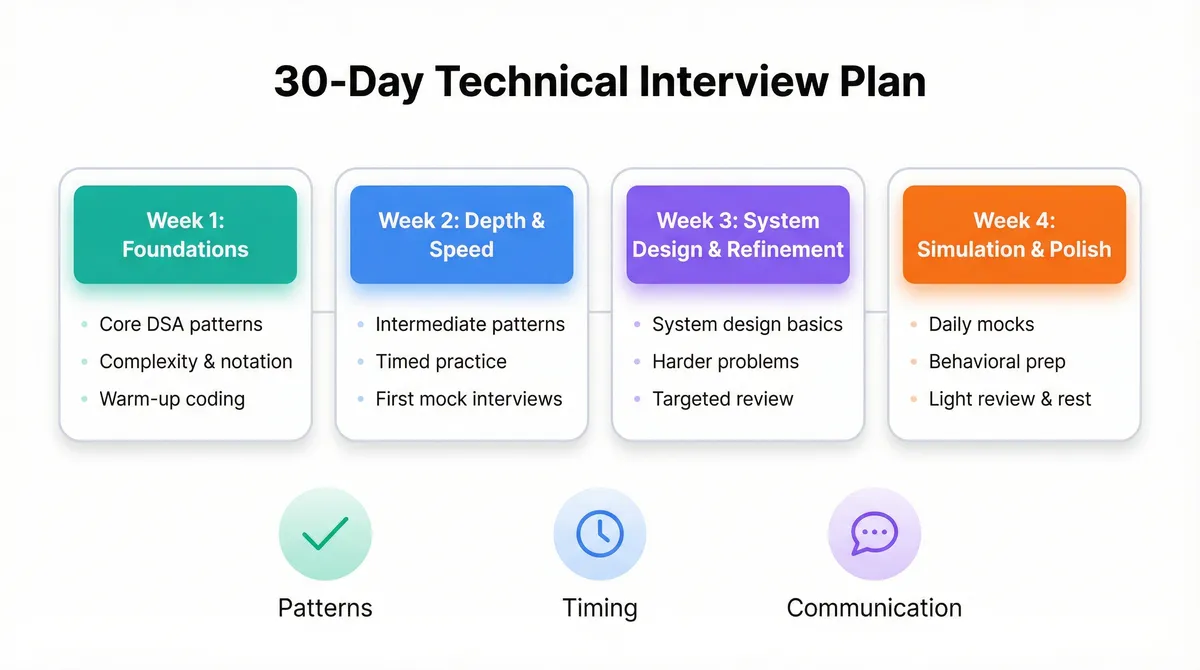
Assume ~2–3 hours/day on weekdays and 4–5 hours/day on weekends. Adjust up or down, but keep the structure.
- Week 1: Foundations and Core Patterns
- Week 2: Intermediate Patterns and Timed Practice
- Week 3: System Design + Advanced Problems + Review
- Week 4: Full Simulation, Behavioral, and Final Polish
We’ll break this down by week and then by daily structure.
3. Week 1 – Foundations: Building the Core
Goal: Get comfortable with the coding environment, complexity analysis, and the most common DSA patterns used in coding interviews.
3.1 Day 1–2: Baseline, Complexity, and Environment
Objectives:
- Set your baseline.
- Configure your tools.
- Refresh Big-O complexity.
Tasks:
-
Baseline assessment (60–90 minutes)
- Solve 2–3 easy/medium problems from arrays/strings without time pressure.
- Track:
- Time to understand the problem
- Time to code
- Time to debug
- Note where you struggle: reading comprehension, edge cases, syntax, etc.
-
Complexity refresh (60 minutes)
Revisit:- Time complexity of:
- Arrays, linked lists: O(1) access vs O(n) search
- Hash maps/sets: average O(1) insert/find
- Heaps: O(log n) insert/pop
- Trees/graphs traversals: O(V + E)
- Space complexity basics.
- Time complexity of:
-
Environment setup (30 minutes)
- Choose a language and stick to it (e.g., Java, Python, C++).
- Set up a fast template (I/O, common helpers).
- Practice writing from scratch in an online judge.
3.2 Day 3–4: Arrays, Strings, and Two-Pointer / Sliding Window
These are the most common topics in coding interviews.
Key patterns:
- Two pointers (same direction, opposite ends)
- Sliding window (fixed and variable size)
- Hash-based frequency maps
Study plan:
- Learn when to use:
- Two pointers: sorted arrays, pair/interval problems.
- Sliding window: subarrays/substrings with constraints (length, sum, distinct chars).
- Solve 3–5 problems:
- Example themes:
- Remove duplicates from sorted array
- Longest substring without repeating characters
- Smallest subarray with sum ≥ S
- Example themes:
Example: Sliding window skeleton in Python
PYTHON
- Time complexity: O(n)
- Space complexity: O(k) or O(1) bounded by alphabet
Pay attention to the loop invariants: what is always true about the window?
3.3 Day 5–6: Hash Maps, Sets, and Basic Sorting/Binary Search
Hash-based problems:
- Two-sum variants
- Checking for duplicates
- Grouping anagrams
Binary search:
- On sorted arrays
- On answer space (e.g., minimum capacity to ship packages in D days)
Practice:
- Implement binary search iteratively.
- Solve at least one “search on answer space” question to understand the pattern.
3.4 Day 7: Weekly Review and Light Mock
Review:
- Revisit 2–3 problems you struggled with.
- For each:
- Re-solve from scratch without looking.
- Explain your solution out loud.
Light mock:
- Do a 45-minute timed session:
- 1 easy + 1 medium problem.
- Enforce constraints: talk through your approach, write clean code, test with examples.
4. Week 2 – Intermediate Patterns and Timed Practice
Goal: Add trees, linked lists, recursion/backtracking, and start serious timed practice + mock interviews.
4.1 Day 8–9: Linked Lists and Fast/Slow Pointers
Patterns:
- Fast/slow pointer:
- Cycle detection (Floyd’s algorithm)
- Middle of linked list
- Reversal of linked lists
- Merging sorted lists
Practice:
- Implement:
- Reverse a linked list (iterative and recursive)
- Detect cycle in a linked list
- Focus on pointer manipulation clarity. Draw diagrams.
4.2 Day 10–11: Trees – DFS, BFS, and Recursion
Core operations:
- Traversals: preorder, inorder, postorder (recursive and iterative)
- BFS with a queue (level order)
- Common problems:
- Maximum depth of binary tree
- Validate BST
- Lowest common ancestor (LCA) of two nodes
Recursive template:
PYTHON
Learn to reason about:
- What the function returns for a subtree
- How that return value is used by the parent
4.3 Day 12: Backtracking and Recursion Patterns
Typical backtracking problems:
- Subsets, permutations, combinations
- N-Queens
- Combination sum
Understand the pattern:
- Decision tree
- Choose → Explore → Un-choose
PYTHON
Focus on:
- Avoiding duplicates
- Pruning invalid branches early
4.4 Day 13: Heaps, Priority Queues, and Top-K
Patterns:
- Find k largest/smallest elements
- Merge k sorted lists
- Scheduling problems (e.g., meeting rooms)
Implement:
- Min-heap and max-heap usage in your language.
- At least 1–2 problems with custom comparator or tuple-based heap elements.
4.5 Day 14: Timed Set + First Real Mock
Timed practice (90 minutes):
- 3 problems:
- 1 easy, 2 medium
- 30 minutes per problem
- After each:
- If stuck for >15 minutes, peek at a hint, but still implement yourself.
Mock interview (45–60 minutes):
- Use AI Mock Interviews vs Real Interviews: Do They Actually Help?.
- Get feedback on:
- Problem understanding
- Communication
- Code structure
- Edge case coverage
5. Week 3 – System Design, Advanced Topics, and Review
Goal: For junior roles, this week deepens problem-solving and reviews weak areas. For mid/senior, add system design fundamentals.
5.1 Day 15–16: Graphs and More Trees
Graphs:
- Representations: adjacency list vs matrix
- Traversals: BFS, DFS (recursive/iterative)
- Common problems:
- Number of connected components
- Shortest path in unweighted graph (BFS)
- Topological sort (Kahn’s algorithm or DFS)
Trees (advanced):
- Binary search tree operations
- Balanced trees (conceptual understanding)
- Trie basics (for string problems)
Practice 3–4 graph/tree problems, focusing on:
- Visited set usage
- Avoiding infinite loops in cycles
5.2 Day 17–18: Dynamic Programming (DP) Fundamentals
DP is intimidating for many, but most interview DP problems follow a few patterns:
- 1D DP (e.g., Fibonacci, climbing stairs)
- 2D DP (e.g., edit distance, grid path)
- Knapsack-like problems
- Subsequence problems (LCS, LIS)
Approach:
- Identify overlapping subproblems.
- Define
dp[i]ordp[i][j]meaning clearly. - Derive recurrence.
- Decide bottom-up vs top-down with memoization.
Example: Climbing stairs (classic DP)
PYTHON
- Time: O(n)
- Space: O(n), can be optimized to O(1) with two variables.
5.3 Day 19–20: System Design Basics (for Mid/Senior) or More Coding (for Junior)
If you’re junior (0–2 years), you can spend these two days reinforcing weak patterns and doing more mocks. If you’re mid/senior, allocate time to system design.
System design fundamentals:
-
Core concepts:
- Latency vs throughput
- Horizontal vs vertical scaling
- Caching (client, CDN, server)
- Databases: SQL vs NoSQL basics
- Load balancers, message queues
-
Practice designing:
- URL shortener
- Rate limiter
- News feed or messaging system
Structure answers as:
- Requirements and constraints
- High-level architecture (clients, services, DBs)
- Data model
- Detailed components (API layer, caching, storage)
- Bottlenecks and scaling strategies
For a comprehensive introduction, see Beginner-Friendly System Design Concepts Every Engineer Should Know.
5.4 Day 21: Consolidated Review and Targeted Practice
- Review notes from weeks 1–2.
- Identify 2–3 weakest patterns (e.g., DP, graphs, backtracking).
- For each:
- Re-read conceptual summary.
- Solve 2 focused problems.
- Do one 60-minute mock that includes:
- 1 coding problem
- 10–15 minutes of system design (if relevant) or deeper complexity discussion.
6. Week 4 – Simulation, Behavioral, and Final Polish
Goal: Shift from learning new content to optimizing performance under interview conditions.
6.1 Day 22–24: Daily Mock Interviews + Review
Each day:
-
One full mock (45–60 minutes)
- Use AI Interview Practice: Free Mock Interview Simulator with Real-Time Feedback for Technical Interviews or a partner.
- Rotate problem types (arrays/strings, trees/graphs, DP, etc.).
-
Post-mock analysis (30–45 minutes)
- What went well?
- Where did you get stuck?
- Did you:
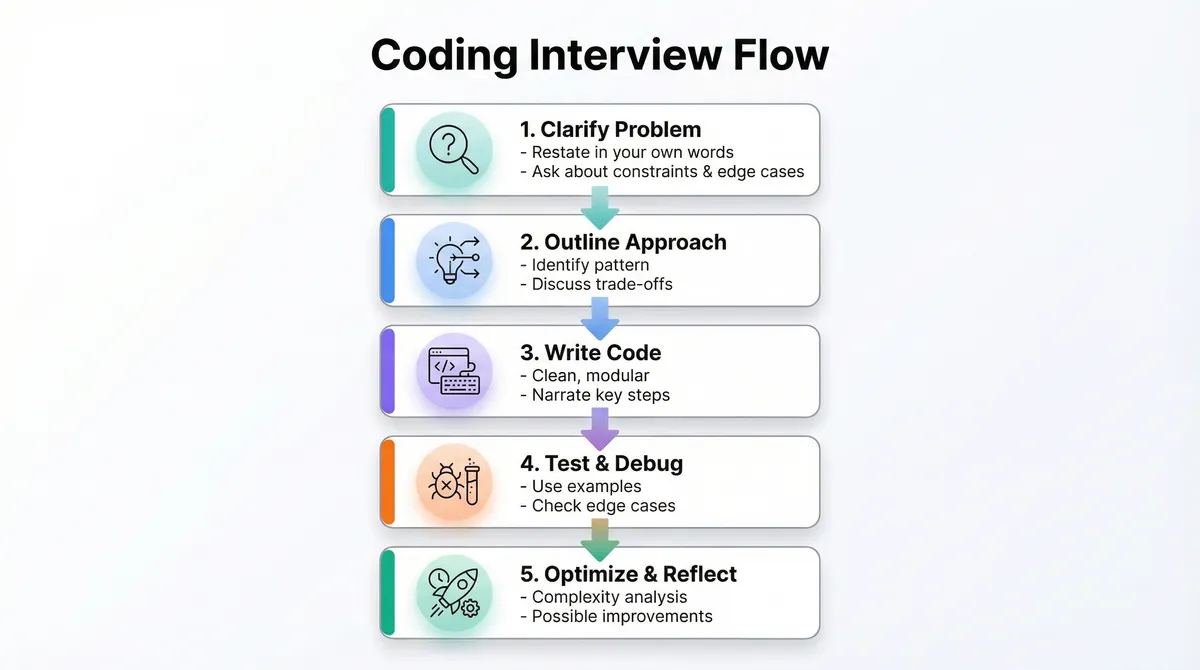
- Clarify requirements?
- Propose multiple approaches?
- Analyze complexity?
- Test thoroughly?
-
Targeted drills (60–90 minutes)
- 1–2 problems focusing on weaknesses exposed in the mock.
6.2 Day 25–26: Behavioral Interview Preparation
Behavioral interviews are often underprepared, but they’re critical.
Prepare your story bank:
- 6–10 stories using the STAR method (Situation, Task, Action, Result) for:
- Conflict with a teammate
- Tight deadline or high-pressure situation
- Leading a project or initiative
- Failure and what you learned
- Debugging a hard production issue
- Working with ambiguous requirements
Practice answering common questions:
- “Tell me about yourself.”
- “Tell me about a time you disagreed with a decision.”
- “What’s a challenging technical problem you solved?”
Record yourself (audio or video) and check for:
- Clarity and structure
- Overly long or rambling answers
- Overuse of “we” vs “I” (you should show your contribution)
If you’re using an AI coach (e.g., /ai-coach), use it to get structured feedback on your responses.
6.3 Day 27–28: Mixed Rounds Simulation
Simulate an actual on-site:
- Day 27:
- 2 coding rounds (back-to-back, 45 minutes each)
- 1 behavioral round (30 minutes)
- Day 28:
- 1 coding + 1 system design (or another coding if junior)
- 1 behavioral or “culture fit” round
After each simulated round:
- Write a short retro:
- What question types came up?
- Where did you hesitate?
- Any recurring mistakes (e.g., forgetting edge cases, not considering space optimization)?
6.4 Day 29–30: Light Review and Rest
At this point, avoid heavy new learning.
Day 29:
- Review:
- Cheat sheets for patterns.
- Your own notes and common pitfalls.
- Solve 2–3 easy/medium problems to stay warm.
Day 30:
- Very light:
- One easy problem.
- Skim your story bank.
- Sleep well, avoid late-night cramming. Cognitive performance matters more now than one extra problem.
7. Daily Structure Template (2–3 Hours)
Regardless of the week, a good daily structure for technical interview preparation looks like:
-
Warm-up (10–15 minutes)
- One easy problem or re-implementing a known pattern from memory.
-
Focused learning (30–45 minutes)
- Read about a pattern or concept.
- Walk through 1–2 example problems.
-
Deep practice (60–90 minutes)
- 2–3 problems of mixed difficulty on that pattern.
- Timebox: 25–30 minutes/problem.
- If stuck >15 minutes, get a hint; still finish coding.
-
Review and reflection (15–30 minutes)
- Revisit mistakes.
- Write down:
- New patterns or tricks.
- Edge cases that surprised you.
- Summarize in your own words.
8. Common Mistakes in 30-Day Technical Interview Preparation
8.1 Grinding Random Problems Without a Plan
Doing 200 random problems without structure leads to shallow understanding. Instead:
- Group problems by pattern.
- After 3–5 problems of a type, write a summary of the pattern.
8.2 Ignoring Communication and Problem-Solving Process
Interviewers care as much about how you solve as what you solve.
Avoid:
- Silent coding.
- Jumping to code before clarifying.
- Not discussing trade-offs.
Make a habit of:
- Restating the problem.
- Asking about constraints.
- Proposing at least two approaches when possible.
8.3 Over-focusing on Rare Topics
In 30 days, don’t sink hours into:
- Exotic data structures (segment trees, Fenwick trees) unless you’re targeting very algorithm-heavy roles.
- Esoteric graph algorithms (e.g., max flow) unless the job description suggests it.
Focus on high-yield topics: arrays, strings, hash maps, trees, graphs, backtracking, DP, heaps.
8.4 Neglecting Behavioral and System Design (for Appropriate Levels)
Many strong coders fail because:
- They can’t articulate past work clearly.
- They struggle with high-level design questions.
Allocate at least:
- 2 days to behavioral prep.
- 2 days to system design (if mid/senior).
8.5 Burning Out Right Before Interviews
Cramming hard problems late into the night before interviews often backfires. Cognitive fatigue reduces:
- Working memory
- Focus
- Emotional regulation (handling stress)
Plan a taper: lighter work in the last 2–3 days.
9. Best Practices and Actionable Tips
9.1 Track Your Progress Quantitatively
Maintain a simple log:
- Date
- Problems solved (with topics)
- Time per problem
- Difficulty
- Notes on mistakes
This helps you:
- Identify weak areas.
- See improvement over time.
- Avoid the illusion of progress from just “being busy.”
9.2 Build Reusable Mental Templates
For each pattern, aim to have a mental template:
- Sliding window: window boundaries, when to expand/shrink, what invariant holds.
- Backtracking: path, choices, base case, choose/un-choose.
- DP: state definition, recurrence, base cases, iteration order.
Before coding, articulate the template verbally.
9.3 Practice Explaining to a Non-Expert
If you can explain your solution to someone less technical (or to an AI coach) clearly, you likely understand it well.
Focus on:
- High-level intuition first.
- Simplified examples.
- Then, detailed edge cases and complexity.
9.4 Use Hints Strategically
Hints are useful if:
- You’ve tried for 10–15 minutes.
- You’ve written down at least one brute-force or naive approach.
When you see a hint:
- Don’t just copy the solution.
- Re-derive the code yourself.
- Explain why the hinted pattern applies.
9.5 Reflect After Real Interviews
If you have interviews within these 30 days:
- After each, write:
- Questions asked.
- Where you did well/poorly.
- Patterns you missed.
- Use this to adjust your next few days of preparation.
10. Key Takeaways
- A 30 day interview plan is enough to significantly improve your performance if you focus on patterns, not raw problem counts.
- Structure your technical interview preparation around:
- Core DSA patterns (arrays, strings, hash maps, trees, graphs, backtracking, DP, heaps).
- Regular mock interviews starting in week 2.
- System design and behavioral prep (for the appropriate level).
- Use a daily loop of learn → code → review → simulate to move from passive reading to active skill.
- Avoid common traps: random grinding, ignoring communication, and neglecting behavioral/system design.
With a disciplined 30-day plan and pattern-based practice, you don’t need to “know everything” to do well in software engineer interviews—you just need to reliably recognize the common structures and communicate your thinking clearly under time pressure.