
Interview
intervu.dev Runs Six Languages But Has No System Design Round
Looking for an intervu.dev alternative? Compare coding practice with a preparation path that also covers evaluated system design interviews.
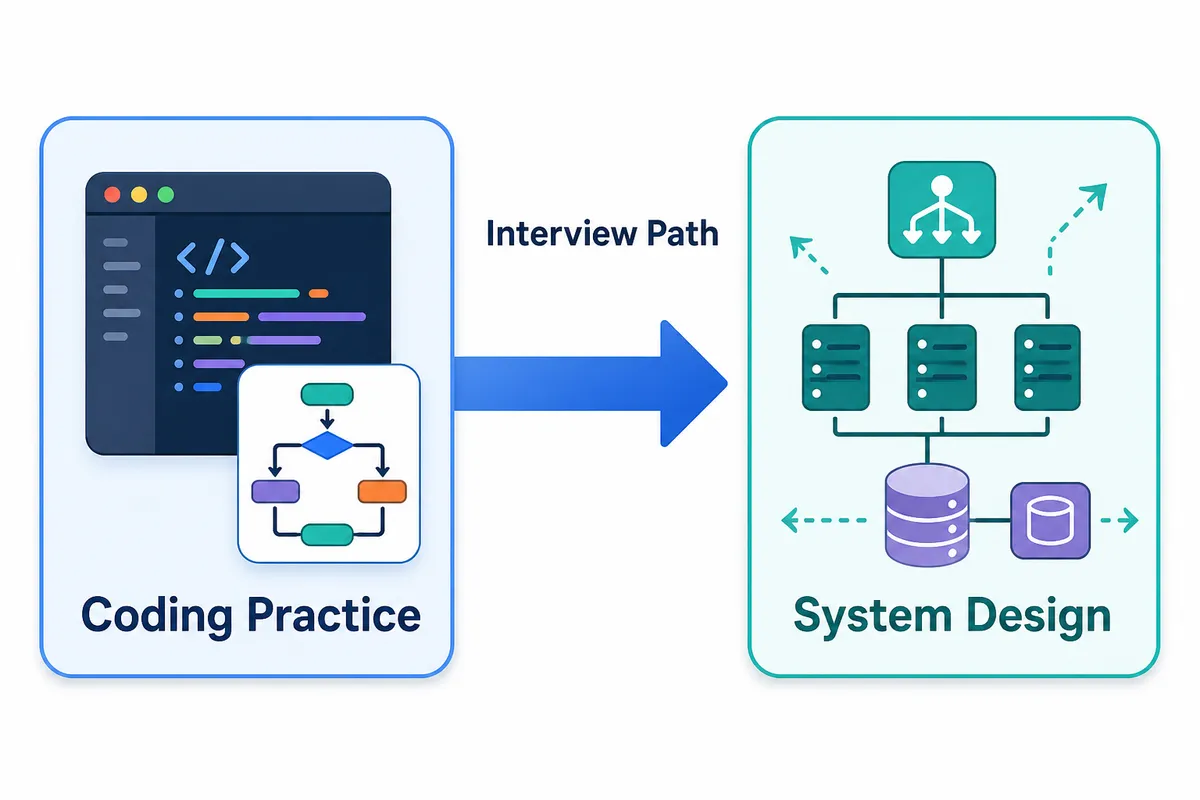
If you are searching for an intervu.dev alternative, it is worth starting with a fair point: intervu.dev is a credible option for coding practice. Its coding experience supports six languages, which matters when you want to practise in the language you would actually use during an interview.
But language support is only one part of technical interview preparation.
For many mid-level and senior engineering roles, a coding round is not the final hurdle. You may need to write and explain an algorithm, then design a scalable architecture, defend your trade-offs, and adapt when the interviewer introduces a new constraint. System design often determines the level at which you are assessed. A strong coding answer may get you through the door; weak design reasoning can still stop the process.
That is why candidates looking beyond coding-only tools should consider live AI interview practice across coding and system design. The objective is not to replace a good coding platform with a weaker all-in-one tool. It is to prepare for the full interview path you are likely to face.
The useful part of intervu.dev: coding in your chosen language
A serious coding practice environment should not force candidates into an unfamiliar language just because the platform has limited support. Syntax, standard libraries, debugging habits and implementation speed all change across languages.
intervu.dev supports practice in six languages. That is a meaningful capability, especially for candidates who have built their preparation around Python, C++, Java, JavaScript, Go or C#. It lets you rehearse the practical part of a coding interview: reading a prompt, choosing an approach, writing working code and communicating your reasoning.
That matters because interview coding is not identical to solving a problem quietly on a judge. You have to explain why a hash map is appropriate, identify edge cases before they break your solution, and respond when an interviewer asks for a more memory-efficient approach.
A good intervu dev review should therefore give credit where it is due: coding practice in multiple languages is useful preparation. If your next process contains only an online assessment or a narrow DSA round, that may be enough for the job in front of you.
The issue is not that coding practice lacks value. The issue is that coding-only preparation can leave a major gap once your interview loop includes design.
⚠️ Important: Supporting several languages does not automatically mean every interview problem needs the same language choice. Pick the language in which you can think, explain and debug fastest. Practise in six languages if that helps your flexibility, but prioritise fluency in the language you would choose under pressure.
For a broader view of what live coding rounds assess beyond correctness, read how interviewers judge problem-solving skills in live coding rounds.
The missing round: system design
intervu.dev's coding page describes coding practice, but it does not describe a system design round. That is the gap candidates should pay attention to when comparing options.
System design is not a larger version of a LeetCode problem. It measures a different set of skills:
- Clarifying vague product requirements
- Estimating scale and identifying bottlenecks
- Choosing storage, caching, queues and service boundaries
- Explaining availability, consistency and reliability trade-offs
- Designing APIs and data flow
- Revising an architecture when requirements change
- Communicating decisions clearly enough for another engineer to challenge them
In a coding round, there is often a recognisable correct direction. In a system design round, there may be several defensible architectures. What matters is whether you can make your assumptions visible, explain the costs of your choices and improve the design when given more information.
That is also why candidates cannot reliably prepare for design by reading diagrams alone. You need to draw an architecture, speak through it, receive a follow-up and decide whether your first answer still holds.
For engineers preparing for SDE 2, senior, staff-adjacent or backend-heavy roles, that practice is not optional. It is frequently the round that distinguishes “can implement a feature” from “can reason about a production system”.
Why coding and design should sit in one preparation path
A real interview process may separate coding and design into different calendar slots, but the skills are connected.
Consider a common progression:
- You solve an API rate-limiting problem in a coding round.
- The interviewer asks how your solution would work across many servers.
- You discuss centralised counters, distributed stores, token buckets and failure modes.
- The conversation becomes a system design discussion.
Or imagine a machine coding round where you build a basic booking service. Once the implementation works, an interviewer may ask what happens when concurrent users try to reserve the same resource. Suddenly, databases, locking, queues and idempotency matter.
Candidates who prepare coding and system design separately often struggle at this boundary. They can produce an efficient algorithm but cannot explain how it behaves in a distributed environment. Or they can sketch a polished architecture but cannot connect it to the implementation details that make it plausible.
The stronger approach is coding and system design in one session or, at minimum, within one consistent practice routine. That helps you build the habit of moving between levels of abstraction:
- From data structure choice to storage choice
- From function complexity to system throughput
- From a local edge case to a production failure mode
- From a working prototype to an operable service
- From “this passes tests” to “this survives traffic”
💡 Pro Tip: After every coding problem, ask one design question: “What changes if this must serve ten million users?” You do not need to force every array problem into a distributed-systems lecture. You are building the reflex to recognise when implementation choices become architecture choices.
For a practical framework, use this guide to answering system design interview questions step by step.
Who needs system design practice most?
Not every candidate needs the same depth of design preparation.
Students and entry-level candidates
If you are applying for internships or entry-level positions, DSA, CS fundamentals, projects and behavioural preparation may take priority. Some companies introduce basic design questions, but they are often focused on object-oriented design, API thinking or project discussion rather than a full-scale architecture interview.
Even so, early exposure helps. Learning to explain why a database table needs an index or why a queue can protect a slow service makes you a stronger candidate in project conversations.
Mid-level engineers
This is where system design becomes much harder to avoid. Companies expect candidates with a few years of experience to reason beyond individual functions. You may be asked to design a notification platform, URL shortener, ride-sharing workflow, file storage system or analytics pipeline.
At this level, design often gates the level of offer. A candidate who codes well but cannot discuss scalability, data modelling or reliability may be assessed below the role they targeted.
Senior engineers
For senior candidates, system design is frequently the centre of the technical evaluation. The interviewer is less interested in whether you remember a niche graph algorithm and more interested in how you lead ambiguity toward a workable plan.
You will be assessed on prioritisation, trade-offs, communication and operational judgement. A strong answer includes not only the first architecture, but also what you would monitor, what could fail and what you would change as usage grows.
❌ Don't spend all your preparation time on coding because it is easier to measure. Solved-problem counts feel reassuring, but they do not tell you whether you can navigate a forty-minute architecture discussion.
✅ Do align your preparation with the level and company process you are targeting. The system design versus coding interview guide can help you decide where to invest your next week.
What an AI coding interview with system design should include
An AI coding interview with system design should not just place coding questions and architecture articles in the same navigation menu. The practice format needs to reflect the pressure and interaction of a real interview.
For coding, that means:
- A real code editor
- Code that compiles and runs
- Test feedback you can use to debug
- Adaptive follow-up questions
- A live conversation where you explain your choices
For design, that means:
- A canvas where you can submit an actual architecture
- Prompts with incomplete requirements, like real interviews
- Evaluation of the architecture you draw
- Follow-ups about scale, bottlenecks, data, failure handling and trade-offs
- Feedback on both technical choices and communication
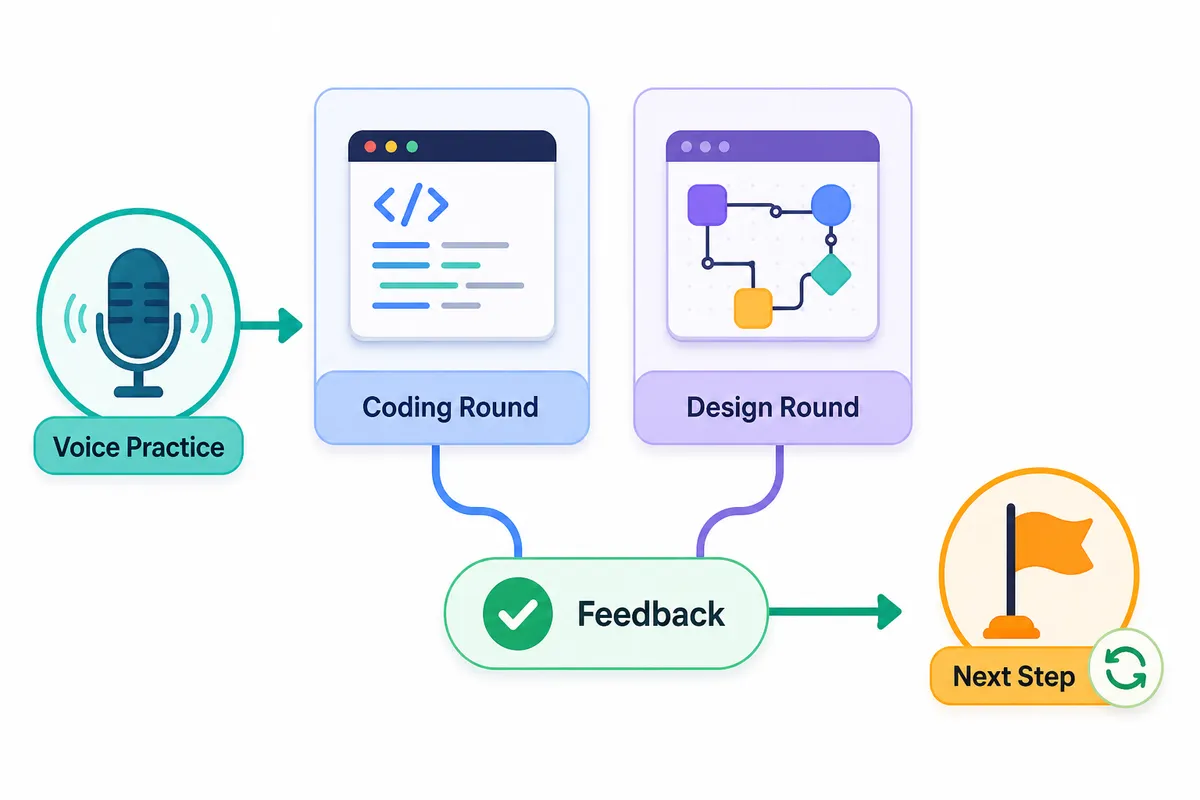
Thita provides that combined route through AI interview practice for coding and system design. You can practise live voice AI interviews across DSA, system design, low-level design and machine coding, rather than moving between disconnected tools whenever the interview type changes.
The coding editor compiles and runs code in Python, C++, Java, JavaScript, Go and C#. The system design environment uses a canvas, and the AI evaluates the architecture you submit. That distinction matters: drawing a design and receiving feedback on your actual design is different from merely reading a model answer after the fact.
The value is not just access to more question types. It is practising the transitions between them while your explanations, follow-ups and decision-making are still fresh.
A practical preparation plan when your process includes both rounds
If you have two to four weeks before interviews, divide your work by capability rather than by whichever topic feels most comfortable.
Days 1 to 7: establish coding consistency
Practise common patterns: arrays, strings, linked lists, trees, graphs, binary search, dynamic programming and interval problems. But do not just solve them. Narrate your approach before you code, test deliberately and explain complexity at the end.
A structured problem list is useful here. The DSA patterns sheet covers 98 patterns and 405 problems to help you organise revision without randomly selecting questions.
Days 8 to 14: build a repeatable design framework
Learn a consistent structure for system design answers:
- Clarify functional requirements.
- Identify scale and non-functional requirements.
- Define core entities and APIs.
- Draw the high-level architecture.
- Deep dive into the likely bottleneck.
- Discuss trade-offs, failure modes and monitoring.
Practise saying your assumptions aloud. A design interview is partly a communication test: the interviewer needs to see why you chose a queue, cache or partitioning strategy.
Days 15 to 21: combine the skills
Run a coding interview, then follow it with a design session. Choose connected topics where possible. If you solve a scheduling problem, design a scheduling service. If you build a cache, discuss cache invalidation and distributed consistency. If you complete a machine coding task, discuss how to productionise it.
This is where a single platform becomes practical rather than merely convenient. You avoid losing momentum while switching products, accounts and formats.
Final week: simulate your target loop
Use company research to identify likely round mixes. Some processes focus heavily on DSA; others include machine coding, low-level design or behavioural leadership questions.
Run timed sessions and review the outcome. Track patterns rather than isolated mistakes: Do you code too quickly before clarifying? Do you forget failure handling in design? Do you go silent while debugging? Do you state trade-offs, or only list technologies?
Intervu.dev versus a combined interview practice path
The choice is not necessarily “use intervu.dev” or “never use intervu.dev”. If its coding format suits your immediate needs, it can be a useful part of preparation.
But candidates should make their decision based on the rounds they expect to face.
Choose a coding-focused environment when:
- Your upcoming assessment is mainly algorithmic
- You need more repetitions in your preferred language
- You are early in your DSA preparation
- System design is not expected at your current target level
Choose a broader interview environment when:
- You are targeting mid-level or senior engineering roles
- Your interviews include system design, low-level design or machine coding
- You need to practise speaking through decisions, not only writing code
- You want feedback on an architecture you actually submit
- You want technical rounds without scheduling a peer mock
The important thing is not to mistake six-language coding support for full interview-loop coverage. Those are different benefits. One helps you practise implementation fluency; the other helps you prepare for the range of decisions an interviewer may evaluate.
Frequently asked questions
Is intervu.dev good for coding interview preparation? Yes, it is a credible coding practice option, particularly for candidates who value support for multiple programming languages. Its coding page describes six languages for practice. The limitation for broader interview preparation is that the page does not describe a system design round.
What is the best intervu.dev alternative for system design practice? Look for a platform that combines live interview interaction with an architecture canvas and evaluates the submitted design. Thita offers live voice AI sessions across coding, system design, low-level design and machine coding.
Can I practise coding and system design in one session? You can practise both within one preparation path on Thita. This is useful for mid-level and senior candidates because coding implementation choices often lead naturally into design discussions about scale, reliability and trade-offs.
Which coding languages can I practise in on Thita? You can practise in six languages: Python, C++, Java, JavaScript, Go and C#. Use the language that best matches your target role and your strongest interview habits.
Does Thita run code during an interview? Yes. Thita's coding editor compiles and runs code, so you can test, debug and respond to real output during practice rather than only discussing a proposed solution.
Who should prioritise system design preparation? Mid-level and senior software engineers should prioritise it most heavily, as system design often affects the level at which they are assessed. Entry-level candidates can also benefit from foundational design practice, especially for project discussions and object-oriented design rounds.
Do I need a partner to practise technical interviews? No. Thita sessions are available on demand with a live voice AI interviewer, so you can practise without coordinating calendars or relying on a peer to attend.
Prepare for the rounds that decide your level
Coding fluency remains essential. intervu.dev's six-language support makes it a real option for candidates who need focused coding practice.
But if your target roles include architecture, scalability, machine coding or technical leadership judgement, coding alone is not the complete preparation plan. Build confidence in the round that may determine your level, not just the round that is easiest to rehearse.
Start a live AI interview for coding and system design to practise code that runs, architecture that gets evaluated and follow-up questions that adapt to your answers.
If you are hiring engineers rather than preparing for interviews, visit https://interviews.thita.ai/.
Topics
Related on Thita
Your next step
Try Thita before you decide
The Starter plan is free: pattern sheets, code execution in six languages and an AI mock interview. Pro adds more AI code feedback and mock interviews, company kits and the 90-day roadmaps.