
Interview
System Design vs Coding Interviews: What to Expect at Different Levels
Most engineers prepare for interviews as if there are only “coding rounds.” Then a recruiter mentions a “system design interview,” and the preparation playbo...
Most engineers prepare for interviews as if there are only “coding rounds.” Then a recruiter mentions a “system design interview,” and the preparation playbook suddenly feels incomplete—especially as you move into senior engineer interviews and beyond.
Understanding how coding interviews and system design interviews differ at each career level is one of the highest-ROI steps you can take in your preparation. The expectations for a new grad coding interview are completely different from those for a staff-level system design interview, and confusing them is a common way to underperform.
This guide walks through:
- What coding vs. system design interviews are actually testing
- How expectations change from junior → mid-level → senior → staff/principal
- Concrete examples of what “good” looks like at each level
- Common pitfalls and how to avoid them
- Practical preparation strategies for both interview types
We’ll keep the focus on teaching, not selling. Use this as a reference as you plan your interview prep roadmap.
Coding Interview vs System Design Interview: What’s the Difference?
At a high level:
-
Coding interview:
- Focus: Algorithmic thinking, correctness, implementation quality
- Typical format: Solve 1–3 programming problems on a whiteboard or shared editor
- Core skills: Data structures, algorithms, complexity, code clarity, debugging
-
System design interview:
- Focus: Architecture, tradeoffs, scalability, communication
- Typical format: Design a system or component (“Design Twitter feed,” “Design a rate limiter”)
- Core skills: Requirements clarification, high-level architecture, data modeling, APIs, scaling, reliability, tradeoff reasoning
Both are core components of senior engineer interviews; at junior levels, coding dominates.
Why Levels Matter: Expectations Aren’t Linear
The same “coding interview” label hides very different expectations:
-
Entry-level / New Grad:
- Can you implement common patterns correctly with guidance?
- Do you know basic data structures?
-
Mid-level (L3–L4-ish):
- Can you independently solve medium-difficulty problems reliably?
- Do you write clean, testable code and reason about complexity?
-
Senior (L5-ish):
- Can you solve harder problems efficiently and communicate clearly?
- Do you choose appropriate tradeoffs and handle edge cases robustly?
Similarly, system design interviews evolve from “can you sketch a reasonable solution” at junior-senior transitions to “can you lead the architecture of complex systems” at staff/principal.
Understanding this gradient is crucial: you don’t need staff-level system design skills for a new grad role, but you do need to show signals that you can grow into the next level.
Deep Dive: Coding Interviews by Career Level
What Is a Coding Interview Really Testing?
Across levels, coding interviews test:
- Problem solving: Decomposing a problem, finding patterns, exploring approaches.
- Algorithmic knowledge: Knowing when to use BFS vs DFS, heap vs sort, etc.
- Code quality: Readable, structured, maintainable code.
- Complexity awareness: Time/space tradeoffs, scalability.
- Communication: Explaining your approach, thinking aloud, responding to hints.
The weighting of each changes with level.
Entry-Level / New Grad Coding Interviews
Typical expectations
- Comfortable with:
- Arrays, strings, hash maps/sets
- Basic linked lists, stacks, queues
- Simple recursion, basic tree traversal
- Can solve:
- Easy → medium problems with some guidance
- Interviewer is tolerant of:
- Minor syntax issues
- Some help in getting unstuck
Example problem
Given a sorted array of integers, remove duplicates in-place such that each unique element appears only once and return the new length.
This tests:
- Two-pointer pattern
- In-place array manipulation
- Understanding of constraints and complexity
Example solution (Python)
PYTHON
At this level, the interviewer mainly checks:
- Do you recognize this as a two-pointer pattern?
- Can you implement it with only minor guidance?
- Do you understand why it’s O(n) time and O(1) space?
Mid-Level Coding Interviews
Typical expectations
- Solid with:
- Core data structures (arrays, hash maps, sets, stacks, queues, trees, heaps, graphs)
- Common algorithms (binary search, BFS/DFS, sliding window, two pointers, prefix sums)
- Can consistently solve:
- Medium problems; some hard problems with hints
- Interviewer expects:
- Clear structure (plan → implement → test)
- Conscious choice of data structures
- Complexity analysis without prompting
Example problem
Given a string
s, find the length of the longest substring without repeating characters.
This tests:
- Sliding window technique
- Hash map usage
- Off-by-one and boundary conditions
Sketch of a strong approach
- Use a sliding window with two pointers
leftandright. - Maintain a map
last_seen[char] = index. - When you see a repeated character, move
lefttomax(left, last_seen[char] + 1). - Track the maximum window size.
A mid-level candidate should:
- Articulate the sliding window idea clearly.
- Implement cleanly with correct index updates.
- State time complexity as O(n) and space O(min(n, charset)).
For mastering these techniques, resources like Master the Sliding Window Pattern: Complete Guide with Examples are invaluable.
Senior Engineer Coding Interviews
Typical expectations
- Comfortable with:
- Complex data structure combinations (e.g., heap + hash map)
- Advanced patterns (topological sort, union-find, interval scheduling, DP)
- Can:
- Solve medium-hard problems reliably under time pressure
- Communicate tradeoffs (e.g., “This DP is O(n²); we can optimize to O(n log n) by…”)
- Interviewer looks for:
- Systematic problem solving (clarify → brute force → optimize)
- Robustness: edge cases, large inputs, invalid inputs
- Code that resembles production quality even under constraints
Example problem
Given a list of tasks represented by characters and a non-negative cooling interval
n, find the least number of time units the CPU will take to finish all the given tasks such that the same tasks are at leastnunits apart.
This tests:
- Greedy scheduling
- Understanding of frequency counting and priority queues
- Ability to reason about lower bounds and formulas
A senior-level answer should:
- Derive the formula-based solution (based on the max frequency of any task).
- Explain why it works, not just implement.
- Possibly mention alternative simulation with a max-heap and discuss tradeoffs.
Deep Dive: System Design Interviews by Career Level
What Is a System Design Interview Really Testing?
System design interviews test:
- Requirements analysis: Clarifying functional and non-functional requirements.
- Architectural thinking: Decomposing into services, components, and data flows.
- Scalability and reliability: Handling load, failures, consistency, latency.
- Tradeoff reasoning: Choosing between designs and justifying decisions.
- Communication and leadership: Driving the conversation, aligning on scope.
The expectations for each dimension grow significantly with seniority.
When Do System Design Interviews Start Appearing?
-
New Grad / Entry-Level:
- Many companies do not have a formal system design round.
- Some may have a “lightweight design” or “architecture reasoning” segment, often tied to a coding or behavioral round.
-
Mid-Level:
- Some companies introduce basic system design screens (e.g., “Design a URL shortener”) for experienced hires.
-
Senior Engineer Interviews and above:
- System design is a core signal.
- Typically 1–2 dedicated rounds focused entirely on design.
Early-Career / “Lightweight” System Design
For early-career candidates, design questions are often scoped down:
- “Design a simple in-memory cache for your service.”
- “How would you structure the code and data for a basic notification system?”
- “How would you design a REST API for this feature?”
What interviewers look for
- Can you:
- Ask clarifying questions?
- Separate concerns (API, storage, business logic)?
- Reason about basic tradeoffs (e.g., SQL vs NoSQL at a high level)?
- Less focus on:
- Cross-region replication
- Advanced consistency models
- Deep infrastructure details
You’re not expected to know every distributed systems pattern, but you should demonstrate:
- Basic familiarity with client-server architecture
- Awareness of latency, throughput, and failure modes
- Clean decomposition of responsibilities
For a solid foundation, reviewing Beginner-Friendly System Design Concepts Every Engineer Should Know can help build your understanding of system design basics and scalability concepts.
Mid-Level System Design Interviews
At this stage, system design interviews become more formal.
Typical prompts
- “Design a URL shortener like bit.ly.”
- “Design a rate limiter for an API gateway.”
- “Design a simplified Instagram feed.”
Expected competencies
-
Requirements and scope
- Clarify:
- Read vs write traffic
- Latency requirements
- Consistency vs availability priorities
- Identify core operations: e.g., for URL shortener: shorten URL, redirect, analytics.
- Clarify:
-
High-level architecture
- Draw a high-level diagram:
- Client → Load Balancer → Application Servers → Databases / Caches → External services
- Explain how components interact.
- Draw a high-level diagram:
-
Data modeling
- Propose schema or data model:
- Tables or collections
- Key fields and indexes
- Discuss access patterns and how they influence the design.
- Propose schema or data model:
-
Scaling and bottlenecks
- Partitioning/sharding strategies
- When to introduce caching (and where)
- Read vs write scaling strategies
At mid-level, interviewers are okay if you don’t deeply optimize everything, but they expect:
- Clear reasoning
- Awareness of common patterns (caching, sharding, queues)
- Ability to identify and address obvious bottlenecks
Senior Engineer System Design Interviews
This is where expectations change dramatically. For senior engineer interviews, system design is typically weighted as heavily as (or more than) coding.
Typical prompts
- “Design Twitter timelines.”
- “Design a real-time chat system (like WhatsApp).”
- “Design an event tracking platform (like Segment).”
What “senior-level” looks like
-
Structured approach
- Start with:
- Clarifying requirements
- Estimating scale (QPS, data size, growth)
- Explicitly state assumptions and adjust as you learn more.
- Start with:
-
End-to-end architecture
- Cover:
- API design (core endpoints, payloads)
- Service boundaries (microservices or logical components)
- Data storage choices (SQL/NoSQL, time-series DB, blob storage)
- Caching layers (client-side, CDN, application cache)
- Asynchronous processing (message queues, background workers)
- Observability (metrics, logs, tracing) at least at a high level
- Cover:
-
Depth on scaling and reliability
- Sharding and partitioning strategies
- Replication, failover, disaster recovery
- Handling hot keys, backpressure, rate limiting
- Tradeoffs in consistency models (e.g., eventual consistency for feeds)
-
Tradeoff discussions
- Example: “We could use a fan-out-on-write model for timelines, which optimizes read latency at the cost of heavier writes and storage. For users with millions of followers, we might need a hybrid approach…”
-
Clear communication under time pressure
- Drive the conversation, summarize periodically:
- “We’ve covered basic architecture and data model. Next, I’ll focus on scaling the read path and handling failures.”
- Drive the conversation, summarize periodically:
At senior level, correctness of the design is less about “the one right answer” and more about:
- Can you reason like someone who has owned large systems in production?
- Can you anticipate and mitigate real-world issues?
For advanced preparation, the Step-by-Step Framework to Answer Any System Design Interview Question offers a structured approach to tackling complex design problems.
Staff / Principal-Level System Design
For completeness: at staff/principal level, system design interviews often test:
- Ability to design platforms or multi-tenant systems
- Cross-team boundary definitions and API contracts
- Long-term evolution and migration strategies
- Risk assessment and incremental rollout plans
You’re evaluated not only as an architect but also as a technical leader who can align multiple teams around a design.
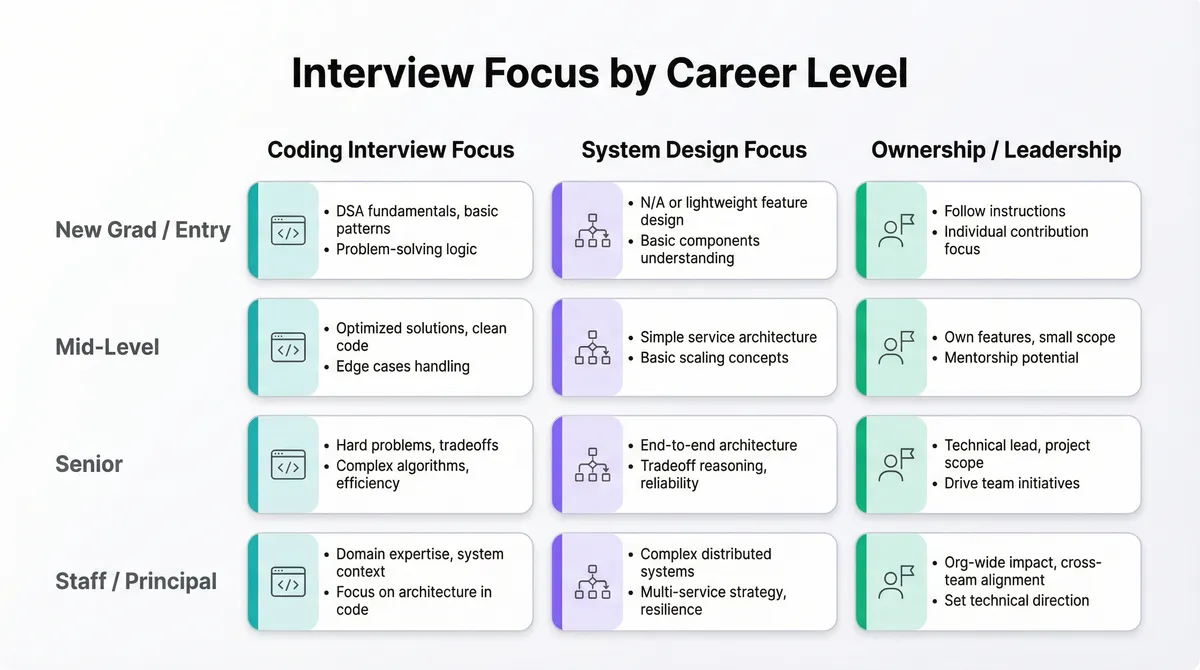
Visual Comparison: Coding vs System Design Focus by Level
Common Mistakes in Coding and System Design Interviews
Coding Interview Pitfalls
-
Jumping straight into code
- Symptom: Start typing immediately after hearing the problem.
- Fix:
- Restate the problem in your own words.
- Clarify constraints and edge cases.
- Outline a high-level approach before coding.
-
Ignoring complexity
- Symptom: “This seems fine” without analyzing time/space.
- Fix:
- Always state complexity.
- If it’s suboptimal, mention possible improvements, even if you can’t fully implement them.
-
Not using patterns
- Symptom: Treating every problem as brand new.
- Fix:
- Recognize recurring patterns (sliding window, two pointers, BFS/DFS, DP, etc.).
- Practice mapping problems to patterns (a pattern-based sheet like
/dsa-patterns-sheetcan be helpful here).
-
Weak testing
- Symptom: Only test the happy path.
- Fix:
- Test: empty input, single element, duplicates, large inputs, invalid inputs if relevant.
- Walk through your code with an example out loud.
System Design Interview Pitfalls
-
Not clarifying requirements
- Symptom: Jumping into architecture without asking questions.
- Fix:
- Ask: “What are the primary use cases?”
- “What scale should we design for?”
- “What are the latency and availability requirements?”
-
Staying too high-level or too low-level
- Too high-level: Only drawing boxes labeled “service” and “DB” without details.
- Too low-level: Diving into specific database configuration flags too early.
- Fix:
- Start high-level, then zoom into 2–3 critical components (e.g., read path, write path, data model).
-
Ignoring bottlenecks
- Symptom: Proposing a single DB instance for huge scale without sharding or caching.
- Fix:
- Identify: “Our main bottlenecks will be the DB write throughput and cache misses.”
- Propose: sharding, replication, caching strategies.
-
Not discussing tradeoffs
- Symptom: Presenting design decisions as obvious without alternatives.
- Fix:
- Compare at least two options for key choices (SQL vs NoSQL, sync vs async, push vs pull) and justify.
-
Forgetting about failures and operations
- Symptom: No mention of what happens when a service or region goes down.
- Fix:
- Discuss monitoring, retries, backoff, circuit breakers, replication, failover.
Best Practices and Actionable Tips
How to Prepare for Coding Interviews at Different Levels
-
New Grad / Entry-Level
- Focus on:
- Core data structures and algorithms.
- Implementing standard patterns.
- Practice:
- Easy → medium problems regularly.
- Explaining your thought process out loud.
- Use:
- Pattern-based resources to cover breadth efficiently (e.g., curated DSA patterns).
- Focus on:
-
Mid-Level
- Focus on:
- Medium → hard problems.
- Clean, modular code with clear abstractions.
- Time/space tradeoffs.
- Practice:
- Timed sessions that simulate real constraints.
- Reviewing your own code for clarity and robustness.
- Focus on:
-
Senior and Above
- Focus on:
- Hard problems and multi-step solutions (e.g., combining multiple patterns).
- Communicating tradeoffs and alternatives.
- Staying calm under pressure and driving the conversation.
- Practice:
- Mock interviews that simulate senior-level expectations, including feedback on communication, not just correctness (AI or human interviewers can help; tools like AI Interview Practice: Free Mock Interview Simulator with Real-Time Feedback for Technical Interviews exist for this purpose).
- Focus on:
How to Prepare for System Design Interviews at Different Levels
-
Foundations for All Levels
- Learn core building blocks:
- Load balancers, caches, message queues, databases (SQL vs NoSQL), object storage, CDNs.
- Understand:
- Latency vs throughput.
- Basic consistency and availability concepts (CAP theorem at a practical level).
- Learn core building blocks:
-
Mid-Level Preparation
- Study 5–10 classic systems:
- URL shortener, news feed, rate limiter, notification system, file storage service.
- For each, practice:
- Requirements → high-level architecture → data model → scaling.
- Draw diagrams and explain them out loud.
- Study 5–10 classic systems:
-
Senior-Level Preparation
- Go deeper on:
- Sharding strategies (by user ID, by time, by geography).
- Caching patterns (read-through, write-through, write-back, cache invalidation).
- Event-driven architectures (pub/sub, stream processing).
- Practice:
- Designing systems with explicit scale: “100M users, 1M DAU, 10k QPS.”
- Handling failure modes: regional outages, partial failures, network partitions.
- Do:
- Mock system design interviews regularly, focusing on structure and communication.
- Go deeper on:
Example: Side-by-Side Expectations for a “Design a URL Shortener” Question
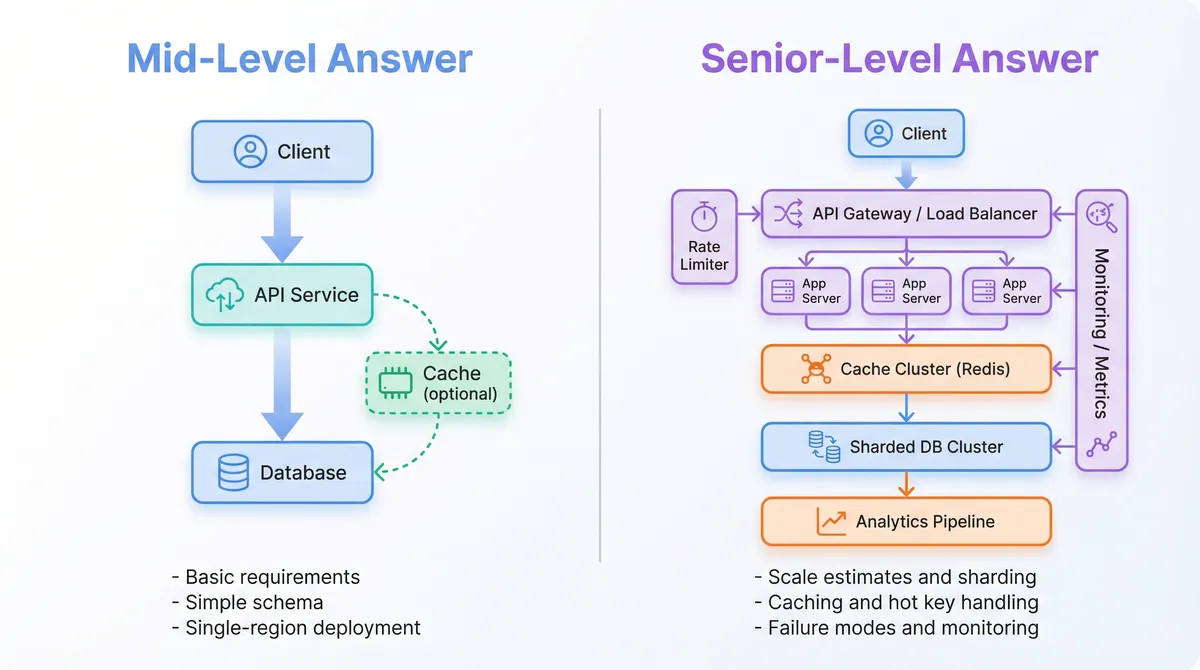
This kind of comparison helps you calibrate what depth is expected at each level.
Putting It All Together: Planning Your Prep by Level
If You’re New Grad / Entry-Level
- Prioritize:
- Coding interview prep (DSA patterns, implementation practice).
- Add:
- Light design thinking: practice explaining how you’d structure a simple feature.
- Goal:
- Show strong coding fundamentals and potential to grow into system design.
If You’re Mid-Level
- Split your time:
- ~70% coding, ~30% system design.
- For coding:
- Ensure you can reliably solve medium problems and some hard ones.
- For system design:
- Get comfortable with classic small-to-medium systems and standard patterns.
If You’re Senior
- Split your time more evenly:
- ~50% coding, ~50% system design.
- For coding:
- Focus on fluency, communication, and handling harder problems.
- For system design:
- Practice full-length design sessions with feedback, focusing on:
- Structure
- Tradeoffs
- Scaling and reliability
- Clear diagrams and explanations
- Practice full-length design sessions with feedback, focusing on:
Key Takeaways
- Coding interviews test algorithmic skills, implementation quality, and problem solving; expectations scale from basic pattern recognition (new grad) to robust, tradeoff-aware solutions (senior).
- System design interviews test architectural thinking, scalability, and communication; they become central in senior engineer interviews and beyond.
- Expectations are level-specific:
- New grads: mostly coding, little to no formal system design.
- Mid-level: solid coding; basic system design for common services.
- Senior: strong in both coding and system design, with emphasis on tradeoffs and real-world constraints.
- Avoid common pitfalls by:
- Clarifying requirements before coding or designing.
- Using known patterns rather than reinventing from scratch.
- Explicitly discussing complexity, bottlenecks, and tradeoffs.
- Prepare deliberately:
- Use pattern-based practice for coding.
- Systematically study and rehearse common system design problems.
- Incorporate realistic mock interviews to simulate pressure and refine communication.
Understanding how system design interviews and coding interviews differ at each career stage lets you target your preparation instead of guessing. That alignment—between what you practice and what interviewers actually expect at your level—is often the difference between “almost there” and an offer.