
Interview
LeetCode vs Real Interviews: Bridging the Preparation Gap
Most engineers discover the same thing the hard way: you can grind LeetCode for months, hit 500+ problems, and still feel blindsided in real software intervi...
Most engineers discover the same thing the hard way: you can grind LeetCode for months, hit 500+ problems, and still feel blindsided in real software interviews.
The patterns look familiar, but the questions don’t. The conversation feels different. The interviewer cares less about your final code and more about how you think. This is the LeetCode vs interviews gap—and closing it is the difference between “I solved a lot of problems” and “I’m ready to pass real interviews.”
This post breaks down that gap systematically and gives you a concrete way to bridge it, especially if your current preparation is mostly coding practice on LeetCode.
LeetCode vs Real Interviews: What’s Actually Different?
On the surface, both involve solving coding problems under time pressure. Underneath, they optimize for very different things.
What LeetCode Optimizes For
LeetCode is excellent at:
- Exposing you to a wide variety of algorithmic patterns
- Building implementation speed in a constrained environment
- Training your intuition for time and space complexity
- Giving you immediate correctness feedback
It’s basically a high-throughput environment for:
- “Given this exact function signature…”
- “Return the answer as an integer/list/tree…”
- “All edge cases are encoded in the test suite…”
You get a binary outcome: Accepted / Wrong Answer / Time Limit Exceeded.
What Real Software Interviews Optimize For
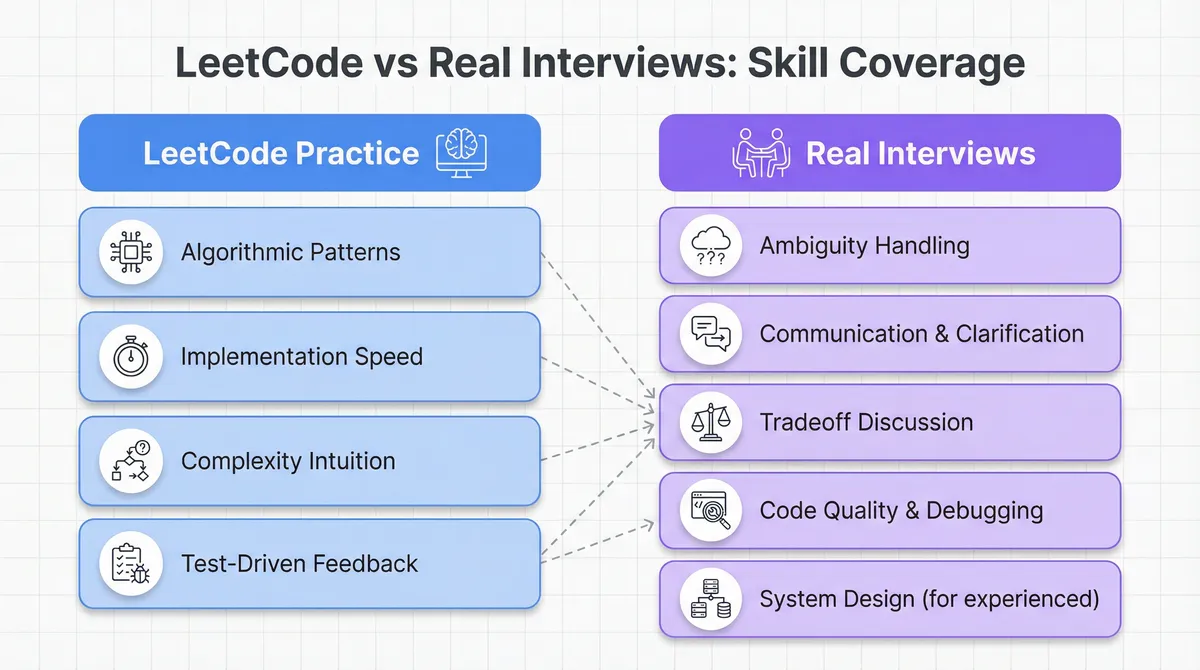
Real interviews, especially at mid-to-senior levels, are not just about getting AC on a hidden test suite. Interviewers are looking for:
-
Problem understanding
Can you clarify ambiguous requirements and restate the problem in your own words? -
Structured thinking
Do you explore the solution space systematically, or jump straight into coding? -
Tradeoff awareness
Can you compare approaches (brute force vs optimized, space vs time, simplicity vs performance)? -
Communication
Do you narrate your thinking clearly and adapt based on interviewer feedback? -
Code quality
Is your code readable, modular, and robust to edge cases? -
Debugging and iteration
What happens when your first attempt has a bug or misses a corner case?
The interview reality is that getting the optimal algorithm is only one part of the evaluation. How you get there matters at least as much as where you end up.
Where LeetCode Helps—and Where It Misleads
LeetCode is a powerful tool, but it has sharp edges. Used incorrectly, it can give you a false sense of readiness.
Strengths of LeetCode-Style Coding Practice
LeetCode is particularly good at:
-
Pattern recognition
After 50–100 problems, you start seeing recurring structures:
- Sliding window for subarray/substring with constraints
- Two pointers for sorted arrays / linked lists
- Binary search on answer space
- Fast & slow pointers for cycles
- DFS/BFS on trees and graphs
- Dynamic programming for optimal substructure problems
This pattern recognition is a real asset in interviews. For a deeper dive into these, check out The 90 DSA Patterns That Cover 99% of Coding Interviews.
-
Complexity intuition
You internalize that:
- Nested loops over
n→ O(n²) - Hash maps/sets → often O(1) average lookups
- Balanced trees / heaps → O(log n) operations
- Recursion depth and memory usage matter
- Nested loops over
-
Implementation fluency
Repeatedly writing:
- Binary search variants
- Linked list manipulations
- Tree traversals
- DP table setups
makes you faster and more confident in code.
Where Pure LeetCode Practice Falls Short
However, LeetCode alone doesn’t train several critical interview skills:
-
Ambiguity handling
LeetCode problems are fully specified. Real interview prompts often are not:
- “Design a rate limiter.”
- “Build a feature to suggest related products.”
- “Implement a cache with eviction.”
You must ask clarifying questions; there’s no problem statement section to scroll.
-
Conversation and collaboration
On LeetCode, you:
- Don’t explain your thinking out loud
- Don’t respond to hints
- Don’t negotiate scope or constraints
In real interviews, this is the core of the experience. Practicing this loop can be enhanced by using AI Mock Interviews vs Real Interviews: Do They Actually Help? to simulate realistic interview conversations.
-
Partial credit and tradeoffs
LeetCode scoring is binary. Interviews are not:
- A clear brute-force solution with solid reasoning can pass a screen
- A slightly suboptimal but simple solution can be better than a fragile optimal one
- Being able to say, “Here’s the tradeoff; I’d choose X in production” matters
-
System design and product sense (for experienced roles)
LeetCode doesn’t cover:
- Distributed systems
- API design
- Data modeling
- Capacity planning
- Failure modes and observability
Yet these are core for mid/senior interviews. For a structured approach to system design preparation, see How to Start System Design Preparation from Zero (Beginner Guide).
A Mental Model: LeetCode as the Gym, Interviews as the Game
Think of LeetCode as practice drills and interviews as actual games.
- Drills isolate a skill: dribbling, shooting, passing.
- Games require integrating them: reading the field, adapting strategy, communicating.
In the same way:
- LeetCode isolates algorithmic implementation.
- Interviews integrate:
- Algorithmic thinking
- Communication
- Design
- Tradeoffs
- Code quality
You need both. But if you only drill and never play simulated games, you’ll underperform when it counts.
Patterns Over Problems: How to Generalize Beyond LeetCode
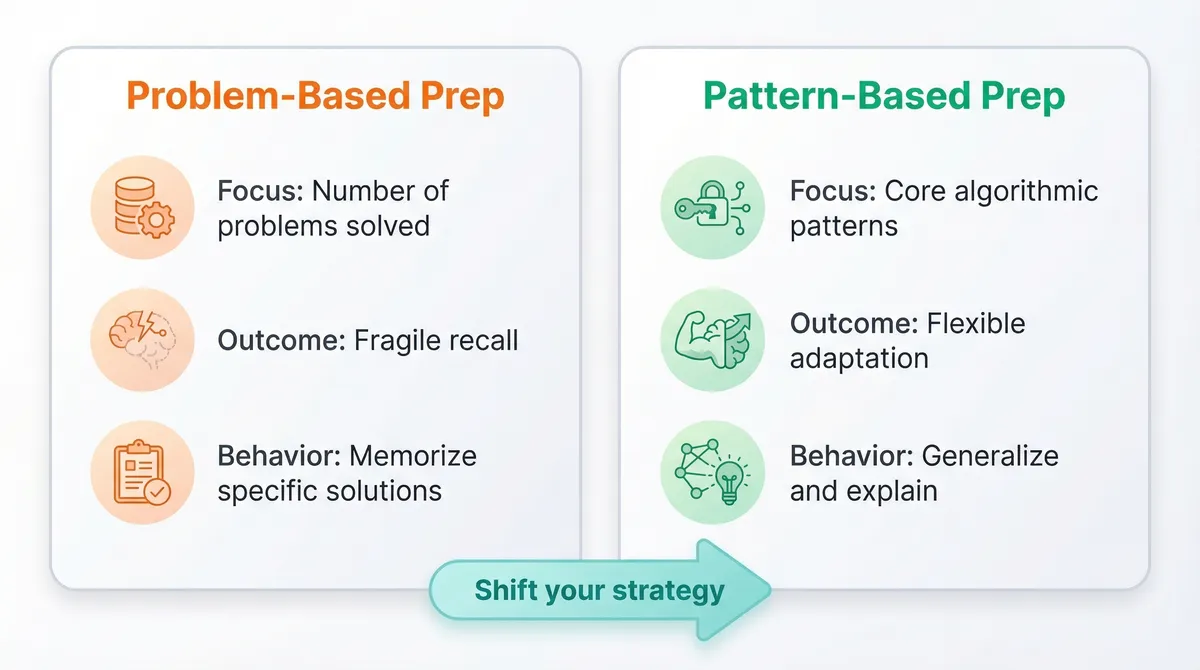
One of the most effective ways to bridge LeetCode vs interviews is to shift from “problems solved” to “patterns mastered.”
Why Pattern-Based Learning Matters
Interview problems are rarely identical to LeetCode questions, but they often share a pattern. For example:
- “Find longest substring without repeating characters”
- “Longest subarray with sum at most K”
- “Number of subarrays with at most K distinct elements”
All are variations of sliding window with constraints.
If you understand the pattern deeply, you can adapt it to new problems under interview conditions. For mastering these, see Master the Sliding Window Pattern: Complete Guide with Examples.
Example: From Specific Problem to General Pattern
Consider the classic two-sum problem:
Given an array of integers and a target, return indices of two numbers such that they add up to target.
A typical solution:
PYTHON
Time: O(n)
Space: O(n)
The pattern here is:
- We need to find pairs that satisfy a relation.
- We can trade space for time with a hash map to store seen values.
This pattern generalizes to:
- “Check if there exists a pair with difference K”
- “Find if any two numbers sum to a value in a given set”
- “Find pairs from two arrays that satisfy a condition”
In an interview, you might not see “two sum” exactly, but if you recognize “pairing + lookups,” you’ll quickly reach for a hash-based or two-pointer approach.
Pattern Checklist During Interviews
When you hear a problem, mentally ask:
- Is this about:
- Subarrays/substrings → sliding window / prefix sums?
- “Kth smallest/largest” → heap / quickselect?
- “Shortest path / minimum steps” → BFS / Dijkstra?
- “All combinations/permutations” → backtracking?
- “Intervals” → sorting + merge / sweep line?
- “Scheduling / deadlines” → greedy + heap?
This pattern-first mindset shortens the path from problem to solution, especially under time pressure.
Simulating Interview Reality: From Solo Coding to Conversation
To bridge the preparation gap, you need to change how you practice, not just how much.
Step 1: Turn LeetCode Problems into Interview Prompts
Instead of silently coding, treat each problem as if an interviewer just asked it.
-
Restate the problem out loud
- “So if I understand correctly, we’re given…”
- “Edge cases I’m considering are…”
-
Ask clarifying questions (even if the text is explicit)
- “Can the array be empty?”
- “Are numbers negative?”
- “What should we return if there’s no valid answer?”
-
Outline approach before coding
- “Naively, we could do X which is O(n²). But we can do better by…”
- “There are two main approaches: A and B. I’d start with A because…”
-
Narrate while coding
- “I’ll use a hash map to store…”
- “Here I’m checking the complement before inserting to avoid duplicates…”
-
Manually test with examples
- Use a small example and walk through the code line by line.
- Catch off-by-one errors, null cases, etc.
This trains the interview conversation loop instead of just the coding reflex.
Step 2: Practice Under Realistic Constraints
Try to mimic actual interview conditions:
- Timebox: 30–45 minutes per medium/hard problem
- No copy-paste from past solutions
- No running code until you’ve walked through it mentally
- Limit debugging attempts: treat each run as “submitting to an interviewer”
If you use tools that simulate interviews (e.g., AI mock interviewers), they can enforce this loop: prompt → clarify → propose → code → iterate. Thita’s AI Interview Practice: Free Mock Interview Simulator with Real-Time Feedback for Technical Interviews flow is designed around this structure.
Beyond Algorithms: Other Interview Dimensions LeetCode Doesn’t Cover
For many roles, especially beyond entry-level, software interviews include more than algorithms. You should deliberately practice these dimensions too.
Behavioral and “Past Experience” Questions
Common mistake: focusing solely on coding practice and ignoring behavioral interviews until the last week.
Interviewers look for:
- Ownership and impact
- Conflict resolution
- Learning from failure
- Communication with non-technical stakeholders
Use the STAR framework (Situation, Task, Action, Result) to structure answers. Prepare 8–10 stories that cover:
- A challenging bug or outage
- A project with ambiguous requirements
- A disagreement with a teammate
- A time you improved a process or performance
System Design (for mid/senior roles)
LeetCode won’t prepare you for:
- “Design a URL shortener”
- “Design a messaging system”
- “Design an API rate limiter”
To bridge this:
-
Learn core building blocks:
- Load balancers, caches, databases, queues
- Sharding, replication, consistency models
- CAP theorem, eventual consistency basics
-
Practice a structured approach:
- Clarify requirements and constraints
- Propose high-level architecture
- Dive into data modeling and APIs
- Discuss scaling, bottlenecks, and failure modes
-
Use a whiteboard or drawing tool
Practice drawing clean diagrams and narrating them.
For a comprehensive system design roadmap, see The Ultimate System Design Roadmap: 120 Topics to Master Every Interview.
Practical Coding and Code Quality
Some companies use more realistic coding tasks:
- Build a small API
- Parse a log file and compute metrics
- Refactor or debug an existing codebase
To prepare:
- Practice writing small, complete programs, not just functions.
- Focus on:
- Naming
- Modularity
- Error handling
- Tests (even if just basic ones)
Example: Translating a LeetCode Problem into an Interview Conversation
Let’s walk through how the same problem looks in LeetCode vs a real interview.
LeetCode Version
Prompt:
“Given an array of integers nums and an integer k, return the length of the longest subarray whose sum is less than or equal to k.”
You’d likely:
- Recognize this as a sliding window variant (if all numbers non-negative).
- Implement directly, test, submit.
Interview Version
An interviewer says:
“You’re given a stream of integers and a limit
k. We want to find the longest contiguous sequence whose sum doesn’t exceedk. How would you do this?”
What you should do:
-
Clarify
- “Are numbers non-negative, or can they be negative?”
- “Is this an offline array or an online stream?”
- “What’s the expected size of the input?”
-
Branch based on constraints
- If all numbers are non-negative:
- Sliding window works: expand right, shrink left while sum > k.
- If numbers can be negative:
- Sliding window no longer works; need different strategy:
- Prefix sums + binary search / balanced tree
- Or dynamic programming in some variants
- Sliding window no longer works; need different strategy:
- If all numbers are non-negative:
-
Propose and compare
- “For non-negative numbers, we can use a sliding window in O(n) time and O(1) space. For arbitrary integers, we need something like prefix sums with a sorted structure, which is O(n log n) time and O(n) space.”
-
Code while narrating
For the non-negative case:
PYTHONThen walk through a small example to validate.
The algorithm is the same as you’d write on LeetCode—but the process (clarification, branching on constraints, tradeoff discussion) is what interviewers actually grade.
Common Mistakes When Moving from LeetCode to Interviews
1. Memorizing Solutions Instead of Internalizing Patterns
Symptom: You recognize problems only when they’re nearly identical to ones you’ve solved before.
Fix:
- After solving a problem, write down:
- The core pattern used
- Why alternatives were worse
- How you’d explain it to someone else
- Periodically review by pattern, not by problem.
2. Ignoring Communication Practice
Symptom: You can solve problems alone, but freeze or ramble in live interviews.
Fix:
- Practice thinking out loud on every problem, even when alone.
- Record yourself solving one problem per day and watch it back.
- Do mock interviews (with peers or an AI coach like AI Mock Interviews vs Real Interviews: Do They Actually Help?).
3. Over-Optimizing for Difficulty
Symptom: Spending all your time on LeetCode “Hard” problems, assuming interviews will be that hard.
Reality:
- Many interview problems are medium-level but require:
- Clear communication
- Clean code
- Robust handling of edge cases
Fix:
- Balance your practice:
- 60–70% mediums
- 20–30% hards
- Occasional easy problems to warm up / reinforce patterns
4. Neglecting Behavioral and System Design
Symptom: Failing onsite loops despite strong coding performance.
Fix:
- Dedicate specific days to:
- Behavioral prep (story bank, STAR answers)
- System design practice (one design per week)
- Treat these with the same seriousness as coding practice.
A Structured Plan to Bridge the LeetCode–Interview Gap
Here’s a concrete 4–6 week plan if you’re already comfortable with basic DSA.
Week 1–2: Solidify Patterns and Communication
- Choose ~30–40 problems across core patterns:
- Arrays & strings
- Hash maps & sets
- Two pointers & sliding window
- Trees & graphs (DFS/BFS)
- Basic dynamic programming
- For each problem:
- Spend 5 minutes identifying the pattern before coding.
- Practice explaining your approach out loud.
- After solving, write a 2–3 sentence summary:
- “This is a sliding window problem because…”
- “Brute force is O(n²); we improved to O(n) by…”
Week 3–4: Add Mock Interviews and Realism
- Do 3–4 mock interviews per week (with peers or AI).
- Simulate full 45–60 minute sessions:
- 1 coding problem
- 10–15 minutes of behavioral questions
- After each session:
- Write down 2–3 things you did well.
- Write down 2–3 concrete improvements (e.g., “Ask more clarifying questions,” “State brute force before jumping to optimal”).
Week 5–6: Integrate System Design and Behavioral (for Mid/Senior)
- 2 coding sessions per week (keep skills warm).
- 2 system design sessions per week:
- Each: 45–60 minutes on a single design prompt.
- 2 behavioral practice sessions per week:
- Pick 3–4 questions and answer using STAR.
- Refine your stories and make them concise and impact-focused.
Visualizing the Gap: Practice vs Interview Skills
Best Practices: Using LeetCode Effectively for Interview Reality
1. Study by Pattern, Not Just Problem Count
-
Maintain a pattern checklist:
- Sliding window
- Two pointers
- Binary search (on index, on answer)
- Fast/slow pointers
- Recursion & backtracking
- BFS/DFS
- Union-find
- Greedy
- DP (1D, 2D, knapsack, subsequences)
-
For each pattern:
- Solve 5–10 representative problems.
- Summarize the pattern’s typical use cases and pitfalls.
2. Always Do a Post-Mortem
After each problem, answer:
- What was the brute force?
- What pattern did the optimal solution use?
- How would I explain this in 3 minutes to an interviewer?
- What edge cases were tricky?
This reflection turns raw practice into interview-ready knowledge.
3. Emphasize Clarity Over Cleverness
In interviews:
- Prefer clear O(n log n) over obscure O(n) that’s hard to explain.
- Use descriptive variable and function names.
- Modularize:
- Extract helpers like
is_valid,expand_window,build_graph.
- Extract helpers like
Interviewers read and reason about your code; help them.
4. Practice with Constraints and Tradeoffs
When you solve a problem, ask:
- What if:
- Input size is 10^5 vs 10^7?
- Memory is limited?
- We need to handle a stream instead of an array?
- Could this be parallelized or distributed?
- What’s the worst-case behavior?
This trains you to think like a systems engineer, not just an algorithm competitor.
5. Periodically Simulate Full Rounds
Every 1–2 weeks, run a full simulation:
- 1 or 2 coding problems
- 1 behavioral segment
- 1 system design (if relevant)
Treat them as real interviews:
- No pausing for long breaks
- No looking up solutions mid-session
- Strict timeboxing
Example Infographic: Pattern-Based vs Problem-Based Preparation
Common Pitfalls to Avoid in the Final Weeks Before Interviews
-
Switching to pure grinding mode
- Doing 10–15 LeetCode problems per day without reflection or mock interviews.
-
Ignoring rest and consolidation
- Cognitive performance drops without sleep and breaks; interviews test clarity, not just memory.
-
Over-focusing on edge-case topics
- Exotic data structures (segment trees, suffix arrays) rarely appear compared to core patterns.
-
Not reviewing past mistakes
- Re-solving problems you previously got wrong is more valuable than chasing new ones.
Key Takeaways: Bridging LeetCode and Interview Reality
-
LeetCode is necessary but not sufficient. It builds algorithmic fluency, but interviews also test communication, ambiguity handling, and design.
-
Think in patterns, not problems. Pattern-based learning lets you adapt to new questions under pressure.
-
Simulate the interview loop. Restate, clarify, propose, code, test—out loud, under time constraints.
-
Broaden your preparation. Include behavioral and (for experienced roles) system design practice alongside coding.
-
Focus on how you solve, not just what you solve. Interviewers care about your reasoning, tradeoffs, and collaboration.
If you align your preparation with the actual interview reality, your LeetCode practice becomes a powerful foundation rather than an isolated skill. The goal isn’t to be good at LeetCode; it’s to be the kind of engineer who can reason clearly through unfamiliar problems—whether they look like a LeetCode question or not.