
Interview
Microsoft Coding Interview Questions: Patterns and Prep (2026)
Prepare for Microsoft coding interview questions with the DSA patterns, difficulty mix, assessment format, live-round strategy and a focused practice plan.
Microsoft coding interview questions reward a particular kind of preparation: fast pattern recognition in coding rounds, followed by clear engineering judgement in design discussions. Reported accounts describe a loop that is more mixed than Microsoft’s DSA-heavy reputation suggests. You may need to move from arrays and graphs to class design, architecture trade-offs, and a discussion of your own work.
That makes random problem-solving a poor strategy. Start with the patterns that recur across the coding portion, then practise explaining decisions under live-round conditions. Microsoft’s interview kit contains 181 mapped DSA questions, nine low-level design problems, and six system design problems evidenced at Microsoft, organised for focused technical preparation.
The core lesson is simple: do not treat the assessment, live coding, low-level design, and system design as unrelated skills. They are different views of the same capability: turning an unclear problem into a correct, maintainable solution while communicating your judgement.
Microsoft’s technical loop: coding is important, but not alone
Reported accounts describe a recruiter conversation followed by an online assessment, then a loop of coding, low-level design, system design for experienced roles, and a behavioural or hiring-manager conversation. Exact sequencing varies by team, level, and location, so treat this as a commonly reported shape rather than a fixed script.
The online assessment is commonly reported as a HackerRank exercise with two DSA problems. Later, the live loop is reported to include several coding rounds, a low-level design discussion, and a system-design round for SDE-2 and above. The hiring-manager round may also ask you to design a feature related to a past project.
That combination matters. A candidate can be fast with a sliding window and still struggle when asked to define responsibilities between classes. Equally, a thoughtful designer can lose momentum in a timed coding round if they cannot identify the underlying pattern early enough.
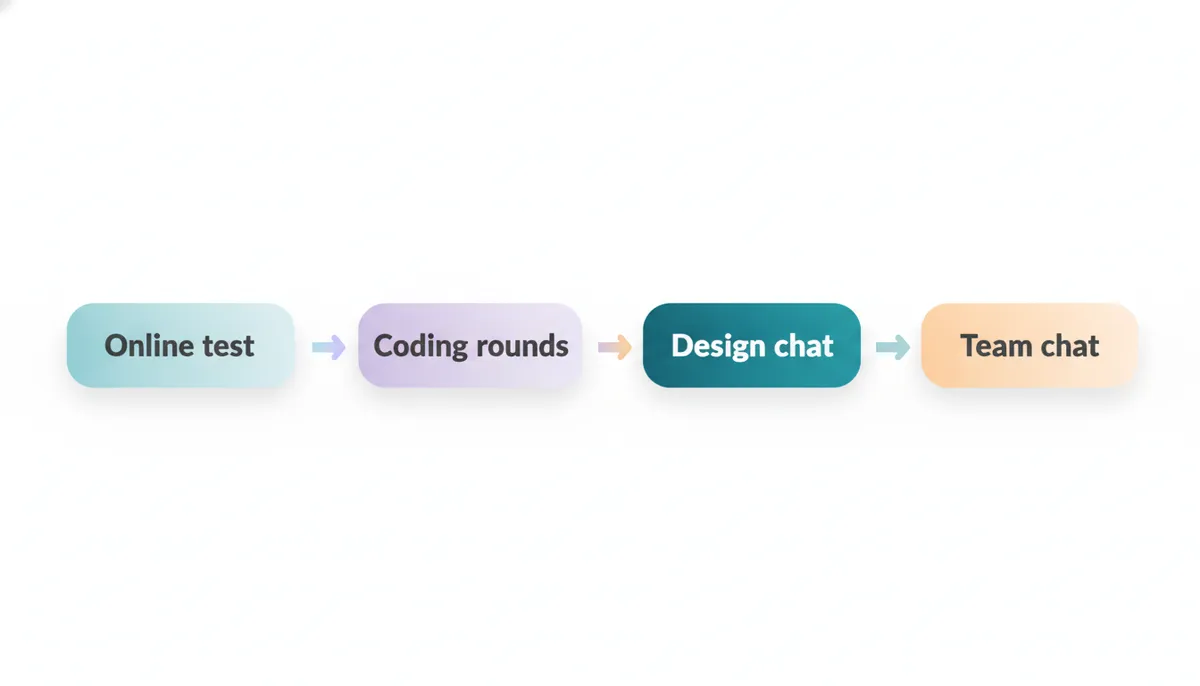
The useful preparation split is therefore not “coding first, design later”. It is pattern recognition for the assessment and coding rounds, followed by structured communication for both coding and design.
The pattern families behind Microsoft coding interview questions
The DSA material is broad, but you should not prepare it as a flat list. Microsoft-style coding preparation becomes manageable when you group problems by the decision that unlocks them.
Arrays, strings, and hashing
These are foundational because they test whether you can reduce a messy prompt into a clean data-access strategy. Common signals include matching, counting, grouping, duplicate handling, and fast membership checks.
The question is rarely “do you know a hash map?” The question is whether you can recognise when repeated searches should become constant-time lookups, and whether you can explain the resulting space-time trade-off.
Practise saying the decision aloud: “I need to remember prior values as I scan, so a map removes repeated work.” That short explanation gives an interviewer a reason to trust the code that follows.
Two pointers and sliding windows
These patterns appear whenever a sequence is processed from both ends or whenever the prompt asks about a contiguous region. They test restraint: can you update only the state that changes, rather than recomputing everything?
Recognition speed matters here. Look for words such as “subarray”, “substring”, “contiguous”, “at most”, “longest”, “smallest”, or “pair”. They are not guarantees, but they are strong clues that a moving boundary may be the right model.
For a structured way to build this instinct, the DSA Patterns Sheet is free to browse and groups problems around the reasoning move, not just the data structure.
Trees, recursion, and traversal state
Tree problems are often less about difficult code than about choosing the right traversal and defining what each recursive call returns. You need to know whether the problem is local to a node, accumulates across a path, or depends on information flowing up from children.
A reliable live-round habit is to state your recursive contract before implementation. For example: define what the helper receives, what it returns, and what state belongs outside it. This prevents the most common error: mixing global state, return values, and traversal order until edge cases become impossible to reason about.
Graph traversal and dependency thinking
Graphs show up in direct form, but also disguised as relationships, routes, prerequisites, transformations, and connected groups. The first task is modelling: identify nodes, edges, direction, and whether an edge has a cost.
Then decide whether breadth-first search, depth-first search, topological ordering, or a shortest-path approach fits the requirement. If the prompt asks for the fewest unweighted steps, breadth-first search should become an immediate candidate. If it asks whether dependencies can be completed, think directed graph and cycle detection.
The guide to graph traversal patterns explains how to separate these choices without memorising isolated solutions.
Binary search beyond sorted arrays
Binary search is not only for finding a value in sorted data. In interviews, its more valuable form is often “binary search on the answer”: find the smallest feasible capacity, time, threshold, or rate, provided you can write a monotonic feasibility check.
Recognition means noticing two things quickly:
- the answer lies in an ordered range;
- a candidate answer can be tested as feasible or infeasible.
The code is short once that framing is clear. The difficult part is proving that feasibility changes in one direction. Work through binary search patterns with that proof in mind.
Dynamic programming and state design
Dynamic programming is where candidates most often reach for memorised templates too early. Microsoft coding interview questions in this family are better approached through state: what information about the earlier part of the input must survive so that the next decision is correct?
Start with a brute-force recurrence. State the choice at each position, then identify repeated subproblems. Only after that should you decide whether memoisation, tabulation, or state compression is appropriate.
This is a pattern family where explanation matters particularly much. An interviewer can follow an imperfect implementation if your state and transition are clear; they cannot credit a compact loop whose meaning you cannot articulate. The dynamic programming patterns guide is useful for building that vocabulary.
What recognition speed actually means
Recognition speed is not guessing the intended technique from one keyword. It is the ability to form and test a useful hypothesis before time pressure turns into panic.
In an assessment, that means you can read a prompt, identify constraints, rule out a quadratic approach, and select a plausible pattern quickly. In a live round, it means you can narrate those steps so the interviewer sees the progression.
Use this short routine:
- Restate the goal and clarify ambiguous inputs.
- Name the obvious brute-force approach and why it will not scale.
- Identify the structure that changes the complexity: ordering, repeated lookup, a moving range, a graph, or reusable subproblems.
- Give the invariant before you code.
- Test the smallest edge cases aloud.
That is a better measure of readiness than how many solutions you can recall. Pattern recognition is useful only when it leads to a defensible approach.
For deeper practice on this transition from prompt to method, read how to identify the right DSA pattern in a coding interview.
The online assessment: accuracy under a clock
Reported accounts commonly describe Microsoft’s assessment as two DSA problems in HackerRank. The format rewards a different skill from a leisurely practice session: you must make good decisions before coding, then protect enough time to test.
Prioritise common high-yield families first: arrays and hashing, windows, binary search, trees, graphs, and practical dynamic programming. The difficulty mix is not best handled by chasing unusually difficult prompts. Instead, build a reliable conversion rate on medium-level problems where recognition and implementation are both required.
When practising, simulate the real constraint:
- read the full prompt before typing;
- write a few examples yourself;
- identify complexity before implementation;
- reserve time for boundaries, empty inputs, duplicates, and large values;
- review failed submissions for the mistaken assumption, not merely the accepted solution.
Use in-browser code practice to rehearse implementation and feedback loops. Then return to the pattern sheet to classify any miss. A failed graph problem caused by an incorrect visited-state rule is not “a graph weakness”; it is a specific modelling weakness you can repair.
Live coding: make your reasoning visible
Live coding rounds are not silent contests. Reported Microsoft loops include coding discussions where interviewers can see how you frame a problem, react to a hint, and check your work.
A strong answer has a visible structure:
“I will first use a simple approach to establish correctness. That is too slow because it repeats work. The constraint suggests a map, so I will retain prior state as I scan. The invariant is that the map contains the information needed for the current position.”
This takes seconds and makes the rest of the round easier to follow.
Avoid narrating every keystroke. Instead, speak at decision points: the data structure, invariant, complexity, tricky branch, and test case. If you discover an error, say what assumption failed and repair it. Good debugging demonstrates judgement; pretending the first draft is perfect does not.
For more on this skill, see what interviewers actually look for in live coding interviews.
Low-level design and system design: the mixed-round advantage
Microsoft’s design content carries real weight in reported loops. The low-level design round is commonly reported as a discussion that begins with brief background and may include CS fundamentals or a project deep-dive before moving into object design. The system-design round is commonly reported for experienced roles.
Do not assume that strong DSA performance automatically transfers.
Low-level design asks whether you can turn requirements into entities, responsibilities, interfaces, and interactions. A good solution starts with the smallest useful domain model, avoids abstractions that solve no present problem, and explains how the design would absorb one likely extension.
System design asks a different question: can you establish requirements, define boundaries, identify bottlenecks, and make trade-offs at scale? Start with a clear baseline rather than listing distributed components immediately. Then add the pieces that solve a stated constraint, such as latency, availability, storage growth, or asynchronous processing.
Microsoft’s interview kit lets you move between these technical modes rather than treating design as an afterthought. The Low Level Design Sheet and System Design Sheet are both free to browse, and the distinction is explained in low-level design versus high-level design.
A useful rule: coding rounds ask whether your algorithm works; design rounds ask whether your decisions will keep working when the requirements change.
A focused preparation plan
Build pattern fluency first
Begin with the core DSA families and work by pattern, not random topic. After every problem, write one sentence describing the recognition signal: “contiguous range with a constraint”, “unweighted shortest route”, or “monotonic feasibility”.
Do not move on just because you saw the editorial. Reimplement the idea later from a blank editor.
Add timed coding sessions
Once you can solve familiar shapes, introduce a timer and practise narrating. Alternate between a first attempt done silently for assessment realism and a spoken attempt for live-round realism.
After each session, review three points: Did you recognise the pattern quickly? Did you state a correct invariant? Did edge cases expose a gap in the implementation?
Practise design separately
Reserve focused sessions for low-level and system design. For low-level design, draw the domain model, then write enough code to show the main flow. For system design, practise leading with requirements and a basic architecture before discussing scale.
The Operating Systems Sheet is free to browse if you want to refresh fundamentals that can surface during technical discussions.
Rehearse your project stories
The hiring-manager conversation is not a break after the technical rounds. Reported accounts describe questions about designing a feature from your own prior work. Prepare examples where you can clearly explain context, your personal decisions, trade-offs, setbacks, and what you would change.
An AI interview can help you practise explaining both technical decisions and behavioural examples aloud. Aim for precision over polish: “I chose this approach because…” is stronger than a vague summary of what the team did.
Frequently asked questions
What patterns should I prioritise for Microsoft coding interview questions?
Prioritise hashing, two pointers, sliding windows, trees, graphs, binary search, recursion, and dynamic programming. Learn the trigger and invariant for each pattern rather than memorising finished solutions.
Is Microsoft’s interview mainly DSA?
Reported accounts describe a mixed technical loop. Coding matters, but low-level design and system design also carry meaningful weight, particularly for experienced roles.
What is the Microsoft online assessment like?
It is commonly reported as a HackerRank assessment with two DSA problems. Practise accurate implementation, complexity reasoning, and edge-case testing under time pressure.
Are design rounds relevant for junior roles?
Low-level design may appear in the technical loop, while system design is more commonly reported for experienced roles. Level and team variation is real, so confirm the expected format with your recruiter.
How should I explain my solution in a live coding round?
State the brute-force idea, explain why it is insufficient, name the improved approach, give the invariant, and discuss complexity before writing the full implementation.
What does the low-level design round test?
It tests how you model requirements through classes, responsibilities, interfaces, and extensibility. Focus on a small coherent design before adding patterns or abstractions.
How is system design different from low-level design?
System design focuses on services, data flow, scale, reliability, and trade-offs. Low-level design focuses on code-level structure and interactions between objects.
Should I practise difficult problems only?
No. Consistent performance on common patterns is more useful than occasional success on unusually difficult prompts. Recognition speed, clean implementation, and explanation are the practical bar.
How should I prepare for the hiring-manager round?
Prepare project stories with clear personal ownership. Be ready to explain a technical decision, its trade-offs, what went wrong, and how you would approach the work differently now.
Prepare across the whole technical loop
The best Microsoft preparation plan is deliberately mixed: build DSA recognition speed for the assessment and coding rounds, then practise design communication so your technical judgement is as visible as your implementation skill.
Start with Microsoft’s interview kit for 181 mapped DSA questions, nine low-level design problems, and six system design problems evidenced at Microsoft. Use the free sheets to strengthen weak pattern families, then rehearse your reasoning in an AI mock interview.
Reported interview processes vary by role, team, and location. Confirm your expected round structure with your recruiter, but prepare for the mixed technical bar rather than assuming Microsoft is a coding-only loop.
Topics
Related on Thita
Your next step
Practise with AI mock interviews
A spoken interview that asks follow-up questions, runs your code and ends with a written report.