
Interview
Microsoft Machine Coding Round: Preparation Guide (2026)
Prepare for Microsoft’s machine coding and low-level design round: format, time plan, grading signals, common mistakes, practice plan and FAQs for SDE roles.
The Microsoft machine coding round is often described as a low-level design conversation, but treating it as a theory-only exercise is a costly mistake. Reported accounts describe a round where you must turn an ambiguous requirement into a coherent object model, explain why responsibilities sit where they do, and make sensible trade-offs under a tight clock.
Microsoft’s broader technical loop is genuinely mixed: coding remains important, while design content carries real weight across low-level and system-design discussions. This guide focuses only on the machine coding and LLD portion. For the wider process, see the Microsoft interview pillar page. To practise the design shapes relevant here, Microsoft’s interview kit includes 181 mapped DSA questions, nine low-level design problems, and six system design problems.
The useful mindset is simple: do not try to impress with a large class hierarchy. Build a small system whose core flow works, explain it clearly, and show how it can change without a rewrite.
Where the machine coding round sits in Microsoft’s loop
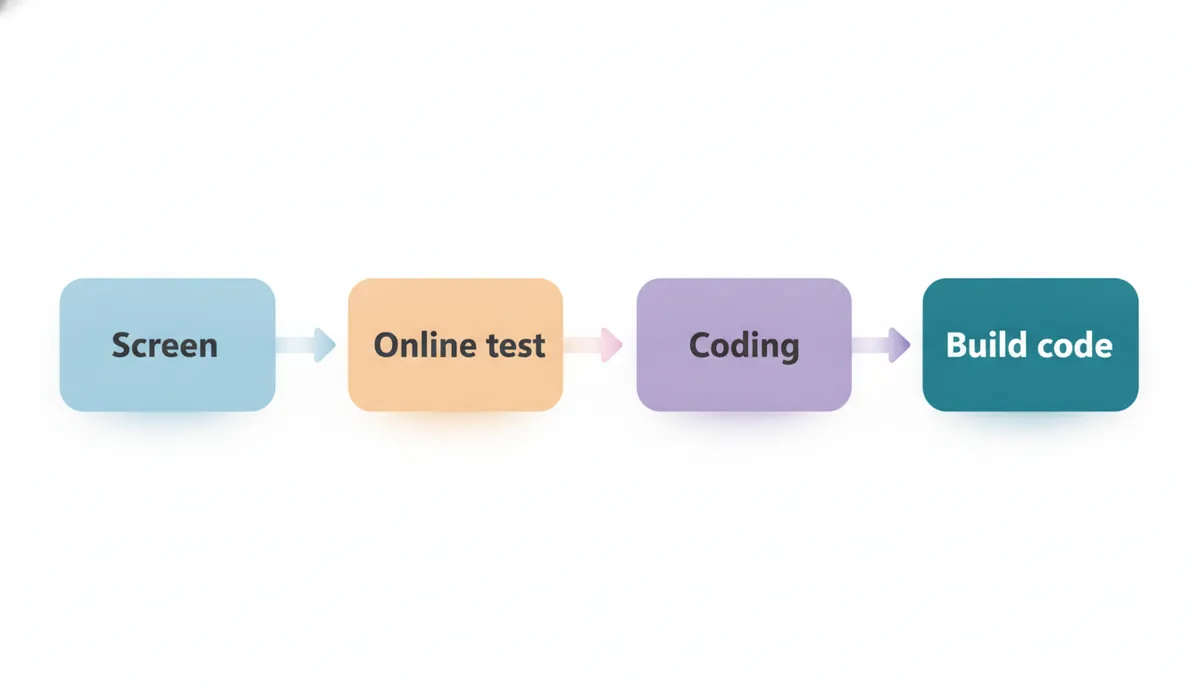
Reported accounts describe a recruiter conversation followed by an online assessment, then a loop of technical and hiring-manager conversations. The online assessment is reported to include two algorithm questions on HackerRank. After that, candidates commonly encounter coding rounds, an LLD round, system design for experienced roles, and a behavioural or hiring-manager discussion.
The machine coding / LLD stage is usually distinct from the algorithmic coding conversations. It is therefore not the place to demonstrate that you remember an obscure graph technique. The interviewer is more likely to assess whether you can take a practical feature request and organise it into code that another engineer could understand and extend.
For experienced candidates, reports also describe a separate system-design discussion. That distinction matters:
- Machine coding and LLD focus on classes, interfaces, state, object relationships, API shape, testability and change.
- System design focuses on components, data flow, scale, reliability and operational trade-offs.
- DSA coding focuses on correct logic, complexity and structured problem solving.
If you are unsure where one ends and the other begins, read low-level design vs high-level design: what interviews actually expect. It will stop you from answering an LLD prompt with an architecture diagram or over-engineering a small coding exercise with distributed infrastructure.
What the format commonly looks like
Candidate reports commonly place the LLD round at around 45 to 60 minutes. It is reported to begin with a short background discussion, followed by some CS-fundamentals questions or a project deep-dive, before moving into the design exercise.
The exact prompt changes by interviewer, team and level. The recurring shape is more stable:
- You receive a practical, deliberately incomplete problem.
- You clarify assumptions, rules and edge cases.
- You identify the core objects and the relationships between them.
- You explain or write the important flows.
- The interviewer changes a requirement and watches how your design responds.
Sometimes the code is the centre of the round; sometimes the conversation around classes and interactions is more important. Prepare for both. You should be able to sketch a clean design first, then implement the critical path without needing to reinvent the model halfway through.
A strong answer normally keeps infrastructure deliberately light unless the prompt demands it. In-memory state, a simple driver, and focused methods are often enough to establish the design. The objective is not to build a production service. It is to show sound engineering judgement under constraints.
💡 Pro Tip: When the interviewer gives a vague requirement, say your assumption aloud before acting on it. A visible assumption can be corrected. A hidden one can turn a correct implementation into the wrong solution.
What graders reward, in rough order of weight
There is no public Microsoft rubric, and reported experiences vary. Still, the signals below are the most useful approximation of what an interviewer can actually observe during a machine coding round.
1. A correct core flow
The strongest signal is that the main use case works. Can a caller create the central objects, invoke the key operation, and get the expected result? If you write code, it should compile or be close enough that its behaviour is unambiguous.
A clean design that never reaches a working path is difficult to credit. Start with the smallest complete journey through the system.
2. Clear ownership of behaviour and state
Interviewers look for whether each class has a reason to exist. State should live with the object that owns it; behaviour should sit near the data and invariants it protects. A controller that knows every internal detail of every object is a warning sign. So is a model made entirely of getters and setters while one giant service performs all the work.
Explain your placement decisions. “This object owns the transition because it validates its own state” is much stronger than silently moving methods around until the diagram looks tidy.
3. Sensible extensibility
Expect a follow-up such as: “What if there are several pricing rules?”, “What if this type of user behaves differently?”, or “How would you add another allocation strategy?”
The right response is not to introduce every design pattern pre-emptively. It is to isolate the part that genuinely varies. An interface is useful when different implementations have a real behavioural difference. A factory is useful when construction logic is becoming a concern. If nothing varies, plain code is often better.
The free Low Level Design Sheet is useful for building this judgement through repeated examples rather than memorising pattern names.
4. Communication and requirement discovery
Machine coding is an interactive round. The interviewer can see whether you clarify the happy path, invalid inputs, capacity rules, ordering requirements and expected outputs before you code.
Narrate in short checkpoints:
- “I will first support the core booking flow.”
- “I am assuming one active reservation per resource.”
- “The behaviour that varies is the selection strategy.”
- “I will now add a small driver to demonstrate the flow.”
This makes your reasoning inspectable and creates opportunities for correction early, when changes are cheap. For a deeper guide to this skill, read how to explain your thought process clearly in coding interviews.
5. Readability and disciplined implementation
Names, small methods, limited duplication and a simple demonstration matter. They are not cosmetic. Readable code lets the interviewer verify your thinking quickly.
Do not spend ten minutes polishing formatting while a major flow remains absent. But once the core path works, cleaning up unclear names and repeated logic is one of the safest ways to improve the impression your code makes.
A practical time plan for the round
Treat the reported 45-to-60-minute window as a budget, not an invitation to design indefinitely.
| Time | Focus | Output |
|---|---|---|
| Opening minutes | Clarify scope and assumptions | Agreed core use case |
| Early section | Identify objects and interactions | Small class sketch |
| Main section | Implement the critical path | Working core flow |
| Next section | Handle one meaningful variation | Focused extension point |
| Final minutes | Test, explain trade-offs, recap | Clear demonstration |
The table is deliberately biased towards implementation. Candidates often reverse it: they spend most of the round listing entities and leave no time to establish that the design does anything.
If the prompt is discussion-led rather than code-led, keep the same sequence. Clarify first, model second, walk through a concrete flow third, then discuss the change request. A design discussion still needs an executable mental model.
Midway through your preparation, revisit Microsoft’s interview kit and solve the design problems in two passes: first without a timer to understand the modelling choices, then under a strict timer to rehearse prioritisation.
Failure modes that cost strong candidates
Building abstractions before behaviour
A candidate creates interfaces, factories, abstract base classes and multiple layers before they have implemented a single main flow. The result can look sophisticated while remaining untested and incomplete.
Better approach: write the simplest version first. Extract an abstraction only when a concrete variation gives it a job.
Treating the prompt as complete
Most machine coding prompts contain omissions. Candidates who never ask about invalid states, ties, limits, cancellation, ownership or output format often build a system that reflects their private assumptions rather than the requirement.
Better approach: ask a handful of high-value questions, state assumptions, and move forward. Do not turn clarification into a prolonged interrogation.
Writing a procedural blob
Putting all logic into a single service class is fast at first and painful immediately afterwards. It makes the follow-up requirement harder because every new rule must pass through the same central method.
Better approach: identify the objects that own important state and rules. Keep orchestration light.
Over-focusing on patterns
Knowing the names of Strategy, Factory and Observer is not the same as knowing when to use them. Forced patterns add indirection without solving a problem.
Better approach: describe the change you are protecting against. If you cannot name it, you probably do not need the abstraction yet. The design patterns interview guide is a useful reference for learning the intent behind common patterns.
Leaving no time to demonstrate the answer
Even a good implementation needs a short walkthrough. Candidates who type until time expires miss the chance to show the key flow, explain trade-offs and identify the next improvement.
Better approach: reserve the end of the round. Walk through one normal case and one edge case, then summarise what you would build next with more time.
Staying silent after receiving a follow-up
A follow-up is not necessarily evidence that your first design was wrong. It is often the actual test: can you reason about change without panicking or starting again?
Better approach: pause, identify the affected responsibility, explain the smallest modification, and discuss any trade-off. Calm revision is a positive signal.
A two-week Microsoft machine coding practice plan
This plan assumes you can give focused daily sessions. Keep DSA practice alive separately, but make this fortnight about design fluency.
Week one — build sound modelling habits
Days one and two: Review object-oriented basics: encapsulation, composition, interfaces, inheritance and dependency direction. Take a small domain and model it in your preferred language. Focus on responsibilities, not pattern vocabulary.
Days three and four: Solve two design exercises without a timer. For each, write down the core use case, candidate objects, invariants and one likely extension. Compare your solution with an editorial only after you have committed to a design.
Day five: Practise writing a small driver or test harness. The goal is to demonstrate a full user journey, not merely define classes.
Day six: Take one earlier solution and add a changed requirement. Notice where the design bends cleanly and where it requires edits across several classes.
Day seven: Review. Explain each solution aloud in five minutes: requirement, assumptions, model, flow, extension and trade-off.
The free Code Practice environment can help you keep implementation sharp while you rehearse concise explanations.
Week two — practise under interview conditions
Days eight and nine: Set a 60-minute timer for one problem each day. Build the core flow first. At the end, write down exactly where time went.
Days ten and eleven: Repeat with unfamiliar problems. Before coding, spend only a short period clarifying and sketching. This trains you to make decisions with incomplete information.
Day twelve: Run a mock discussion. Ask a friend to interrupt with changing requirements, or use an AI interview to rehearse explaining design decisions under pressure.
Day thirteen: Pair LLD work with a brief system-design review. Experienced Microsoft candidates may also encounter a system-design discussion, so browse the free System Design Sheet and practise articulating the boundary between component design and class design.
Day fourteen: Do one final timed round, then review your recording or notes. Grade yourself on working behaviour, ownership, extensibility, communication and code clarity—in that order.
Frequently asked questions
Is the Microsoft machine coding round separate from DSA coding?
Reported accounts commonly describe separate coding and LLD conversations. DSA rounds assess problem solving and complexity, while the machine coding / LLD stage focuses on object modelling, clean code and design judgement.
How long is Microsoft’s LLD round?
Reported accounts commonly place it at 45 to 60 minutes. Confirm the expected format with your recruiter because teams and levels can vary.
Does Microsoft ask low-level design for entry-level roles?
Candidate reports describe an LLD round in the broader loop, but exact expectations vary by role and experience. Less experienced candidates should still be ready to model classes, relationships and basic extensibility clearly.
Is system design part of the same round?
Usually, no. Reported accounts distinguish LLD from a system-design round for experienced roles. The former is class-level design; the latter is architecture-level reasoning.
What language should I use for machine coding?
Use the language in which you can write idiomatic, readable code quickly. The language matters less than your ability to organise the solution, explain it and complete the main flow.
Should I use design patterns in every answer?
No. Use a pattern only when it captures a real source of variation or complexity. Unnecessary abstractions can make a simple answer less clear.
Do I need to write fully compiling code?
Aim for a working, coherent implementation whenever code is expected. A complete core flow is more valuable than an elaborate but unfinished framework.
What should I ask before I start coding?
Clarify the main use case, important constraints, invalid states, ordering or selection rules, expected output and whether persistence or concurrency is in scope. Then state any remaining assumptions.
How should I prepare for the hiring-manager discussion?
Prepare specific stories about your own projects: the decision you made, the constraint you faced, the outcome and what you would change now. Reported accounts describe a hiring-manager discussion that may ask you to design a feature from your own past project.
Start with the design round that changes your outcome
The Microsoft machine coding round rewards practical judgement more than decorative complexity. A candidate who clarifies the problem, models the core objects cleanly, completes a working path and adapts calmly to change will usually show stronger engineering ability than one who reaches for every pattern they know.
Use Microsoft’s interview kit to work through 181 mapped DSA questions, nine low-level design problems, and six system design problems. The design sets are the most direct place to rehearse class design and timed implementation, while the DSA material helps keep the separate coding rounds sharp.
The sheets are free to browse. When you are ready to rehearse the conversation as well as the code, use an AI mock interview and practise explaining each decision out loud.
Topics
Related on Thita
Your next step
Practise with AI mock interviews
A spoken interview that asks follow-up questions, runs your code and ends with a written report.