
Interview
Morgan Stanley Machine Coding Round: Preparation Guide (2026)
Prepare for Morgan Stanley's machine coding round with a practical framework for working code, sound object design, timed rehearsal and clear communication.
The Morgan Stanley machine coding round is not a test of whether you can name every design pattern from memory. It is a test of practical engineering judgement: can you turn an incomplete problem into a small, coherent program, make the important path work, and explain the choices you made?
That distinction matters. Candidates often prepare for coding interviews by solving isolated algorithmic puzzles, then discover that a machine-coding task demands a different workflow: clarify the rules, identify the core objects, keep state manageable, write executable code, and demonstrate it before time expires.
For focused practice, Morgan Stanley's interview kit includes 3 mapped DSA questions and 3 low-level design problems. Use the design set to rehearse building software from a blank file rather than merely describing an ideal design.
This guide stays focused on the machine-coding and low-level design work. For the broader interview process, use your recruiter’s current guidance alongside your preparation materials, because reported processes can differ by role, location and level.
Where machine coding sits in the process
Treat machine coding as a technical design evaluation rather than an extension of a conventional DSA round. A DSA problem usually has a narrow input-output contract and a recognisable algorithmic shape. A machine-coding prompt gives you a small product or workflow and asks you to make engineering decisions the prompt does not completely specify.
The available round-mix research does not establish one standard Morgan Stanley sequence, a fixed placement for machine coding, or a universal duration. That is worth handling directly rather than preparing against a made-up script: ask your recruiter whether the interview is live coding, class-design discussion, take-home work, or a combined exercise, and ask what tools and time constraints apply.
Regardless of the format, the preparation target is consistent:
- Translate requirements into a small set of objects and responsibilities.
- Build the main user flow before optional features.
- Keep the code easy to inspect and change.
- State assumptions early instead of silently inventing requirements.
- Demonstrate the result through a driver, tests or a concise walkthrough.
A machine-coding round can feel open-ended, but it is rarely looking for a production-scale system. Interviewers need to see whether you can make sensible trade-offs under a constraint. A smaller working solution with clear seams usually creates a stronger signal than an elaborate architecture with no completed flow.
Format and time limit: what to prepare for
There is no reliably established common time limit for the Morgan Stanley machine coding round in the supplied candidate-report research. Do not assume that a format reported for another company will apply here. Confirm the duration, language options, IDE rules and whether tests are expected with your recruiter.
Still, you can prepare for the likely pressure points of a timed practical exercise. The interviewer may give a domain problem such as booking, inventory, notifications, permissions, payments, scheduling or a small workflow engine. The actual domain matters less than the skills beneath it:
- extracting the core requirements;
- separating data from behaviour;
- modelling changing behaviour without overengineering;
- handling invalid states and edge cases;
- writing code that can be run and explained.
If the round is discussion-led rather than implementation-heavy, apply the same process on a whiteboard or shared document. Start from the central flow, name the objects, assign responsibilities, then discuss how the design would absorb the next requirement.
The Low Level Design Sheet is free to browse and is useful for practising those choices across different problem shapes. Before you start, it also helps to understand the boundary between component-level design and architecture-level design; low-level design versus high-level design explains what each format tends to assess.
What graders reward, in rough order
Exact scoring rubrics are rarely published, so treat this as a practical ordering of the evidence a good machine-coding solution provides.
1. A correct core flow
The first question is simple: does the main scenario work? If the task is to create, update, allocate, reserve, search or cancel something, can your code actually do it?
This is the heaviest signal because every later quality depends on it. A clean interface hierarchy does not compensate for a program that cannot perform the requested action. Start with one happy path, run it, then extend it.
2. Sound separation of responsibilities
Good design makes it obvious where a change belongs. Entities hold state and domain rules. Services coordinate workflows. Repositories or stores manage retrieval. Input and output code stays at the edges.
You do not need ceremonial layers for a small exercise. You do need to avoid one class that stores every piece of state, performs every validation, prints every response and controls every workflow. That structure is difficult to test, explain and modify.
3. Requirement judgement
Machine-coding prompts are intentionally incomplete. Strong candidates distinguish between a necessary clarification and an optional feature.
Ask about rules that affect correctness: uniqueness, ordering, capacity, cancellation, invalid input, ownership and concurrency assumptions. Then state a reasonable assumption when the missing detail is not central. This shows that you can move forward without pretending uncertainty does not exist.
4. Extensibility where change is plausible
Interviewers often ask, “What if we add another type?” or “How would this support a new rule?” Your design should have a credible answer.
Use an interface, strategy or policy object when behaviour genuinely varies. Keep a simple conditional when it does not. The goal is not to display patterns; it is to make likely changes local rather than expensive.
For a refresher on recognising when a pattern earns its place, read design patterns for interviews. The useful question is always: what specific variation does this abstraction isolate?
5. Readable, maintainable code
Names should explain intent. Methods should be short enough to follow. Mutable state should have an obvious owner. Error handling should fit the exercise rather than becoming an afterthought.
Readable code is not cosmetic. In a live interview, it lets the interviewer understand your reasoning quickly and gives you room to adapt when a follow-up changes the requirement.
6. Clear communication and demonstration
Say what you are doing as you do it. After coding, walk through the objects, the central flow, a key trade-off and one future extension. Run the code or demonstrate representative cases when possible.
The interviewer cannot award credit for reasoning they never hear. How to explain your thought process clearly in coding interviews offers a practical structure for narrating that work without talking continuously.
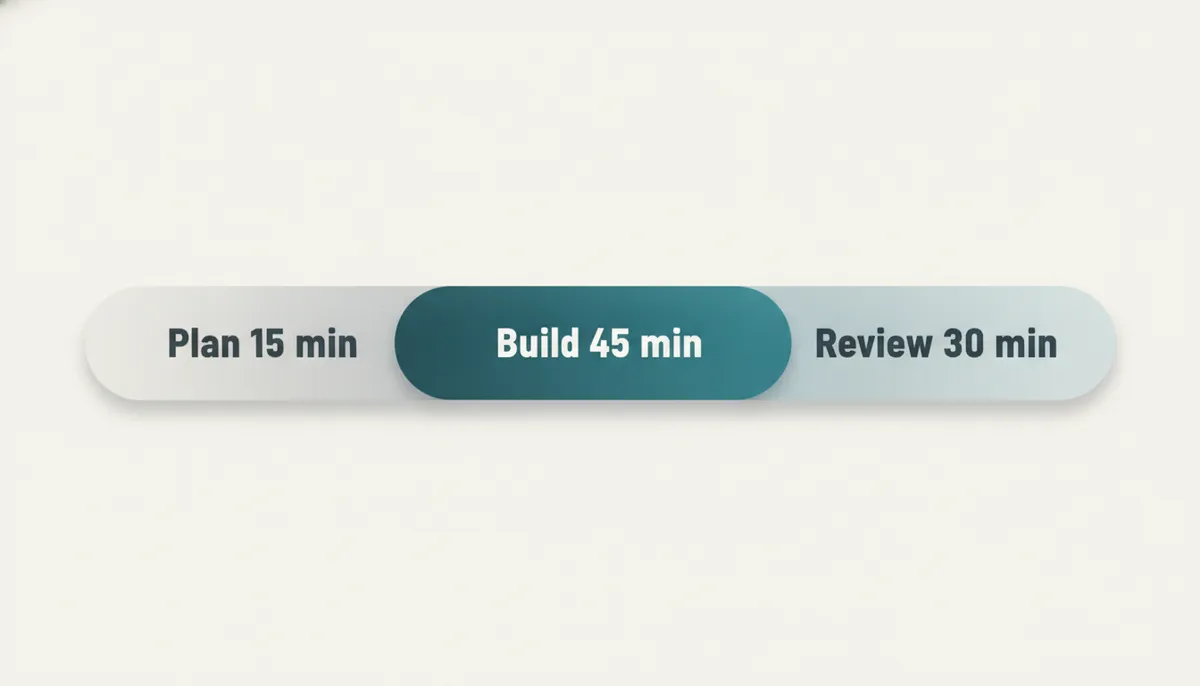
How to structure the available time
Use the interviewer’s stated limit as the source of truth. Rather than relying on a fixed number of minutes, divide whatever time you receive into phases. Protect the final slice for validation and explanation.
| Share of available time | Focus | Output before moving on |
|---|---|---|
| First tenth | Clarify the brief | Core use cases, constraints and assumptions |
| Next tenth | Sketch the design | Main objects, relationships and public methods |
| Middle half | Build the core | A runnable happy path with essential validation |
| Next fifth | Strengthen the solution | Edge cases, cleaner boundaries and one extension |
| Final tenth | Verify and explain | Demo, test cases, trade-offs and next steps |
This is deliberately not a rigid script. If the prompt is familiar, spend less time modelling and begin coding earlier. If the interviewer adds requirements, pause, restate the change and adjust the smallest possible part of the design.
The rule that protects most candidates is this: get something running before you make it elegant.
A useful rehearsal method is to start in in-browser code practice, where you can focus on writing and testing without setting up a project. Then repeat the same design from scratch under a timer. Your first attempt teaches the domain; the second reveals whether you have a repeatable process.
Common failure modes
Coding before understanding the rules
Candidates hear “build a library” or “design a parking system” and immediately create classes. Ten minutes later, a fundamental rule emerges: borrowing limits, allocation priority or cancellation behaviour. Now the initial model fights the actual requirement.
Prevent this by asking a few targeted questions before writing code. Do not turn clarification into delay; identify the decisions that change the design, state assumptions, then begin.
Building abstractions before a working path
Factories, builders, interfaces and event buses can all be useful. But introducing them before the main flow works is a frequent way to run out of time.
Write the smallest version that performs the job. Once it runs, refactor the point where variation is real. This order makes trade-offs visible and keeps your implementation honest.
Treating every edge case as equally important
A good solution handles meaningful invalid states. It does not spend half the round modelling every theoretical failure while the main functionality remains incomplete.
Prioritise by impact. First make the central workflow correct. Then cover the edge cases most likely to be raised by the prompt or interviewer. Name further considerations if time is short.
One giant service class
A single “Manager” class that owns all collections, validates every action and coordinates every operation is tempting because it is fast to start. It becomes hard to reason about almost immediately.
Split by responsibility, not by pattern vocabulary. Ask which object should know a rule, which object should own a state transition, and which component should coordinate the workflow.
Not testing the code you wrote
A solution that compiles is not necessarily a solution that works. Run a happy path, an invalid action and a boundary case. If you cannot execute code in the environment, trace these cases aloud.
This habit is especially important in live coding. Our guide to what interviewers actually look for in live coding rounds explains why verification and communication often matter as much as the final algorithm or class diagram.
Going silent after the implementation
The final review is your opportunity to make the design legible. Summarise the core objects, show the main flow, identify the compromise you made for time, and explain how you would extend the solution.
Do not wait to be asked every question. A concise walkthrough demonstrates ownership.
A two-week preparation plan
Week one: build design fluency
Day one: Choose a small domain problem and write only the requirements, assumptions and object model. Do not code until you can explain the central flow aloud.
Day two: Implement that model with a runnable driver. Focus on correct behaviour, not patterns.
Day three: Rebuild the same problem from scratch. Compare your second version with the first and remove unnecessary complexity.
Day four: Practise identifying responsibilities. Take an existing solution and split one oversized class into focused objects.
Day five: Add one realistic extension: a new policy, state transition or user type. Notice whether the change is local.
Day six: Work through one of the low-level design problems in Morgan Stanley's interview kit. Write down your assumptions before implementation.
Day seven: Review. Explain two completed solutions out loud in five minutes each: requirements, model, core flow, trade-off and extension.
Week two: practise under interview conditions
Day eight: Do a timed implementation rehearsal. Reserve time for tests and a walkthrough.
Day nine: Practise communication. Solve a small design prompt while narrating assumptions, choices and complexity.
Day ten: Revisit DSA fundamentals with the free-to-browse DSA Patterns Sheet. Machine coding and DSA reward different skills, but clear problem framing helps in both.
Day eleven: Build a new design problem with deliberate constraints: in-memory storage, no framework, one core flow and a simple driver.
Day twelve: Run a mock discussion using AI mock interviews. Focus on responding calmly to changed requirements and trade-off questions.
Day thirteen: Complete another timed design exercise from Morgan Stanley's interview kit. Review only after you have demonstrated a working flow.
Day fourteen: Do a final rehearsal. Start with clarifying questions, sketch the design, code the core, test it and deliver a short summary. The aim is not novelty; it is a dependable routine.
Frequently asked questions
Is the Morgan Stanley machine coding round the same as a DSA round?
No. DSA rounds focus on algorithms, data structures and complexity. Machine coding focuses on turning requirements into working, maintainable software with sensible object design.
How long is the Morgan Stanley machine coding round?
The available research does not establish a universal duration. Confirm the format and time limit with your recruiter, then practise using proportional time blocks.
What language should I use?
Use the language in which you can write clean, idiomatic code quickly. Fluency, testing ability and comfort with basic object-oriented features matter more than choosing a fashionable language.
Should I use design patterns?
Use them when they solve a visible source of variation or complexity. Avoid adding patterns merely to show familiarity with them.
Do I need a database or framework?
Do not assume so. Many machine-coding exercises can be solved with in-memory state and a simple driver. Follow the interviewer’s environment and requirements.
What should I ask before coding?
Clarify the core workflow, invalid actions, ownership rules, ordering or capacity constraints, and the expected scope. Then state assumptions for non-essential details.
What matters more: clean code or a complete solution?
Get the core flow working first. Then improve organisation and handle the most important edge cases. A polished but incomplete design is difficult to assess positively.
How do I demonstrate extensibility?
Identify one plausible next requirement and explain the smallest design change needed to support it. Your answer should be concrete, not a vague claim that the code is “scalable”.
How should I practise without an interviewer?
Set a timer, state your assumptions aloud, write a runnable driver and record a short walkthrough afterwards. An AI mock interview can help you rehearse follow-up questions and communication.
Start with a working core
The Morgan Stanley machine coding round rewards practical discipline: understand the problem, model only what matters, build the critical flow, test it and explain it clearly. The best preparation is repeated implementation, not passive reading.
Open Morgan Stanley's interview kit to practise the 3 mapped DSA questions and 3 low-level design problems associated with the company. Pair those exercises with the free-to-browse Low Level Design Sheet, then rehearse your explanation in an AI mock interview.
Confirm the exact interview format with your recruiter, but arrive with a process that works whether the prompt is a shared-editor build, a class-design discussion or a practical coding exercise.
Topics
Related on Thita
Your next step
Practise with AI mock interviews
A spoken interview that asks follow-up questions, runs your code and ends with a written report.