
Interview
Paypal Interview Questions and Process: Complete Guide (2026)
Prepare for Paypal interview questions with a clear round-by-round framework, a 30-day plan, and focused practice for coding and design discussions.
Paypal interview questions are best prepared for as a combined coding, design and communication challenge: practise recognising core algorithmic patterns, explain your reasoning clearly, and be ready to defend practical engineering trade-offs. The supplied research does not establish a single reliable Paypal round sequence, timing or named ritual, so treat recruiter guidance as the source of truth for your specific role. For focused practice, Paypal's interview kit holds 20 mapped DSA questions, 1 low-level design problems, 1 system design problems evidenced at Paypal.
The practical takeaway is simple: do not prepare for a list of isolated questions. Build a repeatable interview process. Understand a problem before coding, communicate the approach and complexity, test deliberately, and connect design decisions to the constraints that caused them.
This guide gives you a useful round-by-round preparation framework, explains what each format usually screens for, and provides a 30-day plan that you can adapt after speaking with your recruiter.
The process at a glance
The research available for this guide does not support a fixed, company-wide Paypal loop. Interview structure can differ by role, level, location, team and hiring route. The table below is therefore a preparation map rather than a promise that every candidate will see every stage.
| Stage to prepare for | Likely format | What it screens for | Best preparation focus |
|---|---|---|---|
| Coding assessment or screen | Timed or live programming | Pattern recognition, correctness, complexity | Core DSA patterns and edge cases |
| Live coding discussion | Collaborative problem solving | Communication, debugging, structured thinking | Narrating trade-offs while coding |
| Low-level design | Object and interaction design | Modelling, extensibility, code structure | Responsibilities, interfaces, tests |
| System design | Architecture discussion | Scoping, scale reasoning, trade-offs | Requirements, APIs, data flow |
| Hiring conversation | Project and behavioural discussion | Ownership, collaboration, judgement | Specific project stories |
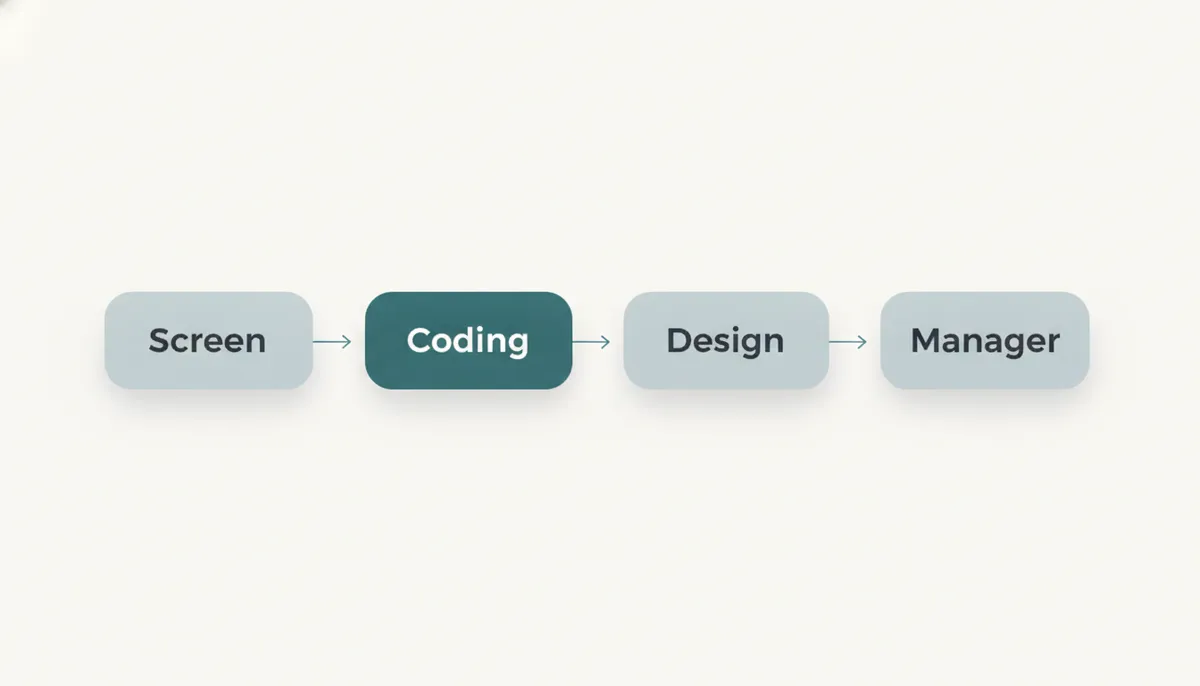
Use the table to organise your preparation, then ask the recruiter which stages apply to your interview. Useful questions include whether there is an assessment, whether design is expected at your level, whether you will code in a shared editor, and whether a project discussion is part of the loop.
Coding assessment or initial screen
A coding assessment or early technical screen is designed to establish a baseline quickly. The interviewer or platform is not merely looking for code that works on a happy path. They are looking for whether you can turn an ambiguous prompt into a correct, efficient solution without losing control of the clock.
Start by clarifying inputs, outputs and constraints. Then state the simplest valid approach before optimising it. This makes your reasoning visible and gives the interviewer a chance to redirect you early if necessary. Once you have selected an approach, name its time and space complexity before writing the implementation.
The most transferable topics are arrays, strings, hash maps, two pointers, sliding windows, binary search, stacks, queues, trees, graphs and dynamic programming. Rather than treating these as separate chapters, learn the signal that selects each pattern. For example, a sorted search space may suggest binary search; a contiguous-subarray constraint may suggest a sliding window; repeated state with optimal choices may suggest dynamic programming.
The DSA Patterns Sheet is free to browse and organises problems by reusable solution shapes. Pair it with how to identify the right DSA pattern in a coding interview if you often understand a solution after the fact but struggle to spot it under pressure.
💡 Pro Tip: Do not save testing for the end. Before you submit or announce that you are done, test an empty input where relevant, a smallest valid input, duplicates, boundary values and one ordinary case. A clean solution with an untested boundary bug is still a bug.
Live coding: make your reasoning assessable
Live coding is not a silent programming exercise. It screens for the way you collaborate through an unfamiliar problem.
A strong candidate gives the interviewer a running commentary that is short but useful:
- Restate the problem in your own words.
- Ask one or two high-value clarifying questions.
- Describe a baseline solution.
- Explain why it is or is not efficient enough.
- State the chosen data structures.
- Code in small, testable pieces.
- Walk through an example aloud.
This sequence prevents a common failure mode: writing a substantial amount of code for an interpretation the interviewer did not intend. It also makes debugging easier because the interviewer can see the assumptions behind the implementation.
When you get stuck, avoid retreating into silence. Say what you have ruled out, what invariant you are trying to maintain, or which example breaks the current idea. That is evidence of structured reasoning, not evidence of failure. Read what interviewers actually look for in live coding rounds for a fuller breakdown of this format.
Practise in conditions that resemble the interview: one editor, a timer, no copied solution, and an explanation spoken aloud. Code practice can help you rehearse implementation and review habits between full mock sessions.
Low-level design: model the changing parts
Low-level design examines whether you can turn a set of behaviours into a codebase that is understandable today and adaptable tomorrow. You may be asked to identify entities, define relationships, isolate changing behaviour and describe how the system will be exercised.
The key is not to produce the largest class diagram. It is to make responsibilities clear.
Begin with the core flow. What must a user or another system be able to do? Which objects own state? Which object coordinates the workflow? What rules should live close to the data they govern? Only after answering those questions should you introduce interfaces, inheritance or patterns.
A dependable discussion structure is:
- identify the main entities and their state;
- define the most important operations;
- show the interaction for one complete user flow;
- identify a requirement likely to change;
- explain how the design absorbs that change;
- describe tests and failure handling.
Paypal's kit includes the kind of low-level design problem evidenced at Paypal. Use it to practise making design choices explicit: why a dependency sits behind an interface, why an object owns a particular rule, and what extension would force you to revisit the model.
The Low Level Design Sheet is free to browse if you need a structured way to revise design principles, common patterns and class-level trade-offs. For the distinction between code-level design and architecture-level design, see low-level design vs high-level design: what interviews actually expect.
✅ Do: Build the simplest model that supports the required flow, then discuss one realistic extension.
❌ Don't: Add factories, strategies and abstract base classes before you can explain what varies and why.
System design: scope before you scale
A system design round tests decision-making under incomplete information. There is rarely one correct architecture. Instead, the interviewer wants to see whether you can ask for the right constraints and make trade-offs that follow from them.
Start by defining functional requirements: what must the system do? Then identify non-functional requirements: availability, latency, consistency, throughput, security, data retention and expected growth. Without this step, decisions about databases, queues, caches and service boundaries are decorative rather than justified.
A useful progression is:
- Clarify the users, core actions and success criteria.
- Estimate rough traffic and data volume only if they affect the design.
- Draw the simplest end-to-end request path.
- Select storage based on access patterns.
- Identify bottlenecks and failure points.
- Add caching, asynchronous processing, replication or partitioning only when they solve a stated constraint.
- Close by naming the most important trade-off.
Paypal's interview kit also contains the kind of system design problem evidenced at Paypal. Treat it as an opportunity to practise architecture explanations rather than memorising a diagram. The System Design Sheet is free to browse and can help you revise the building blocks behind those discussions.
When you make a choice, connect it to a reason. “I would use a queue” is incomplete. “I would use a queue because the downstream operation can be processed asynchronously and we need to smooth traffic spikes” is an engineering argument.
Hiring and behavioural conversations
Technical strength is necessary, but it does not explain how you work with a team. Project and behavioural conversations commonly probe ownership, communication, conflict, prioritisation and judgement.
Prepare four stories from your own work:
- a project where you owned an important decision;
- a difficult technical trade-off;
- an incident, mistake or failure you helped resolve;
- a disagreement that ended in a better outcome.
For each story, be precise about your own contribution. “We improved the service” is a weak answer until you explain what you personally investigated, proposed, implemented or changed. Use a simple situation, action and result structure, but do not sound rehearsed. The aim is clarity, not theatre.
Practise answering follow-up questions. What alternatives did you reject? What metric changed? What would you do differently? What did another person disagree with? Those details make an experience credible and reveal mature reflection.
AI mock interviews are useful for rehearsing coding explanations, design conversations and behavioural answers aloud. The first attempt may feel awkward; that is exactly why it is worth doing before the real conversation.
Named rituals and process variability
No named Paypal ritual is documented in the research supplied for this article. That matters because candidates sometimes overfit their preparation to an alleged company tradition, a fixed round count or a precise interview duration found in a single anecdote.
Instead, prepare for the skills that remain useful across reasonable variations in format: coding fluency, concise communication, design judgement and credible project ownership. Then use recruiter information to tailor the final week.
If the recruiter confirms a particular format, ask what you can reasonably expect from the environment. For coding, ask about language support and whether the session is collaborative. For design, ask whether the focus is class design, architecture, or a project deep dive. These are preparation questions, not attempts to obtain the prompt in advance.
Is the Paypal interview hard?
It can be hard because it requires breadth, not because every stage necessarily rewards the same skill.
The research supplied here does not establish how many Paypal rounds every candidate faces or a reliable end-to-end timeline. Do not rely on a generic estimate. Ask your recruiter for the expected sequence, the interview dates and the level-specific emphasis.
What makes the process demanding in practice is the switch between modes. Coding asks for accuracy under time pressure. Design asks for judgement under ambiguity. Project discussion asks for detail and self-awareness. Candidates often prepare deeply for one mode and leave the others until late.
A useful self-check is this: can you solve a medium coding problem while explaining every major decision; design a small service without overengineering it; and discuss a real project’s trade-offs without vague language? If one answer is no, that is where your next preparation block belongs.
A 30-day Paypal preparation plan
Week 1 — rebuild coding recognition
Work through the core DSA patterns with an emphasis on recognising the signal, not collecting solved problems. Spend each session identifying the likely approach before you code. Review mistakes by category: missed pattern, incorrect invariant, complexity error, implementation bug or incomplete testing.
Use the free-to-browse DSA Patterns Sheet, and reserve one session for graphs and another for dynamic programming. The guide to graph traversal patterns with DFS and BFS is especially useful if traversal choices feel arbitrary.
Week 2 — explain and implement
Continue coding, but make every practice problem a spoken exercise. Start each answer with assumptions, approach and complexity. End every answer with a test walkthrough.
Complete two timed mock sessions this week. Afterwards, review whether your explanation made the code easier to follow. If not, reduce the commentary to decisions and trade-offs rather than narrating every keystroke.
Week 3 — design foundations
Spend the first half of the week on low-level design: entities, responsibilities, interfaces, dependencies and testability. Then move to system design: requirements, APIs, storage, scaling and failure modes.
Work through the design material in Paypal's interview kit, then redraw your solution from memory. The goal is not to reproduce an editorial. It is to be able to defend your own decisions and improve them after feedback.
Week 4 — integrate and rehearse
Alternate coding, design and behavioural practice. Run at least two complete mock sessions with realistic constraints: an opening explanation, a technical task, questions at the end and a short self-review.
Prepare project stories and tighten them until each has a clear personal contribution, a measurable or observable result, and an honest reflection. Keep the final two days lighter. Review patterns, sleep properly and avoid cramming unfamiliar material.
What is specific to Paypal preparation?
The useful Paypal-specific preparation asset is the balance of practice material in Paypal's interview kit: 20 mapped DSA questions, 1 low-level design problems, 1 system design problems evidenced at the company.
That gives you a practical way to connect algorithmic practice with design practice without treating either as an afterthought. Begin with the DSA set to improve recognition and implementation discipline. Then use the design problems to rehearse the transition from “find the answer” to “justify the architecture”.
Keep the attribution appropriately narrow. A design problem evidenced at Paypal is a useful practice shape, not a guarantee that an interviewer will use an identical prompt. Learn the underlying decisions: clarify the scope, identify the important data, choose boundaries, handle failure and explain what would change at greater scale.
Frequently asked questions
What should I study for Paypal interview questions?
Prioritise core DSA patterns, live coding communication, practical low-level design, system design fundamentals and project stories.
How many rounds does Paypal have?
The supplied research does not establish a reliable fixed round count. Confirm the sequence for your role with the recruiter.
How long does the Paypal interview process take?
No reliable company-wide timeline is established in the supplied research. Recruiter scheduling and team needs can affect the process.
Does Paypal ask coding questions?
Prepare for coding assessment and live-coding formats, including problem clarification, complexity analysis and careful testing.
Should I practise low-level design?
Yes. Be ready to model responsibilities, interactions, changing requirements and testable code structure.
Do I need system design preparation?
Prepare system design fundamentals, particularly if the recruiter indicates architecture discussion is part of your loop or level expectations.
What programming language should I use?
Use the language in which you can write correct, readable code quickly and explain standard data structures confidently.
How should I answer project questions?
Focus on your individual ownership: the problem, your decisions, trade-offs, outcome and what you learned.
What is the best way to practise under pressure?
Use timed sessions, speak your reasoning aloud, test edge cases deliberately and review both technical and communication mistakes.
Where to start
Start with the technical foundations, then turn them into interview behaviour. Work through the coding patterns, practise explaining decisions aloud, and use a design prompt to rehearse trade-offs rather than memorised diagrams.
Open Paypal's interview kit to practise the 20 mapped DSA questions, 1 low-level design problems, 1 system design problems evidenced at Paypal. Then use the free-to-browse sheets and an AI mock interview to rehearse the format your recruiter confirms.
Interview processes change by role and team. Treat this guide as your preparation framework, and treat your recruiter’s information as the final word on your specific loop.
Topics
Related on Thita
Your next step
Practise with AI mock interviews
A spoken interview that asks follow-up questions, runs your code and ends with a written report.