
Interview
PayTM Machine Coding Round: Preparation Guide (2026)
Prepare for PayTM's machine coding round: understand the reported format, build under pressure, avoid common failures, and follow a two-week LLD practice plan.
The PayTM machine coding round is not a test of whether you can recite design patterns. It is a test of whether you can turn an incomplete product requirement into a small, working, understandable program while explaining the decisions that make it maintainable.
Reported accounts describe PayTM interviews as including DSA and frontend material earlier in the process, followed by a project discussion and low-level design focus. For this guide, the emphasis is deliberately narrow: how to prepare for the machine-coding and class-design work that follows from that shape. For targeted practice, PayTM's interview kit holds two mapped DSA questions and three low-level design problems.
The broader interview process can vary by team and role, particularly where frontend skills are relevant. Confirm the exact format with your recruiter. What does transfer reliably is the skill this round examines: build the core flow first, make responsibilities clear, and leave enough time to show that the code works.
Where machine coding sits in the PayTM process
Candidate reports commonly describe an online stage that can mix DSA, multiple-choice material and a React-oriented machine-coding component. A subsequent technical discussion may cover DSA and frontend basics. The later discussion is where project depth and low-level design are reported to become more prominent, with attention on scalable, modular design.
That distinction matters. A timed React task and a low-level design conversation are not identical formats, but they reward overlapping behaviours:
- converting a feature request into small responsibilities;
- managing state without creating hidden coupling;
- choosing simple boundaries between UI, service, domain and storage concerns;
- making sensible assumptions visible;
- explaining what you would change if the feature grew.
Do not treat the design segment as a theoretical whiteboard exercise. Even when the interviewer begins with a discussion rather than an empty editor, they are usually looking for evidence that your proposed design could become working code without being rebuilt from scratch.
For the wider coding preparation that may precede this stage, the DSA Patterns Sheet is free to browse. Pattern recognition helps you get through coding rounds efficiently; machine coding then asks whether you can organise a real implementation once the problem no longer has a single neat algorithmic answer.
The format: what to expect without assuming a fixed clock
There is no reliable, company-wide public time limit for the PayTM machine coding round. Reported accounts are thin, role-dependent and vary by team. Some accounts point to React-flavoured work in an earlier assessment, while later technical discussion is described as project and LLD focused.
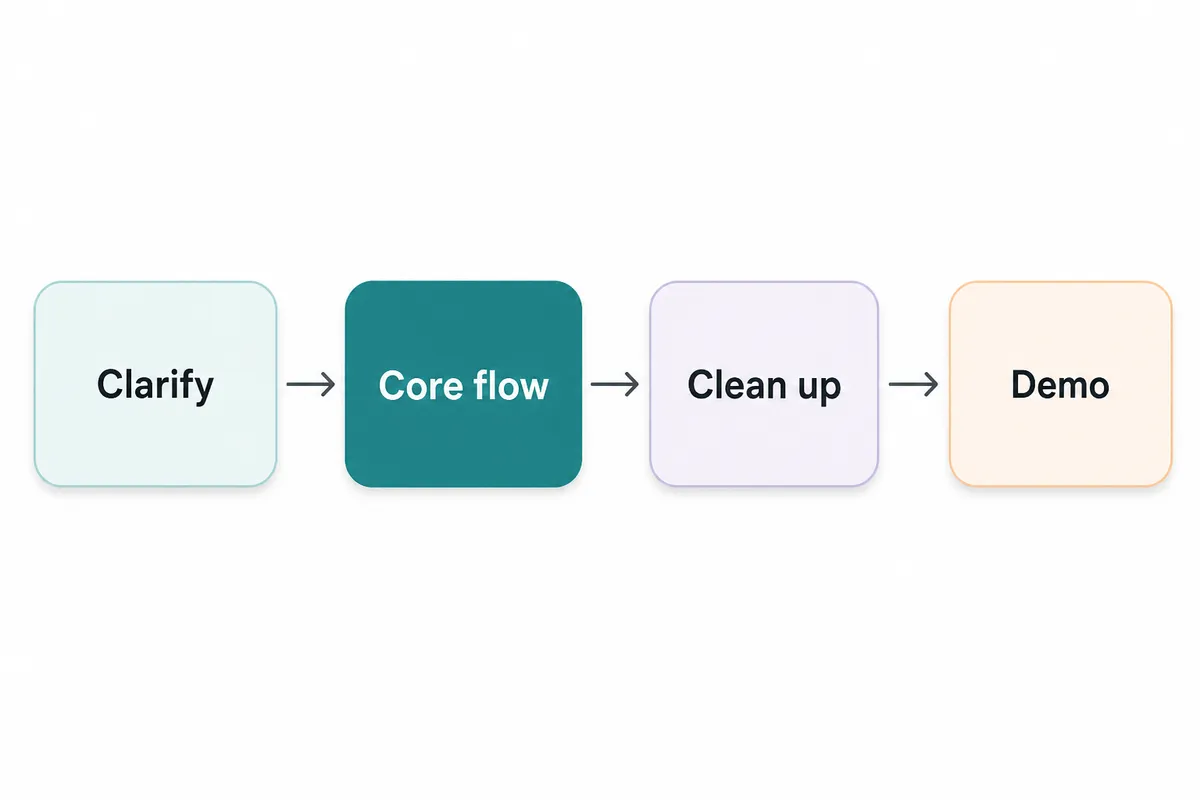
That means your preparation should not depend on memorising a particular duration. Instead, practise a repeatable build sequence that works whether you are asked to code live, extend an existing component, sketch an object model, or discuss how a feature would remain modular as requirements change.
A typical prompt may give you a small business workflow and leave important details unstated. You might need to model objects, accept commands, maintain in-memory state, apply validation, calculate a result, or expose a basic interface. For frontend-oriented work, you may also need to manage component state, loading states, validation and interactions cleanly.
Before writing code, establish these five things:
- The core user action. What is the one flow that must work before anything else?
- The state. What data exists, who owns it, and how does it change?
- The rules. Which actions are allowed, rejected or deferred?
- The boundaries. Which code should know about the interface, business rules and persistence details?
- The proof. How will you demonstrate the important flow before the round ends?
This is not bureaucracy. It prevents a common failure: building a polished outer layer while the actual business rule remains undefined.
What graders tend to reward
The exact rubric is not public, but reported PayTM emphasis on scalable and modular design gives a useful direction. In rough order, a strong machine-coding submission is likely to be rewarded for the following.
1. A working core flow
Correctness comes first. If the task is to create, update, list and validate an entity, those actions should work. If it is a frontend task, the primary user interaction should produce the expected state change. A clean class diagram cannot compensate for a feature that never runs.
Start deliberately small. Make the happy path execute, then handle the important invalid paths. This sequencing shows practical engineering judgement.
2. Clear ownership of responsibilities
Good code answers obvious questions quickly: where does validation live? Which object owns a state transition? Which layer talks to an external dependency? Which component renders data, and which part decides what data should be rendered?
The goal is not maximum separation. It is separation that makes the next change cheaper. A class with a single coherent purpose is better than a hierarchy created merely to demonstrate familiarity with patterns.
3. Extensibility with a reason
Interviewers often introduce a follow-up requirement: another payment mode, another user type, another rule, another status, another sorting option. They are testing whether your first version has useful seams.
Explain your choices in terms of change:
“This rule is isolated because the pricing behaviour may vary later.”
That is stronger than saying, “I used an interface because interfaces are good.” The Low Level Design Sheet is free to browse and is a useful place to practise identifying where a variation point genuinely exists.
4. Sensible assumptions and trade-offs
Machine-coding prompts are intentionally incomplete. Strong candidates do not stop for every missing detail, but they also do not silently invent a large product specification.
State a reasonable assumption, proceed, and invite correction. For example: “I’ll keep this in memory for the exercise and isolate the repository boundary so persistent storage can be added later.” This shows both speed and judgement.
5. Readable, testable code
Names, small methods, predictable data flow and a compact demonstration matter. You do not need a production deployment pipeline. You do need code that another engineer can read, run and extend.
A short driver, a few focused tests, or a visible UI interaction can do more for your submission than another layer of abstraction.
How to structure the available time
Because the exact format and duration vary, use proportions rather than a rigid stopwatch plan. Rehearse this allocation until it becomes instinctive.
| Phase | Share of available time | What to do | Output to protect |
|---|---|---|---|
| Clarify | First tenth | Restate the core flow, ask high-value questions, name assumptions | A precise problem boundary |
| Design | Next fifth | List entities, state, rules and interfaces before coding | A minimal implementation plan |
| Build | Largest share | Implement the happy path, then important validation | Working core behaviour |
| Strengthen | Next fifth | Refactor obvious duplication and add one likely extension | Clearer responsibilities |
| Demonstrate | Final tenth | Run through flows, explain trade-offs and note next steps | Proof that the solution works |
The table contains a priority order, not a request for perfect timekeeping. If you are behind, cut optional enhancements first. Do not cut the demonstration. A candidate who can show a smaller working solution has given the interviewer evidence; a candidate with unfinished ambitious code has created uncertainty.
Midway through practice, use PayTM's interview kit to work through the kind of design problem evidenced at PayTM. After each attempt, review not only the final code but also the order in which you made decisions. Did you build the central flow before considering edge features? Did your abstractions respond to real variation? Could you explain the design in plain language?
Failure modes that cost otherwise good candidates
Starting with a grand architecture
A machine-coding task is not an invitation to recreate a full enterprise platform. Candidates sometimes create factories, managers, repositories, services and adapters before there is enough behaviour to justify them. The result is slow progress and unclear code.
Build one path end to end. Extract only when duplication or a real variation point appears.
Coding before clarifying the rule
The prompt may say “support cancellation” without defining when cancellation is allowed. It may say “show available options” without specifying how availability is calculated. Ask the question that changes the design. If the interviewer leaves it open, state the assumption.
The ability to surface ambiguity is often more valuable than guessing correctly.
Treating frontend work as presentation only
For React-oriented tasks, a neat layout is not enough. Interviewers can still assess state ownership, event handling, error states, validation, component boundaries and data flow. Avoid placing all business logic inside one large component simply because it is faster at the beginning.
A small, clear separation between rendering, state management and domain rules is usually enough.
Over-abstracting too early
A design pattern should reduce future cost, not decorate the submission. Do not introduce multiple subclasses when a small conditional is clearer. Do not create an interface with one implementation unless you can explain the expected variation.
Read design patterns for interviews as a guide to intent, not as a checklist of structures to insert.
Failing to narrate the work
Silence hides good judgement. Give a concise running commentary: what you are building, why a decision belongs in a particular place, what assumption you are making, and what you would tackle next.
For practical ways to keep this explanation structured, see how to explain your thought process clearly in coding interviews.
Leaving no proof of correctness
A working core flow should be easy to demonstrate. Run a simple scenario. Show the state before and after an action. If you cannot execute code in the environment, walk through one example input and the resulting state carefully.
The habit transfers to live coding too. This guide on what interviewers actually look for in live coding rounds explains why communication and verification matter alongside the final answer.
A two-week PayTM machine coding practice plan
This plan assumes you are preparing alongside your normal DSA work. Adapt the workload, but keep the sequence: learn the building blocks, then practise under constraints.
Week one: establish a reliable implementation process
Days one and two: model small domains. Pick simple workflows such as reservations, notifications, carts or task tracking. Write down entities, state transitions and validation rules before coding. Keep implementations in memory.
Days three and four: practise responsibility boundaries. Take one earlier solution and improve it. Move rule-heavy logic out of controllers or UI components. Separate data access from domain decisions where it clarifies the design. Explain every extraction aloud.
Day five: build a React-sized feature. Focus on state, events, validation and rendering. Include empty, loading or error states where relevant. The goal is not visual polish; it is predictable behaviour.
Day six: review design patterns selectively. Use the free-to-browse Low Level Design Sheet and identify where strategy, observer, factory or command-style thinking could help. For each pattern, also state when you would not use it.
Day seven: retrospective. Rebuild one earlier problem from scratch. Compare the new version with the old one and note recurring weak points: unclear names, tangled state, missing validation, or delayed testing.
Week two: practise delivery under interview conditions
Days eight and nine: constrained builds. Choose an unfamiliar problem and follow the time-allocation table. Protect the core flow. Finish with a short demo and a spoken explanation of one extension.
Day ten: follow-up requirements. After building a base version, add a change such as a new user type, rule or status. Refactor only what must change. This is the most direct way to test whether your design is modular.
Day eleven: code review day. Read your own old code as if you were interviewing someone else. Can you identify ownership? Are names precise? Would a teammate know where to add a new rule?
Day twelve: mock discussion. Use an AI mock interview to rehearse explaining assumptions, trade-offs and project decisions aloud. The tool is especially useful when practising alone.
Day thirteen: full rehearsal. Simulate the entire sequence: clarify, design, build, test, explain. Do not pause to search for an ideal pattern.
Day fourteen: consolidate. Revisit one design problem from PayTM's interview kit, review your notes, and prepare concise explanations of your strongest project decisions.
Keep DSA practice active during both weeks. The Code Practice environment can help you maintain coding fluency, while the DBMS Sheet is free to browse if your role may include data-modelling or persistence discussion.
Frequently asked questions
Does PayTM have a machine coding round?
Reported accounts describe a React-oriented machine-coding component in an online stage for some roles, alongside later discussion of project work and low-level design. The precise format varies by team, so confirm details with your recruiter.
Is the PayTM machine coding round only for frontend roles?
Frontend and JavaScript material recurs in reported accounts, including React-oriented work. However, low-level design and modularity are transferable engineering skills, so backend-focused candidates should still prepare to model state, rules and interfaces clearly.
What should I build first in the round?
Build the smallest version of the core user flow that works. Then add validation, important edge cases and one likely extension. A working centre is more valuable than incomplete breadth.
Should I use design patterns?
Use them when they solve a visible problem: changing behaviour, multiple implementations or decoupled events. Avoid adding patterns merely to display vocabulary.
Do I need to write tests?
A full test suite may not be practical in a constrained round, but you should show how you verify the core flow. Focused tests, a driver program or a visible UI demonstration are all useful evidence.
What language should I use?
Use the language and framework in which you can work fluently. For React-oriented tasks, clean state management and component boundaries matter more than elaborate tooling.
How do I handle an unclear requirement?
Ask a concise question if the answer changes the design. Otherwise state a sensible assumption, proceed, and make the assumption easy to revise.
Is low-level design different from system design?
Yes. Low-level design focuses on classes, objects, state, interfaces and local interactions. System design focuses more on services, scale, data distribution and reliability. Low-level design versus high-level design explains the distinction.
What is the best way to practise alone?
Use a timer, speak your reasoning aloud, write runnable code, then review your decisions after the attempt. An AI mock interview can add the questioning and follow-up pressure that solo practice lacks.
Build proof, not just diagrams
The PayTM machine coding round rewards a practical kind of design ability: turn a vague feature into a running core flow, organise the code so the next requirement has somewhere to go, and explain the trade-offs without hiding behind jargon.
Start with PayTM's interview kit for the two mapped DSA questions and three low-level design problems held for PayTM. Then practise each design problem as a build: clarify the requirement, implement the centre, verify it works, and explain how you would extend it.
The sheets are free to browse, and consistent rehearsal will do more for this round than collecting another list of patterns you have not implemented.