
Interview
SAP Interview Questions and Process: The Complete Guide (2026)
Prepare for SAP software engineering interviews with a round-by-round guide to coding, enterprise system design, behavioural discussion, and a 30-day plan.
SAP interview questions commonly span a recruiter conversation, technical coding discussions, and a system-design stage with an enterprise-software lens. Reported accounts describe particular attention to practical engineering judgement: how you reason through code, explain trade-offs, and design for concerns such as multi-tenancy, privacy, and cloud integration. Start with SAP's interview kit, which holds 3 mapped DSA questions for focused coding practice, then use this guide to prepare for the broader loop.
The precise format varies by team, location, role, and seniority. Candidate reports are thinner than they are for some larger interview loops, so treat the process below as a useful reported shape rather than a fixed script. Confirm the current sequence and expectations with your recruiter.
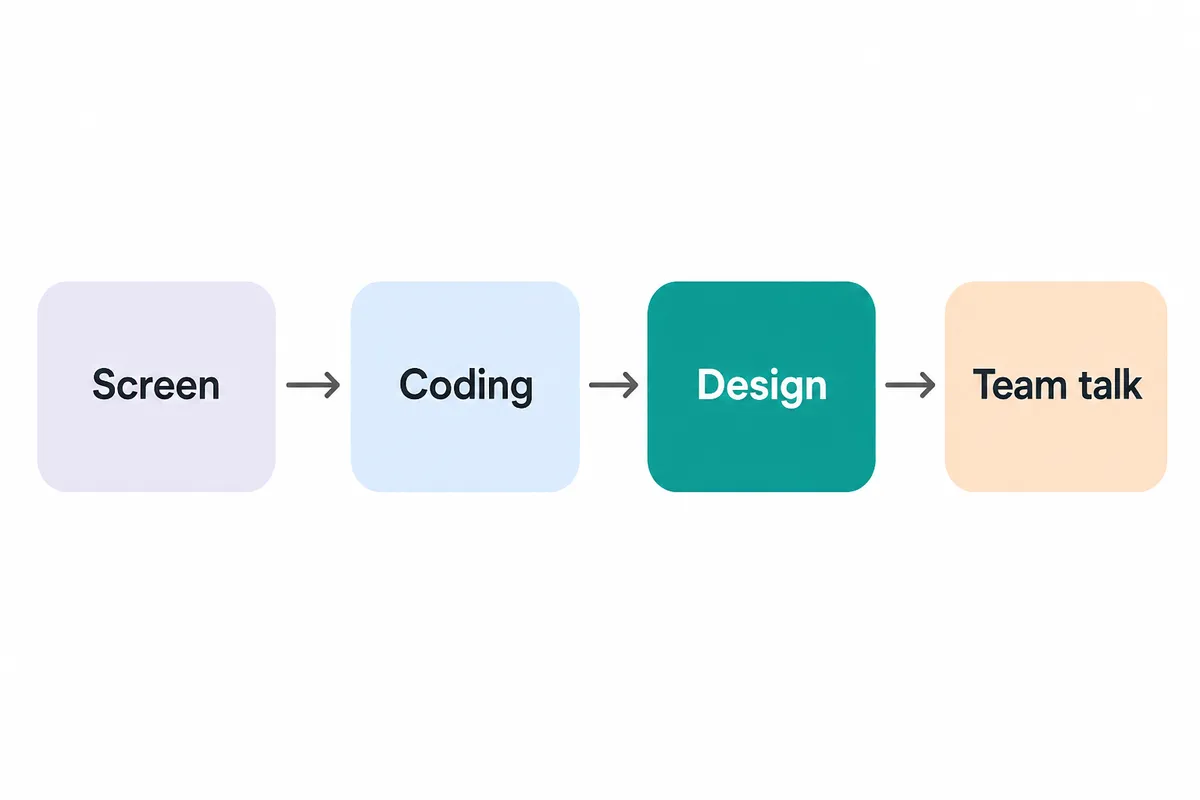
SAP interview process at a glance
| Stage | Reported format | What it screens for | How to prepare |
|---|---|---|---|
| Recruiter screen | Initial conversation, reported around 30 minutes | Role fit, relevant background, communication | Connect your experience to SAP’s enterprise products |
| Technical rounds | Coding and technical discussion | Problem solving, CS fundamentals, code clarity | Practise patterns and explain decisions aloud |
| System design | Design-led technical discussion | Enterprise trade-offs, scalability, privacy, cloud thinking | Structure a design before discussing components |
| Team and behavioural discussion | Project depth and collaboration | Ownership, judgement, stakeholder communication | Prepare detailed stories from your own work |
The headline is not an unusual platform, a named assessment, or a single fixed time limit. It is the enterprise context. Reported accounts describe SAP recruiters screening for familiarity with areas such as S/4HANA, SAP Business Technology Platform (BTP), and cloud-native development. The system-design discussion may then test whether you can apply ordinary engineering principles to software used by many organisations with serious privacy, integration, and operational requirements.
Recruiter screen — establish relevance before technical depth
The recruiter screen is commonly reported as an initial conversation of around 30 minutes. It is unlikely to be a deep coding exercise, but it still matters because it establishes whether your experience matches the team’s needs.
Prepare a concise account of your background that answers three questions:
- What systems have you built or maintained?
- What technical decisions did you personally own?
- Why does enterprise software, cloud infrastructure, or business-platform work interest you?
Avoid treating this as a generic “tell me about yourself” prompt. If the role references cloud services, data platforms, ERP-adjacent systems, developer tooling, or enterprise integrations, identify the closest work in your own background. You do not need to claim experience you do not have. You do need to show that you understand the engineering environment: long-lived systems, demanding customers, compatibility concerns, security obligations, and multiple stakeholders.
A useful preparation exercise is to choose two projects and explain each at two levels. First, give the plain-language business problem. Then explain the technical design, constraints, and outcome. That practice makes your story usable in both recruiter and later team conversations.
Technical coding rounds — make your reasoning observable
Reported accounts describe technical rounds after the recruiter conversation. Their exact format varies, but candidates should expect coding, data structures and algorithms, language fundamentals, and discussion of complexity.
The coding bar is not merely about reaching a correct answer. Interviewers need evidence that you can work through an unfamiliar problem in a collaborative setting. That means making your process audible:
- Restate the problem and clarify assumptions.
- Describe a simple solution before jumping to the efficient one.
- Explain the data structure or pattern you are choosing.
- State time and space complexity.
- Test normal, boundary, and failure cases aloud.
This is especially important if you tend to solve problems silently. A clean implementation with no explanation leaves the interviewer unable to distinguish deliberate judgement from luck. Read what interviewers actually look for in live coding interviews before practising your next problem; it explains why communication changes the score.
For preparation, use SAP's interview kit as a focused starting point. The kit contains 3 mapped DSA questions, and each one is an opportunity to rehearse the complete interview behaviour: clarify, plan, code, validate, and reflect.
The DSA Patterns Sheet is free to browse and helps you organise practice around recognisable problem shapes instead of a random list. If you regularly know the solution only after seeing it, work through how to identify the right DSA pattern in a coding interview. Recognition is the bridge between studying solutions and producing one under pressure.
💡 Pro tip: Do not wait until you are “good enough” to practise aloud. Narrating your work feels awkward at first, which is exactly why it should become part of preparation rather than an experiment on interview day.
System design — screen for enterprise engineering judgement
The reported SAP process includes a system-design stage. For experienced roles, this may be the round that best differentiates candidates with similar coding ability.
A strong answer does not begin by listing databases, queues, caches, and cloud services. It begins by establishing the problem:
- Who uses the system and what is the core workflow?
- What data is sensitive, regulated, or customer-owned?
- Which operations need consistency, and which can be asynchronous?
- What scale, availability, latency, and integration constraints matter?
- What is deliberately outside the first version?
Once those questions are clear, build the design in layers: requirements, APIs or boundaries, data ownership, major components, failure handling, and trade-offs. An interviewer is usually more interested in whether your decisions follow from the requirements than whether you know a fashionable architecture term.
The System Design Sheet is free to browse and can help you rehearse common system concepts. For a clear distinction between class-level design and architecture-level reasoning, see low-level design vs high-level design: what interviews actually expect.
What this round is likely to screen for
Requirement discipline. Enterprise systems are full of unstated constraints. Strong candidates surface them early rather than quietly making convenient assumptions.
Trade-off awareness. There is rarely one “correct” storage model, communication pattern, or deployment strategy. Explain what your choice optimises and what it makes harder.
Operational thinking. Discuss monitoring, retries, auditability, access control, and failure recovery where relevant. These details signal that you think beyond the happy path.
Communication with non-specialists. SAP software often sits between technical teams and business workflows. A design explanation should be structured enough that a product manager, architect, or adjacent engineer can follow it.
The SAP-specific focus: enterprise design under real constraints
What makes SAP interview preparation different from a generic coding routine is the enterprise context reported by candidates. Recruiter conversations may probe familiarity with S/4HANA, BTP, and cloud-native work. Design discussions may introduce concerns such as multi-tenancy and GDPR.
You do not need to memorise product terminology to answer well. You do need to understand what those constraints do to a design.
Multi-tenancy changes questions of isolation, access control, configuration, capacity, and noisy-neighbour risk. Clarify whether customers share infrastructure, data stores, or both. Then explain how tenant identity flows through authentication, authorisation, observability, and data access.
GDPR and privacy change data modelling and operational choices. Ask what personal data exists, where it is stored, who can access it, how retention works, and what deletion or export obligations apply. Do not claim that encryption solves every privacy concern; it is one control within a wider policy and access model.
Enterprise integration introduces versioning, compatibility, retries, audit trails, and failure handling. A service that works in isolation can still fail in production if downstream systems change, messages arrive twice, or customer configurations differ.
This is the kind of design problem evidenced at SAP: less about drawing the largest possible distributed system, more about demonstrating sound judgement when a business platform must stay reliable, secure, and adaptable over time.
Team and behavioural discussion — test ownership and judgement
Technical competence alone does not establish whether you can operate in a large product organisation. Team and behavioural conversations typically examine how you work with others, handle disagreement, make decisions under uncertainty, and learn from failures.
Prepare stories that demonstrate:
- A technical decision you influenced and why.
- A difficult production issue or project setback.
- A disagreement handled constructively.
- A time you simplified an overcomplicated approach.
- A situation where you had to balance delivery speed against quality or risk.
Use a simple structure: context, your responsibility, actions, result, and what you would do differently. Keep “we” for team outcomes but be precise about “I” when describing your own contribution.
The AI interview tool is useful for practising these stories aloud, especially if you tend to rush, over-explain technical detail, or lose the outcome of the story. Behavioural answers improve fastest when you hear them, revise them, and repeat them.
Is the SAP interview hard?
SAP interviews can be challenging because they combine conventional coding expectations with enterprise-oriented technical judgement. The coding rounds reward clear fundamentals and structured reasoning. The system-design stage can be harder for candidates who have prepared only algorithm puzzles, because it asks for requirements thinking, trade-offs, privacy awareness, and operational realism.
How many rounds are there? There is no reliably sourced fixed count for SAP. Reported accounts describe a recruiter screen, technical rounds, and a system-design stage, with the exact sequence varying by role and team.
How long does the process take? A recruiter screen is reported at around 30 minutes, but there is no dependable company-wide timeline for the whole process in the available reports. Ask your recruiter about scheduling, expected stages, and whether the role includes a distinct design conversation.
The loop is manageable with targeted preparation. The key mistake is assuming that coding practice alone covers it. Build coding fluency, then spend meaningful time practising how you scope and explain enterprise systems.
A 30-day SAP interview preparation plan
Days 1–7 — establish coding consistency
Practise core patterns until you can identify an approach quickly and explain it clearly. Use the free-to-browse DSA Patterns Sheet alongside in-browser code practice. Focus on writing readable code, checking edge cases, and discussing complexity before implementation.
Days 8–14 — strengthen technical foundations
Review the fundamentals that often emerge around production engineering: processes, memory, networking, databases, transactions, and caching. The Operating Systems Sheet and DBMS Sheet are free to browse. Do not attempt to memorise definitions. Explain how a concept affects a system you have worked on.
Days 15–21 — practise enterprise design
Choose a service and design it from requirements outward. Include users, data, permissions, observability, failures, and evolution over time. Add an enterprise constraint to every practice session: multiple tenants, sensitive data, integration with a legacy service, or an audit requirement.
When you encounter a familiar design prompt, resist reciting a template. Instead, practise stating which assumptions you need before selecting components. That habit is more valuable than a polished diagram.
Days 22–30 — simulate the complete conversation
Alternate coding sessions, design discussions, and project-story rehearsal. Use SAP's interview kit to revisit the 3 mapped DSA questions under interview conditions: no notes, clear narration, and a short retrospective after each attempt.
Spend the final days refining your project stories. For each one, be ready to explain architecture, ownership, trade-offs, a failure mode, and what you learned. A technically impressive project becomes much more persuasive when you can explain it simply.
Frequently asked questions
What topics should I study for SAP interview questions?
Prioritise coding fundamentals, data structures, complexity analysis, system design, and project depth. Reported accounts also point to enterprise themes such as cloud-native development, multi-tenancy, privacy, and integration.
Does SAP ask coding questions?
Reported technical rounds include coding and technical discussion. Prepare to solve problems while explaining your approach, complexity, and test cases.
Does SAP have a system-design interview?
Reported accounts describe a system-design stage. The exact format depends on the role and team, but enterprise concerns such as privacy and tenant isolation are useful areas to practise.
Is SAP interview preparation different for experienced engineers?
Usually, yes. Experienced candidates should expect deeper discussion of architecture, trade-offs, project ownership, and system evolution alongside coding ability.
What should I know about S/4HANA and BTP?
Reported recruiter screens may look for familiarity with S/4HANA, BTP, and cloud-native work. Understand the role description and be able to connect your experience to enterprise platforms; do not bluff product expertise.
How should I prepare for the coding round?
Practise recognising common patterns, writing clean code, and thinking aloud. Use graph traversal patterns with DFS and BFS if graph problems are a weaker area.
What matters most in the system-design round?
Clear requirements, justified trade-offs, security and privacy awareness, and operational thinking matter more than naming the most components.
Should I prepare behavioural answers for SAP?
Yes. Prepare specific stories about ownership, collaboration, setbacks, decisions, and learning. Team discussions can test whether your technical judgement works well in a real organisation.
What language should I use in a coding interview?
Use the language in which you can write correct, readable code quickly. Clear reasoning, sound complexity analysis, and reliable implementation matter more than a fashionable language choice.
Where to start
Prepare for SAP as an enterprise engineering conversation, not only as a coding test. Build enough pattern fluency to handle the technical rounds, then practise explaining designs that account for privacy, integrations, tenants, operations, and long-term change.
Open SAP's interview kit to work through the 3 mapped DSA questions relevant to SAP. Then use the free sheets and an AI mock interview to rehearse how you communicate your coding, design, and project decisions under pressure.
Interview processes change by team and role. Confirm the current format, expectations, and schedule with your recruiter before finalising your preparation plan.
Topics
Related on Thita
Your next step
Practise with AI mock interviews
A spoken interview that asks follow-up questions, runs your code and ends with a written report.