
Interview
ServiceNow Interview Questions and Process: Complete Guide
Prepare for ServiceNow interview questions with a round-by-round guide to the coding test, CS fundamentals, live coding, onsite loop, and a 30-day plan.
ServiceNow interview questions commonly test more than coding speed. Reported accounts describe a recruiter screen, an online test combining coding with operating-system and database fundamentals, a live coding conversation, and an onsite loop. The recurring differentiator is that interviewers reportedly care about how you reason before you write code: clarify the task, explain the trade-off, then build and test a solution.
For focused coding practice, ServiceNow's interview kit holds six mapped DSA questions. Use it alongside timed practice and spoken explanations: arriving at a correct answer is useful, but making your reasoning visible is what turns a solution into a strong interview performance.
The ServiceNow interview process at a glance
| Stage | Reported format | What it screens for | How to prepare |
|---|---|---|---|
| Recruiter screen | Short introductory conversation | Role fit, experience, motivation | Know your recent work and why the role fits |
| Online test | HackerRank-style coding plus OS and DBMS MCQs | Core coding ability and CS fundamentals | Practise patterns, revise systems basics |
| Live coding | Problem-solving discussion with an engineer | Reasoning, communication, correctness | Narrate your approach before coding |
| Onsite loop | Technical and behavioural conversations | Technical depth, collaboration, project ownership | Prepare coding, design and project stories |
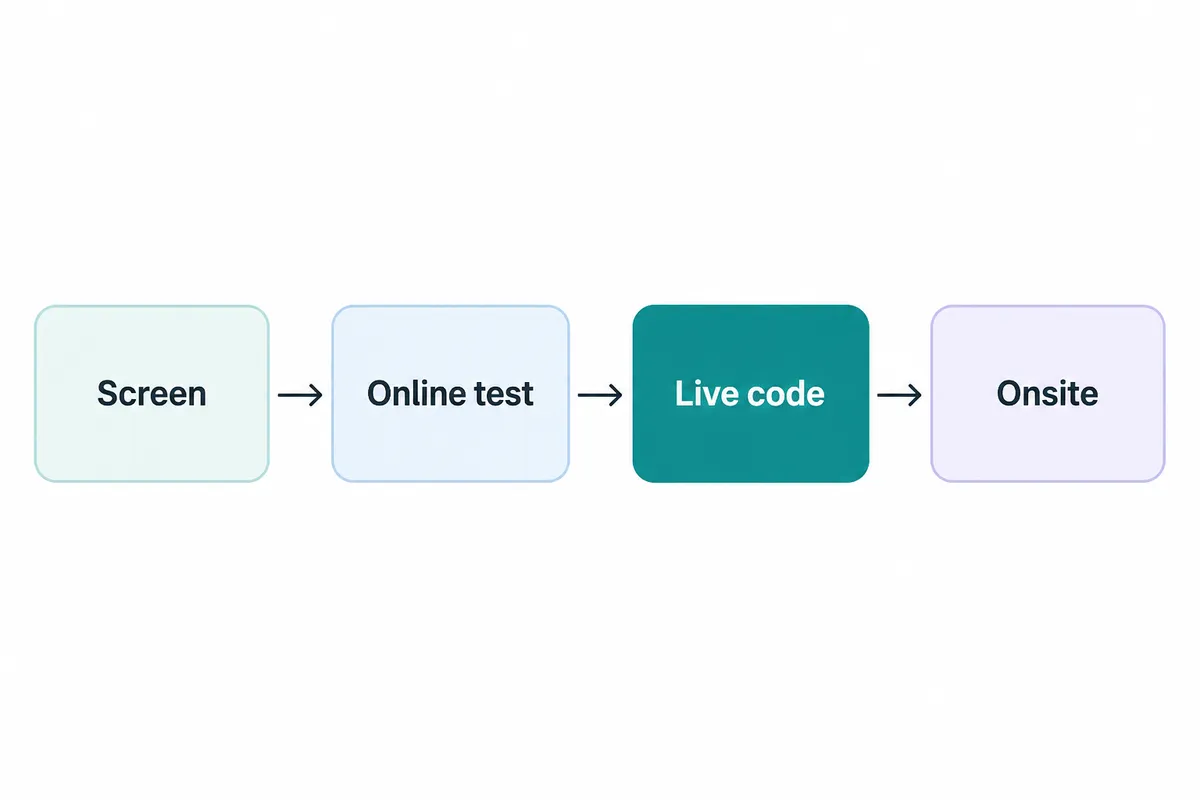
Reported formats vary by team, location and level. Treat this as the commonly reported shape rather than a fixed company policy, and ask your recruiter which stages apply to your role.
Recruiter screen: establish fit before the technical work
Reported accounts describe an initial recruiter screen of roughly half an hour. This is usually the first opportunity to understand the team, level, work location and likely next steps. It is also where a vague career narrative can create doubt before the technical process begins.
Prepare a concise account of your recent work:
- what you owned;
- what problem the work solved;
- which technical choices you influenced;
- what changed because of your contribution; and
- why you are considering ServiceNow now.
Avoid turning this into a memorised sales pitch. A good answer should sound like an engineer reflecting on real decisions, not a candidate reciting a résumé. If you moved between teams or changed direction, explain the reasoning clearly. Recruiters do not need every implementation detail, but they do need to understand the shape of your experience.
Have a few questions ready too. Ask about the team’s product area, the level being assessed, and whether the later technical conversations lean towards coding, systems knowledge or project depth. That information can make your preparation far more efficient.
Online test: coding plus computer-science fundamentals
The online test is the most distinctive reported part of the ServiceNow process. Candidate accounts describe a HackerRank-style exercise of around an hour, with one or two medium-to-hard coding problems alongside multiple-choice questions on operating systems and database management systems.
That combination changes how you should revise. A candidate who prepares only for arrays, trees and dynamic programming can still lose time on fundamentals that are easy to neglect after university.
For the coding portion, focus on recognising common problem shapes:
- hash-map lookups for frequency or membership;
- two pointers and sliding windows for contiguous sequences;
- stacks for matching, ordering and monotonic constraints;
- trees and graphs for traversal and dependency problems;
- binary search when an answer can be bounded; and
- dynamic programming when local choices do not capture the full state.
The free-to-browse DSA Patterns Sheet is useful for revising by underlying technique rather than by a random list of topics. If pattern recognition is still slow, start with how to identify the right DSA pattern in a coding interview.
For the MCQ portion, revise concepts rather than definitions. In operating systems, be ready to reason about processes and threads, scheduling, memory, synchronisation, deadlocks and file systems. The free-to-browse Operating Systems Sheet can help you revisit those topics systematically.
For databases, revise normalisation, indexes, transactions, isolation, joins, query behaviour and the trade-offs behind schema choices. The free-to-browse DBMS Sheet is a practical refresher when you need to turn scattered knowledge into an interview-ready revision plan.
Practical rule: do not spend the whole test fighting a difficult coding problem while leaving the fundamentals untouched. Read every section first, budget your time, and leave room to verify boundary cases.
Live coding: show the reasoning before the answer
Reported accounts describe a live coding stage of roughly three quarters of an hour to an hour. The technical question matters, but this is also the stage where interviewers can observe how you approach uncertainty.
A strong live-coding sequence looks like this:
- Restate the problem in your own words.
- Ask about inputs, limits and edge cases.
- Offer a straightforward approach before reaching for the optimal one.
- Explain the chosen data structures and expected complexity.
- Code in small, checkable steps.
- Test normal, empty and boundary inputs aloud.
- Discuss what you would improve if given more time.
This is not unnecessary ceremony. It gives the interviewer evidence of your judgement. If you silently produce a solution, they may see correctness but not how you got there. If you make a small error while clearly identifying and fixing it, they can see debugging skill and self-correction.
The reported emphasis at ServiceNow is especially useful here: prioritise clear reasoning before implementation. Do not rush to type because you fear silence. A short pause to frame the problem is better than ten minutes rewriting the wrong approach.
For a deeper breakdown of this format, read what interviewers actually look for in live coding interviews. Then practise speaking through solutions in in-browser code practice, where you can build the habit of testing and explaining rather than merely submitting.
Onsite conversations: depth, judgement and collaboration
The onsite portion is less consistently documented in reported accounts, so it is best treated as a set of technical and behavioural conversations rather than a guaranteed fixed sequence. Expect the team to explore whether your technical strengths match the role and whether you can work effectively through ambiguous engineering decisions.
What the technical discussion screens for
A later technical discussion may revisit coding, examine your project experience, or explore design choices at the level appropriate to the role. Prepare to discuss more than the happy path of a project.
For each project you mention, be ready to explain:
- the system boundary and the users it served;
- the constraints you were operating under;
- alternatives you considered and rejected;
- a production issue, failure or trade-off;
- how you measured whether the change worked; and
- what you would redesign today.
At more experienced levels, practise turning an open-ended feature into requirements, components, data flow and failure handling. You do not need to force an elaborate architecture into every answer. Instead, show that you can make a proportionate design, name the assumptions, and adapt when an interviewer changes one of them.
The free-to-browse System Design Sheet can help structure this kind of preparation. If you are unsure where class-level design ends and architecture-level design begins, low-level design versus high-level design explains the distinction.
What the behavioural discussion screens for
Behavioural questions are often where a technically capable candidate becomes difficult to assess. “Tell me about a challenge” is not testing whether you have faced a challenge; it is testing your ownership, judgement, communication and capacity to learn.
Prepare several stories that cover different situations:
- resolving a disagreement;
- delivering under an uncomfortable constraint;
- improving an unreliable system;
- receiving difficult feedback;
- making a decision with incomplete information; and
- helping another engineer succeed.
Use a simple structure: context, your responsibility, actions, result and reflection. Keep saying “I” when describing your contribution. Teamwork matters, but an interviewer cannot assess ownership through a story where every decision belongs to “we”.
A realistic AI mock interview is useful for rehearsing both behavioural follow-ups and technical explanation. The goal is not to memorise model answers. It is to become comfortable being challenged on the details of your own work.
Is the ServiceNow interview hard?
ServiceNow’s process is challenging because it combines several skill types: timed coding, core computer-science knowledge, verbal reasoning and project depth. A candidate who is strong only in one area may find the loop uneven.
The coding questions are commonly reported as medium to hard, so pattern fluency and complexity reasoning matter. The online test adds operating-system and database questions, which rewards broader fundamentals. Then the live coding stage tests whether you can make your thinking legible under pressure.
How many rounds are there? Reported accounts establish the usual stages — recruiter screen, online test, live coding and onsite — but do not provide a reliable fixed count for every team and level. Confirm the exact schedule with your recruiter.
How long does the process take? The source material supports approximate timings for individual early stages, not a dependable end-to-end timeline. Hiring urgency, role level and team availability can all change the pace. Ask about the expected process when you speak with the recruiter.
The useful conclusion is not that you need to prepare everything at once. It is that you should avoid a narrow LeetCode-only plan. Divide your time between coding patterns, OS and DBMS revision, spoken communication and your own project stories.
A 30-day ServiceNow preparation plan
Days one to seven: rebuild coding recognition
Start with core data-structure patterns and solve problems without looking at solutions too early. After each attempt, write down the clue that should have led you to the pattern sooner.
Work through ServiceNow's interview kit and use each question to practise explanation as well as implementation. Aim to state the brute-force idea, improve it, and justify the final complexity.
Days eight to fourteen: revise OS and DBMS fundamentals
Split each session between one operating-systems topic and one database topic. Do not passively reread notes. Ask yourself interview-style questions:
- Why might a process be preferable to a thread?
- What conditions produce a deadlock?
- When does an index help, and when can it hurt?
- What does transaction isolation protect against?
- How would you investigate a slow query?
Finish each session by explaining one concept aloud in plain language. If you cannot explain it simply, you probably cannot apply it under interview pressure.
Days fifteen to twenty-one: practise live coding properly
Use a timer and simulate the full conversation. Spend the opening minutes clarifying requirements and comparing approaches. Then code, test and narrate your decisions.
Review graph traversal patterns with DFS and BFS if graph questions are a weak point, and practise at least one problem where you must reason about state rather than memorise a template.
Days twenty-two to thirty: integrate and rehearse
Alternate between a timed coding session, an OS or DBMS revision session, and a mock interview. Prepare project stories with enough technical detail to survive follow-up questions.
In the final days, reduce new material. Revisit errors, practise explaining familiar concepts cleanly, and protect your confidence. Interview performance improves more from a reliable routine than from a last-minute attempt to learn every advanced topic.
The ServiceNow-specific preparation edge: do not separate code from fundamentals
The online test’s reported mix of coding and OS/DBMS MCQs is the part of this process that should change your preparation plan. At many companies, candidates can spend almost all their early preparation time on coding puzzles. For ServiceNow, that is a risk.
Treat each coding problem as an opportunity to connect implementation to systems knowledge. When you use a hash map, think about memory and lookup trade-offs. When you discuss concurrency, be able to explain shared state and locking. When a database appears in a project story, explain indexing, transactions and failure modes rather than saying the data was “stored”.
This integrated approach also improves live coding. Interviewers reported to value reasoning before the final answer, and a candidate who can connect an implementation choice to a broader engineering principle gives a clearer signal than one who merely remembers a pattern.
Frequently asked questions
What types of ServiceNow interview questions should I expect?
Reported accounts describe coding questions, operating-systems and database MCQs, live coding, technical project discussion and behavioural questions. Exact content varies by role and team.
Does ServiceNow use an online coding test?
Candidate reports commonly describe a HackerRank-style online test that combines coding with OS and DBMS multiple-choice questions.
Are ServiceNow coding questions difficult?
They are commonly reported as medium to hard. The more important preparation target is recognising common patterns quickly and explaining your approach clearly.
Does ServiceNow ask operating-systems questions?
Reported accounts describe operating-systems MCQs in the online test. Revise processes, threads, memory, scheduling, synchronisation and deadlocks.
Does ServiceNow ask database questions?
Yes, candidate reports commonly mention DBMS multiple-choice questions. Focus on indexes, transactions, normalisation, joins and isolation concepts.
How should I prepare for the live coding round?
Practise clarifying the prompt, stating your approach and complexity, coding in small steps, and testing edge cases aloud. Clear communication matters alongside correctness.
How many interview rounds does ServiceNow have?
The commonly reported process includes a recruiter screen, online test, live coding stage and onsite loop. The exact number of onsite conversations varies, so confirm it with your recruiter.
How long is the ServiceNow interview process?
Reported accounts give approximate timings for early stages but do not establish one reliable end-to-end timeline. Team and role differences can affect the schedule.
What should I say in the behavioural interview?
Use specific stories about ownership, disagreement, delivery, failures and learning. Explain what you personally did, why you chose that approach and what changed afterwards.
Start with a balanced preparation plan
ServiceNow interview preparation works best when you treat coding, fundamentals and communication as one combined skill set. Practise patterns until you can recognise them, revise OS and DBMS concepts until you can apply them, and rehearse explanations until your reasoning is easy to follow.
Open ServiceNow's interview kit to practise the six mapped DSA questions, then use the free-to-browse sheets and an AI mock interview to rehearse the full conversation.
Interview processes change, so use your recruiter conversation to confirm the current format, level expectations and timing for your specific role.
Topics
Related on Thita
Your next step
Practise with AI mock interviews
A spoken interview that asks follow-up questions, runs your code and ends with a written report.