
Interview
Splunk Interview Questions and Process: The Complete Guide (2026)
Splunk interview questions: a round-by-round guide to the Karat screen, virtual onsite, difficulty, and a focused 30-day plan for software engineers.
Splunk interview questions commonly begin with a Karat technical screen: an offline component covering backend fundamentals and data structures, followed by a live coding conversation. Reported accounts then describe a virtual onsite with several interviews. The practical preparation priority is clear: refresh core computer-science knowledge, solve coding problems aloud, and be ready to explain trade-offs rather than merely produce an answer. Splunk's interview kit contains five mapped DSA questions to help you practise the coding patterns evidenced at the company.
The exact format can vary by role, level and hiring team. This guide covers the reported shape of the loop, what each stage is likely trying to establish, why the outsourced Karat screen deserves its own preparation strategy, and how to organise a month of preparation without treating candidate reports as fixed policy.
The process at a glance
| Stage | Format | What it screens for | Preparation focus |
|---|---|---|---|
| Karat offline portion | Backend fundamentals and DSA | Core CS recall, structured problem solving | Revise fundamentals and practise timed reasoning |
| Karat live coding | Live coding conversation | Communication, correctness, complexity | Narrate your approach while coding |
| Virtual onsite | Reported as several virtual interviews | Technical depth, role fit and engineering judgement | Confirm the focus with your recruiter |
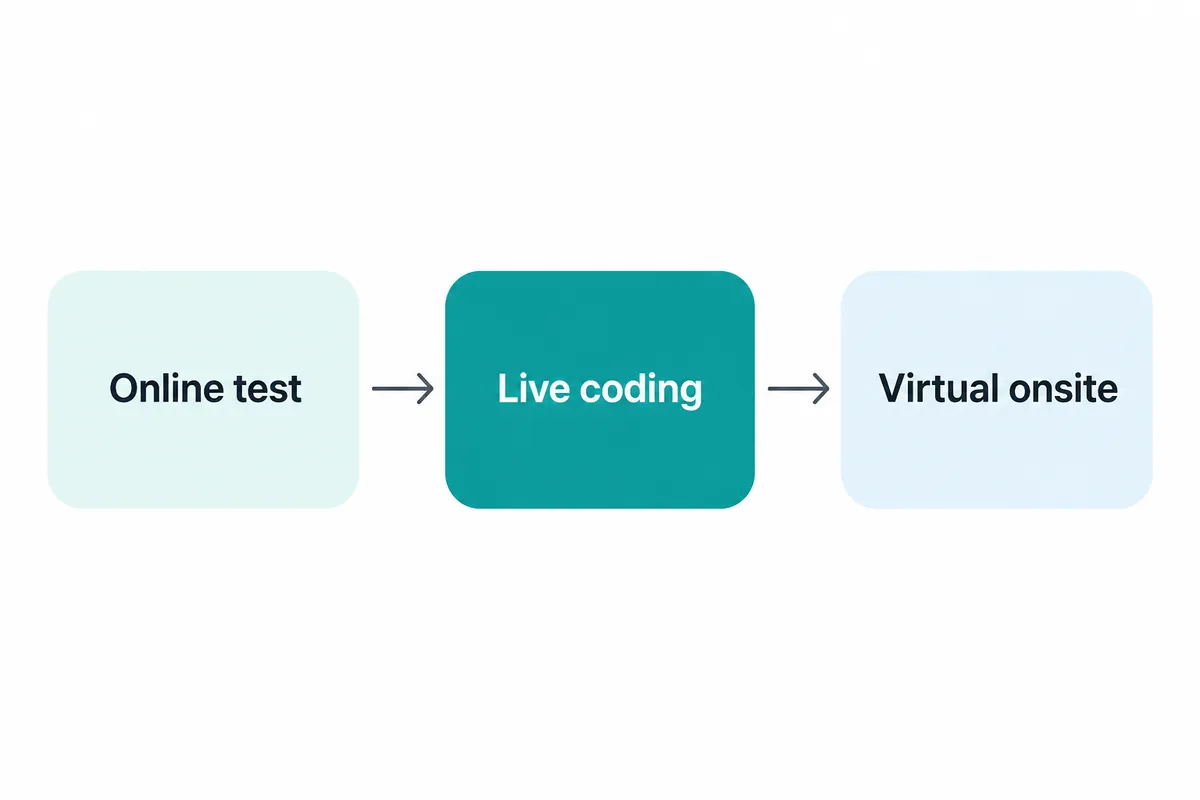
Reported accounts describe a Karat technical screen before a virtual onsite of four to five interviews. Treat that as a useful planning model, not a guarantee. Ask your recruiter which parts apply to your level, whether the role is backend-heavy, and what the onsite will emphasise.
Round 1 — the Karat offline portion
The reported Splunk screen begins with an offline component that combines backend fundamentals with data-structures-and-algorithms work. This changes the preparation mix. A candidate who has practised coding puzzles but has not revised databases, operating systems or networking may be caught out before the live conversation begins.
The purpose is not necessarily to reward obscure trivia. It is more likely to establish whether you can reason from first principles when a practical engineering question touches familiar foundations. Revise how processes, threads, memory, storage, networking and database operations relate to the systems you have built. Focus on explaining the consequences of a design choice: why an index helps a query, what a cache can make stale, or why a network retry needs care.
The free Operating Systems Sheet, DBMS Sheet, and Computer Networks Sheet are useful for targeted revision. Use them to identify weak areas, then practise explaining each concept in plain language. In an interview, memorised definitions are less useful than a clear account of when a concept matters.
For the DSA portion, prioritise recognising a problem shape quickly. Arrays, strings, hash maps, trees, graphs, sorting and complexity analysis are all good foundations. The free DSA Patterns Sheet helps organise practice around reusable approaches rather than a random list of questions.
💡 Pro Tip: For every coding solution, say the time and space complexity before you start typing. It forces you to assess the approach early and makes your reasoning visible.
Round 2 — the Karat live coding interview
Candidate reports describe a live coding screen run through Karat after the offline portion. The live portion is reported as a sixty-minute conversation. Karat is a third-party technical-screening provider, so the interviewer may not be a Splunk engineer. That makes clarity especially important: the interviewer is working from a rubric and needs observable evidence of how you solve problems.
Commonly reported Karat formats include a short introduction, a longer coding segment, and time for feedback at the end. The exact division can vary, but your working style should not. Clarify the prompt, identify constraints, offer a simple baseline if appropriate, then explain why you are choosing the final approach.
A strong live-coding performance usually has a visible sequence:
- Restate the problem and ask about input assumptions.
- Work through a small example before committing to code.
- Compare a straightforward approach with the more efficient option.
- State complexity and edge cases.
- Write readable code in small sections.
- Test the code aloud with ordinary and awkward inputs.
This is not performative narration. It is how an interviewer can distinguish deliberate reasoning from trial and error. Read what interviewers actually look for in live coding rounds before your first mock, then use in-browser code practice to rehearse writing and testing under a timer.
A frequent mistake is over-explaining before any progress is made. Keep the discussion connected to decisions. “I will use a hash map because I need fast lookup while scanning once” is useful. A long lecture on hash maps is not.
Round 3 — the virtual onsite
After the Karat screen, reported accounts describe a virtual onsite consisting of four to five interviews. The available reports do not establish a reliable company-wide breakdown of those interviews, so do not assume every team runs the same set of technical, design or conversational discussions.
Instead, use the onsite as the stage where you need breadth. Be ready to discuss the systems and projects on your CV in detail, including your personal contribution, decisions you made, trade-offs you accepted and what you would change now. If a technical discussion moves beyond code, start from requirements and constraints rather than jumping directly into components.
This is also the point to confirm expectations. A useful recruiter question is: “Are there particular technical areas or parts of my experience that the team plans to explore in the virtual onsite?” It is specific enough to produce a useful answer and does not ask the recruiter to disclose interview questions.
Prepare a concise project narrative for each major item on your CV:
- What problem were you solving?
- What did you personally own?
- Which technical decision had the greatest impact?
- What failed, changed or created an unexpected trade-off?
- What would you do differently with what you know now?
Practising these stories aloud matters. An AI mock interview can help you turn vague project summaries into direct, evidence-based answers and rehearse follow-up questions.
The named ritual: why the Karat screen matters at Splunk
The distinctive feature in reported Splunk interview accounts is not a named in-house interview ritual. It is the use of Karat for the technical screen.
That distinction affects how you should prepare. In a team-run screen, an interviewer may have deep context about the product, team priorities or a particular technology stack. A third-party interviewer is more likely to assess what can be demonstrated consistently in the session: how you clarify, structure a solution, reason about complexity, write code and respond to prompts.
Do not treat this as a reason to prepare more mechanically. It is the opposite. Rubric-based evaluation rewards a repeatable, legible process. The best way to make that process visible is to use the same solution structure in every practice session.
Start with clarification. Name the data structure. Explain why it fits. State complexity. Test edge cases. If you get stuck, narrate the obstacle and propose a smaller next step. That is far stronger than silently changing direction.
For a deeper rehearsal framework, read how to explain your thought process clearly in coding interviews. Then use Splunk's interview kit to practise the DSA problem shapes mapped to Splunk with that communication structure.
Is the Splunk interview hard?
The Splunk interview is likely to feel challenging because it tests more than one preparation mode. The Karat screen reportedly combines backend fundamentals with coding, so candidates need both recall and problem-solving fluency. The live component adds a communication test: a correct solution that remains unexplained is harder to assess well.
How many rounds are there? Reported accounts describe a Karat technical screen followed by a virtual onsite of four to five interviews. Team and level variation are real, so confirm your own loop with the recruiter.
How long does the process take? The available company-specific reports do not establish a dependable end-to-end timeline. Avoid planning around a generic estimate; ask your recruiter about interview scheduling, feedback windows and any deadlines tied to the role.
What is the hard part? For many candidates, it is switching cleanly between fundamentals, coding and discussion. You may know each area separately but still need to demonstrate them under time pressure. The remedy is integrated practice: solve a problem, explain its complexity, then connect the approach to practical engineering concerns such as memory, latency, failure handling or data access.
A 30-day Splunk preparation plan
Days 1–7 — rebuild the foundations
Begin with backend fundamentals. Revise operating systems, databases and networking, but write short explanations in your own words rather than rereading notes. Pair each topic with a practical example from a project you have worked on.
Spend the rest of each session on core coding patterns: arrays, strings, hash maps, linked lists, trees and graph traversal. If graph problems are a weak spot, use this guide to DFS and BFS graph traversal patterns to build a reliable starting framework.
Days 8–14 — make coding communication automatic
Complete one timed coding session each day. The aim is not maximum volume. It is a consistent spoken structure: clarify, propose, compare, code, test and summarise.
Record yourself occasionally. Listen for silent gaps, unexplained leaps and vague phrases such as “this should work”. Replace them with evidence: name an example, identify an invariant, or walk through the loop once.
Days 15–21 — practise the Karat-style transition
Alternate between a fundamentals review session and a live-coding simulation. Begin each simulation with a few minutes of prompt clarification and finish with explicit tests. Include questions where the first solution is not optimal, because explaining the refinement is often more valuable than presenting a polished answer immediately.
Work through Splunk's interview kit during this week. The five mapped DSA questions are a focused set for rehearsing both pattern recognition and clear explanation.
Days 22–30 — prepare for breadth
Use the final stretch to integrate everything. Run full mock sessions: a fundamentals discussion, a coding problem, then a project deep-dive. Review your CV line by line and prepare evidence for every claim.
For design-oriented conversations, avoid memorising a diagram. Instead, practise gathering requirements, identifying the main data flow, explaining trade-offs and naming the assumptions you would validate. The free system design sheet is useful for structured review, while design patterns for interviews can help you discuss code structure without forcing unnecessary abstractions into every answer.
Frequently asked questions
What does the Splunk Karat interview involve?
Reported accounts describe an offline section covering backend fundamentals and DSA, followed by a live coding interview run through Karat.
Is the Karat interviewer a Splunk engineer?
Reportedly, the technical screen is outsourced to Karat, a third-party screening provider. Prepare to make your reasoning explicit rather than relying on product-specific context.
How many onsite interviews does Splunk have?
Candidate reports describe a virtual onsite with four to five interviews after the Karat screen. Confirm the exact structure with your recruiter.
Does Splunk ask coding questions?
Yes. The reported technical screen includes DSA and live coding, so practise pattern recognition, clean implementation and complexity analysis.
What backend topics should I revise?
Prioritise operating systems, databases and networking fundamentals, then connect them to practical examples from your work.
How should I prepare for a rubric-scored coding screen?
Use a repeatable process: clarify requirements, explain the data structure, state complexity, code in small steps and test aloud.
Should I prepare system design for the virtual onsite?
It is sensible to be ready to discuss technical trade-offs and the systems on your CV, but the sourced reports do not establish a fixed company-wide onsite design format. Ask your recruiter for role-specific guidance.
How long does Splunk’s hiring process take?
A reliable company-wide timeline was not established in the available reports. Ask your recruiter about scheduling and feedback expectations.
What is the best way to practise Splunk interview questions?
Use focused coding practice, revise backend fundamentals, and rehearse explaining each decision aloud. Mock interviews are especially useful for turning silent problem solving into observable reasoning.
Where to start
Start with the part of the loop that is most clearly reported: the Karat technical screen. Build confidence in backend fundamentals, then practise coding in a way that makes your choices easy to follow.
Open Splunk's interview kit to practise the five mapped DSA questions for Splunk. Combine that focused work with the free sheets and an AI mock interview to rehearse coding explanations, project depth and technical discussion.
Interview formats can change by team and level. Confirm your current round structure, timing and focus areas with your recruiter before finalising your preparation plan.
Topics
Related on Thita
Your next step
Practise with AI mock interviews
A spoken interview that asks follow-up questions, runs your code and ends with a written report.