
Interview
Spotify Interview Questions and Process: The Complete Guide (2026)
Spotify interview questions: reported process stages, case study preparation, and a 30-day plan for coding, design, clear communication and code quality.
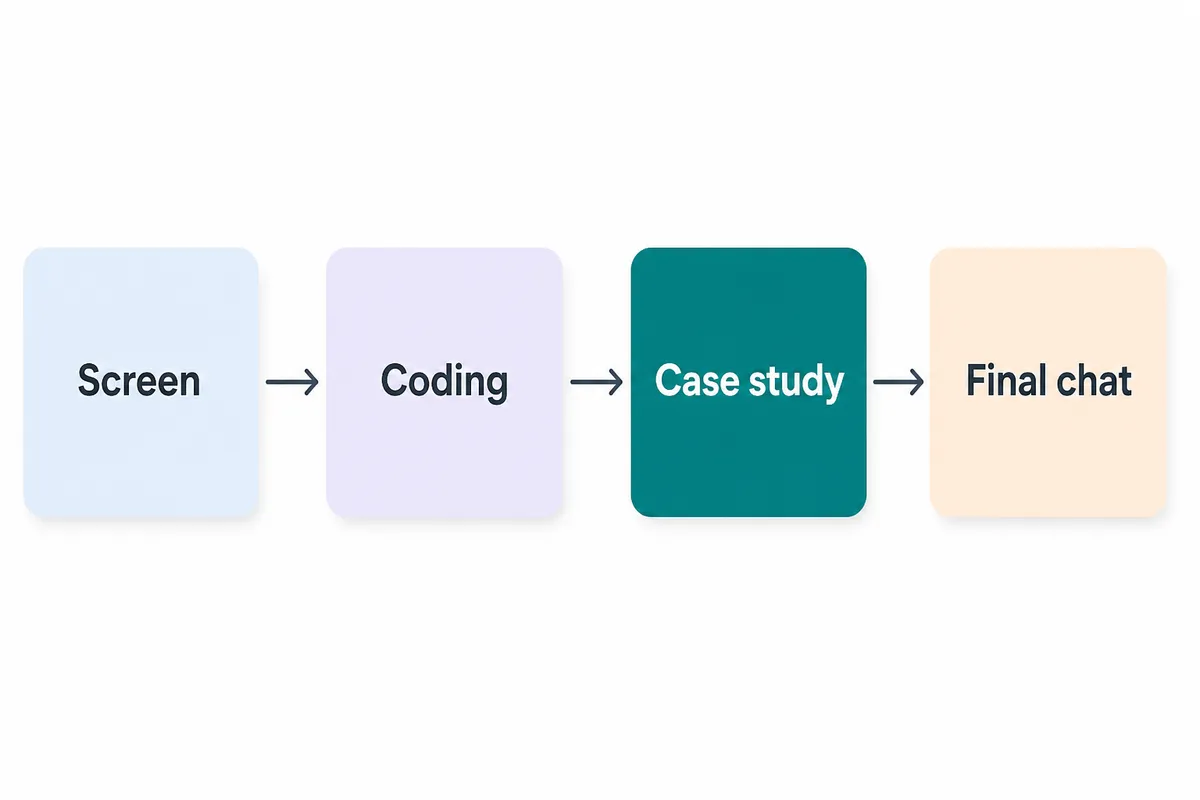
Spotify interview questions are commonly reported to test practical engineering judgement more than obscure algorithmic tricks. Candidate accounts describe a process of four to five stages, often including coding, a Spotify-specific case study, design or project discussion, and final conversations. The recurring preparation theme is simple: write clean code, explain your choices clearly, and show how you make sensible trade-offs when the brief is incomplete.
For coding practice organised around interview patterns, Spotify's interview kit holds five mapped DSA questions. Use it alongside timed practice and mock conversations: a clean medium-difficulty solution you can explain is reported to carry more weight than a rushed hard solution with weak communication.
Reported accounts for Spotify are thinner than for some larger interview loops and can vary by team, level and location. Treat this guide as a preparation map rather than a fixed script, and confirm the current format with your recruiter.
Spotify interview process at a glance
The exact sequence is not consistently documented in candidate reports. The table below combines the reported four-to-five-stage shape with the general structure of a modern software engineering loop.
| Stage | Common format | What it is likely screening for | How to prepare |
|---|---|---|---|
| Initial screen | Recruiter or team conversation | Role fit, background, motivation | Tell a clear story about your work and interests |
| Technical coding | Live problem solving | Core coding, complexity, communication | Narrate your approach and test edge cases |
| Case study | Open-ended product or engineering discussion | Judgement, structured thinking, practical trade-offs | Clarify goals, users, constraints and success measures |
| Design or project depth | Technical discussion | System thinking, ownership, engineering decisions | Explain decisions from past work with evidence |
| Final conversations | Team and behavioural discussion | Collaboration, communication and mutual fit | Prepare specific examples of impact and learning |
A useful way to read the loop is that each stage adds context. Coding establishes whether you can reason accurately. The case study tests whether you can reason usefully when there is no single correct answer. Project and behavioural discussions test whether that reasoning translates into good engineering work with other people.
Stage 1 — the initial screen
The initial conversation is usually less about proving technical depth and more about establishing context. Be ready to describe what you have built, the sort of problems you enjoy, and why the role makes sense for your next step.
Avoid treating this as a formality. A vague answer to “tell me about yourself” can make an otherwise capable candidate appear unfocused. Build a short narrative that links three things:
- the technical work you have done;
- the kind of product or engineering problem you want next;
- the evidence that you can work well in a collaborative environment.
Spotify is a product company, so connect technical choices to user or business outcomes where you can. Instead of saying that you “improved an API”, explain what was slow or unreliable, what you changed, who benefited, and how you knew the result was better.
Prepare this aloud, not only in notes. A concise spoken explanation is a different skill from a well-written résumé bullet.
Stage 2 — technical coding
Reported Spotify experiences point towards coding that values code quality and communication over performative difficulty. That does not mean the technical bar is low. It means the interviewer is likely to care whether your solution is understandable, correct, tested and appropriately efficient.
Start by restating the problem in your own words. Ask about input limits, expected behaviour for edge cases, and whether you may use standard library structures. Then state your intended approach before coding.
A reliable live-coding sequence is:
- clarify the task and define an example;
- name the data structure or pattern you will use;
- explain time and space complexity;
- implement a small, readable solution;
- test normal, boundary and failure cases aloud;
- improve only if the improvement solves a real limitation.
The DSA Patterns Sheet is free to browse and useful for building recognition speed across common coding shapes. For the company-specific set, return to Spotify's interview kit and practise explaining each decision as if an interviewer were listening.
The biggest avoidable error is silent coding. Interviewers cannot award credit for reasoning they cannot hear. If you are considering two approaches, say so. If you reject one because it creates unnecessary complexity, say that too. Our guide to what interviewers actually look for in live coding interviews explains why communication changes the score even when the final code is correct.
💡 Pro tip: Aim for code that another engineer could review quickly. Clear names, small helpers where they earn their place, and deliberate tests are stronger signals than clever compression.
Stage 3 — the Spotify case study round
The case study is the most Spotify-specific element reported in the process. It changes the question from “can you solve this bounded technical problem?” to “how do you approach an ambiguous problem that involves people, product context and engineering constraints?”
Candidate reports describe this stage as a meaningful evaluation of judgement. You may be given a scenario with incomplete information and asked how you would investigate it, prioritise work, define a solution or make a decision among competing options.
Do not rush to a proposal. Start by organising the ambiguity.
A strong answer usually moves through five areas:
Clarify the goal. Who is the user? What outcome matters? Is the aim engagement, reliability, creator experience, operational efficiency, or something else?
Identify constraints. Ask about scale, deadlines, existing systems, data quality, privacy, operational risk and team capacity. Constraints make your recommendation credible.
Offer options, not one instant answer. Compare a simpler path with a more durable one. Explain the cost, risk and expected value of each.
Choose and justify. Make a recommendation once you have enough information. “It depends” is not an answer unless you explain what it depends on and how you would resolve that uncertainty.
Measure the result. Define a success signal, a guardrail and a feedback loop. Good engineering judgement includes knowing how you will learn whether the decision worked.
This is not a design round where elaborate diagrams automatically win. The reported bar is practical thinking: can you make progress, communicate uncertainty and choose proportionately?
Stage 4 — design and project depth
A design or project-focused discussion can take different forms by team. For experienced candidates, expect deeper questions about architecture, trade-offs, reliability and the decisions behind work already on your résumé. For earlier-career candidates, the emphasis may be more on how you structure code and collaborate through a problem.
Prepare two projects in depth. For each one, know how to explain:
- the original problem and constraints;
- your personal ownership;
- the architecture or technical approach;
- a trade-off you made;
- a mistake, incident or revision;
- the measurable outcome;
- what you would do differently now.
The last point matters. Good engineers do not present every past decision as perfect. They can identify what changed, what they learned, and how that learning affects their next decision.
If the conversation moves into design, distinguish between class-level design and broader system design. Class-level design is about responsibilities, interfaces and extensibility in code. System design is about services, data flow, scale, failure handling and operational trade-offs. The guide to low-level design versus high-level design explains how interview expectations differ.
The Low Level Design Sheet and System Design Sheet are free to browse when you want structured practice beyond coding questions.
Stage 5 — final conversations and collaboration
Final conversations commonly assess how you work with others, how you respond to feedback and whether your working style fits the team’s needs. This is not separate from engineering quality. Code quality, communication and collaboration are linked: an engineer who can make a good decision but cannot explain it, invite challenge or align others will struggle to deliver impact.
Use a simple story structure for behavioural answers:
- Situation: what was happening?
- Task: what were you responsible for?
- Action: what did you specifically do?
- Result: what changed, and what did you learn?
Be precise about “I” versus “we”. Team outcomes matter, but interviewers need to understand your individual contribution. Choose examples involving disagreement, changing requirements, production issues, difficult feedback or a decision made under uncertainty. Those reveal more than a polished success story.
Practise speaking through these stories with an AI interview mock. Rehearsal helps you notice where your explanation is too technical, too vague or missing the result.
Is the Spotify interview hard?
Yes, but the difficulty is reported to be more practical than theatrical.
Spotify’s interview process is commonly described as four to five stages. The challenge is not necessarily a sequence of the hardest possible algorithmic puzzles. Instead, candidates need to perform consistently across coding, communication, judgement, project depth and a case study that may be deliberately open-ended.
That can be difficult for candidates who prepare only through problem volume. Solving many hard questions is useful, but it does not automatically teach you to write reviewable code, clarify an incomplete brief or explain why one trade-off is better than another.
How many rounds are there? Reported accounts describe four to five stages, with variation by team and role.
How long does the process take? Current reporting does not establish a dependable company-wide timeline. Ask your recruiter about expected scheduling, feedback cadence and whether any stage is team-specific.
The practical implication is straightforward: prepare broadly, but prioritise execution quality. A clean solution, a clear explanation and a sensible decision process are repeatable advantages across the entire loop.
A 30-day Spotify interview preparation plan
Days 1–7 — build coding fluency
Focus on core patterns: arrays, hash maps, two pointers, sliding windows, trees, graphs and binary search. Do not chase variety for its own sake. Repeat patterns until you can recognise the shape, explain the trade-off and implement without relying on trial and error.
Read how to identify the right DSA pattern in a coding interview, then use in-browser code practice to practise under a timer. The goal is controlled, readable execution.
Days 8–14 — practise communication with coding
Continue coding, but make every session verbal. Explain your assumptions, complexity and test plan before you type. Record yourself if possible. You will quickly hear where you jump between ideas or leave important reasoning unstated.
Work through the five mapped DSA questions in Spotify's interview kit, focusing on the explanation as much as the implementation.
Days 15–21 — prepare for the case study
Take one ambiguous product or engineering scenario each day. Spend time asking clarifying questions before proposing a solution. Create a short written structure: objective, users, constraints, options, recommendation, risks and metrics.
Practise making a recommendation even when information is incomplete. The point is not to guess perfectly; it is to show disciplined reasoning.
Days 22–26 — revisit your project stories
Prepare two deep project walkthroughs and several shorter behavioural examples. For each project, identify one technical decision, one collaboration challenge and one learning moment.
Use an AI interview mock to rehearse concise answers. Ask for feedback on structure, clarity and whether you have made your ownership obvious.
Days 27–30 — simulate the loop
Run a coding mock, a case-study mock and a project-depth conversation. Review where you lost time, where your reasoning became unclear and where you made assumptions without stating them.
Do not add unfamiliar material at the last minute. Consolidate what you know, sleep properly and prepare a short list of questions for the team.
The Spotify-specific preparation advantage: treat the case study as engineering work
The case study is where a Spotify preparation plan should diverge from a generic coding-interview routine.
A generic routine often rewards arriving quickly at a single answer. A strong case-study response rewards the opposite sequence: understand the problem, expose assumptions, compare options and then commit to a proportionate recommendation.
Imagine you are asked about improving a user-facing experience with uneven engagement. A weak answer begins immediately with a feature. A stronger answer asks which users are affected, how the current experience behaves, what evidence exists, what constraints apply and which metric should improve without damaging another metric.
That is the habit to practise: not “what would I build?”, but “what problem are we solving, what do we know, and what is the smallest sensible next decision?”
It is also why code quality and communication belong together in Spotify preparation. In both a coding round and a case study, the interviewer is assessing whether another person could understand, trust and build on your work.
Frequently asked questions
What are the most common Spotify interview questions?
Reported interviews commonly include coding questions, project-depth discussion, behavioural questions and a case study. The exact prompts vary by team, so prepare transferable problem-solving and communication skills.
How many stages are in the Spotify interview process?
Candidate accounts commonly describe four to five stages. The exact sequence can vary by role, team and location.
Does Spotify ask coding questions?
Yes. Reported accounts describe technical coding as part of the process. Focus on correct, readable code and clear complexity reasoning.
Is Spotify’s interview coding harder than other companies?
Reports suggest that code quality and communication can matter more than extreme algorithmic difficulty. A clean, well-explained medium solution is a valuable preparation target.
What is the Spotify case study round?
It is a reported interview stage that tests how you handle an open-ended scenario. Prepare to clarify goals, identify constraints, compare options and explain how you would measure success.
How should I prepare for Spotify’s case study?
Practise structured thinking under ambiguity. Begin with questions, state assumptions, present alternatives, make a recommendation and define metrics or follow-up checks.
Should I prepare system design for Spotify?
Prepare design and project discussion appropriate to your level. Earlier-career candidates should be comfortable with clean code structure; experienced candidates should also expect architecture and trade-off conversations.
How important are behavioural questions at Spotify?
They matter because communication, collaboration and ownership are part of the reported evaluation. Prepare specific examples from your own work rather than generic statements.
How long does Spotify’s interview process take?
There is no dependable company-wide timeline in the available reporting. Confirm scheduling expectations with your recruiter.
Where to start
Start with the part of the loop you can control every day: clear technical reasoning. Build pattern recognition, write code another engineer can read, and practise saying why you chose your approach.
Open Spotify's interview kit for the five mapped DSA questions, then use the free-to-browse DSA Patterns Sheet and an AI interview mock to rehearse coding, case-study and behavioural conversations.
Interview formats change, especially across teams. Confirm the current stages with your recruiter, then prepare for the durable signals: sound judgement, clean code and communication that makes your thinking easy to follow.
Topics
Related on Thita
Your next step
Practise with AI mock interviews
A spoken interview that asks follow-up questions, runs your code and ends with a written report.